The Supreme Court’s observation in May 2026 that the Election Commission appointment process under the Chief Election Commissioner and Other Election Commissioners (Appointment, Conditions of Service and Term of Office) Act, 2023 risks creating a “tyranny of the elected” has reopened one of the most consequential debates in Indian constitutional law. The court was hearing a clutch of petitions challenging the 2023 Act, which replaced the panel envisaged by the Constitution Bench in Anoop Baranwal v. Union of India (2023).
The phrase “tyranny of the elected” is not casual. It captures a structural worry that when the executive controls the appointment of the body that referees elections, the very legitimacy of the electoral process is at risk. The court flagged the worry without striking down the law and asked the Centre to respond. A constitution-bench reference is now likely.
This is a high-yield GS Paper II topic that pulls together Article 324, judicial review, the doctrine of basic structure, and the architecture of constitutional bodies. The Election Commission appointment debate is also a live test of separation of powers in 2026.
Quick Facts
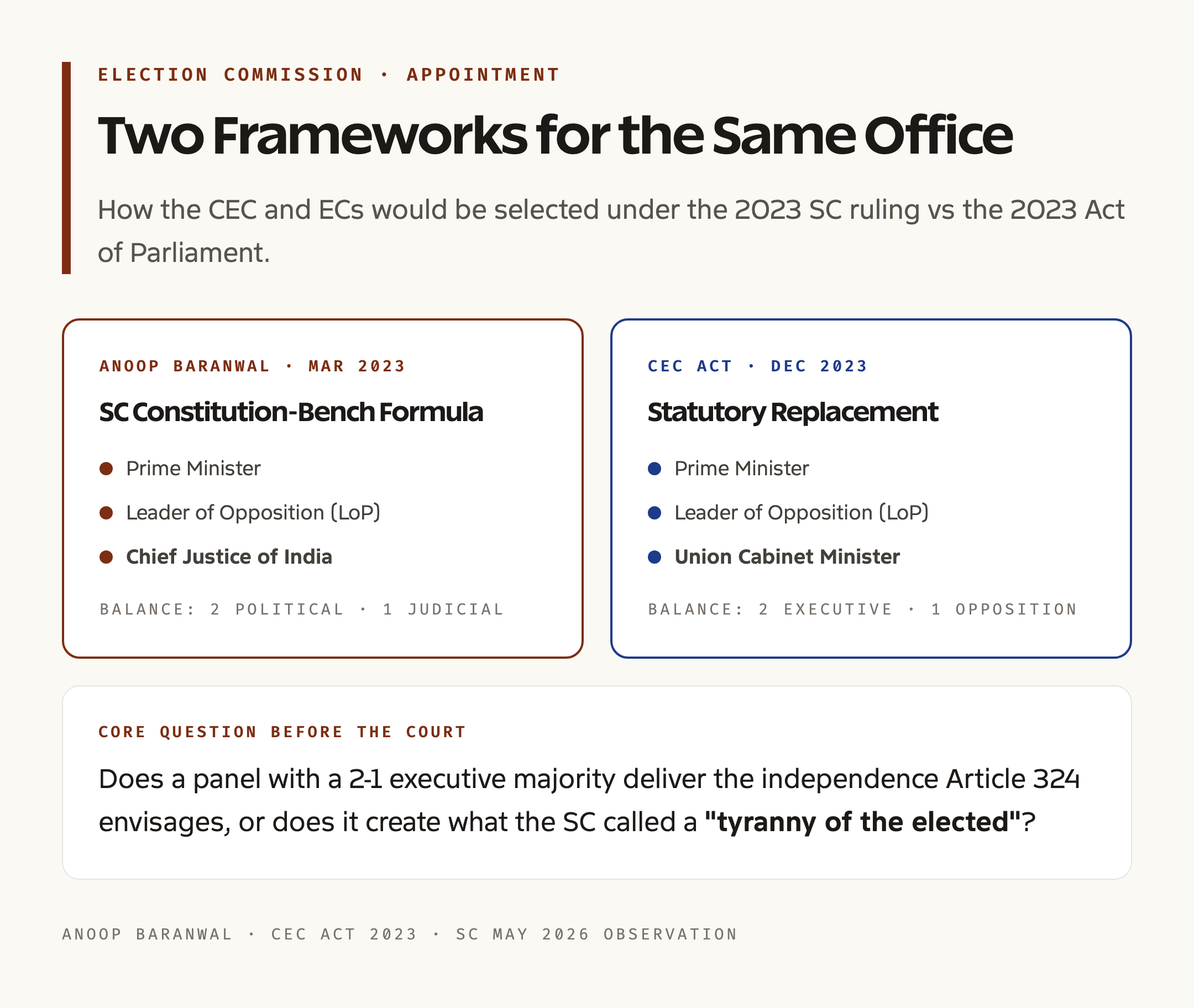
- Case context: Batch of petitions challenging the CEC Act 2023
- Court observation date: May 8, 2026
- Key phrase: “Tyranny of the elected” (used during oral hearings)
- Law under challenge: Chief Election Commissioner and Other Election Commissioners Act, 2023
- Earlier ruling: Anoop Baranwal v. Union of India, March 2023
- Constitutional anchor: Article 324 of the Constitution
- Selection committee under 2023 Act: PM, Leader of Opposition, Union Cabinet Minister
- Selection committee per Anoop Baranwal: PM, LoP, Chief Justice of India
What Just Happened
A bench of the Supreme Court hearing petitions filed by the Association for Democratic Reforms and others observed on May 8, 2026 that the current Election Commission appointment process tilts too heavily toward the executive. The exact phrase used during oral submissions was “tyranny of the elected”, borrowed from the constitutional debate on majoritarian capture of independent institutions.
The petitioners argued that the 2023 Act effectively overruled the 2023 constitution-bench ruling in Anoop Baranwal by removing the Chief Justice of India from the selection panel and replacing the CJI with a Union Cabinet Minister nominated by the Prime Minister. Since two of the three members of the selection committee belong to the ruling executive, the petitioners said the panel cannot deliver the independence that Article 324 envisages.
The bench did not stay the law. It issued notice, sought a fresh response from the Centre, and indicated that the question may need a larger bench given that the petitions touch the basic structure doctrine.
Background and Historical Context
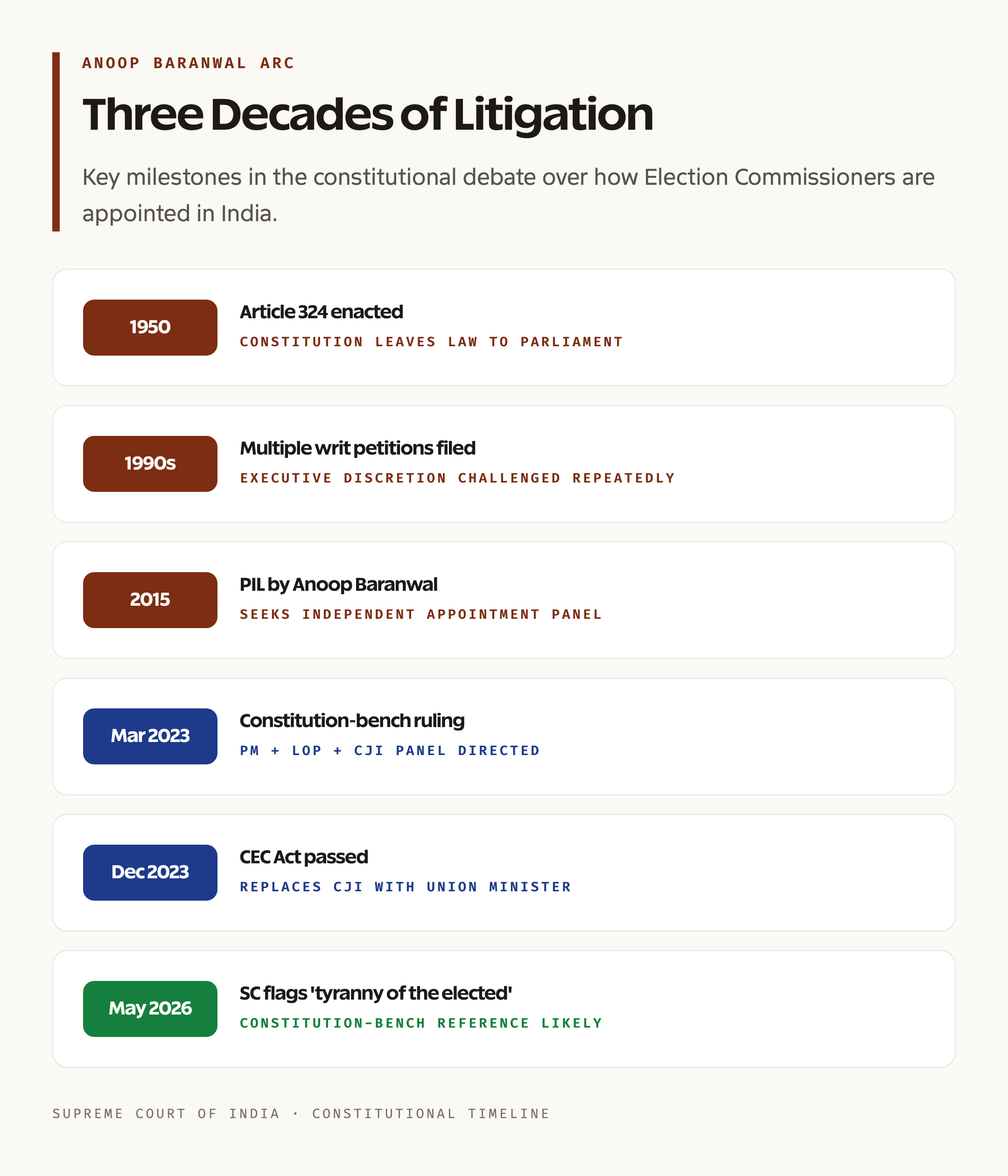
The Indian Constitution leaves the Election Commission appointment process unusually open. Article 324(2) says the Chief Election Commissioner and other Election Commissioners shall be appointed by the President, “subject to the provisions of any law made in that behalf by Parliament”. For over seven decades, no such law existed. The executive simply made the appointment, sometimes after consultations within the cabinet, sometimes purely on a Prime Ministerial recommendation.
This vacuum invited litigation. Multiple petitions over the years argued that an executive-controlled appointment violated the independence that Article 324 envisages. The case finally reached a constitution bench in 2022, and on March 2, 2023, the Supreme Court delivered its judgment in Anoop Baranwal v. Union of India. The bench held that until Parliament made a law, the Election Commission appointment would be made by a panel consisting of the Prime Minister, the Leader of Opposition in the Lok Sabha, and the Chief Justice of India.
Parliament responded later in 2023 with the CEC Act. The Act preserved the three-member structure but replaced the Chief Justice of India with a Union Cabinet Minister. The petitioners argue this defeats the very independence the 2023 ruling sought to protect. The Centre’s response, on the other hand, is that Article 324(2) gives Parliament plenary power to design the appointment process and the court’s stop-gap formula was just that — a stop-gap.
Key Provisions of the CEC Act 2023
The Chief Election Commissioner and Other Election Commissioners Act, 2023 has five core features.
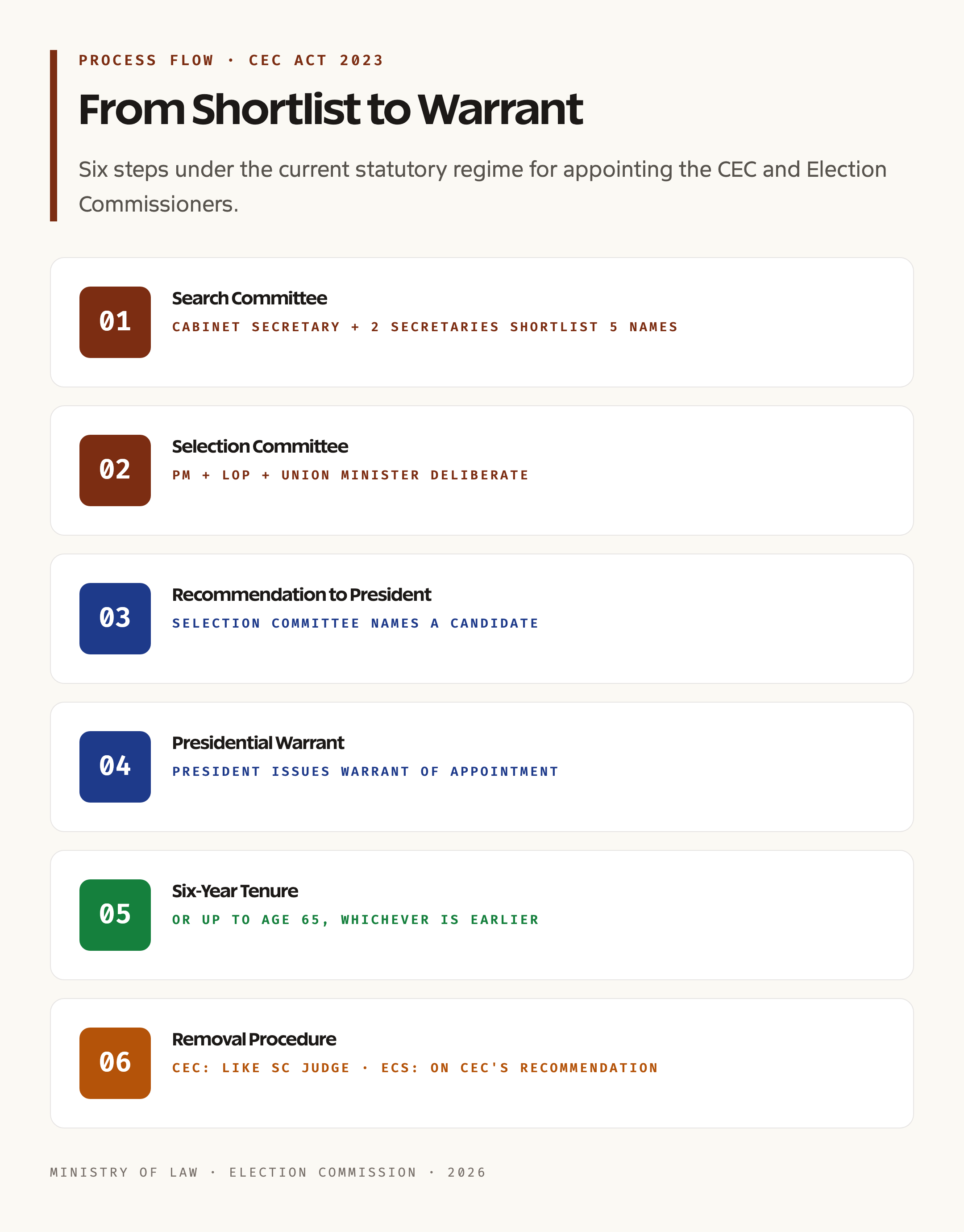
- Selection committee: Prime Minister (chair), Leader of the Opposition in Lok Sabha, and a Union Cabinet Minister nominated by the PM.
- Search committee: Headed by the Cabinet Secretary, with two officials not below the rank of Secretary, who shortlist five names for the selection committee.
- Eligibility: Persons who hold or have held a post equivalent to the Secretary to the Government of India and have knowledge and experience of management and conduct of elections.
- Term: Six years or up to age 65, whichever is earlier. Same as the earlier RP Act framework.
- Removal: CEC can be removed only in the manner of a Supreme Court judge. Other Election Commissioners can be removed on the CEC’s recommendation.
The Act also fixes the salary, allowances, and conditions of service. It explicitly says that no act done by the commission shall be invalid merely because of a vacancy or defect in the appointment.
Why It Matters
The Election Commission is one of the few constitutional bodies whose independence directly affects democratic legitimacy. A government that controls who runs elections risks undermining the consent on which it stands. This is the structural reason why the Supreme Court has repeatedly held that the Election Commission must be insulated from executive interference.
The May 2026 observation matters because it tests three constitutional ideas at once. First, whether Parliament’s power under Article 324(2) is plenary or whether it must respect the judicial gloss put on it by Anoop Baranwal. Second, whether the basic structure doctrine extends to the design of independent regulators. Third, whether the principle of separation of powers, as developed in Kesavananda Bharati and refined in Indira Gandhi v. Raj Narain, constrains how the executive appoints the referee of its own elections.
The political stakes are equally high. State elections in 2026-27, the next general election cycle, and the rollout of one-nation-one-election proposals all depend on a commission whose independence is beyond reasonable doubt.
Detailed Analysis: The Constitutional Question
The constitutional question turns on two competing readings of Article 324(2). The first reading, advanced by the Centre, is that the constitutional text leaves Parliament wholly free to design the appointment process. The Supreme Court’s 2023 directions, on this reading, filled a vacuum until Parliament legislated. Once Parliament did legislate, the directions lapsed.
The second reading, advanced by the petitioners, is that the constitutional framers expected the appointment process to safeguard independence. Even if Article 324(2) is open in form, it is constrained in substance by the basic structure of free and fair elections, recognised in S.R. Bommai and Kihoto Hollohan. A panel that gives the executive a built-in majority cannot deliver substantive independence, and so any such law violates the basic structure.
The court’s reference to “tyranny of the elected” hints that the bench takes the second reading seriously. The phrase echoes Madison and de Tocqueville, who worried that an elected majority could become as oppressive as any monarch if independent institutions did not hold the line. In the Indian context, the same concern animates the doctrine of basic structure.
Comparative View: How Other Democracies Appoint Election Bodies
Election bodies across major democracies are appointed in different ways. The report below sketches a quick comparison.
| Country | Body | Appointment process |
|---|---|---|
| United Kingdom | Electoral Commission | Appointed by Monarch on address from Commons; cross-party Speaker’s Committee approves |
| United States | Federal Election Commission | Six commissioners appointed by President with Senate consent; no more than three from one party |
| South Africa | Independent Electoral Commission | President appoints from panel recommended by an all-party body and the Chief Justice |
| Australia | Australian Electoral Commission | Chair appointed from Federal Court judges by Governor-General |
| India (post-2023) | Election Commission | PM, LoP, Union Minister panel under CEC Act 2023 |
The comparative picture suggests that most mature democracies build in a structural counter-weight to executive dominance. The CEC Act 2023, by contrast, allows a 2-1 executive majority in the selection committee.
Challenges and Concerns
Five concerns dominate the petitioners’ case.
- Executive majority: Two of three selection-committee members are executive appointees.
- CJI exclusion: The bench in Anoop Baranwal specifically included the CJI to provide a neutral fulcrum. The 2023 Act removes that fulcrum.
- Search committee opacity: The Cabinet Secretary-led search committee shortlists names without public disclosure of criteria.
- Tenure asymmetry: A CEC can be removed only like a Supreme Court judge; ECs can be removed on the CEC’s recommendation. The two-tier protection has been challenged before.
- Federal silence: State Election Commissions, also under Article 243K, have their own selection problems that no central law addresses.
A further concern is timing. With the next general election cycle approaching, every commissioner appointed under the 2023 Act will preside over high-stakes polls. A future court ruling that the appointments are constitutionally suspect could create a legitimacy crisis.
Prelims Pointers
- Article 324: Superintendence, direction and control of elections vested in the Election Commission
- Article 324(2): President appoints CEC and ECs, subject to law made by Parliament
- Anoop Baranwal v. Union of India (2023): Constitution-bench ruling, March 2, 2023
- CEC Act, 2023: Chief Election Commissioner and Other Election Commissioners Act
- Selection committee under 2023 Act: PM, LoP, Union Minister nominated by PM
- Selection committee per Anoop Baranwal: PM, LoP, CJI
- Removal of CEC: Like a Supreme Court judge
- State Election Commission anchor: Article 243K
- Basic structure doctrine: Kesavananda Bharati v. State of Kerala (1973)
- Free and fair elections as basic structure: S.R. Bommai (1994), Kihoto Hollohan (1992)
Mains Questions
- The Supreme Court’s observation that the Election Commission appointment process risks creating a “tyranny of the elected” raises a deeper constitutional concern. Critically examine the case for and against the CEC Act 2023. (GS Paper II, 15 marks)
- Discuss the role of the basic structure doctrine in safeguarding the independence of constitutional bodies like the Election Commission. (GS Paper II, 15 marks)
- Compare the appointment process of election bodies in India, the United Kingdom, and South Africa. What lessons can India draw from international practice? (GS Paper II, 10 marks)
- Examine the relationship between the Election Commission’s independence and the legitimacy of democratic outcomes in India. (GS Paper II, 10 marks)
Way Forward
A constitutionally durable Election Commission appointment process needs three things. The first is a balanced selection committee with at least one non-executive member, ideally the CJI or a person nominated by the CJI. The second is transparency in the search committee’s shortlisting, with publicly disclosed criteria and a written rationale for the final pick. The third is parity between the CEC and other ECs in removal protections, addressing the long-standing concern about a two-tier shield.
Beyond the immediate case, a more cooperative architecture is possible. Parliament can legislate after consulting state election commissions, the Inter-State Council, and a parliamentary committee that includes opposition members in proportion to seat share. The goal is to make the commission’s independence visible, not merely formal.
Three companion reads on Anantamias help frame this further. See our explainer on the basic structure doctrine, the Anoop Baranwal judgment and Article 324 and the Election Commission for a deeper reading.
Frequently Asked Questions
What is the CEC Act 2023?
The Chief Election Commissioner and Other Election Commissioners (Appointment, Conditions of Service and Term of Office) Act, 2023 governs how the CEC and other ECs are appointed, what their service conditions are, and how they can be removed. It replaced the executive-discretion regime that existed before March 2023.
What did the Anoop Baranwal ruling decide?
In March 2023, a five-judge constitution bench held that until Parliament made a law, the Election Commission appointment would be made by a panel of the Prime Minister, the Leader of Opposition in Lok Sabha, and the Chief Justice of India. The ruling tried to insulate the appointment from pure executive discretion.
Why is the 2023 Act being challenged?
Petitioners argue that the Act replaces the CJI on the selection committee with a Union Cabinet Minister nominated by the PM, which gives the executive a 2-1 majority. They contend that this defeats the independence Article 324 envisages and violates the basic structure of free and fair elections.
What does ‘tyranny of the elected’ mean?
The phrase warns that an elected majority can become as oppressive as any unelected ruler if independent institutions are captured. In the Election Commission context, it means that a government that controls who referees elections can effectively undermine democratic accountability.
Can a Supreme Court ruling override Parliament’s law?
Parliament has plenary legislative power, but laws are subject to constitutional limits. If a law violates the basic structure of the Constitution, the Supreme Court can strike it down. Whether the CEC Act 2023 crosses that line is exactly what the bench has been asked to decide.
What is Article 324?
Article 324 vests in the Election Commission the superintendence, direction, and control of the preparation of electoral rolls and the conduct of elections to Parliament, state legislatures, the President, and the Vice-President. It is one of the foundational provisions for free and fair elections in India.
How are state election commissioners appointed?
Article 243K provides for State Election Commissions to conduct panchayat and municipal elections. The State Election Commissioner is appointed by the Governor and can be removed only in the manner of a High Court judge. The constitutional text is silent on a selection committee, leaving each state to its own practice.
Is the basic structure doctrine relevant here?
Yes. Free and fair elections have been recognised as part of the basic structure in multiple rulings, including S.R. Bommai and Indira Gandhi v. Raj Narain. If the appointment process compromises that independence, it can be tested against the basic structure standard.
Does the 2026 challenge stay the appointments already made?
No. The Supreme Court has not stayed the law. Appointments already made under the 2023 Act stand. A future ruling that the Act is unconstitutional could, however, raise complex questions about the validity of decisions taken by commissioners appointed under it.
What is the way forward?
The most durable fix is a balanced selection committee with at least one non-executive member, transparent shortlisting by the search committee, and parity in removal protections between the CEC and other ECs. A constitution-bench reference is the most likely next step in the case.
Tell Google you want more of this.
Add Anantam IAS as a preferred sourceOne tap, and this site shows up more often in your own Top Stories, AI Overviews and AI Mode. Remove it any time.