Why in News?
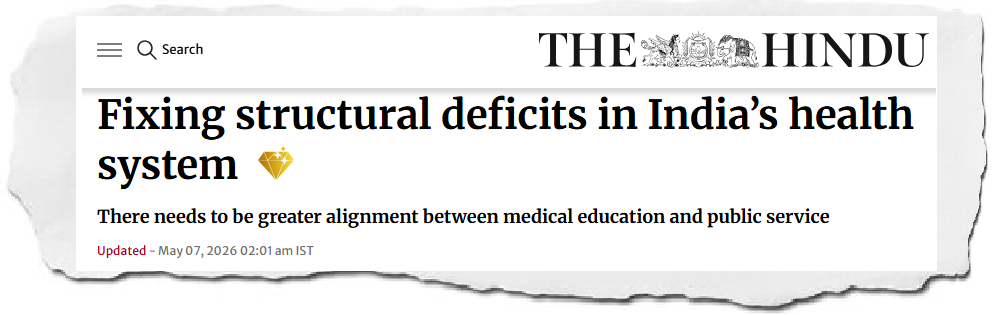
The Union Ministry of Health informed Parliament in March 2026 that 43 new medical colleges and nearly 20,000 MBBS and postgraduate medical seats had been approved for the 2025–26 academic year. Despite this expansion in medical education infrastructure, India continues to face severe shortages of doctors and specialists in rural and underserved regions, raising concerns about structural weaknesses in the public health system.
UPSC Relevance
GS II: Issues relating to health, human resource challenges in healthcare, welfare schemes, social sector development.
GS III : Human capital, inclusive growth, regional disparities, public expenditure and governance challenges.
India’s Public Health Challenge
India has significantly expanded:
- Medical colleges
- MBBS seats
- Postgraduate seats
- Healthcare infrastructure
However, improvements in:
- Rural healthcare delivery
- Specialist availability
- Quality public healthcare access
remain limited.
The core issue is not merely the production of doctors, but their uneven distribution and weak integration into the public health system.
Current Status of Medical Education Expansion
According to the government:
- 43 new medical colleges were approved.
- 11,682 MBBS seats were added.
- 8,967 postgraduate seats were sanctioned for 2025–26.
However:
- 27 of the new colleges belong to the private sector.
- Only eight are under State governments.
Private institutions largely function outside direct public-service obligations.
Shortage of Specialists in Rural India
Community Health Centres (CHCs)
A Community Health Centre is the first referral unit in rural healthcare.
A CHC is expected to serve:
- 1.6–2 lakh population
- With 30 beds
- And five specialists:
- Physician
- Surgeon
- Obstetrician
- Paediatrician
- Anaesthetist
Yet, according to the Health Dynamics of India Report 2022–23:
- India has 5,491 rural CHCs.
- Required specialists: 21,964
- Available specialists: 4,413
This reflects a vacancy rate of nearly 80%.
Structural Problems in the Health System
Infrastructure Without Human Resources
The government’s health strategy has heavily focused on:
- Building hospitals
- Expanding colleges
- Capital expenditure
But insufficient attention has been given to:
- Staffing
- Diagnostics
- Drug availability
- Emergency care
- Operational funding
As a result, many health facilities remain underutilised.
Regional Imbalance
Doctors and specialists are concentrated in:
- Urban centres
- Private hospitals
- Metropolitan regions
Remote regions such as:
- Tribal belts
- Hilly regions
- Aspirational districts
continue to face chronic shortages.
Weak Incentive Structure
Specialists often avoid rural postings due to:
- Poor infrastructure
- Lack of staff quarters
- Weak schooling facilities
- Professional isolation
- Heavy workload
- Limited career opportunities
Thus, merely increasing postgraduate seats does not ensure better rural healthcare delivery.
Problems with Existing CHC Expansion
States continue constructing new CHCs largely to utilise central funds.
However:
- Many CHCs function like Primary Health Centres (PHCs).
- Specialists are spread too thinly.
- Most CHCs lack full specialist teams.
The article argues that instead of creating more centres, India should operationalise fewer CHCs effectively.
Faculty Shortage in Medical Institutions
Even premier institutions face staffing shortages.
Eleven of eighteen All India Institutes of Medical Sciences reportedly have nearly 40% vacancies in teaching and research posts.
This affects:
- Specialist training quality
- Medical research
- Clinical mentorship
- Public health innovation
Health Inequality and Public Dependence
India’s poor and marginalised populations depend overwhelmingly on public healthcare facilities.
Weak rural healthcare results in:
- Long-distance travel for treatment
- High out-of-pocket expenditure
- Delayed treatment
- Preventable mortality
Thus, specialist shortages directly deepen health inequality.
Existing Government Initiatives
Major initiatives include:
- Ayushman Bharat
- Health and Wellness Centres
- National Health Mission (NHM)
- PM Ayushman Bharat Health Infrastructure Mission
- Expansion of AIIMS
- District medical college expansion
However, implementation gaps remain substantial.
Suggested Reforms
Rationalisation of CHCs
Instead of increasing the number of facilities indiscriminately:
- Functional CHCs should be prioritised.
- Two or three fully equipped CHCs per district may be more effective.
Area-Based Classification
Health centres should be classified into:
- Normal areas
- Difficult areas
- Most difficult areas
based on:
- Vacancy levels
- Accessibility
- Terrain
- Infrastructure deficits
This model was earlier attempted in Chhattisgarh under the Rural Medical Corps Scheme.
Incentive-Based Rural Service
Specialists serving in remote regions should receive:
- Financial incentives
- Staff housing
- Schooling support
- Career advancement
- Priority in postgraduate admissions
Linking PG Seats with Public Service
Government-sponsored postgraduate medical seats should be tied to:
- Mandatory rural specialist service
- CHC vacancy requirements
This would create direct linkage between:
- Medical education expansion
- Public healthcare needs
Team-Based Posting
The article recommends an “all-or-none” model:
- Either all five specialists are posted in a CHC
- Or the CHC should not be operationalised as a referral centre
This prevents fragmented healthcare delivery.
Strengthening Operational Capacity
Public health investments must also prioritise:
- Diagnostics
- Drug supply
- ICU facilities
- Labour rooms
- Ambulance services
- Human resources
rather than focusing only on buildings.
Broader Significance
Human Capital Development
A strong healthcare system:
- Improves productivity
- Enhances labour participation
- Reduces poverty traps
Social Justice
Accessible healthcare is central to:
- Equity
- Inclusive development
- Constitutional welfare goals
Economic Importance
Poor health infrastructure increases:
- Household indebtedness
- Catastrophic health expenditure
- Economic vulnerability
Conclusion
India’s healthcare challenge is no longer limited to inadequate infrastructure or low medical education capacity. The deeper structural problem lies in the inability to ensure equitable distribution of trained specialists and operational healthcare services across regions. Without systemic reforms in staffing, incentives, public health financing, and rural service delivery, the expansion of medical colleges alone cannot bridge India’s healthcare deficit. Strengthening the public health system requires shifting focus from infrastructure creation to functional healthcare outcomes.
Practice Questions
1. With reference to Community Health Centres (CHCs) in India, consider the following statements:
- CHCs function as first referral units in rural healthcare.
- A CHC is expected to have five specialist doctors.
- CHCs are established under the Ministry of Rural Development.
Which of the statements given above are correct?
(a) 1 and 2 only
(b) 2 and 3 only
(c) 1 only
(d) 1, 2 and 3
Answer: (a)
2. Which of the following are major reasons for specialist shortages in rural healthcare facilities?
- Lack of infrastructure and staff quarters
- Professional isolation
- Weak schooling facilities in remote areas
- Excessive concentration of specialists in rural India
Select the correct answer using the code below:
(a) 1, 2 and 3 only
(b) 1 and 4 only
(c) 2 and 4 only
(d) 1, 2, 3 and 4
Answer: (a)
Mains Practice Questions
- “Infrastructure without operational capacity cannot improve healthcare outcomes.” Analyse in the context of India’s public health system.
- India’s healthcare challenge is increasingly becoming a problem of distribution rather than production of medical professionals. Discuss.
- Critically examine the structural deficits in India’s rural public healthcare system despite expansion in medical education infrastructure.
Tell Google you want more of this.
Add Anantam IAS as a preferred sourceOne tap, and this site shows up more often in your own Top Stories, AI Overviews and AI Mode. Remove it any time.