Why in News?
On August 13, 2026, the Supreme Court criticised the Food Safety and Standards Authority of India for the lack of progress on front-of-pack warning labels for packaged foods high in sugar, salt and saturated fat.
- A Bench headed by Justice J.B. Pardiwala was hearing a petition filed by the Kerala-based non-profit 3S and Our Health Society seeking mandatory front-of-pack warnings.
- The Court questioned whether the food regulator was sufficiently concerned about the health of children and criticised the limited movement on the issue.
- The litigation follows an April 2025 direction asking an FSSAI expert committee to recommend amendments to the Food Safety and Standards (Labelling and Display) Regulations, 2020 within three months.
- In February 2026, the Court asked FSSAI to examine mandatory warnings and place its response on record within four weeks. FSSAI said stakeholder consultation and further research were needed.
- The dispute is not about whether nutrition information should exist. It is about whether the front label should give a direct nutrient warning or an overall rating that can combine risk-increasing and positive nutrients.
- Food labels are a form of preventive public-health regulation: they intervene before diet-related risk becomes diabetes, hypertension, cardiovascular disease or another chronic condition.
- The issue also concerns information asymmetry. Manufacturers know the formulation, while buyers often face technical back-panel tables, small print and limited time at the point of purchase.
- Children are a high-priority group because taste preferences and dietary habits formed early can persist into adulthood, while package design and marketing can influence their choices.
UPSC Relevance
Prelims Relevance
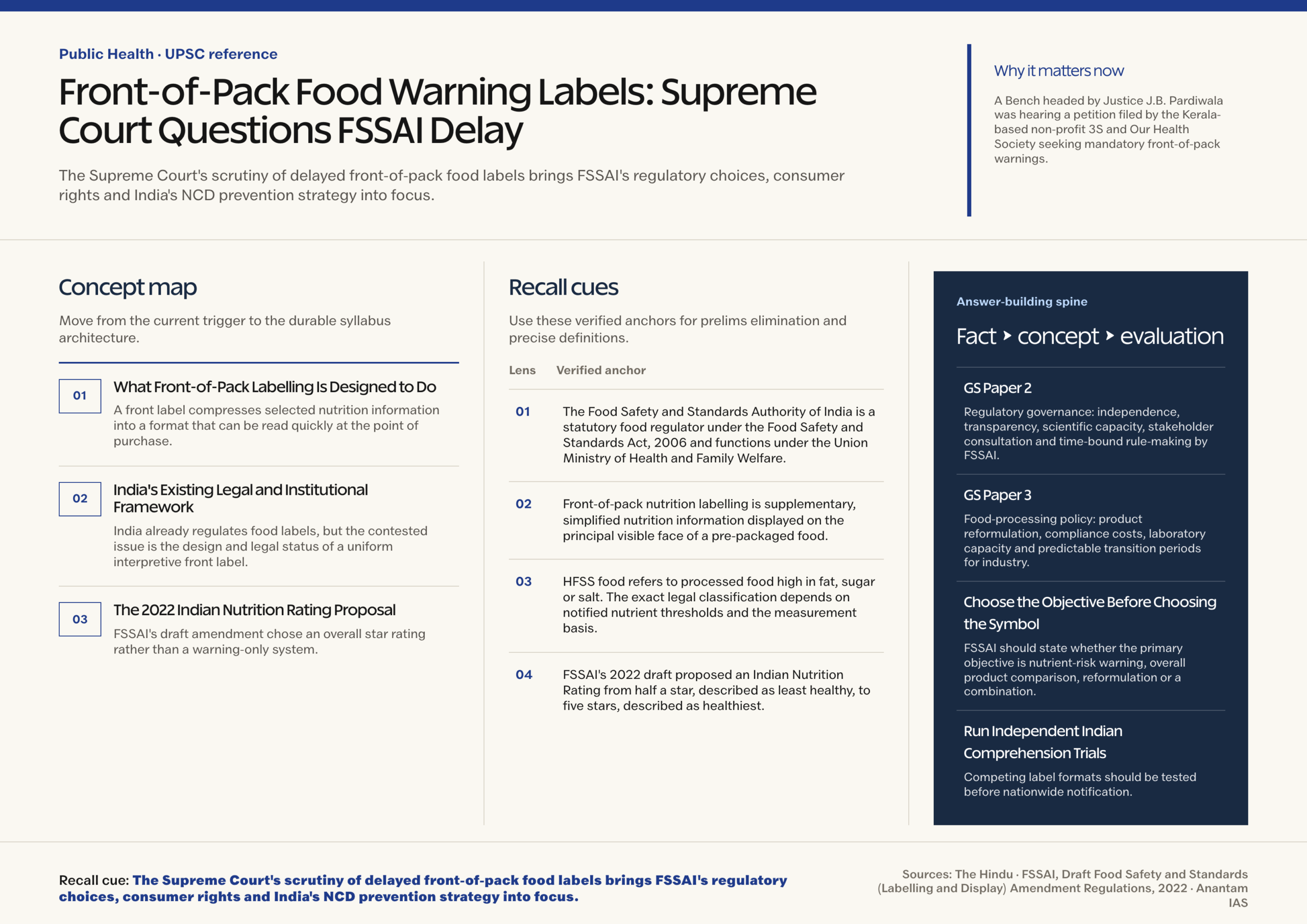
- The Food Safety and Standards Authority of India is a statutory food regulator under the Food Safety and Standards Act, 2006 and functions under the Union Ministry of Health and Family Welfare.
- Front-of-pack nutrition labelling is supplementary, simplified nutrition information displayed on the principal visible face of a pre-packaged food.
- HFSS food refers to processed food high in fat, sugar or salt. The exact legal classification depends on notified nutrient thresholds and the measurement basis.
- FSSAI’s 2022 draft proposed an Indian Nutrition Rating from half a star, described as least healthy, to five stars, described as healthiest.
- The draft rating used risk-increasing factors such as energy, total sugars, saturated fat and sodium, while also considering positive components such as fruit and vegetables, nuts, legumes and millets, fibre and protein.
- A warning-label model identifies when one or more specified nutrients exceed a threshold; an overall rating model summarises the product’s broader nutritional profile into one score.
Mains Relevance
GS Paper 2
- Regulatory governance: independence, transparency, scientific capacity, stakeholder consultation and time-bound rule-making by FSSAI.
- Public health and vulnerable groups: childhood nutrition, prevention of non-communicable diseases and Article 47’s constitutional direction.
GS Paper 3
- Food-processing policy: product reformulation, compliance costs, laboratory capacity and predictable transition periods for industry.
- Consumer markets: reducing information asymmetry without allowing a simplified score to create a misleading health halo.
Essay
- Information is useful only when people can understand and act on it; public policy must convert technical knowledge into an accessible choice architecture.
Background and Context
What Front-of-Pack Labelling Is Designed to Do
A front label compresses selected nutrition information into a format that can be read quickly at the point of purchase.
- The nutrition table on the back of a packet may list quantities per 100 grams, per serving and as percentages of recommended intake. Interpreting it requires time, numeracy and serving-size awareness.
- A front-of-pack system moves the most decision-relevant signal to the visible face. It may be nutrient-specific, such as separate high-sugar or high-sodium warnings, or summary-based, such as stars, letters or a colour scale.
- Interpretive labels do more than reproduce numbers. They apply a nutrient-profile rule to translate disclosed quantities into a judgement such as high, medium, low or an overall rating.
- The policy has two audiences: consumers deciding what to buy and producers deciding whether to reformulate products to avoid an adverse label. Its impact must be measured on both sides.
India's Existing Legal and Institutional Framework
India already regulates food labels, but the contested issue is the design and legal status of a uniform interpretive front label.
- The Food Safety and Standards Act, 2006 created a consolidated framework for food standards and established FSSAI as the national authority.
- The Labelling and Display Regulations, 2020 govern mandatory declarations and presentation requirements for pre-packaged food. Any binding new front-label regime must be integrated into this regulatory framework through the prescribed process.
- FSSAI is expected to combine food science, risk assessment, consumer protection and enforceable standards. Consultation is legitimate, but it must lead to a reasoned decision within a defensible timeline.
- The constitutional frame extends beyond market regulation. Article 47 places nutrition and public health among the State’s primary duties, while Article 21 jurisprudence gives the health consequences a rights-based dimension.
The 2022 Indian Nutrition Rating Proposal
FSSAI’s draft amendment chose an overall star rating rather than a warning-only system.
- The official draft defined front-of-pack nutrition labelling as supplementary nutrition information using symbols, graphics, text or a combination to convey overall nutritional value or information on included nutrients.
- Its proposed Indian Nutrition Rating ranged from half a star to five stars. More stars indicated that a product was better positioned to meet daily nutrient needs.
- The scoring framework considered four risk-increasing factors: energy, total sugars, saturated fat and sodium. It could also award positive points for fruit and vegetable content, nuts, legumes and millets, fibre and protein.
- The draft classified products into solid foods, liquid foods and exempted categories and calculated the rating on an as-sold basis per 100 grams or 100 millilitres.
- This creates the central design dispute. A composite score may permit beneficial ingredients to offset a high level of sugar, sodium or saturated fat, while a warning system keeps each threshold breach visible.
Warning Labels and Summary Ratings: The Policy Trade-off
The strongest system is not the one with the most information; it is the one that produces accurate understanding without concealing a material risk.
- A nutrient-specific warning answers a narrow question quickly: does this product cross the defined threshold for sugar, sodium or saturated fat? It is easy to compare within a category but does not describe the entire diet.
- A summary rating gives a quick overall comparison and can recognise positive nutrients. Its weakness is compensation: a product may receive a better overall score despite containing a nutrient that some consumers need to limit.
- Labels can also create a health halo. A favourable symbol may be read as permission for unlimited consumption even though portion size, frequency, total diet and individual medical needs still matter.
- The comparison should be tested with Indian consumers across languages, age groups, literacy levels, rural and urban markets, and different package sizes. Comprehension, not visual attractiveness, is the core outcome.
- Thresholds must be scientifically defensible and category-sensitive, yet excessive exemptions or complex formulas can weaken the signal and make enforcement difficult.
Way Forward
Choose the Objective Before Choosing the Symbol
- Define a small set of measurable outcomes: correct identification of high-risk nutrients, comparison accuracy, purchase intention, reformulation and compliance.
- If a summary rating is retained, pair it with non-compensable nutrient warnings so positive components cannot erase an excessive critical nutrient from view.
- Use pre-registered studies with children, caregivers and adults across languages, literacy levels and regions, and publish the protocol and full results.
- Test real purchase tasks and package sizes rather than asking only whether participants like a design. Include digital grocery interfaces, where the front panel may appear as a thumbnail.
Conclusion
- The Supreme Court’s intervention highlights a governance failure risk, but the durable answer is not a court-designed nutrition label.
- India should treat front-of-pack labelling as public-health infrastructure .
UPSC Practice Questions
Prelims MCQ 1
With reference to front-of-pack nutrition labelling in India, consider the following statements:
- FSSAI’s 2022 draft proposed an Indian Nutrition Rating ranging from half a star to five stars.
- The draft scoring framework considered both risk-increasing nutrients and selected positive components.
- The Indian Nutrition Rating is already a binding warning-label system notified under the 2020 Regulations.
How many of the above statements are correct?
(a) Only one (b) Only two (c) All three (d) None
Answer: (b) Only two
Explanation:
Statements 1 and 2 describe the 2022 FSSAI draft. Statement 3 is incorrect because the proposal was a draft composite rating, not an already binding nutrient-warning regime.
Prelims MCQ 2
Which constitutional provision directs the State to regard raising the level of nutrition and improving public health as among its primary duties?
(a) Article 39A (b) Article 44 (c) Article 47 (d) Article 51A
Answer: (c) Article 47
Explanation:
Article 47 is a Directive Principle of State Policy concerning nutrition, standard of living and public health.
UPSC Mains Questions
- Front-of-pack nutrition labels are not merely consumer information; they are instruments of preventive public health. Discuss the design and governance choices India must resolve before adopting a national regime. (250 words)
- Compare nutrient-specific warning labels with composite nutrition ratings. What safeguards can prevent information overload on one side and a misleading health halo on the other? (250 words)
Sources: The Hindu and FSSAI, Draft Food Safety and Standards (Labelling and Display) Amendment Regulations, 2022.
Frequently Asked Questions
What is front-of-pack nutrition labelling?
It is simplified nutrition information placed on the main visible face of a pre-packaged food. It may show nutrient-specific warnings or an overall interpretive rating. Its purpose is to help buyers understand selected nutritional characteristics quickly, while the detailed nutrition.
What did the Supreme Court say about FSSAI in August 2026?
On August 13, the Court criticised the limited progress on front-of-pack warnings and questioned FSSAI’s response to the health concerns, especially those involving children. The case arose from a petition seeking mandatory warnings for packaged foods high in sugar, salt.
What was the Indian Nutrition Rating proposed by FSSAI?
FSSAI’s 2022 draft proposed a composite rating from half a star to five stars. It considered energy, total sugars, saturated fat and sodium along with selected positive components such as fruit and vegetables, nuts, legumes and millets, fibre and protein.
How is a warning label different from a star rating?
A warning label identifies a specific nutrient that crosses a defined threshold. A star rating combines several negative and positive factors into one overall score. Warnings are direct but narrower; ratings enable quick comparison but may allow positive ingredients to.
Which body regulates food labelling in India?
The Food Safety and Standards Authority of India regulates food standards and labelling under the Food Safety and Standards Act, 2006 and related regulations. It functions under the Union Ministry of Health and Family Welfare and works with State food-safety.
Tell Google you want more of this.
Add Anantam IAS as a preferred sourceOne tap, and this site shows up more often in your own Top Stories, AI Overviews and AI Mode. Remove it any time.