
Why in News?
India’s Global Capability Centre (GCC) ecosystem is undergoing a rapid and structural transformation. Multinational corporations are increasingly using their India centres not merely for back-office operations, but for artificial intelligence (AI) development, engineering, research, and global business functions.
| UPSC Relevance: GS-3 Economy: Service sector Mains: Global Capability Centres: Growth & Challenges. |
What are Global Capability Centres (GCCs)?
- Global Capability Centres (GCCs), also called captive centres, are offshore units established by multinational corporations (MNCs) to manage strategic and operational functions for their global businesses.
- Initially, GCCs in India were mainly focused on low-cost back-office operations and business process outsourcing (BPO). However, they have now evolved into high-value innovation and engineering hubs.
- These centres undertake activities such as:
- Software engineering
- AI and machine learning
- Finance and accounting
- Product development
- Cybersecurity
- Cloud engineering
- Semiconductor and chip design
- R&D and innovation
- Data analytics
- Human resource management.
Status of GCCs in India:
- India has emerged as one of the world’s largest GCC destinations, often described as the GCC Capital of the World. Key hubs include Bengaluru, Hyderabad, Pune, Chennai, Mumbai, and the National Capital Region (NCR).
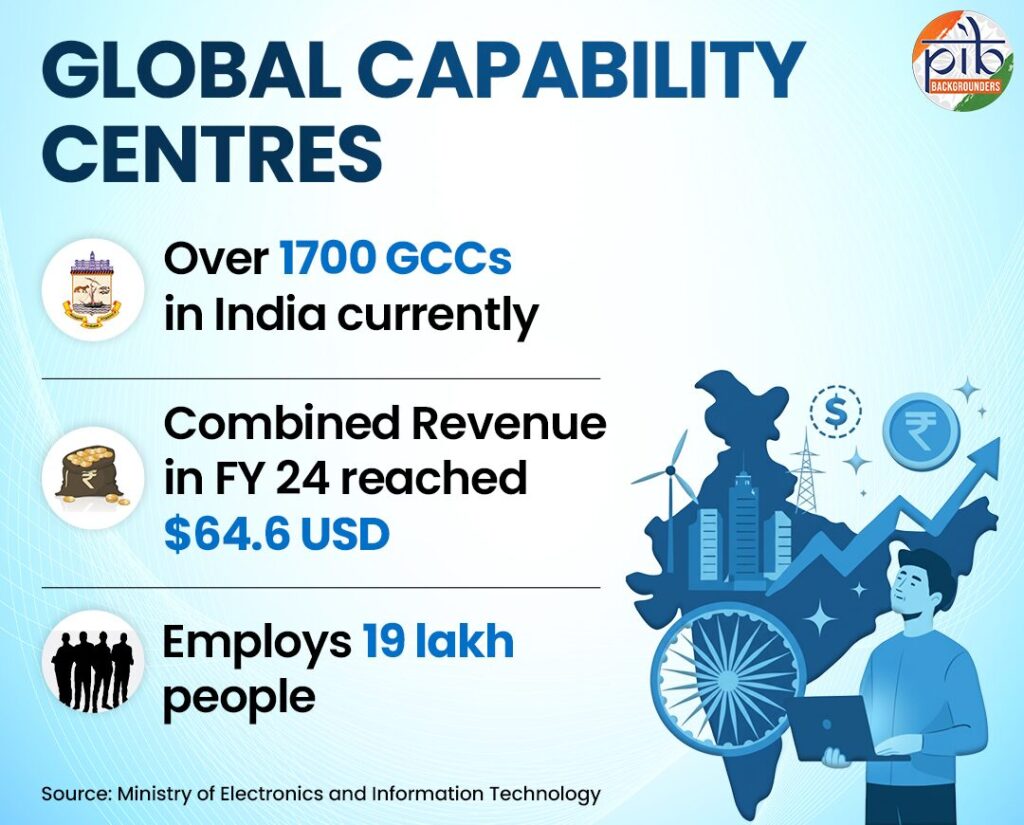
- As of FY26, India hosts approximately 2,117 GCCs employing 2.36 million professionals and generating $98.4 billion in revenue. The sector has expanded by 32% over the last five years, with more than 500 new GCCs and 1,000 additional units set up during the period.
- The GCC sector contributes approximately $68 billion as direct Gross Value Addition (GVA), equivalent to around 1.6% of India’s GDP. Projections suggest GVA from GCCs could rise to $200 billion by 2030.
- Employment is projected to grow to 2.8 million professionals by 2030, up from 2.36 million in FY26. India’s GCC ecosystem employs more than 250,000 AI professionals, making it the world’s second-largest enterprise AI talent base after the United States.
- The rate of establishment of Engineering R&D GCCs has grown 1.3 times faster than the overall GCC setup rate over the last five years, reflecting a decisive shift towards high-value-added work.
From Cost Arbitrage to Strategic Ownership:
- India’s GCC story is no longer about just low-cost outsourcing. Global firms are increasingly assigning India centres end-to-end ownership over products, AI systems, platforms, and business outcomes. This describes GCCs as evolving from “delivery engines” into “enterprise nerve centres.”
- However, this evolution is uneven. Only 5% of GCCs have evolved into “transformation hubs” characterised by CXO-level roles and functional sovereignty from India. Strategic control and top-level corporate authority largely continue to remain headquartered overseas.
- India’s next challenge is to move beyond being a large execution and engineering base and to become a location where multinationals place global business heads, AI leadership teams, and enterprise-wide decision-making authority.
Factors Conducive to GCC Growth in India:
- Government Initiatives: Strategic programmes such as Digital India and Ease of Doing Business reforms have created a conducive environment backed by improved physical and digital infrastructure. The Union Budget 2025 unveiled a National Framework to expand GCCs beyond metro hubs to Tier-II cities. State-level policies in Karnataka, Telangana, Maharashtra, Tamil Nadu, and Gujarat have further accelerated GCC clustering. Over 215+ GCC units are now housed in emerging Tier-II locations.
- Talent Pool: India’s talent pool is a critical competitive advantage, with approximately 2.1 million STEM graduates entering the workforce annually. Female participation in the GCC workforce stands at approximately 35%, reflecting an improving gender profile.
- Cost-Effectiveness: GCC operations in India cost 30-50% less than equivalent operations in the US, UK, and Australia, making it a compelling destination for multinational investment.
- Digital Ecosystem: India’s mature digital ecosystem, spanning fintech, cloud adoption, and enterprise technology, makes it an ideal location for deploying next-generation GCC capabilities.
- Broadening Participation: While US-headquartered firms historically dominated, companies from the UK, Germany, Japan, Denmark, and other nations are now deepening their India GCC presence. Over 130 UK firms now operate 250+ GCCs in India, employing more than 200,000 professionals.
How GCCs are reshaping India’s IT Industry?
The rise of GCCs is intensifying competitive pressure on India’s traditional IT services industry.
- Shift from Outsourcing to Ownership: Traditional Indian IT firms relied on labour-intensive outsourcing, time-and-material contracts and large workforces handling repetitive technology operations. However, multinational firms are now building in-house GCCs, retaining strategic control and owning intellectual property internally. This reduces dependence on external IT vendors.
- Transition in Business Models: Indian IT firms are being pushed up the value chain towards consulting, AI integration, automation services, and platform engineering.
Challenges Associated with GCCs:
- Geographic Concentration: Approximately 95% of GCCs are concentrated in six major urban clusters. Expanding to Tier-II cities is constrained by gaps in digital infrastructure, power reliability, internet connectivity, and urban amenities.
- Regulatory Fragmentation: The absence of a national-level GCC policy has led to a fragmented landscape of state-specific policies with varying standards. Concerns also persist around dispute resolution mechanisms and the length of appellate processes.
- Transfer Pricing and Taxation: The Safe Harbour Regime was introduced to provide certainty in transfer pricing for MNCs. The earlier transfer pricing margin rates of 17-24% were seen as deterrents for GCC expansion. Industry experts had long recommended rates of 14-15% to align with global standards.
| • India’s Union Budget 2026-27 has introduced a landmark rationalisation of transfer pricing rules. A unified Safe Harbour margin of 15.5% has been prescribed for a consolidated “Information Technology Services” category covering software development, IT-enabled services, KPO, and contract R&D. • Eligibility threshold has also been raised from ₹300 crore to ₹2,000 crore, bringing a significantly larger cohort of mid-to-large GCCs within the safe harbour framework. • Safe harbour validity of up to five consecutive years has also been introduced. This directly addresses a longstanding demand of the GCC sector. |
- Operational and Cross-Border Data Challenges: Conflicts between cross-border data transfer laws and regional frameworks create significant compliance complexity for GCCs. For example, balancing obligations under the EU-US Data Privacy Framework and India’s own mandates under the Digital Personal Data Protection (DPDP) Act, 2023, poses ongoing operational challenges.
- Intellectual Property (IP) Concerns: Despite hosting large engineering workforces, GCCs typically retain innovation and intellectual property abroad. Risks of IP disputes, multi-jurisdictional IP ownership complexities, and limited cross-border IP enforcement remain important concerns.
- Leadership Gap: Only 5% of GCCs have evolved to include CXO roles with functional sovereignty from India. India remains primarily an execution and engineering hub rather than a global decision-making base.
Way Forward:
- Enhanced Outreach: Develop comprehensive outreach strategies to attract GCC investments from beyond US-headquartered companies, expanding to European, Japanese, and Southeast Asian corporations.
- Geographic Diversification: Centre-State-Industry dialogue framework should actively promote GCC expansion to Tier-II cities, supported by the identification and sharing of best practices from established GCC hubs.
- Regulatory Simplification: A national-level single-window clearance system for GCC establishment would reduce regulatory friction. The transfer pricing rationalisation in Budget 2026-27 is a significant step; consistent administrative implementation is now critical.
- Innovation Incentives: Introduction of concessional tax rates for GCCs engaged in R&D and IP creation within India would incentivise shifting IP ownership onshore and reward higher-value mandates.
- Digital Economic Zones: Creation of specialised zones housing GPU-based data centres, academia, startups, and co-located workspaces would facilitate the transition from traditional business functions to AI-led engineering and R&D.
- Leadership Elevation: Targeted policy dialogue with multinational parent companies to encourage the placement of global business heads and AI leadership roles in India, moving GCCs from execution centres to strategic decision-making hubs.
- IP Framework Strengthening: Developing clearer cross-border IP protection mechanisms and harmonised frameworks would reduce disputes and encourage GCCs to anchor IP creation in India.
India has successfully pivoted from a cost-arbitrage destination to an innovation-driven economy, with over 1,700 Global Capability Centres acting as critical hubs for AI, engineering, and R&D.
Tell Google you want more of this.
Add Anantam IAS as a preferred sourceOne tap, and this site shows up more often in your own Top Stories, AI Overviews and AI Mode. Remove it any time.