Why in News?
A July 2026 filing by AIIMS New Delhi before the National Green Tribunal documented continuing exposure concerns in specific localities of Kanpur Nagar and Kanpur Dehat and called for a systematic epidemiological survey linked to water-source testing.
- The AIIMS team visited two locations in Jajmau and one in Rakhi Mandi on 29 October 2025; it did not conduct an exhaustive field survey of every locality named in the connected cases.
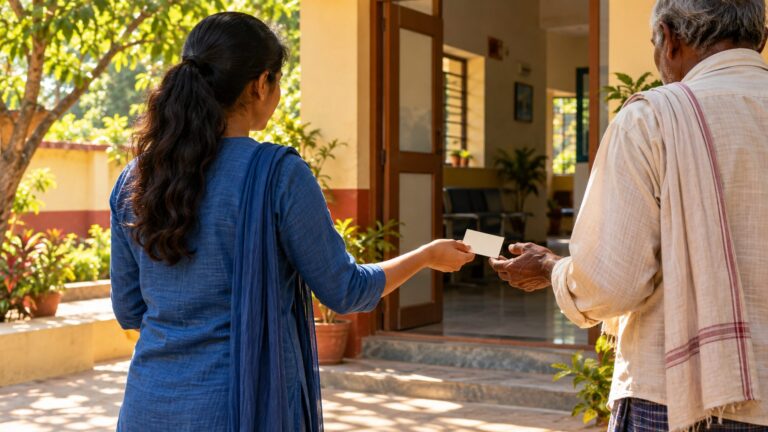
- AIIMS reported that some residents continued using shallow hand pumps or borewells previously declared unfit because piped supply or other safe alternatives were absent or irregular.
- Earlier CPCB-UPPCB material placed before the NGT recorded Cr(VI) in groundwater at several areas of potential concern around the Rania waste-dump site, with concentrations varying sharply by sampling location.
- The NGT record treats the districts and sites as related proceedings, but the source, plume, exposure pathway and evidence quality are not identical at every location.
- The immediate public-health duty is to stop exposure through reliable safe water; long-term action must also remove waste, stabilise contaminated soil, remediate aquifers and recover costs from responsible polluters.
- The case shows why groundwater pollution is harder to reverse than a visible surface spill: contaminants can move with an aquifer, persist after dumping stops and re-enter exposure pathways through domestic use, irrigation or food chains.
- It also exposes a governance gap between screening people, testing environmental sources and proving a defensible source-to-exposure-to-health relationship.
- For a broader groundwater frame, see Anantam IAS’s Polluted Groundwater note and its guide to Jal Jeevan Mission and water-quality surveillance.
UPSC Relevance
Prelims Relevance
- Chromium(III), or Cr(III), and chromium(VI), or Cr(VI), are different oxidation states with different mobility and toxicological profiles.
- Cr(VI) compounds are generally more soluble and mobile in water than Cr(III); Cr(III) more readily forms less-soluble hydroxides or complexes under suitable conditions.
- WHO’s drinking-water guideline is 50 micrograms per litre, or 0.05 mg/L, for total chromium, not a separate routine value for each chromium species.
- India’s IS 10500 drinking-water specification also lists 0.05 mg/L for total chromium, with no higher permissible limit in the absence of an alternate source.
- The National Green Tribunal Act, 2010 directs the NGT to apply sustainable development, the precautionary principle and the polluter-pays principle.
- The Water (Prevention and Control of Pollution) Act, 1974 provides the core institutional framework for pollution control boards to prevent and control water pollution.
Mains Relevance
GS Paper 3
- Groundwater contamination, hazardous-waste management, industrial pollution control and scientific remediation of contaminated sites.
- Application of the precautionary and polluter-pays principles to legacy pollution where cleanup costs continue after industrial activity changes or stops.
GS Paper 2
- Right-to-health and safe-water obligations, particularly where residents rely on sources already marked unsafe.
- Coordination among district administrations, health departments, Jal Kal or water-supply bodies, UPPCB, CPCB, medical colleges and technical institutes.
Essay
- Environmental injustice is often a geography of unequal exposure: the people least able to relocate or purchase safe water bear the longest tail of industrial pollution.
Background and Context
The Geography of the NGT Proceedings
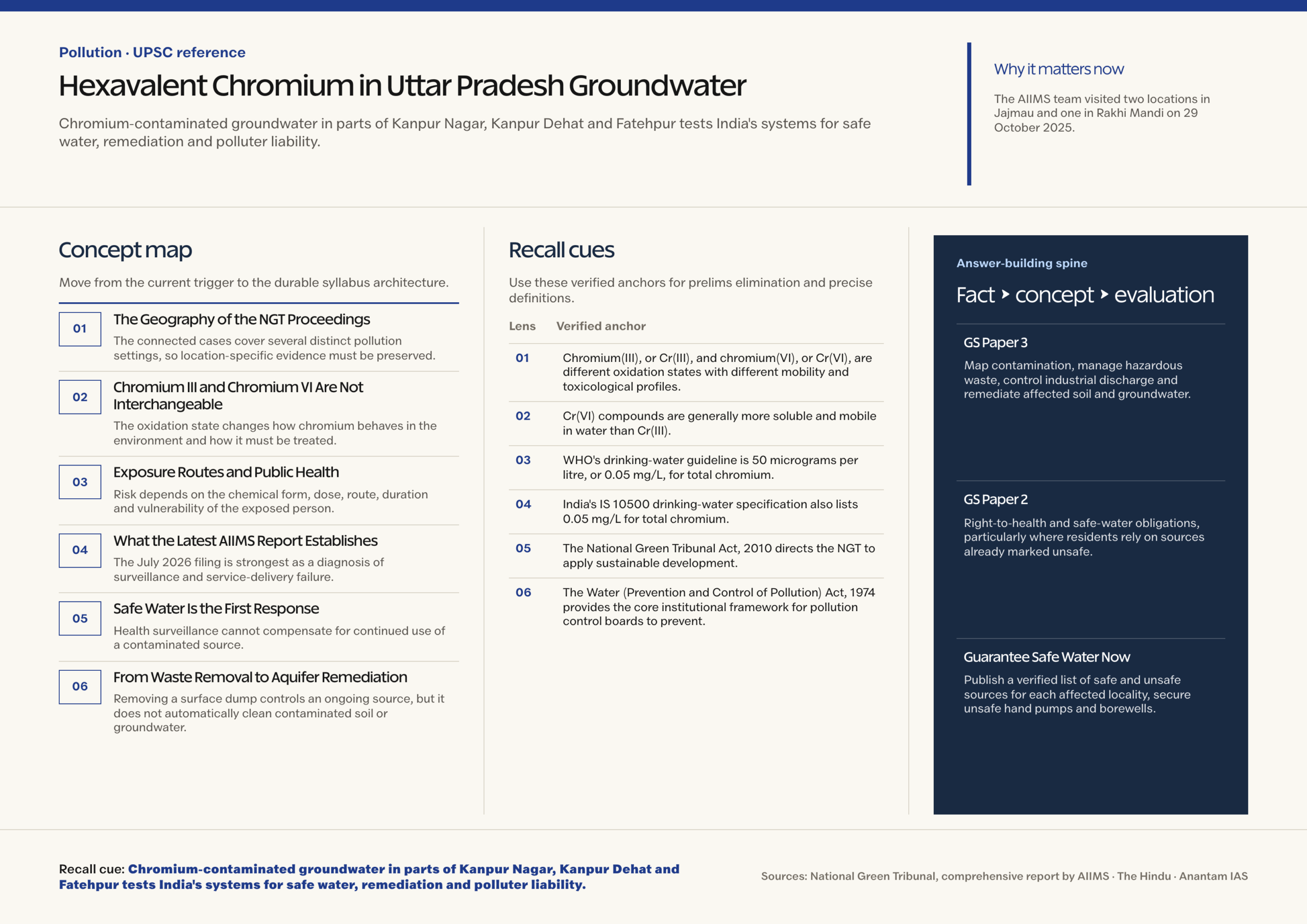
The connected cases cover several distinct pollution settings, so location-specific evidence must be preserved.
- Rania, Kanpur Dehat: the record concerns legacy chromium-bearing waste around Khan Chandpur and nearby areas. A 2023 CPCB-UPPCB meeting note identified five areas of potential concern and reported Cr(VI) in groundwater across wide concentration ranges.
- Rakhi Mandi, Kanpur Nagar: the litigation separately concerns a contaminated locality where unsafe water sources and alternative-supply gaps have been examined. AIIMS visited this locality during its October 2025 field assessment.
- Jajmau, Kanpur Nagar: the tannery cluster presents an industrial-effluent and sewage-treatment problem near the Ganga. Its evidence should not be copied onto Rania or Fatehpur merely because the matters are heard together.
- Fatehpur: NGT proceedings include Godhrauli and other identified villages or dump locations. The Fatehpur record contains separate questions about chromium-bearing deposits, mercury-laden ash, safe water and health screening.
- A defensible answer should say parts of three districts or name the verified sites. It should not claim that all groundwater across Kanpur Nagar, Kanpur Dehat and Fatehpur is contaminated.
Chromium III and Chromium VI Are Not Interchangeable
The oxidation state changes how chromium behaves in the environment and how it must be treated.
- Cr(III) is less able to cross cell membranes and is usually less mobile because it can adsorb to particles or form relatively insoluble compounds. This does not make uncontrolled Cr(III) waste harmless.
- Cr(VI) readily penetrates cell membranes, is commonly present as chromate or hydrogen chromate in water, and is generally more soluble and mobile. WHO’s assessment considers both cancer and non-cancer endpoints for drinking-water exposure to Cr(VI).
- The strongest carcinogenic evidence historically concerns occupational inhalation of Cr(VI). For drinking water, WHO retained a total-chromium guideline using chronic ingestion evidence and a mode-of-action assessment protective of cancer and non-cancer effects.
- Speciation matters in remediation. A treatment train may first reduce Cr(VI) to Cr(III), then remove the resulting chromium by coagulation, precipitation, adsorption or filtration.
- A report of total chromium does not by itself reveal how much was Cr(VI). Sampling protocols should preserve and measure speciation where the exposure question requires it.
Exposure Routes and Public Health
Risk depends on the chemical form, dose, route, duration and vulnerability of the exposed person.
- Ingestion can occur through drinking and cooking water. A household may also be exposed when contaminated water is used in food preparation even if bottled water is reserved for drinking.
- Inhalation is especially relevant to workers handling chromium compounds or to dust from disturbed waste. It is a different pathway from drinking-water ingestion and should not be conflated with it.
- Dermal contact can occur during bathing, washing, work or contact with contaminated soil. Its contribution varies with chemical form, concentration, skin condition and contact time.
- Food-chain transfer is a plausible concern where contaminated groundwater is used for irrigation or livestock, but AIIMS recommended crop, milk, poultry and environmental testing because the existing evidence did not establish the extent of that pathway.
- AIIMS found no clear acute heavy-metal syndrome during its limited field assessment. It noted reported chronic complaints and said long-term manifestations could not be ruled out; that is a call for surveillance, not proof that chromium.
What the Latest AIIMS Report Establishes
The July 2026 filing is strongest as a diagnosis of surveillance and service-delivery failure.
- AIIMS recorded 569 blood samples collected through earlier health camps in the affected Kanpur localities, with 55 reports awaited at the time described in its October 2025 assessment.
- The sampling was convenience-based and sporadic, not a representative population survey. People who volunteered or could attend a camp may differ from residents who did not.
- Laboratory results were clubbed across camps and lacked standard labels linking a result to an individual household and water source. This prevented robust community attribution and source-exposure analysis.
- AIIMS recommended a community-based cross-sectional survey covering selected affected wards and nearby areas, with household water testing, source testing, blood biomarkers, kidney and liver function tests, symptom histories and geospatial documentation.
- The report focused on Kanpur Nagar and Kanpur Dehat. It cannot be used as if AIIMS had conducted the same field protocol in every Fatehpur site. Fatehpur evidence comes from other filings and orders in.
Way Forward
Guarantee Safe Water Now
- Publish a verified list of safe and unsafe sources for each affected locality, secure unsafe hand pumps and borewells, and provide a dependable quantity of tested water.
- Test at source and household endpoints, disclose results in plain language and create a complaint channel for missed tankers, failed treatment units or suspected contamination.
- Use unique sample codes, chain-of-custody records, accredited laboratories, chromium speciation where relevant and geocoded source data.
- Run representative surveys with comparison areas, exposure histories and clinical follow-up; report uncertainty instead of turning screening counts into prevalence estimates.
Conclusion
- The chromium cases in Uttar Pradesh are not one uniform contamination story.
- The policy sequence is straightforward even where causal evidence is still being strengthened: provide safe water, trace exposure properly, remove pollution sources, remediate the aquifer, care for affected residents and make responsible polluters bear the restoration cost.
UPSC Practice Questions
Prelims MCQ 1
With reference to chromium in drinking water, consider the following statements:
- Chromium(VI) is generally more soluble and mobile in water than chromium(III).
- The WHO drinking-water guideline value is expressed for total chromium.
- Reducing chromium(VI) to chromium(III) can form part of a treatment process before removal.
How many of the above statements are correct?
(a) Only one (b) Only two (c) All three (d) None
Answer: (c) All three
Explanation:
All three statements are correct. Cr(VI) is relatively mobile; WHO retains a 0.05 mg/L guideline for total chromium; and reduction to Cr(III) can precede precipitation, coagulation or adsorption.
Prelims MCQ 2
Which one of the following best distinguishes source removal from groundwater remediation?
(a) Source removal excavates or secures pollution-causing waste, while groundwater remediation treats or contains contamination already present in the aquifer. (b) Source removal applies only to domestic sewage, while groundwater remediation applies only to industrial effluent. (c) Source removal is a medical intervention, while groundwater remediation is a legal intervention. (d) There is no operational difference between the two.
Answer: (a) Source removal excavates or secures pollution-causing waste, while groundwater remediation treats or contains contamination already present in the aquifer.
Explanation:
Removing a dump stops or reduces a continuing source, but contaminated soil and groundwater may need separate characterisation, treatment, containment and long-term monitoring.
UPSC Mains Questions
- Legacy chromium pollution is as much a governance failure as a treatment-technology challenge. Discuss with reference to safe-water delivery, remediation and polluter liability.
- Why must environmental health investigations connect household water sources, human biomarkers and geospatial data? Explain the safeguards needed for scientifically credible surveillance.
Sources: National Green Tribunal, comprehensive report by AIIMS New Delhi and The Hindu.
Frequently Asked Questions
What is hexavalent chromium?
Hexavalent chromium, or Cr(VI), is chromium in the +6 oxidation state. Its compounds are generally more soluble and mobile than Cr(III), can cross cell membranes more readily and are associated with serious toxic effects. Risk depends on the compound, dose.
Which Uttar Pradesh areas are involved in the NGT proceedings?
The connected matters concern identified sites in Kanpur Nagar, Kanpur Dehat and Fatehpur, including Jajmau, Rakhi Mandi, Rania-Khan Chandpur and Godhrauli-related locations. Evidence differs by site, so the record does not support treating all groundwater across the three districts as.
What did the AIIMS report find?
AIIMS found fragmented water testing, poorly traceable blood-sample records and continued dependence on unsafe groundwater in some visited Kanpur localities. It called for a representative epidemiological survey linked to household and source-level water testing, biomarkers, organ-function tests and geospatial documentation.
Is every illness reported by residents proven to be caused by chromium?
No. AIIMS recorded chronic complaints but found no clear acute heavy-metal syndrome during its limited assessment. Existing sampling was not designed to establish prevalence or individual causation. Exposure should still be stopped immediately while rigorous environmental and health investigations establish.
How can chromium be removed from groundwater?
Options include pump-and-treat, reduction of Cr(VI) to Cr(III) followed by precipitation or coagulation, adsorption, ion exchange, reverse osmosis, nanofiltration and selected bioremediation methods. Site chemistry, aquifer conditions, residual-waste handling and long-term monitoring determine whether a method is suitable.
Tell Google you want more of this.
Add Anantam IAS as a preferred sourceOne tap, and this site shows up more often in your own Top Stories, AI Overviews and AI Mode. Remove it any time.