Why in News?
The ongoing Iran conflict has severely disrupted West Asian trade routes and placed IMEC’s implementation under acute stress.
During PM Modi’s recent visit to Italy, India and Italy elevated ties to a Special Strategic Partnership and agreed to convene the first-ever IMEC Ministerial Meeting in 2026.
IMEC is now under pressure to redesign its route alignment to bypass conflict-prone chokepoints while managing growing divergence between Saudi Arabia and the UAE, two of its most critical partner states.
| UPSC Relevance: GS-2 International Relations: Effect of policies and politics of developed and developing countries on India’s interests, Connectivity Projects Prelims: Location of IMEC. Mains: IMEC: Significance and Challenges |
What is IMEC?
- The India-Middle East-Europe Economic Corridor (IMEC) is a transcontinental connectivity initiative announced through a Memorandum of Understanding (MoU) during the G20 New Delhi Summit (2023).
- Seven countries and the European Union signed the MoU: India, the USA, Saudi Arabia, UAE, France, Germany, Italy, and the EU.
- The framework was envisioned as a direct strategic counter to China’s Belt and Road Initiative (BRI).
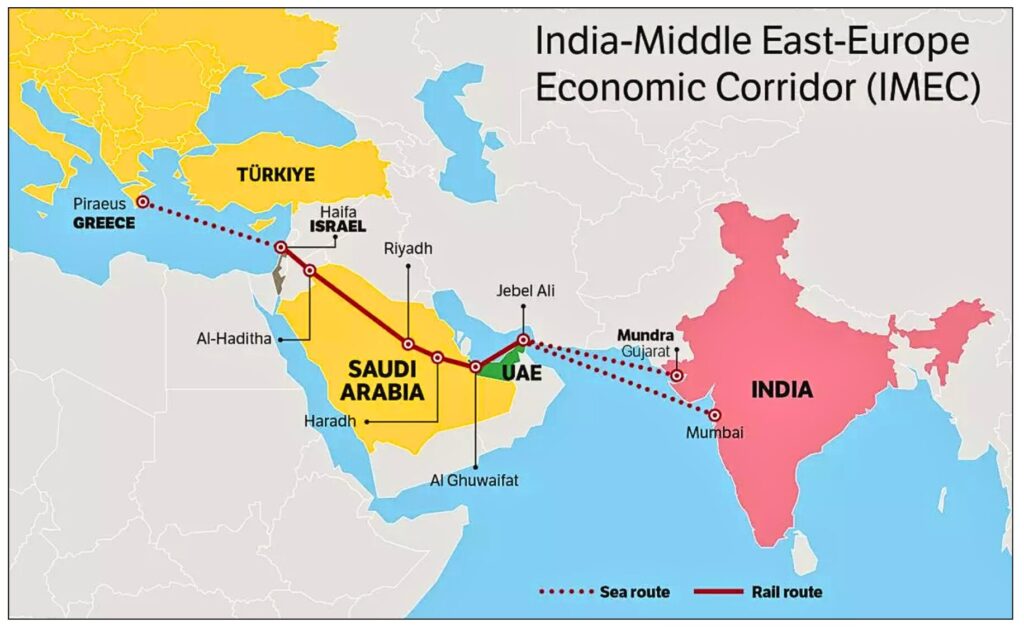
Three-Segment Structure of IMEC:
- Eastern Leg (Sea): India connected to the UAE via sea routes, entering through ports such as Mundra and JNPT on the Indian side and Jebel Ali or Fujairah on the UAE side.
- Central Leg (Overland): An overland multimodal corridor crossing the UAE → Saudi Arabia → Jordan → Israel, terminating at the port of Haifa on Israel’s Mediterranean coast.
- Western Leg (Sea): From Haifa across the Mediterranean to European ports, feeding into the EU’s existing transportation network.
Beyond a Transport Corridor:
- Unlike conventional trade routes, IMEC was conceived as a holistic infrastructure ecosystem integrating: railways, sea routes, road networks, green hydrogen pipelines, undersea high-speed data cables, electricity transmission grids, and gas pipelines.
- The corridor aims to reduce the transit time for cargo from Mumbai to Piraeus (Greece) by approximately 3 days compared with the Suez Canal route.
Political Prerequisites:
- IMEC’s original alignment (specifically the Israel segment through the central corridor) was premised on the Abraham Accords framework, which normalised Israel’s relations with the UAE and Bahrain in 2020 and anticipated eventual Saudi-Israeli normalisation.
- The corridor was, in effect, an economic incentive structure designed to accelerate Saudi-Israeli normalisation as a geopolitical goal of the United States.
Significance of IMEC for India:
- Alternative to Suez Canal dependence: India’s trade heavily depends on the Suez Canal-Bab-el-Mandab corridor, which is controlled by geopolitically volatile chokepoints. IMEC would reduce India’s exposure to disruptions at these choke points and potentially cut transit times from Mumbai to European ports by approximately three days, reducing shipping costs.
- Act West Policy: IMEC aligns with India’s “Act West” policy aimed at deepening economic and strategic integration with West Asia and Europe. The corridor positions India as a connectivity hub rather than a peripheral player, consistent with its aspirations for permanent UNSC membership and leadership of the Global South.
- Energy diversification: The electricity grid interconnection and green hydrogen pipeline components of IMEC directly advance India’s renewable energy transition. The corridor provides a potential framework for importing green hydrogen from the Gulf and exporting it to Europe, connecting India to the emerging global clean energy trade system.
- Trade diversification: Faster, cheaper access to European markets benefits India’s manufacturing sector, particularly in pharmaceuticals, textiles, engineering goods, and electronics. IMEC could serve as the physical infrastructure backbone of India-EU trade growth, especially as the India-EU Free Trade Agreement negotiations gain momentum in 2025-26.
- India as a trusted diplomatic broker: India’s unique position, maintaining close relations with both Saudi Arabia and the UAE, as well as with both the US and Iran historically, gives it the diplomatic leverage to act as a bridge between diverging regional partners. This is a distinctive and time-sensitive opportunity that India must exercise proactively.
- Counter-BRI strategic value: IMEC offers India, the US, and Europe a credible, values-aligned alternative to China’s BRI, which has drawn 140+ countries into debt-funded infrastructure dependence on Beijing. As BRI’s structural problems become more visible, IMEC’s model of non-predatory connectivity gains strategic salience.
Challenges to IMEC:
- Geopolitical instability: IMEC’s central corridor passes through one of the most conflict-prone regions in the world. The Gaza war froze Israeli normalisation; the Iran conflict has now struck the UAE’s ports and created Saudi-UAE divergence. Neither the Haifa hub nor the UAE entry ports can currently function as stable multimodal nodes. The corridor needs a “wartime redesign” to remain viable.
- No dedicated financing mechanism: As of mid-2026, neither a dedicated corpus nor a multilateral financing institution has been finalised for IMEC. Unlike the BRI (which has the China Development Bank and Silk Road Fund behind it), IMEC relies on decentralised commitments from partner governments and private investors who have yet to formalise investment frameworks. This leaves the corridor vulnerable to delays and competing priorities.
- Regulatory harmonisation: Seamless trade across IMEC requires convergence of customs procedures, safety standards, phytosanitary regulations, port logistics technology, data exchange protocols, and taxation regimes across India, the UAE, Saudi Arabia, Jordan, Israel, and EU member states. Without harmonisation, the corridor risks becoming a collection of disconnected nodes rather than an integrated system.
- China and Turkey as structural adversaries: China views IMEC as a direct strategic challenge to BRI, particularly in the Gulf and Mediterranean. Turkey (excluded from IMEC) objects to being bypassed as a natural Eurasian transit corridor and has leverage through its control of the Turkish Straits, NATO membership, and influence in the Caucasus and Central Asia.
- India’s own track record: India’s previous transnational connectivity projects, the International North-South Trade Corridor (INSTC, involving India, Iran, and Russia) and the Asia-Africa Growth Corridor (with Japan), have not advanced from paper to operational status due to financial, political, and diplomatic reasons. This pattern, if repeated with IMEC, would damage India’s credibility as a connectivity leader.
Way Forward:
- Develop Oman as the eastern entry point: Oman’s main export terminals (Salalah, Duqm, Muscat, and Sohar) lie well outside the Hormuz zone and are perceived as geopolitically neutral, as Iran views Oman as a non-hostile state. Routing IMEC’s eastern leg through Oman instead of (or in addition to) Jebel Ali and Fujairah (the UAE) would substantially reduce the corridor’s exposure to any future Hormuz closure.
- Develop a western Egypt spur as a contingency for Haifa: Until Israel’s port of Haifa becomes a secure and politically acceptable transit hub, a western spur through Egypt, connecting overland to one of Egypt’s Mediterranean ports, offers a viable alternative. Egypt possesses the Suez Canal Economic Zone, six operational ports, and four industrial zones (in green hydrogen, LNG, shipbuilding, and future-facing sectors).
- India as a diplomatic broker: India must leverage its unique position, trusted by Saudi Arabia, UAE, Egypt, and Iran, to prevent IMEC partner fragmentation. India should convene back-channel dialogues between Saudi Arabia and the UAE.
- Establish a formal IMEC coordinating and financing structure: A dedicated corpus, potentially modelled on the World Bank’s Multilateral Investment Guarantee Agency (MIGA) or the US Development Finance Corporation (DFC), would reduce private sector risk perception and attract the institutional capital needed for corridor infrastructure.
- Broaden stakeholder inclusion: Including Turkey, Oman, and Egypt formally within the IMEC framework, moving them from bystanders to participants, would reduce regional opposition, increase route flexibility, and distribute political risk more evenly.
The IMEC represents one of the most ambitious connectivity projects of the 21st century, with the potential to reshape trade flows between Asia, the Middle East, and Europe. If successfully implemented, IMEC could emerge as a cornerstone of resilient supply chains, energy security, and India’s rise as a leading connectivity power.
Tell Google you want more of this.
Add Anantam IAS as a preferred sourceOne tap, and this site shows up more often in your own Top Stories, AI Overviews and AI Mode. Remove it any time.