

Introduction
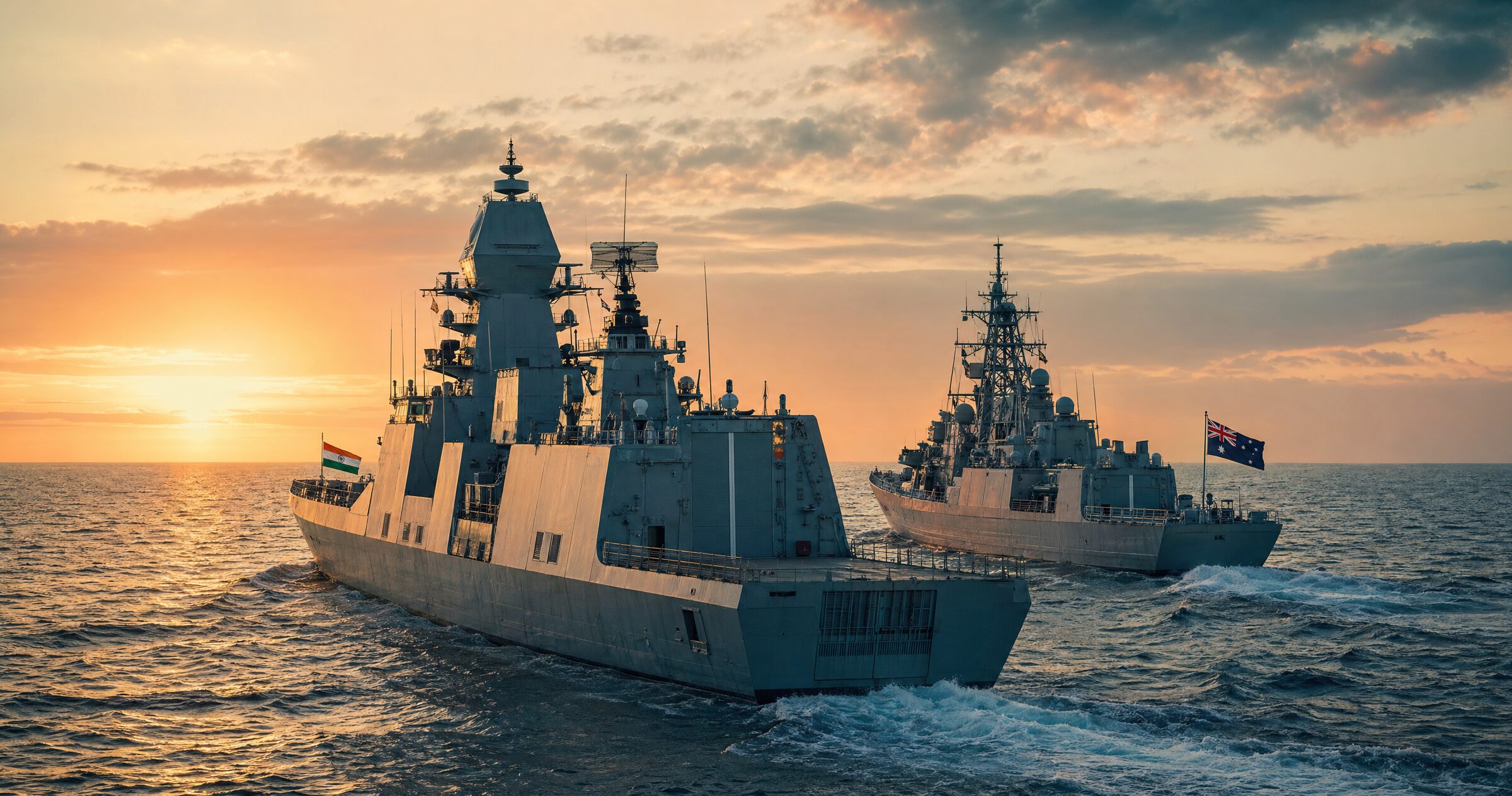
On 20 October 2025, India’s Defence Minister Rajnath Singh travelled to Canberra for the inaugural full-format India–Australia Defence Ministers’ Dialogue, hosted by Australian Deputy Prime Minister and Defence Minister Richard Marles. The meeting placed the bilateral relationship squarely inside the Indo-Pacific security architecture, drawing together strands from the 2+2 Foreign and Defence Ministerial, the Comprehensive Strategic Partnership (CSP) signed in 2020, and the expanding suite of joint maritime exercises. For the Indian Ministry of Defence, this dialogue was the most consequential bilateral defence engagement of the calendar year after the BRICS-Quad cycle, signalling a sharper convergence on undersea-cable security, defence-industry co-production, and a shared reading of grey-zone activities in the Indian Ocean Region (IOR). The dialogue is closely watched as a barometer of how middle powers are repositioning themselves amid intensifying China–US strategic competition. Source: Ministry of Defence, Government of India.
For aspirants preparing the UPSC Civil Services Examination, the dialogue is a textbook case-study spanning GS Paper II (International Relations) and GS Paper III (Internal Security and Defence). It tests whether candidates can read bilateral diplomacy as a layered project — part Quad architecture, part bilateral defence-industry roadmap, part response to AUKUS spillover effects, and part economic interdependence rooted in the Economic Cooperation and Trade Agreement (ECTA) of 2022. This article walks through the dialogue’s outcomes, situates them in the long arc of India–Australia defence ties, and lays out prelims pointers and mains questions you can directly use in revision.
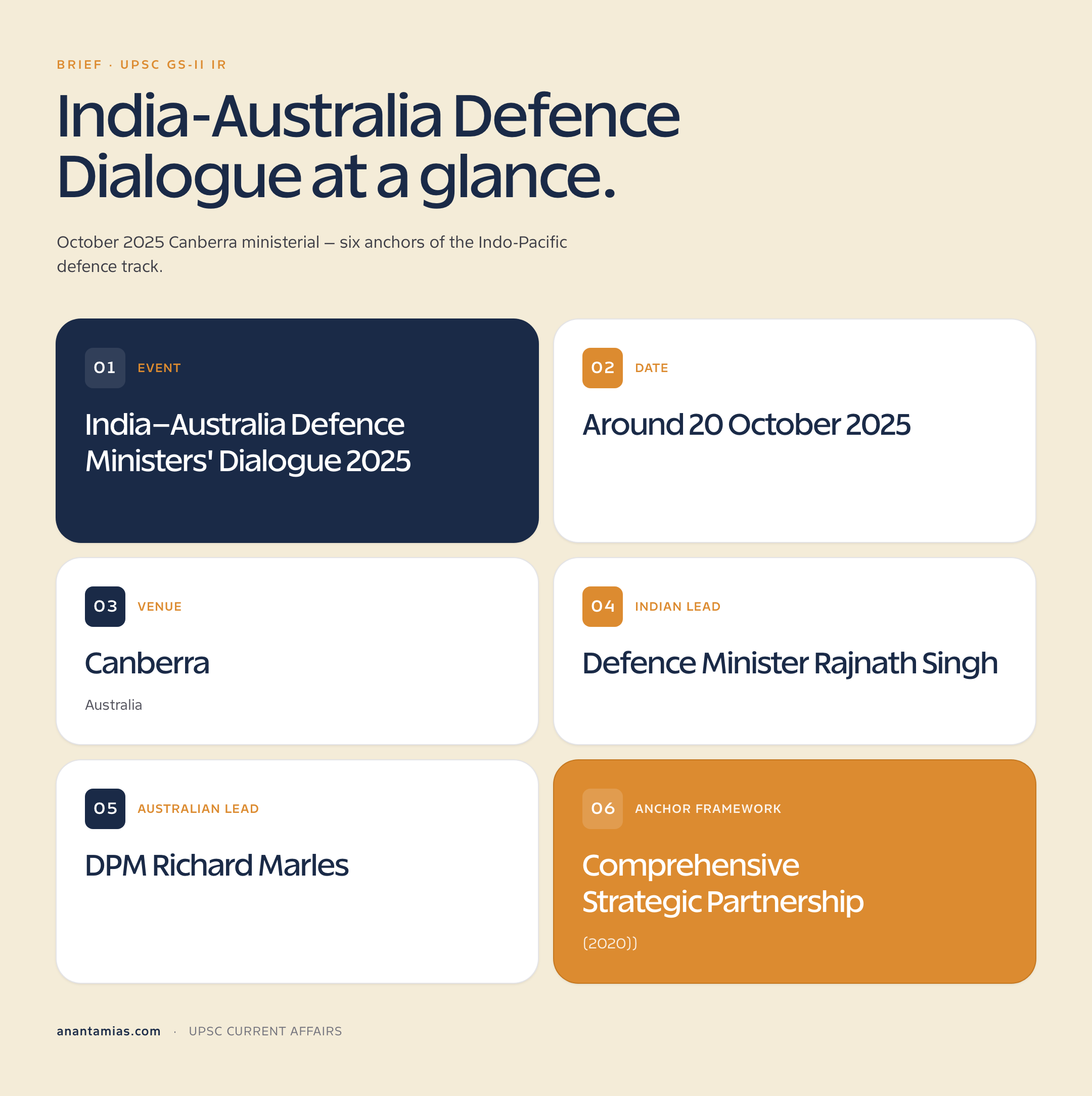
Quick Facts at a Glance
| Parameter | Detail | Significance |
|---|---|---|
| Event | India–Australia Defence Ministers’ Dialogue 2025 | Reaffirms CSP defence pillar |
| Date | Around 20 October 2025 | Pre-Quad summit cycle alignment |
| Venue | Canberra, Australia | Hosted by Australian DPM & Defence Minister |
| Indian Lead | Defence Minister Rajnath Singh | Headed Indian delegation |
| Australian Lead | DPM Richard Marles | Headed Australian delegation |
| Anchor Framework | Comprehensive Strategic Partnership (2020) | Elevated from Strategic Partnership (2009) |
| Trade Backbone | ECTA (2022) | First trade pact Australia signed with a major economy in over a decade |
| Key Exercises | AUSINDEX, MALABAR, AUSTRA HIND, Pitch Black | Naval, land, and air-domain interoperability |
| Multilateral Anchor | Quad, IPOI, IORA | Indo-Pacific minilateralism |
Background and Historical Context
India–Australia defence ties have moved through three distinct phases. The first phase, from the 1990s through 2009, was marked by hesitancy — the 1998 nuclear tests strained relations, and Canberra’s uranium-export ban to non-NPT states kept the strategic conversation cool. The second phase opened with the 2009 Strategic Partnership under Prime Ministers Manmohan Singh and Kevin Rudd, followed by the 2014 Framework for Security Cooperation signed during PM Tony Abbott’s visit. The watershed came in June 2020 when, in a virtual summit at the height of the Galwan crisis, Prime Ministers Narendra Modi and Scott Morrison elevated the relationship to a Comprehensive Strategic Partnership, signing the landmark Mutual Logistics Support Arrangement (MLSA). The MLSA enabled reciprocal access to military bases for refuelling and replenishment — a quiet but profound shift for an Indian defence posture historically allergic to logistics agreements. The CSP also formalised defence science cooperation, defence-industry engagement, and a shared maritime doctrine for the Indo-Pacific.
The third phase has been driven by economic interdependence. The India–Australia Economic Cooperation and Trade Agreement (ECTA), which entered into force on 29 December 2022, was the first trade agreement Australia concluded with a major economy in more than a decade and India’s first FTA with a developed Western economy in over ten years. ECTA eliminated tariffs on roughly 96% of Indian exports by value at entry into force, with 100% coverage phased in. Critically, defence-industrial cooperation rides on this commercial foundation: Australian critical-minerals supply (lithium, cobalt, rare earths), undersea-cable manufacturing, and shipbuilding services have all become more accessible. The 2025 dialogue is the first ministerial meeting where these threads — strategic, military, industrial — were stitched together into a single roadmap. Read more about the broader Quad architecture and Indo-Pacific strategy on Anantamias. Source: Ministry of External Affairs.
Outcomes of the 2025 Dialogue
Defence-Industry Roadmap
The most substantive deliverable was the agreement to draft a bilateral Defence Industry Roadmap covering five tracks: shipbuilding and ship-repair, unmanned systems (aerial and underwater), critical minerals and battery supply chains, space-situational-awareness cooperation, and undersea-cable manufacturing. India’s Defence Public Sector Undertakings (DPSUs) — particularly Mazagon Dock Shipbuilders, Bharat Electronics, and HAL — were identified as anchor partners on the Indian side. Australia’s Defence Industrial Capability Plan (released earlier in 2024) listed India as a “Tier-1” industrial partner. The dialogue also endorsed a Memorandum of Understanding on hydrographic cooperation between the Indian Navy and the Royal Australian Navy, a quiet but strategically significant move given the centrality of seabed mapping to anti-submarine warfare in the IOR.
Maritime Exercises and Interoperability
The ministers reviewed the trajectory of AUSINDEX — the bilateral naval exercise first held in 2015, now in its eighth iteration — and committed to expanding its complexity to include surface, sub-surface, and air domains with anti-submarine warfare drills as the centrepiece. MALABAR, the trilateral-turned-quadrilateral exercise that Australia rejoined in 2020, was reaffirmed as the apex Quad-aligned naval exercise. The army-level AUSTRA HIND and air-force-level participation in Pitch Black received endorsements for higher tempo. Crucially, the dialogue agreed to operationalise reciprocal information-sharing under the existing Mutual Logistics Support Arrangement, allowing Indian P-8I aircraft to use Australian bases such as RAAF Edinburgh and the Cocos Islands airstrip for maritime-domain-awareness sorties.
Strategic Communications and Undersea Cables
A new track introduced at the 2025 dialogue is strategic communications cooperation — specifically on undersea cables. The Indo-Pacific carries roughly 99% of intercontinental data traffic over submarine cables, and the IOR is fast emerging as a contested seabed. The ministers agreed to coordinate on cable-route resilience, joint repair-vessel availability, and a working group on subsea-cable security with Quad partners. India’s Information Fusion Centre — Indian Ocean Region (IFC-IOR) at Gurugram and Australia’s Pacific Fusion Centre will deepen liaison-officer exchanges. This track also covers shared narratives on rules-based order, freedom of navigation, and maritime-domain transparency — answering the grey-zone information warfare that has intensified in the South China Sea and is now spilling into the Bay of Bengal.
Significance for UPSC
- GS-II — International Relations: Operationalises Quad-aligned bilateral defence diplomacy without locking India into a treaty alliance, preserving strategic autonomy.
- GS-III — Defence: Concrete co-production and supply-chain integration in shipbuilding, unmanned systems, and critical minerals.
- Indo-Pacific architecture: Reinforces the SAGAR doctrine and Indo-Pacific Oceans Initiative (IPOI) by adding an Australian pillar.
- Maritime security: Anti-submarine warfare focus directly addresses the rising PLA-Navy footprint in the IOR.
- Economic-strategic linkage: ECTA (2022) demonstrates how trade agreements seed defence-industrial cooperation.
- Critical and emerging technologies: Space-situational awareness, undersea-cable resilience, and unmanned systems align with India’s National Security Strategy priorities.
- Plurilateral diplomacy: Shows how 2+2, Quad, and bilateral dialogues stack into a single Indo-Pacific stack.
Detailed Analysis
The 2025 dialogue must be read against three concurrent dynamics. First, the AUKUS trilateral (Australia–UK–US) is reshaping Australia’s defence-industrial base around nuclear-propelled submarines and Pillar-II advanced capabilities — quantum, AI, hypersonics. India is not an AUKUS member and has no intention of becoming one, but the spillover effect is significant: Australia is investing heavily in shipyards, sustainment infrastructure, and undersea-warfare capacity that India can plug into commercially. The dialogue carefully framed cooperation on undersea systems as bilateral, sidestepping any direct AUKUS interoperability conversation while leaving room for parallel tracks.
Second, the China factor hovered over every agenda item without being named in the joint statement. Chinese research vessels in the Bay of Bengal, port-call requests in Sri Lanka and the Maldives, and the expansion of the PLA Navy’s Djibouti footprint have collectively pushed India and Australia closer on maritime-domain awareness. The decision to expand AUSINDEX’s anti-submarine warfare component is a direct, if quiet, response to Chinese submarine activity in the IOR. The information-sharing arrangement around IFC-IOR effectively creates a real-time picture of what is moving through the Indian Ocean.
Third, the dialogue surfaced India’s enduring strategic-autonomy considerations. New Delhi’s continued operation of S-400 Triumf systems acquired from Russia, ongoing Russian-platform sustainment (Su-30MKI, MiG-29, Akula-class submarine lease), and CAATSA-related US sensitivities all sit in the background. Australia, while closely aligned with the US, has shown pragmatic acceptance — recognising that India’s heterogeneous defence inventory is a feature, not a bug, of its non-aligned posture. The 2025 dialogue notably avoided any language that would force India into binary choices on platform interoperability.
Fourth, the dialogue advanced people-to-people defence cooperation. Service exchanges, staff-college slots at the Australian Defence College and the Indian National Defence College, and a new Young Defence Officers’ Exchange were endorsed. These soft-power tools build the muscle memory needed to convert paper agreements into operational reflexes a decade out.
| Year | Milestone / Exercise | Significance |
|---|---|---|
| 2006 | MoU on Defence Cooperation | First formal defence framework |
| 2009 | Strategic Partnership declared | Joint Declaration on Security Cooperation |
| 2014 | Framework for Security Cooperation | Signed during PM Abbott’s visit to India |
| 2015 | AUSINDEX inaugural edition | Bilateral naval exercise launched |
| 2017 | AUSTRA HIND inaugurated | Bilateral special-forces / army exercise |
| 2020 | Comprehensive Strategic Partnership + MLSA | CSP elevation; reciprocal logistics access |
| 2020 | Australia rejoins MALABAR | Quadrilateral naval exercise revived |
| 2021 | 2+2 Foreign & Defence Ministerial inaugurated | First India–Australia 2+2 (New Delhi) |
| 2022 | ECTA enters into force | Trade pact backbone for defence-industrial ties |
| 2023 | 2nd 2+2 Ministerial (New Delhi) | Defence-industry roadmap discussions begin |
| 2024 | Joint Declaration on Maritime Cooperation | Hydrographic cooperation MoU signalled |
| 2025 | Defence Ministers’ Dialogue, Canberra | Defence Industry Roadmap; undersea-cable track |
Challenges and Criticisms
The first and most persistent challenge is the China factor. Both India and Australia have substantial economic interdependence with China — Australia through iron ore, coking coal, and education exports; India through electronics components, APIs, and machinery. Defence cooperation that visibly targets China risks economic blowback. The dialogue’s careful avoidance of naming China in the joint statement reflects this calculus, but the underlying tension is structural and will not dissipate.
The second challenge is AUKUS interoperability spillover. As Australia integrates US and UK platforms (Virginia-class submarines from the early 2030s, SSN-AUKUS thereafter), the technical gap with Indian platforms could widen. India’s Project-75I conventional-submarine programme, S-400 system, and Russian-origin air-defence assets sit in different technical ecosystems. Without deliberate interoperability investments — common data links, shared communications protocols, joint logistics — the two navies risk drifting into parallel operational worlds despite political proximity.
The third challenge concerns Russian-platform sensitivities. CAATSA (the US Countering America’s Adversaries Through Sanctions Act) creates secondary-sanctions risk on entities transacting with Russia’s defence sector. India’s continued S-400 operations and ammunition supply chains have historically irritated Washington and, by extension, complicated technology transfer from Five Eyes partners. While Australia has been accommodating, the structural risk that a future US administration tightens CAATSA enforcement is real. The dialogue did not, and could not, resolve this; it simply created enough institutional ballast to weather it.
Other challenges include uneven defence-industrial absorption capacity (India’s procurement cycle remains slow), the need for stronger technology-protection regimes before sensitive co-production can deepen, and the political risk of changes in Canberra’s government priorities. The Coalition’s victory in any future Australian election could reweight defence spending toward AUKUS at the expense of bilateral tracks.
Prelims Pointers
- India–Australia Comprehensive Strategic Partnership was signed in June 2020 (virtual summit, Modi–Morrison).
- Mutual Logistics Support Arrangement (MLSA) was signed in 2020, allowing reciprocal use of military bases.
- AUSINDEX is the bilateral naval exercise — first held in 2015 off Visakhapatnam.
- Australia rejoined the MALABAR exercise in 2020 (originally India–US bilateral, became trilateral with Japan, then quadrilateral).
- AUSTRA HIND is the bilateral army exercise, inaugurated in 2017.
- Pitch Black is the Royal Australian Air Force-hosted multinational air exercise; Indian Air Force participates.
- The India–Australia ECTA entered into force on 29 December 2022.
- The first India–Australia 2+2 Ministerial Dialogue was held in 2021 in New Delhi.
- The Information Fusion Centre — Indian Ocean Region (IFC-IOR) is located at Gurugram, Haryana.
- The Indo-Pacific Oceans Initiative (IPOI) was announced by PM Modi at the East Asia Summit, 2019; Australia leads the Maritime Ecology pillar.
- AUKUS is a trilateral security partnership of Australia, UK, and USA, announced in September 2021.
- Australia is a member of the Quad along with India, Japan, and the United States.
Mains Practice Questions
- “India–Australia defence cooperation has matured from symbolism to substance under the Comprehensive Strategic Partnership.” Critically examine in light of the 2025 Defence Ministers’ Dialogue. (GS-II, 250 words)
- Discuss how the Quad and bilateral mechanisms reinforce each other in shaping India’s Indo-Pacific posture, with reference to the India–Australia partnership. (GS-II, 250 words)
- Examine the implications of AUKUS for India–Australia defence-industrial cooperation. How should India navigate the spillover effects? (GS-III, 250 words)
- “Trade and defence are mutually reinforcing pillars in the modern strategic partnership.” Substantiate using the example of the India–Australia ECTA and the Defence Industry Roadmap. (GS-II/III, 250 words)
- Evaluate the role of joint exercises such as AUSINDEX and MALABAR in operationalising the maritime-security architecture of the Indian Ocean Region. (GS-III, 150 words)
Conclusion
The 2025 India–Australia Defence Ministers’ Dialogue is best understood not as a single event but as a structural moment. It cemented a Defence Industry Roadmap, expanded interoperability through AUSINDEX and MALABAR, opened a new strategic-communications track on undersea cables, and quietly absorbed AUKUS spillover into bilateral channels. For India, it advances the SAGAR doctrine and the Indo-Pacific Oceans Initiative without compromising strategic autonomy. For Australia, it adds a Tier-1 Indo-Pacific partner that is neither a treaty ally nor a transactional purchaser but a co-producer. The dialogue’s real test will be in execution — whether Defence Public Sector Undertakings, private shipyards, and joint working groups can convert ministerial language into platforms, protocols, and platforms-at-sea over the next five years. For UPSC aspirants, the takeaway is to read the dialogue as a layered text: bilateral on the surface, Quad-adjacent in the middle, and Indo-Pacific in its deepest implications.
Frequently Asked Questions
When was the India–Australia Defence Ministers’ Dialogue 2025 held?
The dialogue was held in Canberra around 20 October 2025, with India’s Defence Minister Rajnath Singh meeting Australian Deputy Prime Minister and Defence Minister Richard Marles.
What is the Comprehensive Strategic Partnership between India and Australia?
The Comprehensive Strategic Partnership was signed in June 2020 at a virtual summit between PM Narendra Modi and PM Scott Morrison. It elevated the 2009 Strategic Partnership and brought defence, trade, education, and people-to-people ties under a single architecture.
What is the MLSA between India and Australia?
The Mutual Logistics Support Arrangement, signed in 2020, allows the armed forces of both countries to access each other’s military bases for refuelling, replenishment, repairs, and logistics support — a cornerstone of operational interoperability.
What are AUSINDEX and MALABAR?
AUSINDEX is the bilateral India–Australia naval exercise, first held in 2015. MALABAR is the multilateral exercise involving India, the United States, Japan, and Australia (which rejoined in 2020), focused on advanced maritime warfare and Quad-aligned interoperability.
How does the ECTA support defence cooperation?
The Economic Cooperation and Trade Agreement (ECTA), in force since 29 December 2022, lowers tariffs and eases services trade, making Australian critical minerals, shipbuilding services, and dual-use technologies more accessible to Indian defence-industrial supply chains.
Is India part of AUKUS?
No. AUKUS is a trilateral security partnership of Australia, the UK, and the USA, announced in September 2021. India is not a member but engages with AUKUS Pillar-II priorities (advanced technologies) bilaterally with Australia and the United States.
What is the Indo-Pacific Oceans Initiative (IPOI)?
The IPOI is an open, non-treaty initiative announced by PM Modi at the 2019 East Asia Summit. It has seven pillars including Maritime Security, Maritime Ecology (led by Australia), and Disaster Risk Reduction.
Why are undersea cables a strategic concern?
Submarine cables carry approximately 99% of intercontinental data traffic. Their disruption — by accident, sabotage, or grey-zone activity — can cripple economies and military communications. India and Australia have agreed to coordinate on cable-route resilience, joint repair-vessel availability, and a Quad-aligned working group on subsea-cable security.
Tell Google you want more of this.
Add Anantam IAS as a preferred sourceOne tap, and this site shows up more often in your own Top Stories, AI Overviews and AI Mode. Remove it any time.






