

Why in News?
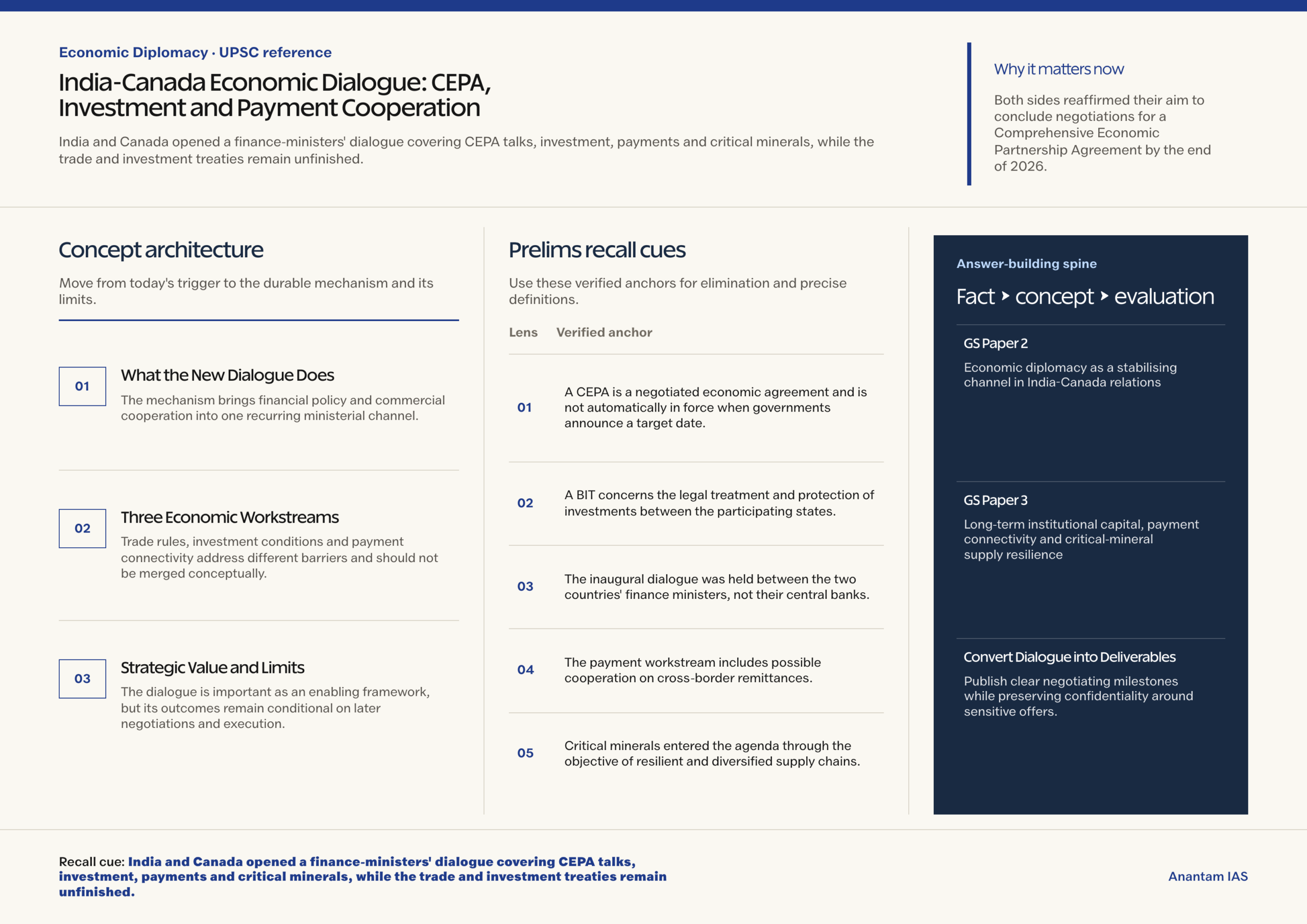
India and Canada concluded their inaugural Finance Ministers’ Economic and Financial Dialogue in Toronto and identified trade, investment, payments and critical minerals as priority areas.
- Both sides reaffirmed their aim to conclude negotiations for a Comprehensive Economic Partnership Agreement by the end of 2026.
- India expressed readiness to initiate negotiations on a Bilateral Investment Treaty at the earliest; no such treaty was concluded at the dialogue.
- The leaders’ shared aspiration is to expand bilateral trade to CAD 70 billion, or about ₹4.65 lakh crore, by 2030.
- The agenda included institutional capital, payments modernisation, financial stability, FinTech, capital markets, financial crime and critical-mineral supply chains.
- The dialogue creates a recurring finance-ministry channel that can connect trade negotiations with financial regulation, investment facilitation and payment infrastructure.
- Its significance lies in converting a renewed political relationship into specific economic workstreams without treating negotiating intentions as completed agreements.
- For India, Canadian pension capital, remittance links and critical minerals offer opportunities, but each requires predictable rules and commercially viable projects.
UPSC Relevance
Prelims Relevance
- A CEPA is a negotiated economic agreement and is not automatically in force when governments announce a target date.
- A BIT concerns the legal treatment and protection of investments between the participating states.
- The inaugural dialogue was held between the two countries’ finance ministers, not their central banks.
- The payment workstream includes possible cooperation on cross-border remittances, merchant payments and UPI through service-provider partnerships.
- Critical minerals entered the agenda through the objective of resilient and diversified supply chains.
Mains Relevance
GS Paper 2
- Economic diplomacy as a stabilising channel in India-Canada relations
- Difference between political commitments, negotiations and legally operative agreements
GS Paper 3
- Long-term institutional capital, payment connectivity and critical-mineral supply resilience
- Regulatory certainty and financial-crime safeguards in deeper cross-border finance
Essay
- Economic interdependence can create practical space for cooperation even when a wider bilateral relationship remains politically sensitive.
Background and Context
What the New Dialogue Does
The mechanism brings financial policy and commercial cooperation into one recurring ministerial channel.
- It allows both governments to review macroeconomic developments and domestic policy priorities while identifying bilateral projects that require coordination across finance, trade and regulatory authorities.
- The agenda joins trade expansion with investment facilitation, recognising that market access alone cannot mobilise capital without credible projects, tax certainty and stable financial rules.
- Officials can use the channel to connect financial institutions, institutional investors and public investment platforms with commercially viable opportunities rather than relying only on diplomatic declarations.
- The 2030 trade aspiration supplies direction, but it is not a binding guarantee; actual gains depend on negotiated market access, business demand and implementation.
- The next dialogue is planned for 2027, giving the mechanism a follow-up cycle through which announced workstreams can be reviewed against concrete outcomes.
Three Economic Workstreams
Trade rules, investment conditions and payment connectivity address different barriers and should not be merged conceptually.
- The proposed CEPA would be the trade-policy track. Its final coverage, commitments and legal obligations depend on the text negotiated and adopted by both countries.
- A possible BIT would be a separate investment-law track. India’s statement of readiness begins a process; it does not establish protections or dispute rules by itself.
- Canadian pension funds illustrate the role of patient institutional capital, which can support infrastructure and other long-horizon assets when projects, taxation and regulation provide sufficient predictability.
- Payment cooperation may examine faster and less costly remittances and merchant payments, including wider UPI use through partnerships with payment service providers in Canada.
- Cooperation on financial stability, FinTech, capital markets and financial crime acknowledges that connectivity must be accompanied by supervision, consumer protection and enforcement capacity.
Strategic Value and Limits
The dialogue is important as an enabling framework, but its outcomes remain conditional on later negotiations and execution.
- Critical-mineral cooperation links bilateral finance to economic security: diversified supply chains can reduce concentration risk, while investment can help develop extraction, processing and recycling capacity.
- The bilateral format can match complementary strengths more closely than a broad forum, yet it must remain consistent with each country’s domestic law and wider international obligations.
- Students should distinguish a political aspiration, such as the 2030 trade figure, from a negotiated treaty obligation with defined commitments and implementation procedures.
- They should also separate a dialogue’s agreed areas of exploration from operational outcomes: discussing UPI partnerships does not mean a universal payment link has already been launched.
- Durable progress requires institutions to manage political shocks, regulatory differences and project risks without allowing every disagreement to halt functional economic cooperation.
Way Forward
Convert Dialogue into Deliverables
- Publish clear negotiating milestones while preserving confidentiality around sensitive offers, so businesses can distinguish agreed rules from provisional objectives.
- Create regulator-to-regulator work on payments, consumer safeguards, cybersecurity, anti-money-laundering controls and interoperable technical standards.
- Develop investible project pipelines with transparent risk allocation, tax treatment and dispute-management arrangements for long-term institutional investors.
- Define critical-mineral projects by supply-chain need, environmental safeguards, community interests and processing capability rather than by diplomatic signalling alone.
Conclusion
- The inaugural dialogue gives India and Canada a structured economic channel spanning trade, investment, finance and supply chains, but the test will be measurable implementation.
- In a Mains answer, present CEPA and BIT as unfinished negotiating tracks, then assess how payments, institutional capital and critical minerals can deepen cooperation with safeguards.
UPSC Practice Questions
Prelims MCQ 1
With reference to the 2026 India-Canada Economic and Financial Dialogue, consider the following statements:
- It was the inaugural finance-ministers’ economic and financial dialogue between the two countries.
- A Bilateral Investment Treaty entered into force at the conclusion of the dialogue.
- The agenda included payments modernisation and critical-mineral supply chains.
How many of the above statements are correct?
(a) Only one (b) Only two (c) All three (d) None
Answer: (b) Only two
Explanation:
Statements 1 and 3 are correct. India expressed readiness to initiate BIT negotiations, but no treaty was concluded or brought into force at the dialogue.
Prelims MCQ 2
Which one of the following best describes the status of the India-Canada CEPA after the dialogue?
(a) It entered into force immediately (b) It was replaced by a currency union (c) Negotiations remained underway with an end-2026 completion aim (d) It became a multilateral treaty
Answer: (c) Negotiations remained underway with an end-2026 completion aim
Explanation:
Both sides reaffirmed an aim to conclude CEPA talks by the end of 2026. The announcement did not make the agreement operative.
UPSC Mains Questions
- How can an institutional economic dialogue help stabilise India-Canada relations? Discuss with reference to trade, investment and payment cooperation.
- Differentiate political commitments, treaty negotiations and implementation. Apply this distinction to the proposed India-Canada CEPA and Bilateral Investment Treaty.
Sources: Department of Finance Canada and The Hindu.
Frequently Asked Questions
What is the India-Canada Economic and Financial Dialogue?
It is a finance-ministers’ mechanism for coordinating economic and financial cooperation. Its inaugural meeting covered trade, investment, payments, financial-sector issues and resilient critical-mineral supply chains.
Was the India-Canada CEPA concluded at the dialogue?
No. Both governments reaffirmed their shared aim to conclude CEPA negotiations by the end of 2026, but the agreement remained under negotiation after the meeting.
Is an India-Canada Bilateral Investment Treaty now in force?
No. India expressed readiness to initiate BIT negotiations at the earliest. Starting negotiations, concluding a treaty and bringing it into force are separate stages.
Why were UPI and remittances discussed?
The ministers supported exploration of cross-border remittance and merchant-payment opportunities, including wider UPI use through provider partnerships, to improve payment efficiency for trade and people-to-people links.
Why do critical minerals matter in this dialogue?
They connect bilateral cooperation with economic security. Diversified mineral supply chains can support strategic industries, provided projects meet commercial, environmental, regulatory and community safeguards.
Tell Google you want more of this.
Add Anantam IAS as a preferred sourceOne tap, and this site shows up more often in your own Top Stories, AI Overviews and AI Mode. Remove it any time.






