

Why in News?
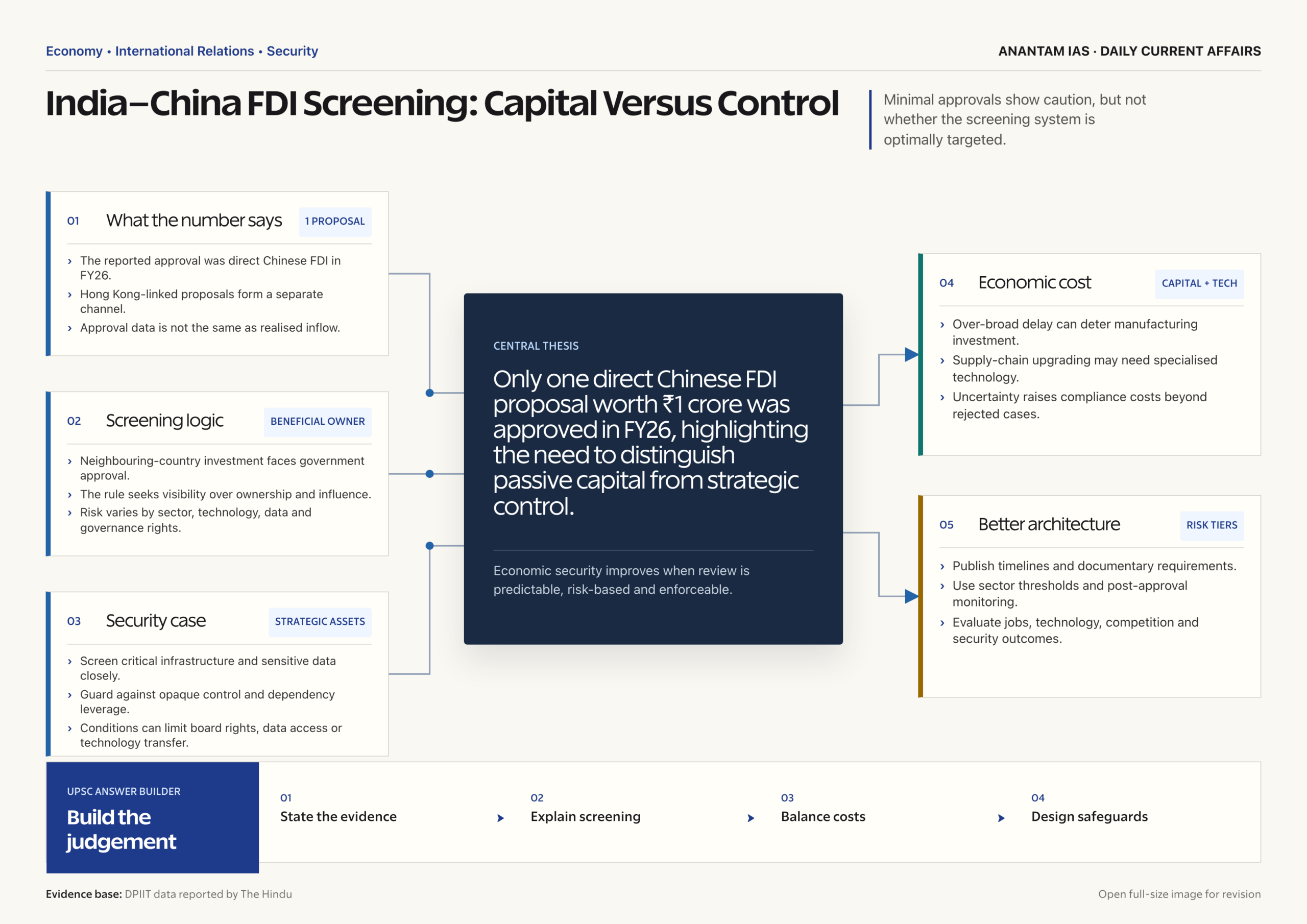
DPIIT data reported by The Hindu show that India approved only one direct Chinese foreign direct investment proposal, worth ₹1 crore, during FY 2025-26.
- The government cleared 13 proposals from Hong Kong worth ₹610.42 crore during April 2025-March 2026, compared with the single ₹1 crore proposal from mainland China.
- Across all source countries, 63 government-route FDI proposals worth ₹10,292.67 crore, or $1.18 billion, were approved in FY 2025-26. This is proposal-approval data, not a measure of all FDI actually received during the year.
- Singapore led the approved proposals by value with five clearances worth ₹3,259.88 crore, followed by the United Kingdom with five worth ₹2,477.67 crore and Thailand with two worth ₹1,600 crore.
- In FY 2024-25, India had also approved only one direct Chinese proposal, valued at ₹28.71 crore. Eleven Hong Kong proposals worth ₹1,225.28 crore were approved that year.
- China accounted for 0.32% of India’s cumulative FDI equity inflows from April 2000 to March 2026, while Hong Kong accounted for 0.62%, according to the reported DPIIT series.
- The numbers show that direct Chinese investment approvals remain small in value even after India clarified the beneficial-ownership test in 2026.
- India’s policy question is not a simple choice between open and closed investment. It is how to distinguish passive minority capital from ownership or control that may create strategic vulnerability.
- Screening matters for manufacturing because Chinese firms and supply chains hold capabilities in electronics components, capital goods, solar manufacturing and other sectors central to India’s industrial ambitions.
UPSC Relevance
Prelims Relevance
- FDI generally involves a lasting interest and a degree of management influence in an enterprise located in another economy; it differs from short-term portfolio exposure.
- Under the automatic route, prior Union government approval is not required, subject to sectoral caps and conditions. Under the government route, prior approval is required.
- Press Note 3 of 2020 applies to an entity or citizen of a country sharing a land border with India and to an investment whose beneficial ownership falls within the restricted jurisdiction.
- The land-border countries named in this context are Afghanistan, Bangladesh, Bhutan, China, Myanmar, Nepal and Pakistan.
- A transfer of ownership of an existing or future FDI that brings beneficial ownership within the restriction also requires prior government approval.
- The 2026 rules link beneficial ownership to the Prevention of Money-laundering Act, 2002 and the criteria in Rule 9(3) of the Prevention of Money-laundering (Maintenance of Records) Rules, 2005.
Mains Relevance
GS Paper 3
- Evaluate investment screening as an instrument of economic security, industrial policy and protection against opportunistic acquisition.
- Discuss the trade-off between domestic manufacturing goals and dependence on foreign capital, components, machinery, technology and managerial know-how.
GS Paper 2
- Connect investment policy with the wider management of India-China relations, where strategic rivalry coexists with deep commercial links.
- Assess how transparent rules, reasoned decisions and predictable timelines can protect national interests without creating arbitrary administrative barriers.
Essay
- Economic openness is strongest when it is paired with institutional capacity to identify and manage strategic risk.
Background and Context
What Press Note 3 Changed in 2020
India introduced a location-and-ownership based screening rule during the economic shock caused by the COVID-19 pandemic.
- DPIIT’s Press Note 3 dated 17 April 2020 moved investments connected to countries sharing a land border with India to the government route. The stated concern was opportunistic takeover or acquisition of Indian companies at depressed.
- The rule looks beyond the immediate investor. It also covers cases where the beneficial owner of the investment is situated in, or is a citizen of, a land-border country.
- It also addresses later changes in ownership. If a direct or indirect transfer makes restricted-country beneficial ownership arise, prior approval is required even when the original investment was permissible.
The 2026 Beneficial-Ownership Clarification
The revised framework narrows uncertainty around passive, non-controlling ownership without removing screening for direct land-border investors.
- The Union Cabinet announced the policy review on 10 March 2026, and DPIIT issued Press Note No. 2 on 15 March. The corresponding FEMA non-debt instrument rules took effect on their Gazette publication on 2 May.
- For an investor entity incorporated outside a land-border country, the beneficial-owner test now refers to the PMLA definition and the applicable thresholds under Rule 9(3) of the PML record-keeping rules.
- Thresholds alone do not settle every case. Prior approval can still be triggered when a land-border citizen or entity can exercise control over the investor or ultimate effective control over the Indian investee.
- Investments that contain some direct or indirect LBC ownership but remain outside the approval trigger face a separate reporting requirement specified by the Reserve Bank of India.
- Direct entities or citizens from land-border countries remain on the government route. This distinction prevents the clarification for global funds from being read as a general opening for direct Chinese investment.
What the FY26 Numbers Show
The annual approval series points to a sharply limited direct China channel, but it must be read with care.
- Only one mainland Chinese proposal worth ₹1 crore was approved in FY 2025-26, against one worth ₹28.71 crore in FY 2024-25.
- Hong Kong recorded 13 approved proposals worth ₹610.42 crore in FY26, compared with 11 worth ₹1,225.28 crore in FY25. Hong Kong is reported separately in the source-country data, even though direct Hong Kong entities.
- The all-country government-route total also declined from 82 proposals worth ₹39,758 crore in FY25 to 63 proposals worth ₹10,292.67 crore in FY26.
- Approval is not the same as realised inflow. A cleared proposal may be implemented in stages, reduced, delayed or not completed, while automatic-route inflows are outside this approval count.
- Cumulative equity inflow shares were small: China ranked 23rd with $2.51 billion, or 0.32%, during April 2000-March 2026; Hong Kong ranked 15th with $4.91 billion, or 0.62%.
Why India Still Needs Selective Capital and Technology
A screening regime cannot be judged only by the investment it blocks; it must also account for capabilities India wants to build.
- Manufacturing expansion needs capital as well as process knowledge, supplier relationships and access to machinery. These links are especially important in electronics components, capital goods, solar cells and upstream solar inputs.
- The Cabinet announced a 60-day decision objective for proposals in specified manufacturing activities, alongside the condition that resident Indian citizens or Indian-owned and controlled entities retain majority shareholding and control in those cases.
- Joint ventures can support domestic value addition and technology access, but poorly designed arrangements can also preserve import dependence or shift strategic control over data, production and supplier networks.
- India’s goal should be deeper participation in global value chains, not an indiscriminate replacement of one foreign dependency with another.
Way Forward
Adopt a Transparent Risk Matrix
- Classify proposals by sector sensitivity, access to data or technology, ownership rights, board influence, supply-chain concentration and the reversibility of risk.
- Publish clear documentary requirements and non-sensitive decision principles so investors can identify approval triggers before filing.
- Require consistent disclosure of direct, indirect, cumulative and coordinated holdings, including control rights contained in shareholder agreements.
- Link DPIIT review with RBI, securities, company-law, competition, tax and security databases while protecting legitimate commercial confidentiality.
Conclusion
- The FY26 data show that direct Chinese FDI approvals remain minimal, while Hong Kong-linked proposals occupy a somewhat larger but still limited channel.
- India needs a system that can tell passive capital from strategic control.
UPSC Practice Questions
Prelims MCQ 1
With reference to India’s FDI policy for countries sharing a land border with India, consider the following statements:
- A direct entity from such a country can invest in India only through the government route.
- A later transfer that brings beneficial ownership within the restricted jurisdiction can require prior government approval.
- The 2026 amendment permits every investor with up to 10% direct equity from a land-border country to invest automatically, irrespective of control.
How many of the above statements are correct?
(a) Only one (b) Only two (c) All three (d) None
Answer: (b) Only two
Explanation:
Statements 1 and 2 are correct. Statement 3 is incorrect because direct LBC entities remain under the government route, while the beneficial-ownership test for an investor incorporated outside an LBC also examines applicable PML-rule thresholds and control.
Prelims MCQ 2
Which institution issued Press Note No. 2 of 2026 clarifying the beneficial-ownership test for land-border investments?
(a) Reserve Bank of India (b) Securities and Exchange Board of India (c) Department for Promotion of Industry and Internal Trade (d) Competition Commission of India
Answer: (c) Department for Promotion of Industry and Internal Trade
Explanation:
DPIIT issued Press Note No. 2 of 2026. The associated legal changes were incorporated through amendments to the Foreign Exchange Management (Non-debt Instruments) Rules, 2019.
UPSC Mains Questions
- India’s screening of land-border investments reflects a tension between economic security and access to capital and technology. Critically examine. (15 marks, 250 words)
- A beneficial-ownership test is more precise than a nationality-only investment restriction, but it is also harder to enforce. Discuss with reference to India’s FDI framework. (10 marks, 150 words)
Sources: The Hindu, citing DPIIT data and PIB, Cabinet and DPIIT Press Note No. 2 of 2026.
Frequently Asked Questions
What did the FY26 Chinese FDI approval data show?
India approved one direct Chinese FDI proposal worth ₹1 crore in FY 2025-26. It also approved 13 proposals from Hong Kong worth ₹610.42 crore. These are government-route proposal approvals reported from DPIIT data, not the total value of all FDI.
What is Press Note 3 of 2020?
Press Note 3 moved investments connected to countries sharing a land border with India to the government route. It covers direct investors, relevant beneficial owners and later ownership transfers that bring an investment within the restriction. It was introduced amid.
Did India remove screening for Chinese investment in 2026?
No. Direct entities and citizens from China, Hong Kong and other land-border jurisdictions remain under the government route. The 2026 change clarified how beneficial ownership is tested for investor entities incorporated outside those jurisdictions and added reporting for certain non-triggering.
Why is beneficial ownership different from legal ownership?
Legal ownership identifies the entity named on the investment. Beneficial ownership looks through layers to the person or entity that ultimately enjoys rights or can exercise control. This helps detect strategic influence routed through funds, holding companies or coordinated investors.
Why might India permit some investment linked to Chinese capital?
Some capital can bring machinery, process knowledge, supplier access and technology needed for electronics, capital goods and solar manufacturing. A calibrated regime can permit passive or condition-bound investment while keeping transactions involving control, critical infrastructure, sensitive data or strategic technology.
Tell Google you want more of this.
Add Anantam IAS as a preferred sourceOne tap, and this site shows up more often in your own Top Stories, AI Overviews and AI Mode. Remove it any time.






