Why in News?
On 19 August 2026, sponsors reported that INTerpath-001 met its Phase III recurrence-free and distant-metastasis-free survival endpoints in resected high-risk melanoma.
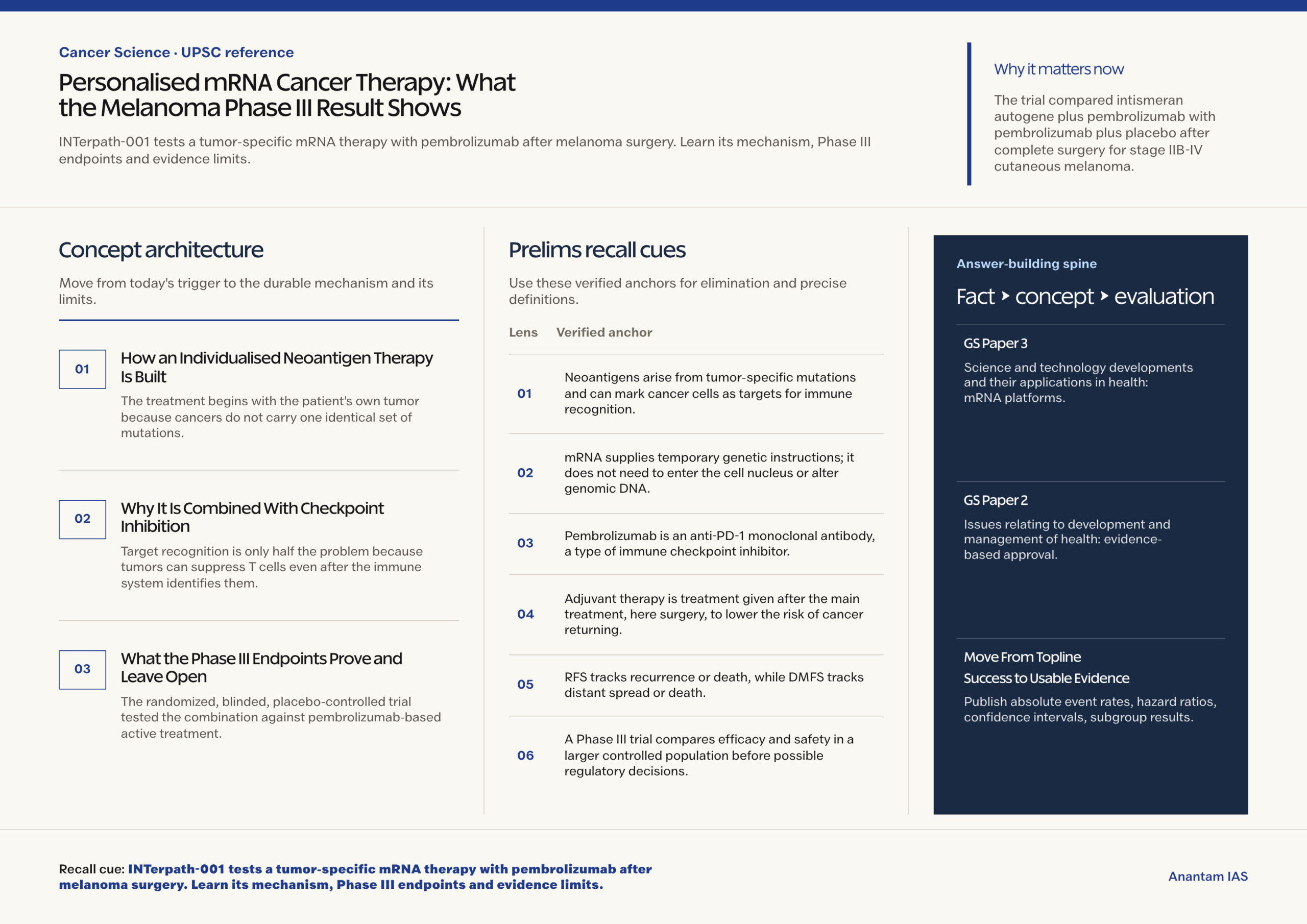
- The trial compared intismeran autogene plus pembrolizumab with pembrolizumab plus placebo after complete surgery for stage IIB-IV cutaneous melanoma.
- Sponsors described statistically significant and clinically meaningful improvement at a pre-specified interim analysis, while follow-up for overall survival continues.
- The public announcement did not provide Phase III hazard ratios, absolute event rates or detailed subgroup findings; the registry still showed No Results Posted.
- Intismeran remains investigational. Endpoint success is not regulatory approval and does not establish a vaccine for every cancer or for healthy people.
- The advance tests whether a therapy built from one patient’s tumor mutations can add benefit to an established checkpoint inhibitor.
- The exam-worthy distinction is between a therapeutic, individualised cancer treatment and a preventive vaccine given before disease develops.
- The evidence is encouraging but incomplete until detailed efficacy, safety, quality-of-life and overall-survival data are publicly assessed.
UPSC Relevance
Prelims Relevance
- Neoantigens arise from tumor-specific mutations and can mark cancer cells as targets for immune recognition.
- mRNA supplies temporary genetic instructions; it does not need to enter the cell nucleus or alter genomic DNA.
- Pembrolizumab is an anti-PD-1 monoclonal antibody, a type of immune checkpoint inhibitor.
- Adjuvant therapy is treatment given after the main treatment, here surgery, to lower the risk of cancer returning.
- RFS tracks recurrence or death, while DMFS tracks distant spread or death.
- A Phase III trial compares efficacy and safety in a larger controlled population before possible regulatory decisions.
Mains Relevance
GS Paper 3
- Science and technology developments and their applications in health: mRNA platforms, cancer genomics and precision medicine.
- Indigenization and access questions around sequencing, bioinformatics, individualized manufacturing and cold-chain capacity.
GS Paper 2
- Issues relating to development and management of health: evidence-based approval, affordability and equitable access to advanced cancer care.
- Regulatory oversight of complex biologics, genomic privacy and long-term safety monitoring.
Essay
- Precision medicine can make treatment biologically personal, but public-health value still depends on evidence, manufacturing capacity and fair access.
Background and Context
How an Individualised Neoantigen Therapy Is Built
The treatment begins with the patient’s own tumor because cancers do not carry one identical set of mutations.
- A resected tumor sample is analyzed alongside normal material to find mutations that distinguish the patient’s cancer cells from healthy cells.
- Some mutations create altered protein fragments called neoantigens. Because they are new to the body, immune cells may recognize them as abnormal targets that normal cells usually lack.
- Computational selection identifies candidate neoantigens likely to be presented to T cells. This selection step matters because not every tumor mutation produces a useful immune target.
- Intismeran uses a synthetic mRNA sequence encoding up to 34 neoantigens, tailoring temporary instructions to the patient’s tumor rather than permanently editing DNA or using one unchanged sequence for everyone.
- After injection, cells translate the mRNA instructions into antigen fragments. Antigen-presenting cells display them, helping activate tumor-specific T-cell responses against cells carrying those markers.
Why It Is Combined With Checkpoint Inhibition
Target recognition is only half the problem because tumors can suppress T cells even after the immune system identifies them.
- The PD-1 pathway works as an immune brake that normally limits excessive immune damage. Tumors can exploit this checkpoint through PD-L1 signaling and reduce T-cell activity.
- Pembrolizumab is an anti-PD-1 antibody. By blocking PD-1 interaction with its ligands, it can release this inhibitory signal and restore immune activity.
- The combination has complementary jobs: intismeran supplies patient-specific target instructions, while pembrolizumab helps activated T cells remain functional against tumor cells.
- This is adjuvant treatment, given after complete surgical resection when visible disease has been removed but microscopic residual cancer may still cause recurrence.
- Calling it a cancer vaccine can mislead. It is therapeutic, prepared after diagnosis from tumor information, and tested here for a defined high-risk melanoma population.
What the Phase III Endpoints Prove and Leave Open
The randomized, blinded, placebo-controlled trial tested the combination against pembrolizumab-based active treatment, but a positive endpoint does not answer every clinical or policy question.
- Recurrence-free survival measures time from randomization until melanoma returns at any site or the participant dies from any cause.
- Distant-metastasis-free survival measures time until cancer spreads to a distant site or death. It asks a narrower question about dangerous systemic recurrence.
- The sponsor’s topline statement says both endpoints improved, but detailed Phase III effect sizes, confidence intervals, event counts and peer-reviewed analyses were not yet public.
- Overall survival remains under follow-up. Longer survival, long-term toxicity, quality of life and durability require separate observation and cannot be inferred from the two reported endpoints alone.
- The widely cited 49% and 59% risk reductions come from the earlier Phase IIb KEYNOTE-942 study. They are not INTerpath-001 Phase III results.
Way Forward
Move From Topline Success to Usable Evidence
Regulatory and health-system decisions need the full dataset, not the announcement alone.
- Publish absolute event rates, hazard ratios, confidence intervals, subgroup results, adverse events and quality-of-life outcomes for independent scrutiny.
- Continue follow-up for overall survival and late immune-related effects before extending claims beyond the endpoints already reported.
- Regulators should assess both clinical benefit and the reproducibility of the tumor-sequencing, neoantigen-selection and individualized manufacturing chain.
- Access planning should address cost, turnaround time, specialist laboratories, genomic-data protection and the risk of concentrating precision oncology in a few urban centers.
Conclusion
- INTerpath-001 is a major proof-of-concept for combining individualised mRNA instructions with checkpoint inhibition after melanoma surgery, but it remains an investigational treatment with incomplete public Phase III data.
- A strong answer should separate mechanism from evidence: explain neoantigen selection and PD-1 blockade, define RFS and DMFS, then state that approval, overall-survival benefit and wider cancer applicability remain unsettled.
UPSC Practice Questions
Prelims MCQ 1
With reference to individualised mRNA cancer therapy, consider the following statements:
- Its neoantigen targets may be selected from mutations found in a patient’s tumor.
- It is necessarily a preventive vaccine administered to healthy people before cancer develops.
- Pembrolizumab blocks the PD-1 immune checkpoint.
How many of the above statements are correct?
(a) Only one (b) Only two (c) All three (d) None
Answer: (b) Only two
Explanation:
Statements 1 and 3 are correct. The therapy is individualized from tumor information and is combined with anti-PD-1 treatment; it is therapeutic, not a preventive vaccine for healthy people.
Prelims MCQ 2
Which clinical-trial endpoint most specifically measures the time until cancer spreads to a distant site or death?
(a) Recurrence-free survival (b) Distant-metastasis-free survival (c) Objective response rate (d) Progression-free survival
Answer: (b) Distant-metastasis-free survival
Explanation:
DMFS counts distant metastasis or death. RFS is broader because it also includes local, locoregional and regional recurrence.
UPSC Mains Questions
- Explain how individualised neoantigen mRNA therapy and immune checkpoint inhibition can work together in cancer treatment. What scientific and access challenges could limit their wider use?
- A positive Phase III endpoint is a milestone, not the end of evidence generation. Discuss with reference to recurrence-free survival, overall survival, safety and regulatory assessment.
Sources: Merck and Moderna and ClinicalTrials.gov.
Frequently Asked Questions
What is intismeran autogene?
It is an investigational mRNA-based individualised neoantigen therapy. Its synthetic mRNA encodes selected targets derived from a patient’s tumor mutations to stimulate tumor-specific T-cell responses.
Is intismeran a preventive cancer vaccine?
No. It is a therapeutic treatment prepared after cancer diagnosis using tumor information and tested after melanoma surgery to reduce recurrence risk.
Why is pembrolizumab given with the mRNA therapy?
Pembrolizumab blocks PD-1, an immune checkpoint that can restrain T cells. Intismeran supplies tumor-specific targets while pembrolizumab helps sustain immune attack.
What did INTerpath-001 report?
Sponsors reported that the combination met recurrence-free and distant-metastasis-free survival endpoints versus pembrolizumab-based control. Detailed Phase III effect sizes were not yet public.
Do the 49% and 59% figures describe the Phase III result?
No. Those risk-reduction figures came from the earlier Phase IIb KEYNOTE-942 study and should not be presented as INTerpath-001 Phase III results.
Tell Google you want more of this.
Add Anantam IAS as a preferred sourceOne tap, and this site shows up more often in your own Top Stories, AI Overviews and AI Mode. Remove it any time.