

Why in News?
A public-interest plea linked to recurring public-examination paper leaks, including the alleged NEET-UG 2026 leak, has asked the Supreme Court to revisit restrictions on the investigative use of polygraph and Brain Electrical Activation Profile tests.
- The petition seeks a national investigation framework and faster trials for organised paper-leak offences, while arguing that selected deception-detection techniques could help identify syndicate organisers.
- It reportedly accepts that compulsory narco-analysis remains impermissible but asks the Court to reconsider the treatment of polygraph and BEAP techniques in serious paper-leak investigations.
- A petition is an argument placed before a court, not a judicial determination. Unless the Supreme Court modifies its precedent, investigators remain bound by Selvi and the consent safeguards it adopted.
- The controversy creates a classic GS Paper 2 conflict: the State’s duty to investigate organised crime versus the individual’s rights to silence, dignity, fair trial and mental privacy.
- Exam fraud can harm equality of opportunity and public trust, but the seriousness of an offence does not itself suspend constitutional protections.
- The real policy choice is not between civil liberties and effective investigation. It is between coercive shortcuts of uncertain reliability and evidence-led investigation built on digital, financial, documentary and witness trails.
- The issue also anticipates wider debates over neurotechnology, emotion recognition and AI-based deception claims, all of which may attempt to infer private mental states from bodily or neural signals.
UPSC Relevance
Prelims Relevance
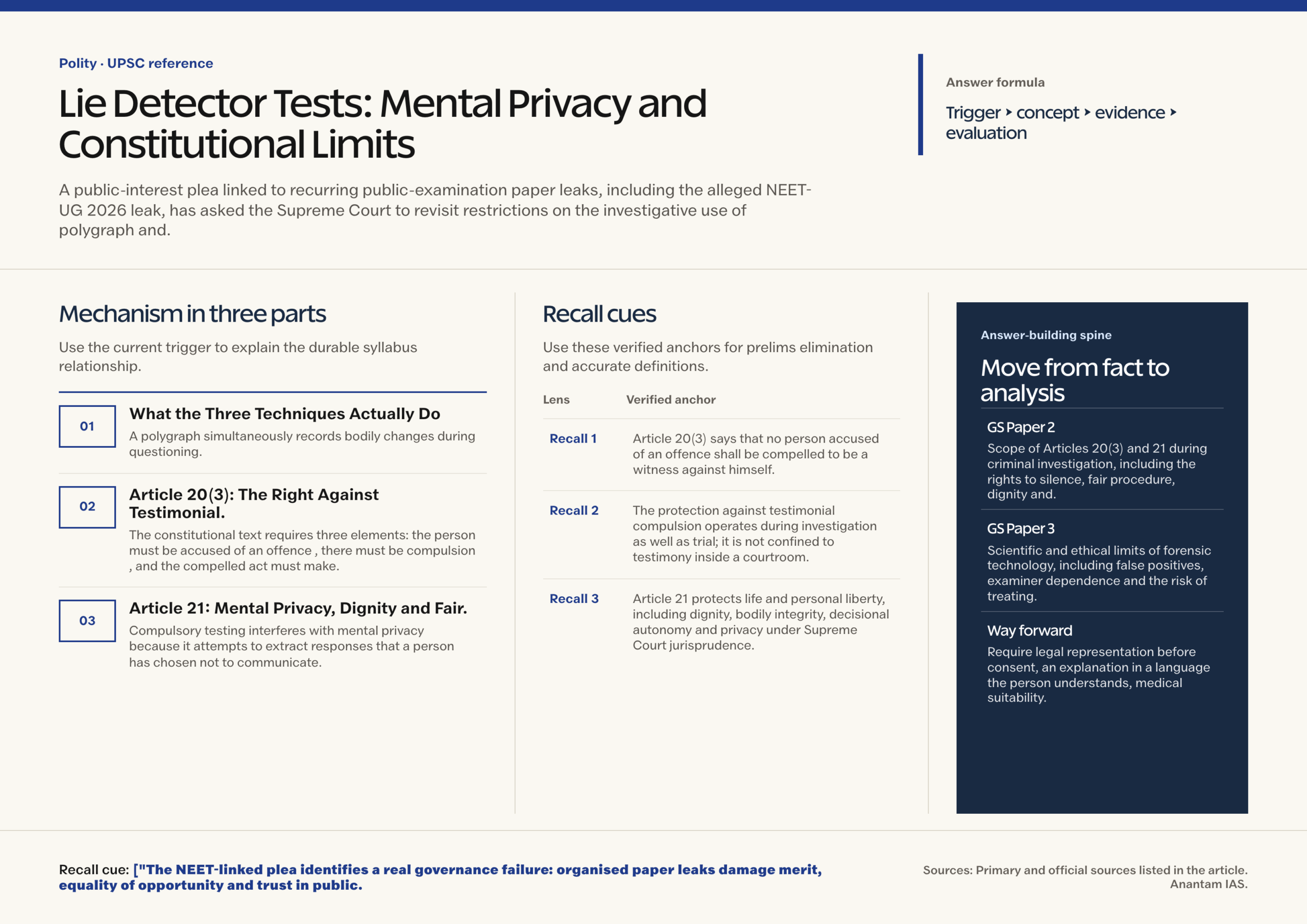
- Article 20(3) says that no person accused of an offence shall be compelled to be a witness against himself.
- The protection against testimonial compulsion operates during investigation as well as trial; it is not confined to testimony inside a courtroom.
- Article 21 protects life and personal liberty, including dignity, bodily integrity, decisional autonomy and privacy under Supreme Court jurisprudence.
- A polygraph records physiological variables such as respiration, blood pressure, pulse and skin conductivity; it does not directly read a lie or establish guilt.
- Narco-analysis uses a drug-induced state to lower inhibitions during questioning, while BEAP records brain responses to stimuli associated with information or experience.
- In Selvi v State of Karnataka (2010), the Supreme Court held that no individual may be forcibly subjected to narco-analysis, polygraph or BEAP techniques.
Mains Relevance
GS Paper 2
- Scope of Articles 20(3) and 21 during criminal investigation, including the rights to silence, fair procedure, dignity and mental privacy.
- Role of judicial precedent, informed consent and procedural safeguards in limiting coercive State power.
GS Paper 3
- Scientific and ethical limits of forensic technology, including false positives, examiner dependence and the risk of treating physiological arousal as deception.
- Better investigation of organised paper leaks through digital forensics, financial tracing, chain-of-custody controls and inter-agency coordination.
Essay
- A constitutional democracy is tested most seriously when efficiency appears to conflict with liberty.
Background and Context
What the Three Techniques Actually Do
The label ‘lie detector’ creates more certainty than the underlying technologies can support.
- A polygraph simultaneously records bodily changes during questioning. Stress, fear, confusion, illness and the testing environment can affect those signals, so physiological arousal cannot be equated mechanically with lying.
- In narco-analysis, a drug is administered to place the subject in a lowered-inhibition state. The subject may become suggestible, and responses may mix memory, imagination and cues supplied by the examiner.
- A BEAP test, sometimes described as brain mapping, records electrical brain responses when a person encounters selected stimuli. Recognition or familiarity is not the same as participation in a crime.
- All three techniques depend on test design, examiner choices and interpretation. Their scientific limitations reinforce, but do not replace, the independent constitutional objection to compelled mental extraction.
Article 20(3): The Right Against Testimonial Compulsion
Article 20(3) protects an accused person from being forced to supply personal knowledge that can be used against that person.
- The constitutional text requires three elements: the person must be accused of an offence, there must be compulsion, and the compelled act must make the person a witness against himself or herself.
- The protection reaches the investigation stage because compelled answers can shape the prosecution long before trial. Section 180(2) of the BNSS supplies a related statutory safeguard during police questioning.
- Indian law distinguishes testimonial evidence, which communicates personal knowledge, from many forms of physical evidence such as fingerprints, handwriting specimens or bodily samples. Selvi placed involuntarily generated polygraph and BEAP responses on the testimonial side.
- The right is not a licence to obstruct collection of independently existing evidence. Investigators may lawfully gather documents, devices, financial records, fingerprints, biological samples and other material under applicable procedure.
Article 21: Mental Privacy, Dignity and Fair Procedure
Selvi treated the mind as a protected domain, not merely another location that investigators may search by using technology.
- Compulsory testing interferes with mental privacy because it attempts to extract responses that a person has chosen not to communicate. It also compromises decisional autonomy over whether to speak or remain silent.
- Article 21 requires State interference with liberty to follow fair, just and reasonable procedure. A court order cannot cure a method that violates a substantive constitutional guarantee.
- The judgment connected forced tests with human dignity and the prohibition on cruel, inhuman or degrading treatment. Those concerns apply to suspects and witnesses as well as formally accused persons when personal liberty is invaded.
- The nine-judge ruling in K.S. Puttaswamy v Union of India (2017) later confirmed privacy as intrinsic to life and liberty and emphasised bodily integrity and autonomy.
The Selvi Rule and the Consent Safeguards
The Supreme Court did not create a general licence for these tests; it left a narrow voluntary route guarded against coercion.
- No person may be forced to undergo narco-analysis, polygraph or BEAP testing, whether in a criminal investigation or otherwise. An asserted public interest does not dilute the right against self-incrimination.
- If an accused volunteers, the person must have access to a lawyer, receive an explanation of physical, emotional and legal implications, and have consent recorded before a Judicial Magistrate.
- The Magistrate must examine the reality of consent, including the nature and length of detention. The person must be represented and told that the statement has the status of a police statement, not a confession made.
- The test should be conducted by an independent agency, with the lawyer present, and the medical and factual process must be documented. Similar safeguards apply across the three techniques.
- A test report is not substantive proof of truth or guilt. At most, a fact independently discovered from information arising out of a lawfully voluntary test may enter evidence under the discovery rule, and it still.
Way Forward
Keep Consent Free, Informed and Judicially Verified
- Require legal representation before consent, an explanation in a language the person understands, medical suitability screening and a cooling-off opportunity to withdraw.
- Record the Magistrate’s inquiry and the examination process so later courts can evaluate whether consent was real rather than produced by threat, inducement or custodial pressure.
- Treat refusal as the exercise of a right, not as evidence of guilt or a ground for adverse publicity.
Conclusion
- The NEET-linked plea identifies a real governance failure: organised paper leaks damage merit, equality of opportunity and trust in public institutions.
- Selvi supplies the correct starting point.
UPSC Practice Questions
Prelims MCQ 1
With reference to the Supreme Court’s decision in Selvi v State of Karnataka (2010), consider the following statements:
- Involuntary administration of polygraph and BEAP tests violates the protection against self-incrimination.
- A voluntary test result is by itself admissible as proof of guilt.
- Information leading to a subsequently discovered fact may be admissible, subject to the discovery rule and other legal safeguards.
How many of the above statements are correct?
(a) Only one (b) Only two (c) All three (d) None
Answer: (b) Only two
Explanation:
Statements 1 and 3 are correct. Selvi bars compulsory tests and holds that test results are not independently admissible even after consent. A fact discovered with the help of information from a voluntary test may be proved within the narrow discovery rule.
Prelims MCQ 2
Which one of the following best describes a polygraph examination?
(a) It directly records whether each answer is true or false (b) It reads stored memories from the brain without asking questions (c) It records physiological responses that an examiner interprets during questioning (d) It produces a confession automatically admissible before a criminal court
Answer: (c) It records physiological responses that an examiner interprets during questioning
Explanation:
A polygraph records variables such as respiration, cardiovascular activity and skin conductivity. These are indicators of physiological arousal, not direct measurements of truth, and the legal result cannot automatically prove guilt.
UPSC Mains Questions
- The constitutional bar on compelled lie-detector tests protects both the reliability of criminal justice and the dignity of the individual. Discuss with reference to Articles 20(3) and 21. (150 words)
- Public-examination fraud requires swift and technically capable investigation, but investigative efficiency cannot become a ground for diluting mental privacy. Examine. (250 words)
Sources: Indian Express Explained and Supreme Court of India, Selvi v State of Karnataka (2010).
Frequently Asked Questions
Can police force an accused to undergo a polygraph test?
No. In Selvi v State of Karnataka, the Supreme Court held that no individual may be forcibly subjected to polygraph, narco-analysis or BEAP testing. Compulsory administration violates the right against self-incrimination and personal liberty, including mental privacy. A court or.
Are voluntary lie-detector test results admissible in court?
The results are not by themselves admissible as proof because the subject does not exercise conscious control over the responses. If a properly voluntary test supplies information that leads to discovery of a material fact, the distinctly related portion may.
What is mental privacy in this context?
Mental privacy protects a person’s control over thoughts, memories and responses that have not been voluntarily communicated. Selvi held that forcibly extracting such responses through investigative technology is an unjustified intrusion into personal liberty and dignity. The idea is also.
Does Article 20(3) protect only statements made during trial?
No. The protection against testimonial compulsion extends to the investigative stage because information forcibly obtained during questioning can incriminate the accused and shape the prosecution. BNSS Section 180(2) also protects a person examined by police from being compelled to answer.
How is a polygraph different from narco-analysis and BEAP?
A polygraph records physiological arousal during questions. Narco-analysis uses a drug-induced, lowered-inhibition state during questioning. BEAP records electrical brain responses to selected stimuli. None directly proves deception or guilt, and each raises separate scientific concerns alongside the common constitutional objection.
Tell Google you want more of this.
Add Anantam IAS as a preferred sourceOne tap, and this site shows up more often in your own Top Stories, AI Overviews and AI Mode. Remove it any time.






