Why in News?
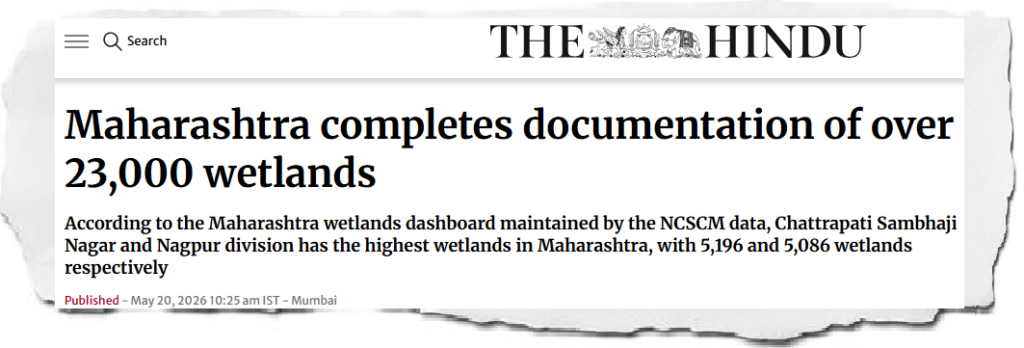
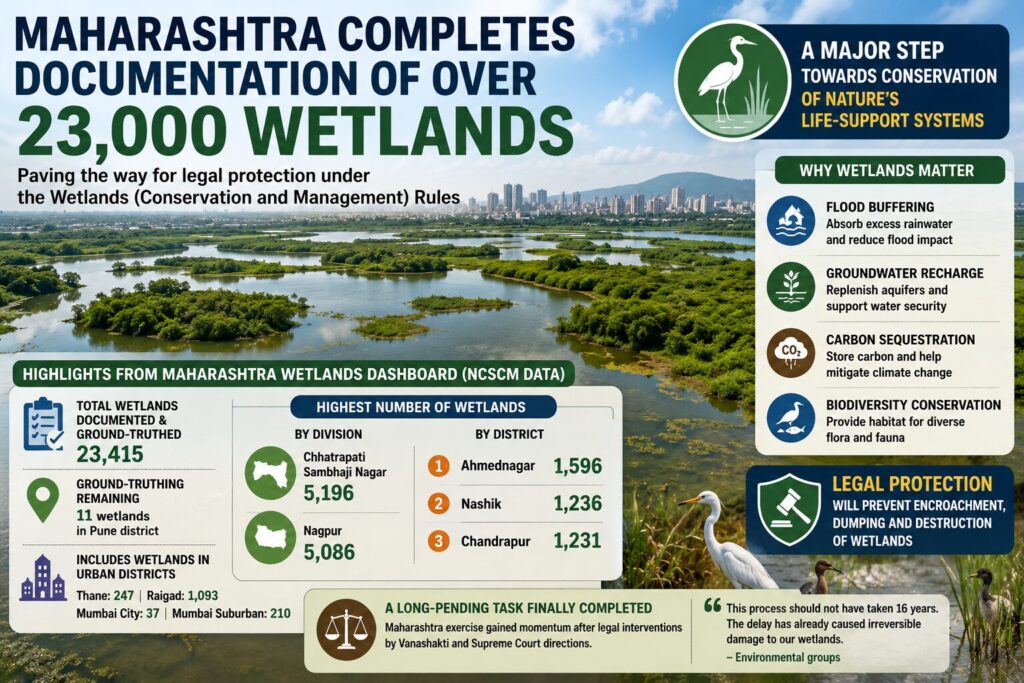
The National Centre for Sustainable Coastal Management (NCSCM) has completed documentation and ground-truthing of 23,415 wetlands in Maharashtra, with only 11 wetlands in Pune pending verification. The exercise paves the way for legal notification and protection of these wetlands under the Wetlands (Conservation and Management) Rules. The initiative gained momentum following judicial interventions and concerns over increasing wetland degradation and encroachments.
UPSC Relevance
Prelims:
Wetlands (Conservation and Management) Rules, Ramsar Convention, National Wetland Atlas, NCSCM, ecological importance of wetlands.
Mains:
GS I: Geography, Wetlands and environmental geography,
GS III Environment and Conservation, Climate Change, Disaster Management, Urbanisation and Sustainable Development
Background
Wetlands are ecosystems where water remains present either permanently or seasonally, creating unique ecological conditions that support diverse biological communities. They include marshes, lakes, rivers, floodplains, estuaries, mangroves, lagoons and peatlands.
India possesses extensive wetland ecosystems due to its diverse geography and climatic conditions. However, rapid urbanisation, infrastructure expansion and changes in land use have increasingly threatened these ecosystems.
Maharashtra’s wetland documentation exercise forms part of broader national efforts initiated through the National Wetlands Inventory and Assessment (NWIA) programme and the National Wetland Atlas. The completion of documentation and ground verification is expected to provide legal protection to these ecosystems and prevent their destruction.
The exercise has acquired significance because many wetlands remain un-notified and therefore vulnerable to reclamation, debris dumping, encroachment and infrastructure projects.
Understanding Ground-Truthing
Ground-truthing refers to the process of physically verifying satellite imagery and remote sensing data through field-based surveys.
The process includes:
Verification of boundaries: Determining the actual geographical extent of wetlands.
Assessment of ecological condition: Evaluating vegetation, biodiversity and hydrological characteristics.
Land-use assessment: Identifying human activities and encroachments affecting wetlands.
Validation of satellite observations: Ensuring that remote sensing data accurately reflects on-ground conditions.
Ground-truthing becomes an essential prerequisite before wetlands can receive legal notification and protection under environmental regulations.
Importance of Wetlands
Flood buffering
Wetlands act as natural sponges that absorb excess rainwater and release it slowly, thereby reducing flood intensity and protecting nearby settlements.
Recent urban flooding events demonstrate the consequences of wetland degradation and encroachment.
Groundwater recharge
Wetlands facilitate infiltration of water into underground aquifers and help maintain groundwater levels.
This function becomes particularly important in drought-prone and water-stressed regions.
Carbon sequestration
Wetlands capture and store significant quantities of carbon in vegetation and soils, thereby contributing to climate change mitigation.
Mangroves and peatlands are particularly effective carbon sinks.
Biodiversity conservation
Wetlands support a rich diversity of flora and fauna, including migratory birds, fish species, amphibians, reptiles and aquatic plants.
Several endangered species depend upon wetland ecosystems for their survival.
Livelihood support
Wetlands contribute to livelihoods through fisheries, agriculture, tourism and other ecosystem services.
Millions of people directly depend on wetland resources for economic sustenance.
Legal and Institutional Framework for Wetland Conservation
Constitutional provisions
Article 48A: Directs the State to protect and improve the environment and safeguard forests and wildlife.
Article 51A(g): Makes environmental protection a Fundamental Duty of citizens.
Wetlands (Conservation and Management) Rules, 2017
The Rules replaced the Wetlands Rules of 2010 and seek to regulate activities affecting wetland ecosystems.
Major provisions include:
- Prohibition of reclamation and conversion of wetlands
- Restriction on waste dumping and pollution
- Creation of State Wetland Authorities
- Preparation of wetland inventories and management plans
National Wetlands Inventory and Assessment (NWIA)
It was initiated to identify and map wetlands through satellite-based remote sensing technologies.
National Wetland Atlas
Prepared by the Space Applications Centre under ISRO, the Atlas provides information on the distribution and status of wetlands across India.
The decadal version launched in 2020 tracks changes in wetland ecosystems over time.
Ramsar Convention on Wetlands
India became a signatory to the Ramsar Convention in 1982.
Its objectives include: Conservation of wetlands, Sustainable or wise use of wetland resources, International cooperation on wetland protection
India currently has one of the highest numbers of Ramsar sites globally.
National Centre for Sustainable Coastal Management (NCSCM)
NCSCM functions under the Ministry of Environment, Forest and Climate Change (MoEFCC).
Its responsibilities include: Coastal and wetland research, Ecological mapping and monitoring, Conservation planning, Ground verification exercises
Challenges
Delayed identification and notification
Several wetlands remain un-notified years after their identification, leaving them vulnerable to degradation and encroachments. Maharashtra’s exercise itself experienced considerable delays.
Urbanisation and infrastructure expansion
Wetlands are often treated as vacant land suitable for construction activities, resulting in reclamation and ecological destruction.
Weak institutional coordination
Multiple agencies exercise overlapping jurisdictions over wetlands, leading to fragmented governance and weak implementation.
Encroachments and pollution
Illegal dumping of debris, sewage discharge and industrial pollution continue to threaten wetland ecosystems.
Inadequate public awareness
Limited understanding of the ecological importance of wetlands reduces citizen participation in conservation efforts.
Climate change pressures
Changing rainfall patterns and extreme weather events can alter wetland hydrology and adversely affect ecological functioning.
Way Forward
Accelerate legal notification of wetlands
States should complete the process of legal notification within fixed timelines to provide formal protection against encroachments.
Strengthen monitoring through technology
Advanced technologies such as GIS mapping, satellite monitoring and drones should complement field verification exercises.
Integrate wetlands into urban planning
Urban master plans and infrastructure projects should treat wetlands as ecological assets and critical urban infrastructure.
Encourage community-based conservation
Local communities should be actively involved in wetland management, monitoring and restoration activities.
Improve institutional coordination
State Wetland Authorities, local bodies and environmental agencies should function through integrated governance mechanisms.
Promote restoration of degraded wetlands
Restoration programmes should focus on removing encroachments, restoring natural hydrology and rehabilitating habitats.
Conclusion
Wetlands are ecological assets that provide essential environmental services and support sustainable development. Maharashtra’s completion of documentation and ground verification of over 23,000 wetlands marks a significant step toward strengthening wetland governance in India. However, mapping alone is insufficient. Effective conservation requires timely legal notification, institutional coordination and active public participation to ensure long-term ecological security.
Practice Questions
Prelims Question 1
With reference to wetlands in India, consider the following statements:
- Wetlands help in groundwater recharge and flood mitigation.
- Wetlands are protected under the Wetlands (Conservation and Management) Rules, 2017.
- All wetlands identified under the National Wetland Atlas automatically receive legal protection.
Which of the statements given above are correct?
(a) 1 and 2 only
(b) 2 and 3 only
(c) 1 and 3 only
(d) 1, 2 and 3
Correct Answer: (a)
Explanation: Statements 1 and 2 are correct. Wetlands perform important ecological functions and are regulated under the Wetland Rules, 2017. Mere identification in the National Wetland Atlas does not automatically grant legal protection.
Prelims Question 2
Consider the following:
- National Wetland Atlas
- Ramsar Convention
- National Centre for Sustainable Coastal Management (NCSCM)
Which of the above are associated with wetland conservation?
(a) 1 only
(b) 2 and 3 only
(c) 1 and 2 only
(d) 1, 2 and 3
Correct Answer: (d)
Explanation: All three are associated with wetland identification, conservation and management.
Mains Question
- Wetlands are increasingly being recognised as ecological infrastructure rather than wastelands. Examine their significance in climate resilience and sustainable development.
- Discuss the major challenges associated with wetland conservation in India. Suggest measures for improving wetland governance and management.
Tell Google you want more of this.
Add Anantam IAS as a preferred sourceOne tap, and this site shows up more often in your own Top Stories, AI Overviews and AI Mode. Remove it any time.