Why in News?
Meta released Muse Glimmer on 10 August 2026 as a 30-billion-parameter, open-weight multimodal model designed for local agentic work on consumer-grade hardware.
- Meta’s official release describes Muse Glimmer as a dense 30B model that accepts text and images and produces text, with an emphasis on planning, tool use, coding, result checking and recovery from failed steps.
- The official model materials specify a context window of about 131,000 tokens and support for more than 100 languages, making the model relevant to multilingual and long-context applications.
- Meta provides model weights under the Apache License 2.0, a permissive software licence that allows use, modification and distribution subject to its notice, copyright and patent-related terms.
- Meta says a roughly four-bit version keeps the language-model weights below 20 GB, allowing deployment within a 24 GB memory envelope while leaving room for the cache, perception encoder and decoding components.
- The accompanying official model card and research note document intended agentic uses, technical characteristics, evaluations and limitations. These disclosures help scrutiny, but they do not by themselves independently verify every benchmark or downstream deployment.
- Downloading weights can let universities, start-ups and public institutions run or adapt a model without sending every prompt to the provider’s cloud, improving experimentation, data control and bargaining power.
- The same adaptability weakens a provider’s technical control after release. Fine-tuning, tool access and autonomous execution can change the risk profile far beyond the behaviour tested in the original model card.
- For India, the issue connects digital public infrastructure, domestic AI capacity, language inclusion, competition policy, data protection, cyber security and public procurement rather than fitting into a single ministry or law.
UPSC Relevance
Prelims Relevance
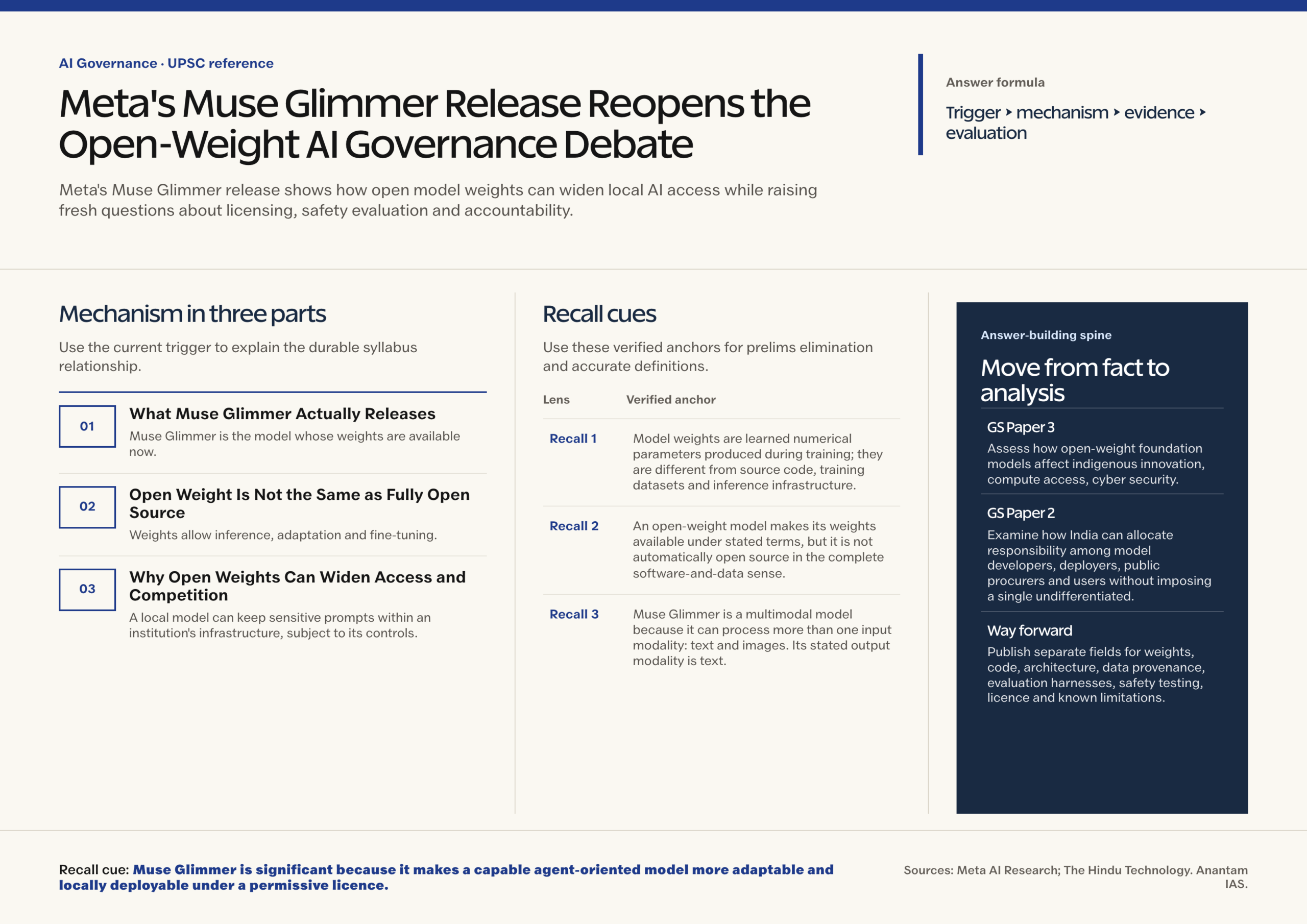
- Model weights are learned numerical parameters produced during training; they are different from source code, training datasets and inference infrastructure.
- An open-weight model makes its weights available under stated terms, but it is not automatically open source in the complete software-and-data sense.
- Muse Glimmer is a multimodal model because it can process more than one input modality: text and images. Its stated output modality is text.
- A context window is the amount of tokenized information a model can consider in one interaction; it is not the same as factual memory or guaranteed accuracy.
- Quantization reduces the numerical precision used to represent model parameters, usually lowering memory and compute requirements with a possible performance trade-off.
- Speculative decoding uses a smaller drafting component to propose token blocks that the main model checks, aiming to improve inference speed without simply accepting unverified draft output.
Mains Relevance
GS Paper 3
- Assess how open-weight foundation models affect indigenous innovation, compute access, cyber security, research capacity and the diffusion of dual-use capabilities.
- Explain the technical-policy distinction among open weights, open-source software, open training data and reproducible AI research.
GS Paper 2
- Examine how India can allocate responsibility among model developers, deployers, public procurers and users without imposing a single undifferentiated compliance burden.
- Connect AI governance with privacy, non-discrimination, consumer protection, competition, administrative accountability and access in Indian languages.
Essay
- Technological openness can distribute the capacity to innovate, but public accountability must travel with the capacity to act.
Background and Context
What Muse Glimmer Actually Releases
The governance analysis must begin with the exact release rather than the loose label of open AI.
- Muse Glimmer is the model whose weights are available now. Meta describes it as a dense, approximately 30-billion-parameter model optimized for local agentic workloads.
- Its input capabilities cover text and images, while the output is text. It may analyse an image within an agent workflow, but that does not make it an image-generation model.
- The release targets planning, coding, tool calling, verification and recovery. These are system-level tasks in practice, since a usable agent also needs a harness, permissions, tools and an execution environment.
- Meta’s four-bit deployment claim concerns memory efficiency. Quantization can make local use practical, but local deployment still requires compatible software, adequate hardware, security configuration and operator competence.
- The announced future release of Muse Spark 1.2 weights is a separate proposition. Policy notes should distinguish an accomplished release from a stated future plan.
Open Weight Is Not the Same as Fully Open Source
Openness has several layers, and each layer supports a different form of scrutiny or reuse.
- Weights allow inference, adaptation and fine-tuning. Code shows how a system is implemented. Training data helps assess provenance, consent, bias and reproducibility. None automatically supplies the others.
- The Apache 2.0 licence gives broad permissions over the released material and contains notice and patent terms. The licence does not certify that training data were lawfully sourced, that outputs are accurate or that a deployment.
- A release can be open-weight yet incomplete for scientific reproduction if the full dataset, filtering process, training recipe, compute configuration and evaluation harness are unavailable.
- The better policy vocabulary is a disclosure matrix: weights, architecture, code, data documentation, evaluation methods, licence, security controls and downstream restrictions should each be stated separately.
- This avoids treating openness as a binary badge and lets regulators or public buyers compare models on evidence relevant to the intended use.
Why Open Weights Can Widen Access and Competition
Open weights change who can experiment, where inference happens and how much leverage users retain over a provider.
- A local model can keep sensitive prompts within an institution’s infrastructure, subject to its controls. This may help research labs, hospitals, courts or firms with confidentiality needs, though suitability must be tested for each use.
- Developers can adapt a released model for Indian languages, domain terminology and low-connectivity settings without waiting for every feature to be offered through a foreign cloud interface.
- Multiple hosts and derivative models can reduce vendor lock-in and create price and service competition. Open access to weights can also make independent red-teaming and comparative evaluation easier.
- Access to weights does not erase the compute divide. Training frontier systems, producing high-quality datasets and running large deployments still require capital, chips, energy and specialist talent.
- India’s policy goal should be usable capability: shared compute, benchmark infrastructure, language datasets, skilling and procurement standards, not model downloads alone.
Risk Moves from the Provider to the Deployment Ecosystem
Once weights can be copied and modified, governance must follow the chain from original developer to adapter, host, deployer and end user.
- Open weights can support beneficial security research, but modified systems may also remove safeguards or automate harmful tasks. The relevant question is not whether openness is safe in the abstract, but which capability, actor and deployment.
- Agentic systems deserve special attention because tool permissions can turn a mistaken answer into an external action. Least-privilege access, sandboxing, human approval for high-impact steps and tamper-resistant logs become central controls.
- A model card is a baseline disclosure. Independent evaluation should test local languages, hallucination, bias, cyber misuse, tool-use reliability and performance after quantization or fine-tuning.
- Responsibility should track control. A base-model developer controls training and release documentation; a fine-tuner controls adaptation; a deployer controls data, tools, interface, monitoring and the decision context.
- Rules that treat every small researcher like a frontier developer could entrench large firms. A risk-tiered approach can protect research while placing stronger duties on high-capability or high-impact deployments.
Way Forward
Use a Layered Disclosure Standard
- Publish separate fields for weights, code, architecture, data provenance, evaluation harnesses, safety testing, licence and known limitations.
- Make model cards versioned and machine-readable so updates, derivative models and withdrawn claims can be traced.
- Combine capability testing with deployment factors such as tool access, user scale, sensitive data, autonomy, sector and reversibility of harm.
- Create accredited independent testing capacity for Indian languages, cyber safety, bias, hallucination and tool-use reliability.
Conclusion
- Muse Glimmer is significant because it makes a capable agent-oriented model more adaptable and locally deployable under a permissive licence.
- India’s strongest response is neither a blanket ban nor blind celebration.
UPSC Practice Questions
Prelims MCQ 1
With reference to open-weight artificial-intelligence models, consider the following statements:
- Access to model weights automatically includes access to the complete training dataset.
- Quantization can reduce the memory needed to run a model.
- A model card is a disclosure document rather than a government safety certification.
How many of the above statements are correct?
(a) Only one (b) Only two (c) All three (d) None
Answer: (b) Only two
Explanation:
Statements 2 and 3 are correct. Quantization uses lower-precision representations to reduce memory needs, and a model card communicates documented characteristics and limits. Releasing weights does not automatically release the training dataset.
Prelims MCQ 2
Which one of the following best describes speculative decoding in a large language model?
(a) Encrypting model weights before they are downloaded (b) Replacing all model evaluation with human voting (c) Letting a smaller component propose tokens that a larger model verifies (d) Converting text prompts into training data without consent
Answer: (c) Letting a smaller component propose tokens that a larger model verifies
Explanation:
Speculative decoding seeks faster inference by allowing a draft component to propose token sequences while the main model verifies which proposals can be accepted.
UPSC Mains Questions
- Open-weight AI can democratize innovation, yet openness alone does not guarantee transparency or safety. Discuss with reference to the release of Meta’s Muse Glimmer.
- How should India distribute accountability among foundation-model developers, fine-tuners and deployers in an agentic AI ecosystem? Suggest a risk-based framework.
Sources: Meta AI Research and The Hindu Technology.
Frequently Asked Questions
What did Meta release in August 2026?
Meta released the weights for Muse Glimmer, a dense 30-billion-parameter multimodal model designed for agentic tasks and local deployment. Meta also said it planned to release Muse Spark 1.2 weights later. The completed Glimmer release and the future Spark plan.
Is Muse Glimmer open source?
It is safest to call Muse Glimmer open-weight. Its weights are available under Apache 2.0, but access to weights does not automatically mean that all training data, training code, filtering decisions and compute details needed for full reproduction are available.
What does the Apache License 2.0 permit?
Apache 2.0 broadly permits use, modification and redistribution of licensed material, including commercial use, subject to conditions such as preserving required notices and marking modified files. It also contains an express patent licence. It does not certify a model’s accuracy.
Why does quantization matter for AI access?
Quantization represents weights at lower numerical precision, cutting memory and often reducing compute needs. Meta says its roughly four-bit Muse Glimmer configuration keeps language-model weights below 20 GB for a 24 GB memory envelope. Actual usability still depends on hardware.
Why are agentic models a distinct governance concern?
An agentic system can plan, call tools and take actions across multiple steps. A wrong answer may become an external action if the system has email, code, payment or database permissions. Least-privilege access, sandboxing, approval gates, logs and incident response.
Tell Google you want more of this.
Add Anantam IAS as a preferred sourceOne tap, and this site shows up more often in your own Top Stories, AI Overviews and AI Mode. Remove it any time.