Why in News?
The National Company Law Appellate Tribunal (NCLAT) has held that insolvency proceedings cannot be used to shield assets allegedly linked to money laundering. The principal bench, ruling in the liquidation of Siddhi Vinayak Logistics Ltd, dismissed the liquidator’s plea to recover funds and assets seized by the Enforcement Directorate (ED), as reported in the Indian Express Explained section.
The tribunal observed that the Insolvency and Bankruptcy Code (IBC) was never intended to become a “holy ganges” that could wash away a corporate debtor’s “sin of criminality” under the Prevention of Money Laundering Act (PMLA). It held that the two statutes operate in distinct spheres — the IBC deals with legitimately acquired assets, while the PMLA tracks proceeds of crime.
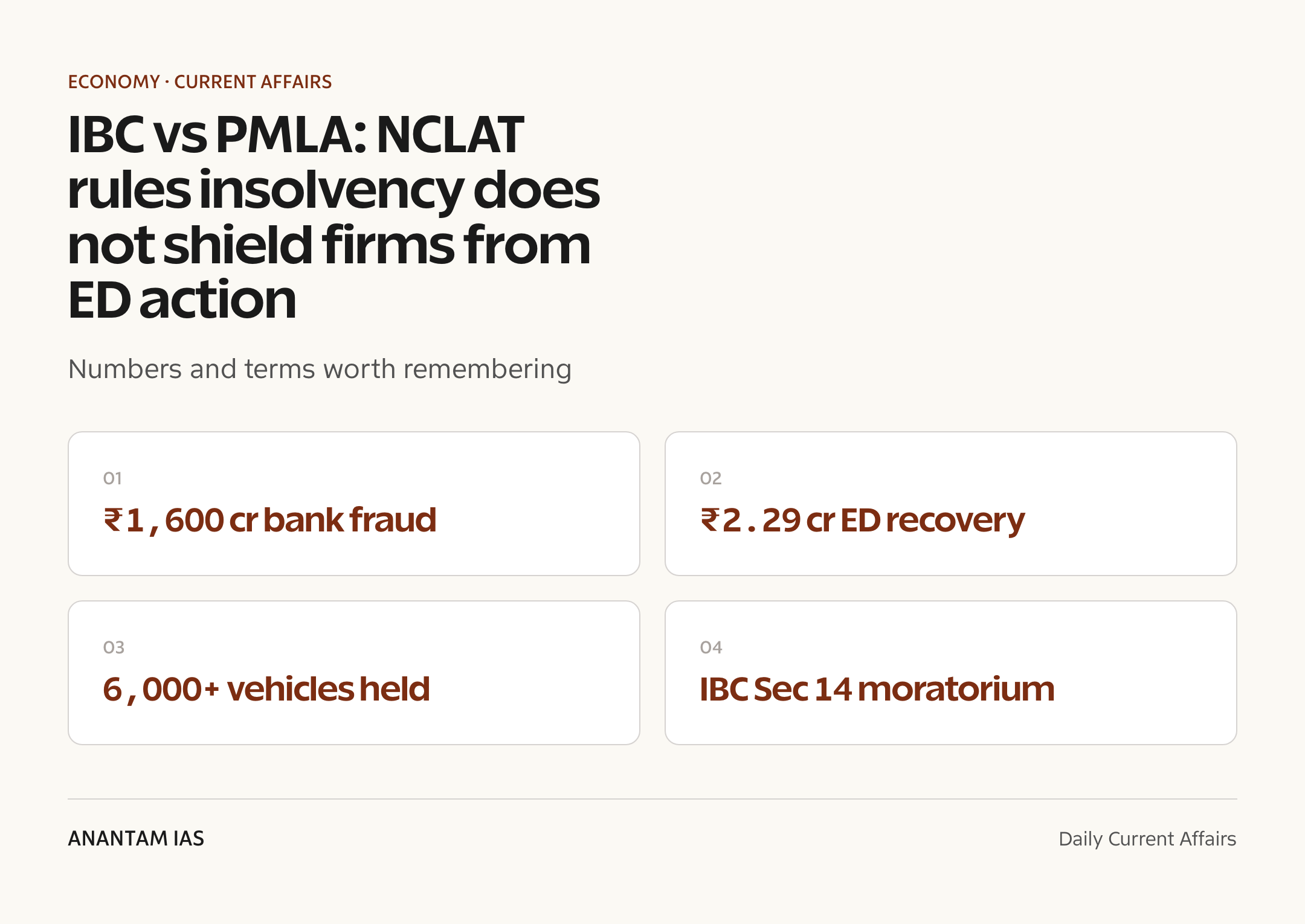
- The company faced ED investigation over FIRs alleging bank fraud and loan diversion exceeding ₹1,600 crore.
- The ED attached assets BEFORE the Corporate Insolvency Resolution Process (CIRP) began in September 2017, and later withdrew ₹2.29 crore from a company account during the moratorium.
- In 2019 the ED attached over 6,000 vehicles of the logistics firm; the company eventually went into liquidation.
- The liquidator argued the withdrawal violated the Section 14 IBC moratorium; the NCLAT disagreed.
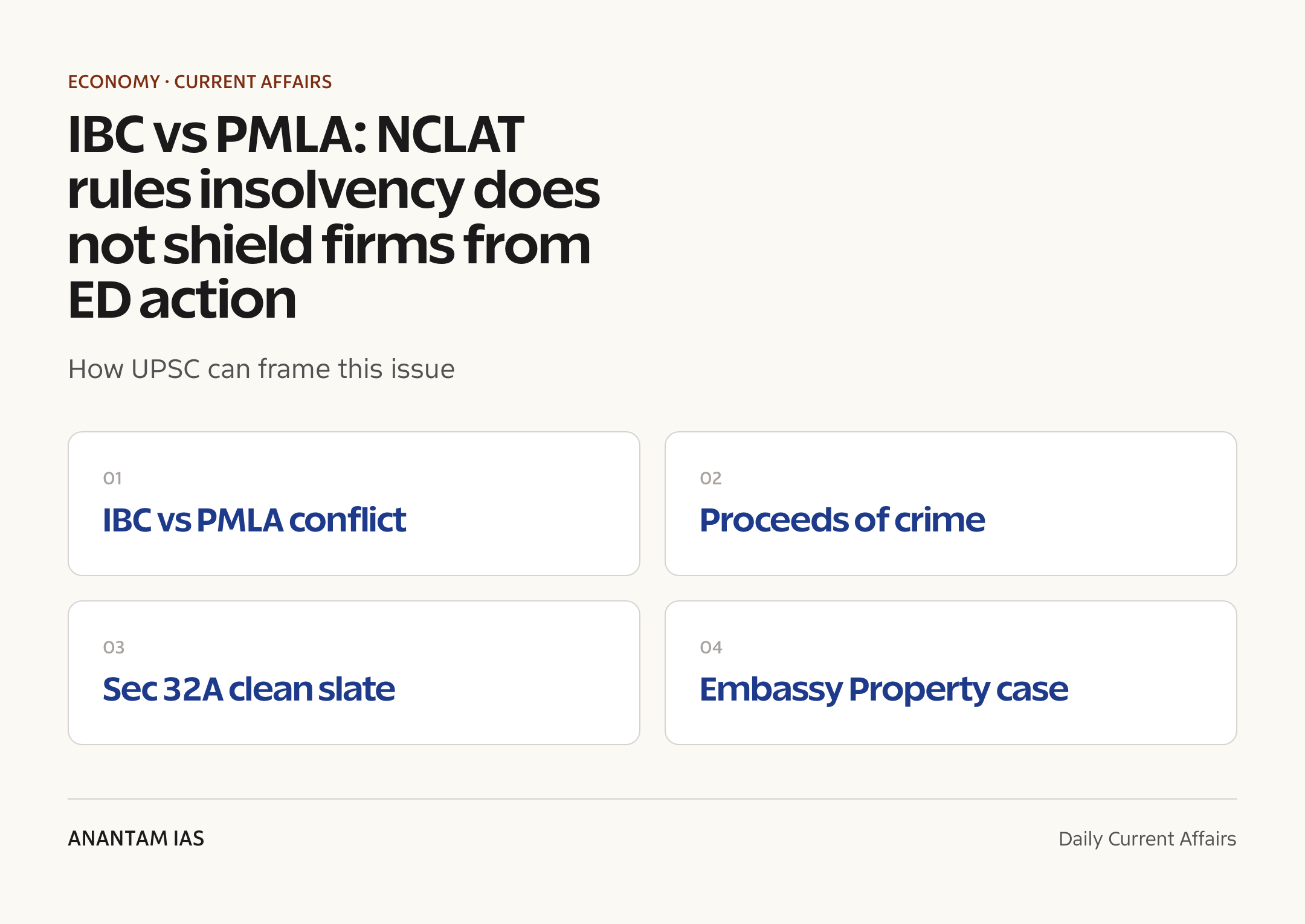
- The bench framed the dispute as “IBC vs PMLA” — a clash of statutes, not parties — and ruled that ED attachments of alleged proceeds of crime survive the moratorium.
The development matters in the context of:
- The friction between the IBC moratorium and PMLA attachment powers is a recurring fault line in India’s insolvency ecosystem — it decides how much creditors recover in fraud-hit cases.
- It also clarifies jurisdictional boundaries — the NCLT/NCLAT cannot review ED attachment orders, which must be contested only before PMLA authorities.
UPSC Relevance
Prelims Relevance
- IBC, 2016 — adjudicating authority is the NCLT; appeals lie to the NCLAT, then the Supreme Court.
- Section 14, IBC — moratorium barring suits and proceedings against the corporate debtor once CIRP begins.
- Section 32A, IBC (2020) — “clean slate”: prior-offence liability ceases once a resolution plan is approved for new, unconnected management.
- PMLA, 2002 — enforced by the ED (Department of Revenue, Ministry of Finance); provisional attachment of proceeds of crime is confirmed by an Adjudicating Authority.
- Section 41, PMLA — bars civil courts from matters the PMLA authorities are empowered to decide.
- Proceeds of crime — property derived, directly or indirectly, from a scheduled offence.
- P. Mohanraj v. Shah Brothers Ispat (2021) — coercive recovery during the moratorium is impermissible.
- Embassy Property Developments case (2019) — NCLT’s jurisdiction is confined to the IBC’s own working; it cannot review other statutory authorities.
- Manish Kumar v. Union of India (2021) — upheld the constitutional validity of Section 32A.
- IBBI — regulator for insolvency professionals and processes under the IBC.
Mains Relevance
GS Paper 3
- IBC’s creditor-recovery objective vs the state’s interest in confiscating proceeds of crime — “compromisable” recovery against “uncompromisable” national interest.
- Impact of parallel ED attachments on resolution timelines, haircuts and the bankability of fraud-hit debtors.
GS Paper 2
- Tribunals and jurisdictional discipline: NCLT/NCLAT’s statutory limits (Embassy Property doctrine) and the Section 41 PMLA bar.
- Harmonising two special statutes — legislative silence on the IBC-PMLA interface and the case for clarification by Parliament.
Essay
- Rule of law vs economic efficiency — should the pursuit of ill-gotten wealth yield to speedy commercial resolution?
- Institutions as gatekeepers: how credible enforcement against economic crime underpins trust in markets.
Background and Context
The Siddhi Vinayak Logistics case: facts in brief
The dispute arose from a Surat-based logistics company that faced money-laundering attachment before and during its insolvency.
- Siddhi Vinayak Logistics Ltd came under ED investigation over FIRs alleging bank fraud and diversion of loan funds exceeding ₹1,600 crore.
- The ED provisionally attached its assets and told customers not to release payments — all before insolvency began.
- The company entered CIRP in September 2017, triggering the Section 14 moratorium.
- During the moratorium, the ED confirmed the attachment and withdrew ₹2.29 crore from a company bank account; in 2019 it attached over 6,000 vehicles.
- The Appellate Tribunal under PMLA set aside the original 2017 attachment; a challenge to that order is pending in the Bombay High Court.
- Resolution failed and the company went into liquidation; the liquidator argued the ED’s withdrawal “constituted unlawful depletion of the insolvency estate”.
IBC 2016 and the Section 14 moratorium
The Insolvency and Bankruptcy Code is India’s consolidated law for time-bound resolution of corporate distress.
- The IBC, 2016 replaced a fragmented regime (SICA, BIFR, Companies Act winding-up) with a single creditor-driven process overseen by the NCLT and regulated by the IBBI; CIRP is time-bound at 180 days, with a 330-day outer limit including litigation.
- Section 14(1)(a) imposes a moratorium once CIRP begins: it bars the institution or continuation of suits or proceedings against the corporate debtor, including execution of any judgment or order.
- Its purpose is collective resolution: freezing the debtor’s position so creditors are dealt with together, not through a race of individual recoveries.
- In P. Mohanraj v. Shah Brothers Ispat (2021), the Supreme Court held coercive recovery actions during the moratorium impermissible — the liquidator’s central authority.
- Section 32A (2020 amendment, upheld in Manish Kumar v. Union of India, 2021) gives the debtor a clean slate: prior-offence liability ceases once a resolution plan is approved for new, unconnected management.
PMLA 2002 and the ED's attachment powers
The Prevention of Money Laundering Act arms the state to track, attach and eventually confiscate ill-gotten wealth.
- The PMLA, 2002 (in force from 2005) criminalises laundering of proceeds of crime — property derived directly or indirectly from a scheduled offence.
- The Enforcement Directorate, under the Department of Revenue, Ministry of Finance, investigates and enforces the Act.
- Under Section 5, the ED may provisionally attach suspected proceeds of crime; an Adjudicating Authority confirms it, an Appellate Tribunal hears appeals, and confirmed cases move towards confiscation.
- Section 41 bars civil courts from matters the Director, Adjudicating Authority or Appellate Tribunal is empowered to decide — the ED’s shield against NCLT/NCLAT scrutiny here.
- The ED contended its proceedings concerned proceeds of crime under a separate statute altogether, beyond the jurisdiction of the insolvency tribunals.
- In Vijay Madanlal Choudhary v. Union of India (2022), the Supreme Court broadly upheld the ED’s attachment, arrest and search powers under the PMLA.
What the NCLAT actually held
The principal bench framed the case as a clash of statutes and drew a bright line between legitimate assets and criminal wealth.
- The bench said the dispute “is not appellant vs the Enforcement Directorate but IBC vs PMLA, when both the legislations are in action”.
- It distinguished legitimately acquired assets — which the IBC pools and sells to repay creditors — from assets sourced “by and out of a crime”, where the PMLA prevails.
- Parliament “did not legislate IBC with an intent to create… a mechanism for legitimising ill-gotten wealth“; PMLA attachment is a framework for “tracking and hunting” such assets towards confiscation.
- It read Section 14 narrowly: the moratorium covers only proceedings that add to the company’s civil debt; penal actions of a public-law nature are untouched, even if they shrink the creditors’ pool.
- Creditor recovery is “compromisable” — every creditor accepts haircuts in insolvency — whereas “national interest at all times remains uncompromisable”.
- On Section 32A, the bench declined to engage: the clean-slate immunity operates only on a successful resolution, and this company had gone into liquidation.
- On jurisdiction, relying on Embassy Property Developments v. State of Karnataka, it held ED attachments must be contested before PMLA authorities alone.
Why the IBC-PMLA friction persists
Neither statute expressly resolves what happens when a money-laundering attachment collides with an insolvency estate.
- Both laws carry non-obstante (overriding) clauses — Section 238 IBC and Section 71 PMLA — each claiming primacy, with no express rule for their mutual conflict.
- Benches and courts have pulled in different directions: some rulings prioritised the resolution objective and estate integrity, others protected ED attachments as a distinct public-law track.
- Section 32A settled one scenario — a successful plan wipes prior offence liability — but is silent on liquidation, pre-CIRP attachments and interim depletion of the estate: the exact gaps this case exposed.
- For lenders the stakes are concrete: attached assets are carved out of the estate, deepening haircuts in fraud-driven insolvencies.
- For enforcement, letting the moratorium freeze attachments would let promoters route tainted assets through insolvency and emerge laundered — the “holy ganges” risk the NCLAT flagged.
- The ruling strengthens the ED’s hand but leaves the boundary to case-by-case litigation until Parliament clarifies the interface.
Significance for the insolvency ecosystem
The decision recalibrates expectations for creditors, resolution professionals and bidders in fraud-tainted insolvencies.
- Resolution professionals and liquidators cannot count attached assets as part of the estate; PMLA overhangs must be disclosed upfront.
- Resolution applicants get a clearer incentive: the Section 32A clean slate rewards a successful resolution plan, while liquidation offers no immunity.
- Financial creditors — mostly public-sector banks in large fraud accounts — face deeper haircuts where the ED has attached core assets.
- The judgment reinforces tribunal discipline and reduces forum shopping between the NCLT and PMLA authorities.
- Track related developments on the Anantam IAS current affairs digests, and read the primary statutes on the IBBI website and the Enforcement Directorate portal.
Way Forward
Statutory clarity
- Parliament should codify the IBC-PMLA interface — the fate of pre-CIRP attachments, treatment during liquidation, and time-bound PMLA adjudication for companies in insolvency.
- Extend a calibrated Section 32A logic to liquidation sales to bona fide third-party buyers, so clean assets find buyers without legitimising crime.
Institutional coordination
- A formal ED-IBBI-RBI protocol for fraud-hit debtors — shared asset registries and early disclosure of attachments to resolution professionals.
- Strengthen PMLA Adjudicating Authority capacity so attachment appeals don’t outlast the insolvency process itself.
A definitive Supreme Court ruling on the IBC-PMLA overlap would settle the field faster than piecemeal tribunal orders.
Conclusion
The NCLAT ruling draws a principled line: the IBC exists to resolve honest business failure, not to launder the proceeds of dishonest enterprise. By reading the Section 14 moratorium as a shield for civil liabilities — not against penal action targeting proceeds of crime — the tribunal kept both statutes in their own spheres.
But the decision also exposes the cost of legislative silence. Creditors bear deeper haircuts, and the boundary between legitimate and tainted assets will be fought case by case. A statutory fix to the IBC-PMLA interface is the durable answer.
UPSC Practice Questions
Prelims MCQ 1
With reference to the Insolvency and Bankruptcy Code (IBC), 2016, consider the following statements:
- Section 14 of the IBC imposes a moratorium barring the institution or continuation of suits and proceedings against the corporate debtor once the insolvency resolution process begins.
- Section 32A of the IBC extinguishes the corporate debtor’s liability for prior offences only after a resolution plan is successfully approved, and does not apply where the company goes into liquidation.
- Appeals against orders of the National Company Law Tribunal (NCLT) in insolvency matters lie directly to the Supreme Court.
How many of the above statements are correct?
(a) Only one (b) Only two (c) All three (d) None
Answer: (b) Only two
Explanation:
Statements 1 and 2 are correct — Section 14 freezes suits against the corporate debtor, and the Section 32A clean slate operates only on a successful resolution, not in liquidation. Statement 3 is incorrect: appeals from the NCLT lie to the NCLAT, and only then to the Supreme Court.
Prelims MCQ 2
Under the Prevention of Money Laundering Act (PMLA), 2002, a provisional attachment of property suspected to be proceeds of crime is confirmed by which of the following?
(a) The Special Court trying the scheduled offence (b) The Adjudicating Authority constituted under the PMLA (c) The National Company Law Tribunal (d) The jurisdictional High Court
Answer: (b) The Adjudicating Authority constituted under the PMLA
Explanation:
The ED provisionally attaches suspected proceeds of crime under Section 5 of the PMLA; the attachment must be confirmed by the Adjudicating Authority, with appeals lying to the Appellate Tribunal. Section 41 bars civil courts — and, per the NCLAT, insolvency tribunals — from interfering with this chain.
UPSC Mains Questions
- The IBC and the PMLA pursue distinct public objectives that can collide in fraud-hit insolvencies. In the light of recent NCLAT jurisprudence, examine the conflict between the IBC moratorium and ED attachment powers, and suggest a statutory resolution.
- “Creditor recovery is compromisable, but national interest is not.” Critically analyse this framing of the balance between speedy resolution of stressed assets and enforcement against economic offences in India.
- Discuss how jurisdictional discipline among specialised tribunals — as reflected in the Embassy Property doctrine — affects the efficiency and credibility of India’s insolvency framework.
Source: Indian Express Explained.
Frequently Asked Questions
What did the NCLAT rule on IBC vs PMLA?
The NCLAT held that the insolvency process cannot shield assets allegedly linked to money laundering. ED attachments of proceeds of crime under the PMLA survive the IBC moratorium, because the two laws operate in distinct spheres — the IBC pools legitimate assets for creditors, while the PMLA targets criminal wealth for confiscation.
What is the Section 14 moratorium under the IBC?
Once the corporate insolvency resolution process begins, Section 14 bars the institution or continuation of suits and proceedings against the corporate debtor. Its purpose is collective resolution — freezing the debtor’s position so all creditors are dealt with together. The NCLAT read it narrowly, covering only proceedings that add to the company’s civil debt.
What are proceeds of crime under the PMLA?
Proceeds of crime means property derived or obtained, directly or indirectly, from criminal activity relating to a scheduled offence under the PMLA, 2002. The Enforcement Directorate can provisionally attach such property; an Adjudicating Authority confirms the attachment, and confirmed cases move towards confiscation to the Central Government.
What is Section 32A of the IBC?
Section 32A, inserted in 2020 and upheld in Manish Kumar v. Union of India (2021), gives a corporate debtor a clean slate: its liability for offences committed before insolvency ceases once a resolution plan is approved for new, unconnected management. The NCLAT clarified it does not apply where the company goes into liquidation.
Why could the NCLAT not review the ED’s attachment?
Relying on Embassy Property Developments v. State of Karnataka, the tribunal held that the NCLT’s jurisdiction extends only as far as the IBC’s own working requires. Section 41 of the PMLA separately bars civil courts from matters the PMLA authorities are empowered to decide, so ED attachments must be contested before PMLA forums alone.
What was the Siddhi Vinayak Logistics case about?
The logistics company faced ED investigation over alleged bank fraud and diversion of loans exceeding ₹1,600 crore. The ED attached its assets before insolvency began in September 2017, later withdrew ₹2.29 crore from its account, and attached over 6,000 vehicles in 2019. The liquidator’s plea to recover these was dismissed by the NCLAT.
Tell Google you want more of this.
Add Anantam IAS as a preferred sourceOne tap, and this site shows up more often in your own Top Stories, AI Overviews and AI Mode. Remove it any time.