

Why in News?
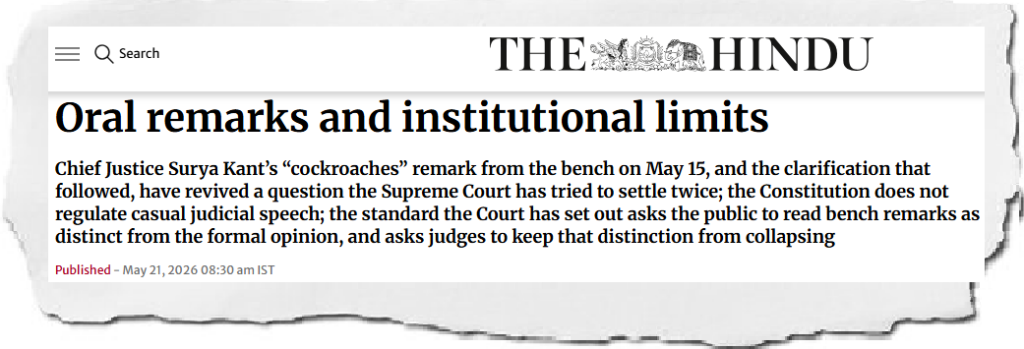
Recent oral remarks made by Chief Justice Surya Kant during proceedings related to the designation of senior advocates, and the subsequent clarification issued by the Supreme Court, have revived debate on the standards governing judicial conduct and courtroom speech. The issue raises questions regarding judicial restraint, ethical standards, institutional dignity, and the distinction between oral observations and formal judgments.
UPSC Relevance:
Prelims:
Judicial ethics, constitutional bodies, Restatement of Values of Judicial Life, Article 50;
Mains:
GS II: Judiciary, Constitutional institutions, Judicial accountability and ethics
Background/Context
Judicial proceedings often involve active interactions between judges and lawyers. During hearings, judges frequently make observations, pose hypothetical questions, or express concerns to test legal arguments and understand the implications of different positions.
However, oral observations differ fundamentally from written judgments. While judgments become part of binding legal reasoning, oral remarks are generally spontaneous and exploratory in nature.
The recent controversy has renewed discussion regarding the limits of judicial speech and whether judges should exercise greater caution in public-facing courtrooms where every observation can instantly become part of the public discourse.
The issue becomes more important in an era of real-time media reporting and social media amplification, where oral remarks can shape public perceptions even before the final judgment is delivered.
Judicial Standards Governing Oral Remarks
India has established certain conventions and principles to guide judicial conduct and preserve institutional credibility.
Restatement of Values of Judicial Life (1997)
The Full Court of the Supreme Court adopted the Restatement of Values of Judicial Life in 1997 as a code of ethics for judges.
Key features include:
- Judges should maintain independence, impartiality and dignity in judicial conduct.
- Judges should avoid entering public controversies and political debates.
- Language used in court should maintain decorum and institutional respect.
- Judicial conduct should reinforce public confidence in the justice system.
Chief Election Commissioner v. M.R. Vijayabhaskar (2021)
The Supreme Court clarified the status of oral observations made during hearings.
The judgment emphasised:
- The official opinion of a court emerges only through written judgments and orders.
- Oral observations are often exploratory and aimed at testing arguments.
- Courts should avoid unnecessarily harsh or scathing language directed at individuals or institutions.
- Judicial language must reflect institutional restraint.
Benjamin Cardozo’s Principle of Judicial Conduct
The principles underlying judicial restraint were articulated by legal scholar and judge Benjamin Cardozo.
According to Cardozo, judicial discretion should be:
- Informed by tradition.
- Guided by established methods.
- Disciplined by institutional principles.
- Subordinated to the larger requirement of maintaining social order.
This framework continues to influence judicial philosophy globally.
Understanding the Two Dimensions of Oral Remarks
Bench Questions That Test Arguments
Judges often ask difficult or provocative questions during hearings to examine the strength of legal arguments.
Such questioning serves several purposes:
- Clarifies legal ambiguities.
- Tests the implications of arguments.
- Encourages comprehensive reasoning.
- Assists judges in arriving at informed decisions.
Examples demonstrate that courtroom questions frequently do not indicate the final outcome of a case.
Thus, oral questioning serves as a method of judicial inquiry rather than a declaration of legal position.
Intemperate Remarks
The second category involves remarks that may appear demeaning, excessive, or emotionally charged.
Problems arising from such remarks include:
- Potential harm to institutional credibility.
- Negative impact on public confidence in the judiciary.
- Risk of perceived judicial bias.
- Possibility of reputational injury to individuals or groups.
Such remarks may acquire disproportionate influence because they are often widely circulated by media and social platforms.
Challenges and Concerns
Judicial Remarks Influencing Public Opinion
Although oral observations have no binding legal force, they often shape media narratives and public perception before the delivery of judgments. This can create prejudgment in sensitive matters.
Institutional Credibility and Judicial Restraint
Harsh language or personal comments may undermine the judiciary’s image as a neutral institution and affect public trust.
Distinction Between Oral and Written Observations
The public often finds it difficult to distinguish between informal courtroom exchanges and final judicial conclusions, leading to misunderstanding.
Expansion of Real-Time Media Reporting
Instant reporting and social media dissemination have increased the visibility of judicial remarks beyond courtroom boundaries, magnifying their impact.
Lack of Formal Accountability Mechanisms
Judicial independence is essential, but excessive reliance on convention and self-regulation creates challenges in ensuring consistent adherence to ethical norms.
Constitutional and Institutional Dimensions
Article 50: Directs separation of judiciary from executive functions.
Article 129: Declares the Supreme Court as a Court of Record.
Article 142: Allows the Supreme Court to pass orders necessary for complete justice.
Judicial Independence: Recognised as part of the basic structure doctrine.
Judicial Accountability: Operates through conventions, ethical standards and constitutional mechanisms.
Way Forward
Strengthening Judicial Sensitisation
Continuous orientation programmes and judicial education should emphasise communication ethics, courtroom language and institutional responsibility.
Greater Awareness About Oral Observations
Public institutions and media should clearly distinguish between oral remarks and final judicial decisions to reduce misunderstanding.
Reinforcing Ethical Frameworks
Existing standards such as the Restatement of Values of Judicial Life should be revisited and periodically updated according to changing technological and social realities.
Responsible Media Reporting
Media organisations should exercise caution in presenting oral remarks without proper context, avoiding sensationalism.
Promoting Institutional Self-Correction
Judicial institutions should encourage transparent acknowledgement and correction when remarks exceed accepted standards.
Conclusion
Judicial independence and judicial restraint are complementary rather than conflicting principles. Oral observations remain an essential part of judicial functioning, allowing rigorous testing of legal arguments. However, in an era of instant communication and expanded public scrutiny, the language used by courts acquires greater significance. Preserving institutional dignity requires that judicial speech remain measured, balanced and consistent with constitutional values.
Practice Questions
Prelims Question 1
With reference to the Restatement of Values of Judicial Life (1997), consider the following statements:
- It serves as a judicial code of ethics for judges.
- It was enacted by Parliament as a statutory law.
- It discourages judges from entering public debates on political matters.
Which of the statements given above is/are correct?
(a) 1 only
(b) 1 and 3 only
(c) 2 and 3 only
(d) 1, 2 and 3
Correct Answer: (b)
Explanation:
The Restatement of Values of Judicial Life is an ethical framework adopted by the Supreme Court and is not a statutory enactment of Parliament. Statements 1 and 3 are correct.
Prelims Question 2
Consider the following:
- Oral observations of judges during hearings
- Written judgments of courts
- Interim administrative directions issued by courts
Which among the above constitute the formal opinion of a judicial institution?
(a) 1 only
(b) 2 only
(c) 2 and 3 only
(d) 1, 2 and 3
Correct Answer: (b)
Explanation:
As clarified by the Supreme Court in Chief Election Commissioner v. M.R. Vijayabhaskar (2021), the formal opinion of a court is reflected in its written judgments and orders, not oral observations.
Mains Question
- “Judicial independence must be balanced with judicial restraint.” Discuss in the context of oral observations made by courts during proceedings.
- Examine the role of judicial ethics and institutional accountability in maintaining public confidence in constitutional courts in India.
Tell Google you want more of this.
Add Anantam IAS as a preferred sourceOne tap, and this site shows up more often in your own Top Stories, AI Overviews and AI Mode. Remove it any time.


