The PM Modi austerity appeal of 12 May 2026 has landed in the middle of a tightening external balance sheet. Speaking at a public event in Delhi, the Prime Minister urged citizens to consciously moderate their spending on five flagged categories: gold, petroleum products, foreign travel, edible oils, and chemical fertilisers. The list is not a random selection. Each of these items accounts for a substantial slice of India’s import bill and feeds directly into current account deficit pressure.
The appeal is being read as the rhetorical anchor of a broader Swadeshi 2.0 narrative. Where the original Swadeshi movement of the early twentieth century was about political assertion through economic self-reliance, the 2026 version is about macroeconomic stability through behavioural shift. The signal is voluntary, but the economic logic behind it is hard.
This article explains what the PM Modi austerity appeal covers, why each category matters for the external accounts, how it links to the current account deficit and forex reserve cushion, and what the policy mix behind the rhetoric looks like.
Quick Facts
- Date of appeal: 12 May 2026 at a public event in Delhi.
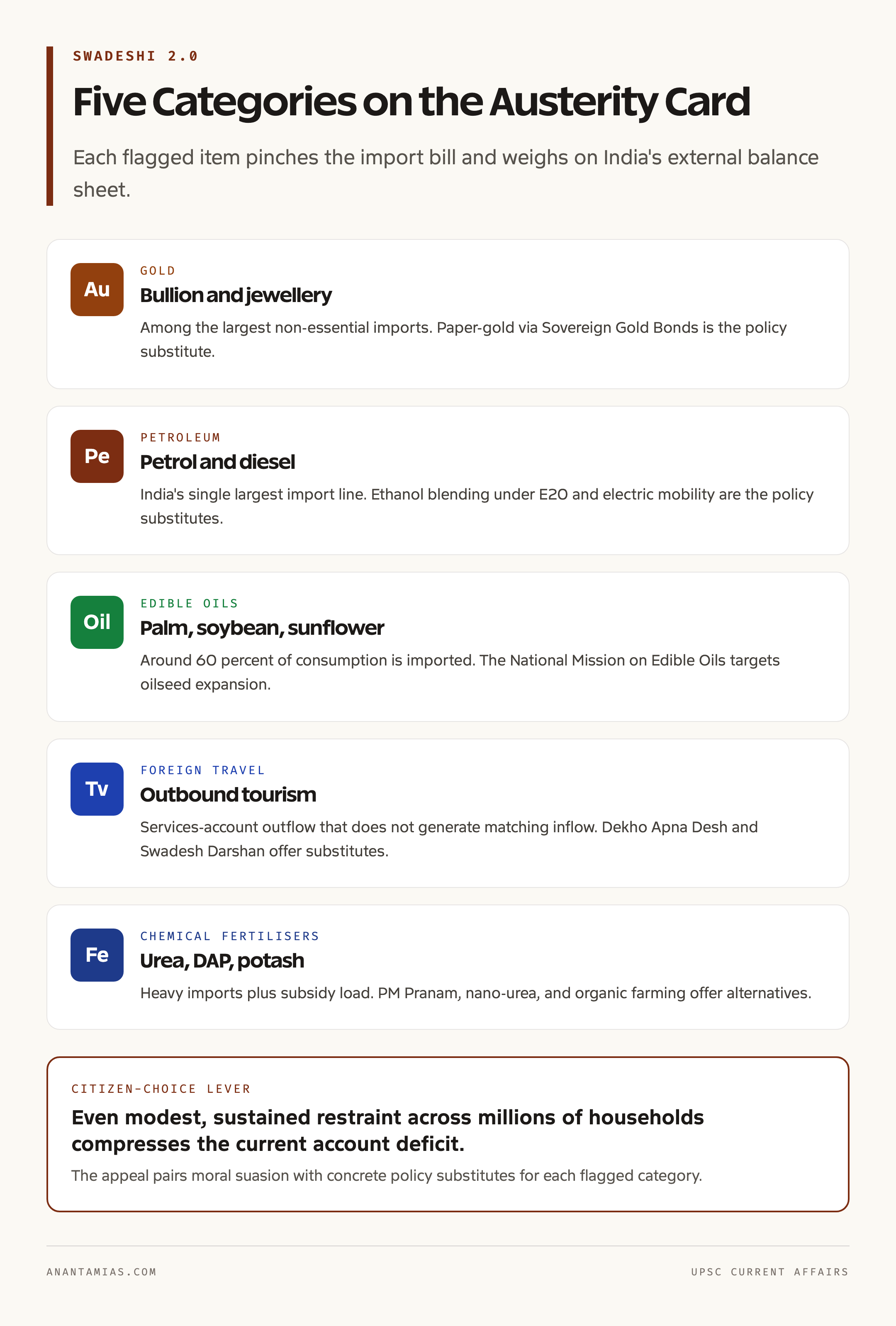
- Five flagged categories: gold, petrol or petroleum products, foreign travel, edible oils, and chemical fertilisers.
- Combined import dependence: these five categories together account for a substantial share of India’s merchandise import bill.
- Macroeconomic anchor: sustained pressure on the current account deficit and forex reserves.
- Broader narrative: positioned as Swadeshi 2.0, linking citizen choices to import substitution.
- Policy adjacencies: PM Pranam, National Mission on Edible Oils, PLI schemes, and ethanol blending.
What Just Happened
In a public address on 12 May 2026, PM Modi flagged five spending categories where citizen restraint, he argued, would directly help the national balance sheet. The phrasing was conversational, but the choice of items signalled coordination with the macroeconomic policy stance.
Gold imports had recently spiked again, partly because global prices and partly because of festive and wedding demand. Petroleum imports remained elevated despite ethanol blending progress. Foreign travel, which counts under services-account outflows, has been rising as outbound tourism normalises post-pandemic. Edible oil imports remained near 60 percent of consumption. Chemical fertilisers, especially urea and DAP, continue to weigh on import bills and subsidy budgets.
The PM Modi austerity appeal asks for citizen-level moderation: jewellery instead of bullion stockpiling, public transport over private fuel-heavy vehicles, domestic tourism over foreign trips, traditional oils blended with imported ones, and organic or nano-fertiliser use where viable. The framing is voluntary, not regulatory, but it dovetails with several existing policy instruments.
Background and Historical Context
India has long run a structural trade deficit, offset partly by services exports and remittances. The current account deficit has historically been the most-watched external indicator because it tells investors how much foreign capital India needs each year to balance its books. When the current account deficit widens beyond 2.5 to 3 percent of GDP, the rupee comes under pressure, forex reserve drawdowns accelerate, and import inflation rises.
Three of the five flagged categories have figured in past austerity calls. Indira Gandhi famously appealed for restraint on gold imports in the 1970s. The 1991 balance-of-payments crisis prompted explicit measures including gold pledging by the government. Atal Bihari Vajpayee’s government in the early 2000s pushed import substitution for select capital goods. The present appeal sits in that lineage but uses softer, behavioural framing rather than tariff hikes alone.
The Swadeshi movement of the early twentieth century, anchored by figures like Bal Gangadhar Tilak, Aurobindo Ghose, and later Mahatma Gandhi, was an early example of consumer choice as a political and economic tool. The contemporary Swadeshi movement discourse has evolved from boycott to brand-choice, with policy instruments like Make in India, PLI, and Vocal for Local layered on top.
Key Provisions of the Austerity Appeal
The PM Modi austerity appeal is not a notification or a legal instrument; it is a behavioural call paired with a policy stack. Each of the five categories maps to specific government programmes that the appeal implicitly reinforces.
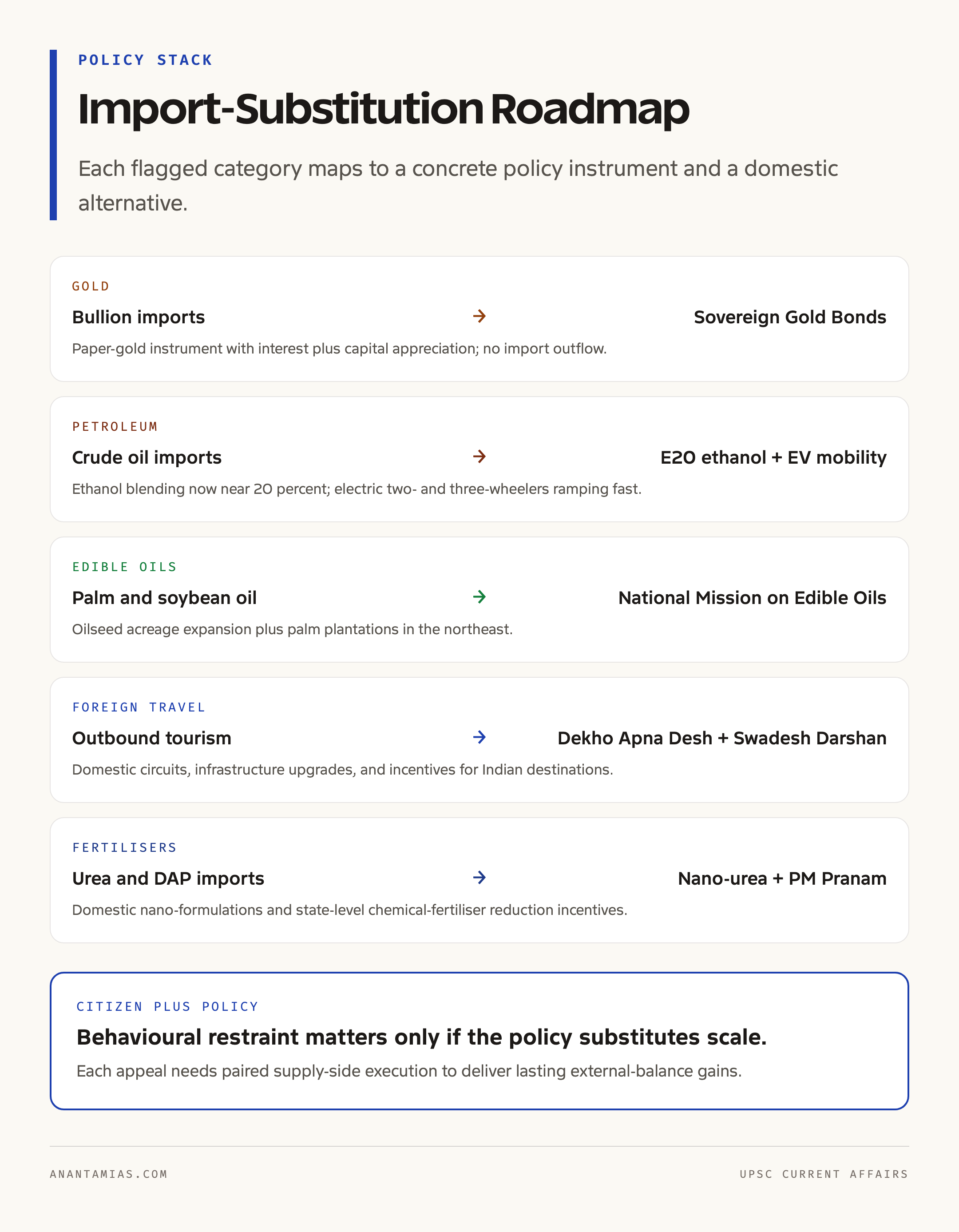
On gold, the policy stack includes import duty, Sovereign Gold Bonds, the Gold Monetisation Scheme, and PAN-card thresholds for high-value transactions. The appeal nudges citizens toward holding paper-gold or sovereign instruments rather than fresh bullion imports. On petroleum, the ethanol blending programme has reached around 20 percent under the E20 roadmap, electric vehicle penetration is rising, and public transport investments are scaling. The appeal asks citizens to align personal travel choices with these instruments.
On edible oils, the National Mission on Edible Oils targets palm-oil acreage expansion in the northeast and oilseed productivity gains, complemented by the MSP push for oilseeds discussed in our MSP Kharif crops 2026-27 analysis. On foreign travel, the Dekho Apna Desh initiative and Swadesh Darshan circuit funding aim to deepen domestic tourism. On chemical fertilisers, the PM Pranam scheme rewards states that reduce chemical fertiliser use, and the One Nation One Fertiliser branding consolidates the market, alongside the nano-fertiliser rollout.
Why It Matters
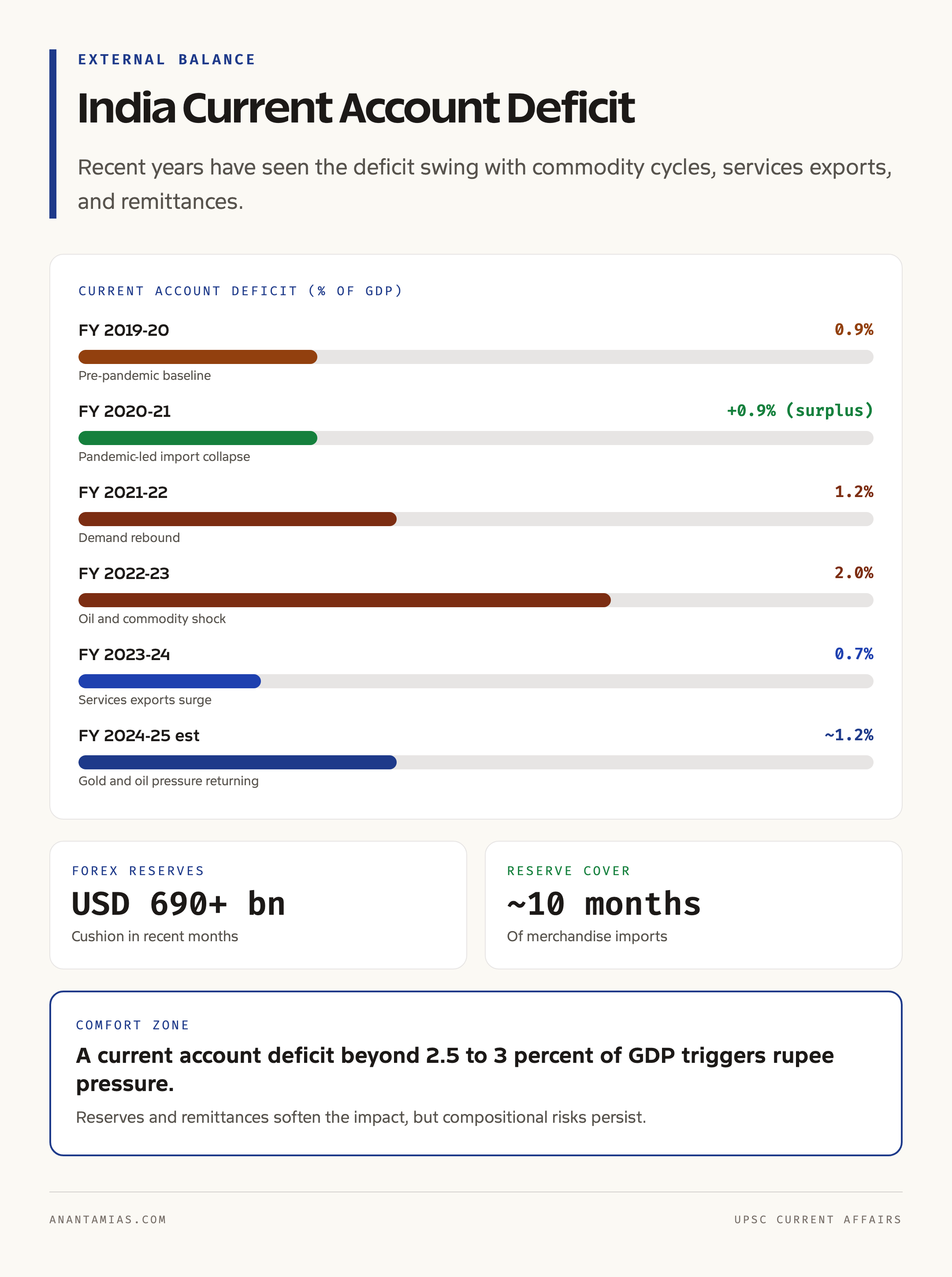
The PM Modi austerity appeal matters because the underlying arithmetic is real. The five categories together account for a large slice of India’s merchandise import bill and several percentage points of services outflow. Even a modest behavioural shift, sustained across millions of households, can compress the current account deficit by a meaningful margin.
The appeal also matters because it reframes citizen behaviour as a tool of macroeconomic management. The classical levers of monetary tightening and tariff hikes have known side-effects: slower growth, dearer credit, and reciprocal trade actions. Behavioural calls have lower direct cost but also depend on credibility and follow-through. The fact that the appeal is paired with concrete policy schemes makes it harder to dismiss as rhetoric.
Finally, the appeal sits within a longer geopolitical pivot. Critical-mineral dependence, semiconductor imports, and energy security have all become bipartisan concerns. By widening the conversation to everyday consumption, the government links household choices to strategic autonomy in a way that earlier austerity calls did not.
Detailed Analysis: How Each Category Links to the External Balance
Gold accounts for one of the largest non-essential import categories in India’s merchandise basket. In high-import months, gold inflows have crossed USD 5 to 7 billion. Restraint on jewellery and bullion purchases, even modest, can compress the deficit. Sovereign Gold Bonds offer a domestic-financed alternative that meets investment demand without import outflow.
Petroleum imports are the single largest line item in India’s trade deficit, and prices are exogenously volatile. Ethanol blending under E20 has reduced petrol-equivalent imports, but diesel-heavy freight and aviation fuel demand keep the bill high. Personal-vehicle fuel restraint, electric two-wheeler and three-wheeler uptake, and shift toward public transport all bend the import curve.
Edible oils are a structural vulnerability. India imports palm oil from Indonesia and Malaysia, soybean oil from Argentina and Brazil, and sunflower oil largely from Ukraine and Russia. Any supply shock translates almost instantly into household inflation. Foreign travel under the services account adds dollar outflow that does not generate matching dollar inflow unless India can attract reciprocal tourism. Chemical fertilisers depend on imported urea, DAP, and potash, with the import bill peaking when global gas prices rise.
Comparative Perspective
Several economies have used austerity messaging during external stress. The United Kingdom ran wartime austerity into the 1950s. South Korea staged a gold-collection drive during the 1997 Asian crisis where citizens donated gold to shore up reserves. China has historically used administrative and tariff levers rather than appeals. Japan blends both: nudging through public communication and structural policy on energy efficiency.
India’s choice in 2026 is closer to the South Korean playbook in spirit, though scaled for a much larger and more decentralised consumer base. The combination of moral suasion plus policy stack also recalls Singapore’s long-running campaigns on water conservation and saving, where behavioural framing complemented pricing.
Challenges with the Austerity Approach
The first challenge is that voluntary appeals often work at the margin but rarely deliver structural shifts on their own. Without sustained policy reinforcement, the effect fades within a few quarters. The second challenge is income elasticity. Lower-income households consume less of the imported basket to begin with; their compliance has limited dollar impact. Higher-income households drive most discretionary imports, and their behaviour is shaped by lifestyle expectations more than appeals.
The third challenge is sectoral. Gold demand has a deep cultural component tied to weddings, festivals, and wealth storage. Foreign travel has a status dimension. Edible oils have substitution limits set by cuisine and pricing. Chemical fertilisers have crop-cycle inertia. Each requires a different policy mix, not a single message.
The fourth challenge is implementation. An austerity appeal not backed by visible state-level discipline on capital expenditure, subsidy efficiency, and import-substitution timelines can read as one-sided. The PM Modi austerity appeal will be judged in part by whether public-sector and government-side spending shows comparable restraint where it can.
Prelims Pointers
- The current account deficit measures the gap between a country’s outflows and inflows on trade in goods and services, primary income, and secondary income.
- Forex reserves include foreign currency assets, gold, Special Drawing Rights, and reserve tranche position with the IMF.
- The Sovereign Gold Bond scheme was launched in 2015 to reduce physical gold demand by offering paper-gold investment instruments with interest plus capital appreciation.
- The PM Pranam scheme rewards states that reduce chemical fertiliser use by redirecting urea subsidy savings to alternative agriculture investments.
- Ethanol blending in petrol crossed 15 percent in 2024 and is targeting 20 percent under the E20 roadmap.
- The Swadesh Darshan and Dekho Apna Desh schemes promote domestic tourism circuits and reduce services-account outflows.
Mains Questions
- Discuss how citizen-level consumption choices can influence India’s current account balance. Critically examine the PM Modi austerity appeal of 2026 in this context. (GS Paper III, Economy)
- Examine the policy stack supporting the PM Modi austerity appeal, including ethanol blending, Sovereign Gold Bonds, and PM Pranam. How effective are these instruments in reducing import dependence? (GS Paper III, Government Policies)
- Compare and contrast the original Swadeshi movement with the contemporary Swadeshi 2.0 narrative. What are the continuities and changes in objectives and methods? (GS Paper I, History and GS Paper III, Economy)
- Edible oil imports remain a structural vulnerability for India. Suggest a comprehensive strategy to reduce import dependence over the medium term. (GS Paper III, Agriculture and Economy)
Way Forward
The PM Modi austerity appeal will deliver lasting impact only if it is paired with execution on three fronts. First, the policy stack on each flagged category must move on a measurable timeline: ethanol blending to 20 percent and beyond, oilseed acreage and yield improvements with deep procurement support, fertiliser productivity through nano-formulations, and Sovereign Gold Bond uptake at scale.
Second, supply-side reforms must lower the cost of compliant choices. Domestic tourism infrastructure must catch up so that the substitution from foreign travel feels like an upgrade, not a compromise. Electric mobility must scale beyond two-wheelers, with charging infrastructure that makes substitution from petrol viable in tier-two cities. Third, transparency must improve. Periodic publication of import bills by category, milestones on substitution targets, and household-level guidance would convert a one-off appeal into a sustained behavioural-change programme.
Frequently Asked Questions
What did PM Modi say in the austerity appeal of May 2026?
PM Modi urged citizens to consciously moderate spending on five categories: gold, petroleum products, foreign travel, edible oils, and chemical fertilisers. The appeal was framed as Swadeshi 2.0 and linked citizen choices to reducing India’s import dependence and external account pressure.
Why these five categories specifically?
Each of the five categories contributes a large share of India’s merchandise or services import bill and weighs on the current account deficit. They are also areas where domestic substitutes or alternative consumption choices exist and where government policy is actively pushing self-reliance.
What is the current account deficit?
The current account deficit is the difference between a country’s payments to and receipts from the rest of the world on trade in goods and services, primary income such as interest and dividends, and secondary income such as remittances. A wider deficit means a country needs more foreign capital inflow to balance its books.
How does gold demand affect India’s external balance?
Gold is one of the largest non-essential import items for India. High gold imports drain forex reserves, widen the trade deficit, and put pressure on the rupee. Sovereign Gold Bonds and the Gold Monetisation Scheme offer paper-gold alternatives that meet investment demand without import outflow.
Is the appeal a legal restriction?
No. The appeal is a behavioural call by the Prime Minister, not a legal or regulatory instrument. It is reinforced by existing policy schemes like ethanol blending, PM Pranam, the National Mission on Edible Oils, Sovereign Gold Bonds, and the Dekho Apna Desh initiative.
What is Swadeshi 2.0?
Swadeshi 2.0 is the contemporary framing of economic self-reliance that combines consumer choice, manufacturing-side Production-Linked Incentives, and import substitution. It draws inspiration from the original Swadeshi movement but applies the logic to modern global value chains.
How will the appeal affect inflation?
If the appeal succeeds in moderating import demand, it can ease rupee depreciation pressure and reduce imported-inflation risk. The short-run effect on retail inflation is limited; the medium-run effect depends on whether domestic substitutes scale.
Has India done this before?
Yes. Calls for austerity and gold restraint were made during the 1970s economic stress and the 1991 balance-of-payments crisis. South Korea ran a famous gold-collection drive during the 1997 Asian crisis. The 2026 appeal is in that tradition but framed for a much larger consumer economy.
What is PM Pranam?
PM Pranam, or the Prime Minister Programme for Restoration, Awareness, Nourishment and Amelioration of Mother Earth, incentivises states to reduce chemical fertiliser use by redirecting urea subsidy savings into alternative-agriculture investments.
How can citizens contribute beyond the five flagged categories?
Beyond the five categories, supporting locally manufactured goods under the Make in India and Vocal for Local push, choosing domestic services where comparable quality exists, and adopting energy-efficient appliances all contribute to lower import dependence over time.
Tell Google you want more of this.
Add Anantam IAS as a preferred sourceOne tap, and this site shows up more often in your own Top Stories, AI Overviews and AI Mode. Remove it any time.