Why in News?
The Cabinet Committee on Economic Affairs (CCEA) has approved a reform to improve the quality of rice supplied under the Pradhan Mantri Garib Kalyan Anna Yojana (PMGKAY) and Other Welfare Schemes. PIB confirmed the decision through the Ministry of Consumer Affairs, Food and Public Distribution on 2 July 2026.
For the first time in nearly three decades, the government has revised the quality specifications of rice moving through the Public Distribution System (PDS). Over 80 crore beneficiaries will receive rice with substantially lower broken-grain content — with no change in their existing entitlements.
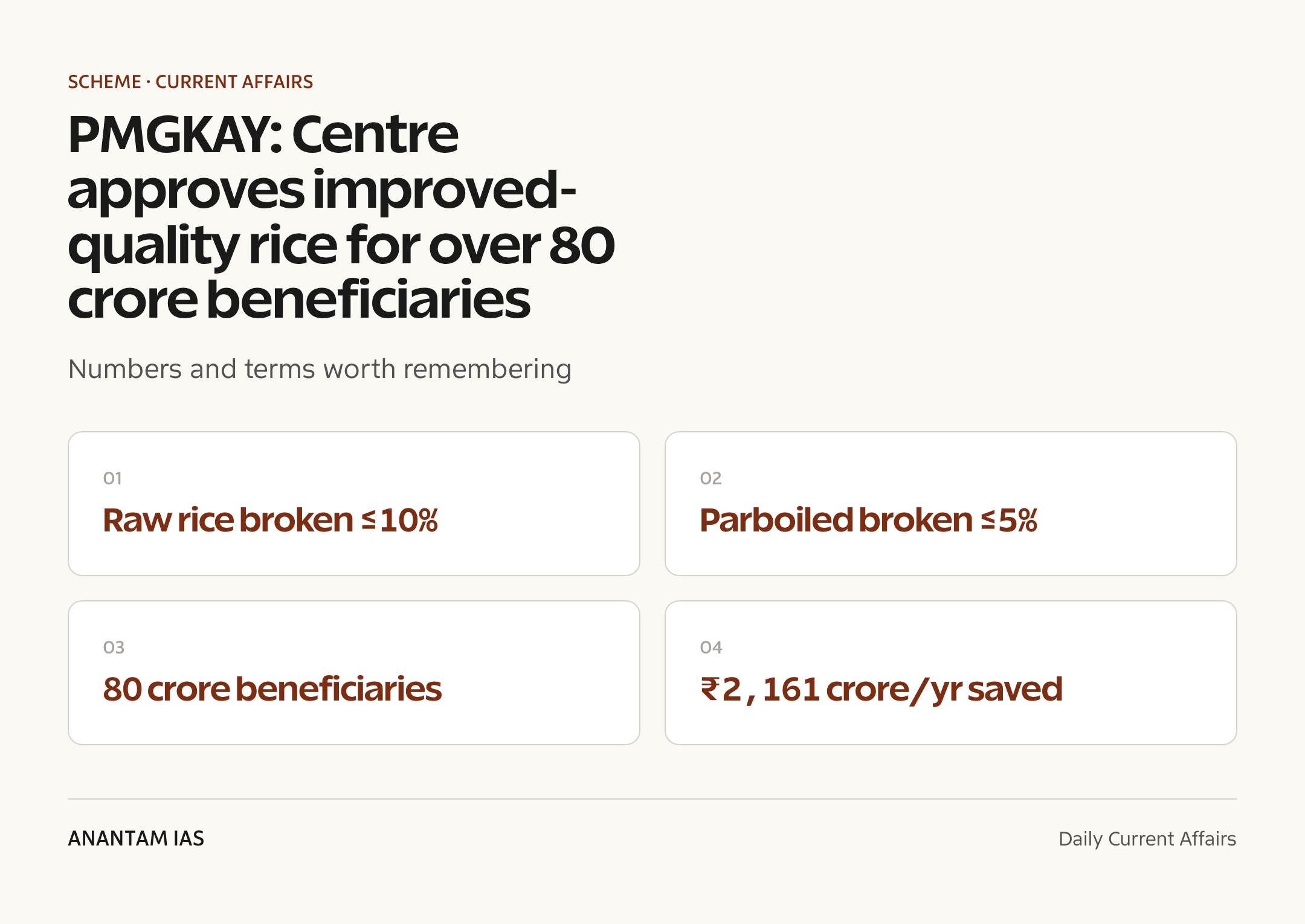
- Raw rice under PMGKAY will now contain up to 10% broken grains, replacing the earlier ceiling of 25%.
- Parboiled rice will contain up to 5% broken grains, down from the earlier ceiling of 16%.
- Procurement of improved-quality rice starts immediately; the rollout covers all procuring states by Kharif Marketing Season (KMS) 2027–28 in a phased manner.
- The reform is expected to generate annual savings of about ₹2,161 crore through reduced logistics, storage and packaging costs.
- Rice bags will carry QR-code tagging for end-to-end traceability across the PDS supply chain.
- The change was validated through pilots in Haryana, Andhra Pradesh, Punjab, Odisha, Telangana and Chhattisgarh.
The development matters in the context of:
- This shifts the food-security debate from quantity (universal free grain) to quality — grain integrity, appearance and consumer acceptability inside the world’s largest food distribution programme.
- It complements ongoing PDS modernisation — One Nation One Ration Card, ePoS authentication and rice fortification — that together target both leakages and nutrition.
- Broken rice separated at milling will be put to productive industrial use and auctioned from millers’ premises, easing the food subsidy burden.
UPSC Relevance
Prelims Relevance
- PMGKAY — launched March 2020 as pandemic relief (extra 5 kg free foodgrain per person per month); merged with free NFSA distribution from 1 January 2023; extended for 5 years from 1 January 2024.
- New rice specs — broken grains capped at 10% in raw rice (earlier 25%) and 5% in parboiled rice (earlier 16%); first revision in nearly 30 years.
- NFSA 2013 — legal entitlement covering up to 75% rural and 50% urban population; 5 kg per person per month for priority households, 35 kg per household for Antyodaya Anna Yojana (AAY) families.
- CCEA — the Cabinet committee that clears major economic decisions, chaired by the Prime Minister.
- KMS 2027–28 — the outer deadline for all procuring states to switch to improved-quality rice.
- ₹2,161 crore — estimated annual cost rationalisation from logistics, storage and packaging.
- QR-code tagging of rice bags — end-to-end traceability tool for the PDS supply chain.
- HDPE bags — broken rice will be stored in HDPE bags, cutting jute bag requirements.
- Pilot states — Haryana, Andhra Pradesh, Punjab, Odisha, Telangana, Chhattisgarh.
Mains Relevance
GS Paper 2
- Welfare schemes for vulnerable sections — design upgrade of PMGKAY from coverage to quality of service delivery.
- Governance and transparency — QR-code traceability, ePoS and ONORC as e-governance tools against PDS leakages.
- Issues relating to poverty and hunger — dignity of beneficiaries as a policy objective, not just calorie delivery.
GS Paper 3
- Food security and PDS reform — buffer stocking, procurement economics, FCI operations and the food subsidy bill.
- Value addition — productive industrial use of separated broken rice and its revenue potential.
Essay
- Welfare with dignity: from feeding the poor to serving them well.
- Food security in India: the journey from scarcity to quality.
Background and Context
What exactly has changed in the rice specifications
The reform rewrites the quality benchmark that governs every kilogram of PDS rice.
- PDS rice is procured against uniform specifications; the permissible broken-grain content has stood at 25% for raw rice and 16% for parboiled rice for nearly three decades.
- The approved policy caps broken grains at 10% in raw rice and 5% in parboiled rice — beneficiaries get rice with better grain integrity, appearance and cooking quality.
- Entitlements stay untouched: the same quantity of grain, free of cost, but of visibly better quality.
- Procurement of the improved-quality rice begins immediately; distribution follows in phases so states can transition smoothly.
- All procuring states must conform by KMS 2027–28, giving millers and state agencies two full seasons to adjust milling and sortex operations.
- PIB noted that pilots in six states — Haryana, Andhra Pradesh, Punjab, Odisha, Telangana and Chhattisgarh — have already demonstrated that improved-quality rice can be produced at scale.
PMGKAY: from pandemic relief to the world's largest food scheme
PMGKAY has evolved through three distinct phases since 2020.
- March 2020 — launched as part of the Pradhan Mantri Garib Kalyan Package during the COVID-19 lockdown, giving an additional 5 kg free foodgrain per person per month over and above NFSA entitlements.
- The scheme ran in successive phases through December 2022, cushioning households through the pandemic’s economic shock.
- 1 January 2023 — the government made NFSA foodgrains entirely free and subsumed that distribution under PMGKAY, ending the ₹1–₹3 per kg issue prices.
- 1 January 2024 — PMGKAY was extended for five years at an estimated outlay of about ₹11.80 lakh crore, locking in free grain until end-2028.
- It reaches over 80 crore beneficiaries — roughly two-thirds of India’s population — making it the largest food distribution programme in the world.
- The quality upgrade is the first structural improvement to what beneficiaries receive, after years of expanding how many receive it and at what price.
NFSA 2013: the legal backbone of the entitlement
PMGKAY operates on the beneficiary architecture created by the National Food Security Act.
- The National Food Security Act (NFSA), 2013 converted food security from a welfare measure into a legal entitlement, covering up to 75% of the rural and 50% of the urban population.
- Priority households get 5 kg per person per month; Antyodaya Anna Yojana (AAY) households — the poorest of the poor — get 35 kg per household per month.
- The Act also mandates maternity benefits, nutritional support to children, and a two-tier grievance redressal machinery with district grievance officers and state food commissions.
- Identification of beneficiaries rests with states; grain allocation, procurement and inter-state movement rest with the Centre through the Food Corporation of India (FCI).
- A quality floor for the grain itself was the missing piece in this rights framework — the new specifications begin to close that gap. A fuller primer is in our note on the Public Distribution System: issues and reforms.
Why grain quality matters: nutrition, acceptability, dignity
Broken rice is not just a cosmetic problem — it shapes whether entitlements translate into nutrition.
- High broken content lowers cooking quality and consumer acceptability; households sometimes sell or divert poor-quality PDS grain, defeating the scheme’s purpose.
- Better grain integrity improves uptake — beneficiaries actually consume what they lift, strengthening the nutrition outcomes the scheme is meant to deliver.
- The reform runs parallel to rice fortification: fortified rice kernels blended with iron, folic acid and vitamin B12 are supplied across welfare schemes to fight anaemia — explained in our guide to food fortification in India.
- PIB framed the decision as moving from food security to food security with improved quality — receiving good rice “with dignity” is itself the stated policy goal.
- Quality PDS grain also supports the fight against child malnutrition and stunting, where dietary quality matters as much as quantity.
The fiscal and operational arithmetic
Counter-intuitively, supplying better rice is expected to save money, not cost more.
- Broken rice separated during milling will be auctioned directly from millers’ premises — it never enters the FCI logistics chain, cutting transport, storage and handling costs.
- Broken rice will be stored in HDPE bags, reducing the requirement of costlier jute bags.
- Together these changes are projected to save about ₹2,161 crore annually in logistics, storage and packaging.
- Sale proceeds of broken rice add non-tax revenue, further trimming the food subsidy burden — the fiscal context is covered in our note on the food subsidy bill: constraints and strategies.
- The separated broken rice goes to productive industrial uses — feed, ethanol and food processing — so no grain is wasted while superior edible rice reaches beneficiaries.
- Procurement itself continues at MSP through the custom-milling chain, so farmers’ price assurance is unaffected by the quality change downstream.
The transparency stack: QR codes on top of ONORC and ePoS
The quality reform arrives with a traceability layer that extends a decade of PDS digitisation.
- QR-code tagging of rice bags will enable end-to-end traceability from miller to fair price shop, strengthening accountability and inventory management and plugging leakage points.
- It builds on ePoS devices at fair price shops, which authenticate beneficiaries through Aadhaar before grain is issued.
- One Nation One Ration Card (ONORC) lets migrant workers draw entitlements anywhere in India — full national portability was achieved in 2022.
- End-to-end computerisation of supply chains, digitised ration cards and online allocation have already reduced the diversion that the Shanta Kumar Committee (2015) flagged as the PDS’s central weakness.
- Traceable, better-quality, fortified grain moving through an authenticated network is the emerging design of a reformed PDS — quality, nutrition and integrity addressed in one architecture.
Way Forward
Execution levers for a smooth transition
- Upgrade milling and sortex capacity in procuring states well before KMS 2027–28, with clear incentives for millers to meet the tighter specifications.
- Publish transparent auction protocols for broken rice at millers’ premises to prevent cartelisation and ensure fair price discovery.
- Run beneficiary-level quality audits at fair price shops so the improved specification is verified at the last mile, not just at depots.
- Use the QR-code data to build a public traceability dashboard, letting states benchmark leakage and delivery performance.
Deepening the quality agenda
- Extend the quality-first approach to wheat and coarse grains, including millets, supplied through welfare schemes.
- Pair better rice with sustained fortification coverage and nutrition education so quality gains convert into measurable health outcomes.
- Periodically review specifications through a standing technical committee rather than waiting decades between revisions.
Conclusion
The CCEA’s decision marks a quiet but significant maturing of India’s food security policy. Having achieved near-universal free coverage through PMGKAY, the state is now competing on quality — capping broken grains at 10% and 5%, tagging bags with QR codes, and monetising the by-product to save about ₹2,161 crore a year.
For the exam, the takeaway is the design logic: a welfare reform that simultaneously improves the beneficiary’s plate, the system’s transparency and the exchequer’s arithmetic. It shows how service quality is becoming the next frontier of welfare governance after coverage and affordability.
UPSC Practice Questions
Prelims MCQ 1
With reference to the improved-quality rice reform approved under PMGKAY in 2026, consider the following statements:
- Raw rice supplied under PMGKAY will contain up to 10% broken grains, replacing the earlier ceiling of 25%.
- Parboiled rice will contain up to 16% broken grains under the revised specifications.
- This is the first revision of PDS rice quality specifications in nearly three decades.
How many of the above statements are correct?
(a) Only one (b) Only two (c) All three (d) None
Answer: (b) Only two
Explanation:
Statements 1 and 3 are correct. Statement 2 is wrong — parboiled rice will contain up to 5% broken grains; 16% was the earlier ceiling being replaced.
Prelims MCQ 2
With reference to the Pradhan Mantri Garib Kalyan Anna Yojana (PMGKAY), which of the following statements is correct?
(a) It supplies foodgrains to NFSA beneficiaries at subsidised issue prices of ₹1–₹3 per kg. (b) Since 1 January 2023, foodgrains under the NFSA are supplied free of cost through PMGKAY. (c) It covers only Antyodaya Anna Yojana households. (d) It is implemented by the Ministry of Agriculture and Farmers Welfare.
Answer: (b) Since 1 January 2023, foodgrains under the NFSA are supplied free of cost through PMGKAY.
Explanation:
NFSA grains were made free and merged into PMGKAY from 1 January 2023; the scheme was extended for five years from 1 January 2024. It covers both priority and AAY households and is run by the Ministry of Consumer Affairs, Food and Public Distribution.
UPSC Mains Questions
- The recent decision to supply improved-quality rice under PMGKAY signals a shift from coverage-centric to quality-centric welfare delivery. Examine the significance of this shift for food and nutrition security in India. (250 words)
- Technology-driven reforms — ePoS authentication, One Nation One Ration Card and QR-code traceability — are transforming the Public Distribution System. Critically evaluate their effectiveness in plugging leakages and improving beneficiary experience. (250 words)
- India’s food subsidy regime must balance fiscal prudence with the legal entitlements of the National Food Security Act, 2013. Discuss how by-product monetisation and logistics rationalisation can reconcile the two. (150 words)
Source: PIB, Ministry of Consumer Affairs, Food & Public Distribution.
Frequently Asked Questions
What has the CCEA approved for PMGKAY rice?
The Cabinet Committee on Economic Affairs approved supply of improved-quality rice under PMGKAY and Other Welfare Schemes. Broken-grain content is capped at 10% in raw rice (earlier 25%) and 5% in parboiled rice (earlier 16%) — the first revision of PDS rice quality specifications in nearly three decades.
When will beneficiaries get the improved-quality rice?
Procurement of improved-quality rice begins immediately, and distribution will be phased in. All procuring states must conform to the new specifications by Kharif Marketing Season (KMS) 2027–28, allowing millers and state agencies a smooth transition without disrupting supplies.
What is the Pradhan Mantri Garib Kalyan Anna Yojana?
PMGKAY began in March 2020 as pandemic relief giving 5 kg extra free foodgrain per person monthly. From 1 January 2023 it absorbed free NFSA distribution, and from 1 January 2024 it was extended five years at about ₹11.80 lakh crore, serving over 80 crore beneficiaries.
How does the reform save the government money?
Broken rice separated at milling will be auctioned directly from millers’ premises, skipping FCI transport and storage, and stored in cheaper HDPE bags instead of jute. This rationalises logistics, storage and packaging costs by about ₹2,161 crore annually, while broken-rice sales add revenue.
What is QR-code tagging of rice bags?
Each rice bag will carry a QR code enabling end-to-end traceability across the PDS supply chain — from miller to depot to fair price shop. It strengthens transparency, accountability and inventory management, and plugs points where grain could earlier leak out of the system.
Do beneficiaries lose any entitlement under the new policy?
No. Entitlements under the NFSA remain unchanged — 5 kg per person per month for priority households and 35 kg per household for Antyodaya families, free of cost. Only the quality of the rice improves, with lower broken-grain content and better cooking quality.
Tell Google you want more of this.
Add Anantam IAS as a preferred sourceOne tap, and this site shows up more often in your own Top Stories, AI Overviews and AI Mode. Remove it any time.