Why in News?
The Punjab government has acted against seven officials of Markfed and Milkfed — the state’s marketing and milk producers’ cooperatives — and police have registered multiple FIRs over the alleged diversion of subsidised agricultural urea for industrial use. The Indian Express reported that investigators believe neem-coated farm urea was pulled out of the fertiliser supply chain, repackaged, and passed off as technical-grade urea for factories and cattle-feed plants.
The case matters well beyond Punjab. It challenges the assumption that 100% neem coating, digital tracking and point-of-sale authentication have closed the diversion route, and it spotlights the design of one of the world’s largest fertiliser subsidy programmes — worth about ₹1.71 lakh crore in 2026-27.
- Seven officials of Markfed and Milkfed chargesheeted; FIRs name cooperative officers and private suppliers.
- Laboratory tests reportedly found material labelled technical-grade urea was actually subsidised agricultural-grade urea.
- Diverted fertiliser is suspected to have reached cattle-feed plants and other non-agricultural users.
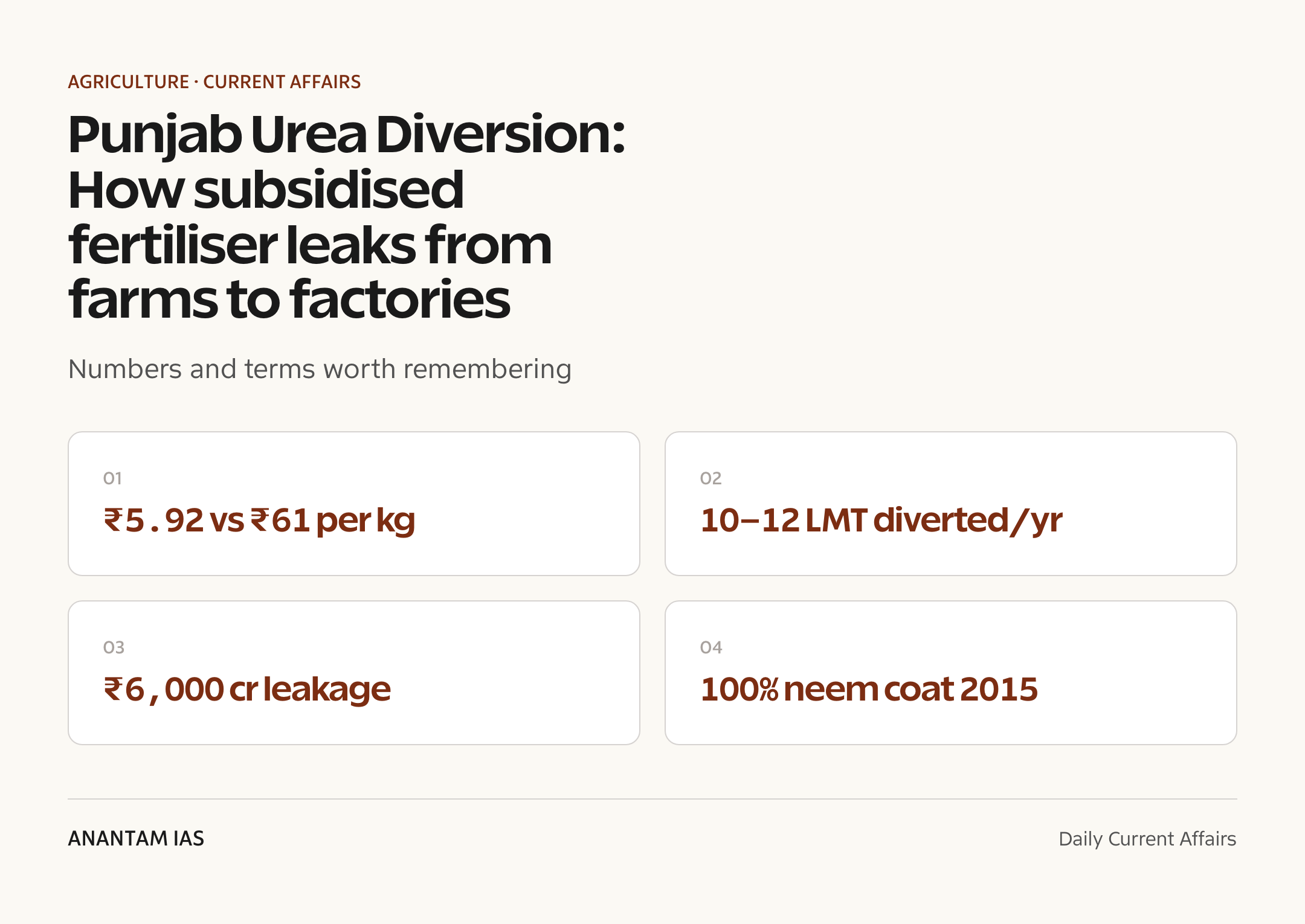
- Farm urea sells at roughly ₹5.92 per kg; Punjab investigators cite an industrial market price of about ₹61 per kg — a ten-fold gap.
- A 2022 crackdown by the Centre had estimated 10–12 lakh tonnes of urea diverted annually, a leakage of about ₹6,000 crore a year.
The development matters in the context of:
- The case involves cooperative institutions embedded in Punjab’s farm economy, not just private traders — a governance failure inside the delivery system itself.
- It tests the durable GS3 theme of subsidy design: when the same molecule is priced at ₹6 for one buyer and ₹61 for another, enforcement alone struggles to hold the line.
- Similar diversion cases have surfaced across several states despite mandatory neem coating and repeated enforcement drives by the Centre.

UPSC Relevance
Prelims Relevance
- Urea MRP is statutorily fixed (₹242 per 45-kg bag, excluding taxes and neem-coating charges); farmers effectively pay about ₹266.50 per bag.
- Urea is outside the Nutrient Based Subsidy (NBS) scheme; NBS (2010) covers only P&K fertilisers.
- 100% neem coating of all subsidised urea, domestic and imported, is mandatory since May 2015 (New Urea Policy 2015).
- Neem coating slows nitrification, raising nitrogen-use efficiency, and makes urea unfit for direct industrial use.
- DBT in fertilisers (pan-India from March 2018) pays subsidy to companies only after actual retail sale through PoS devices with buyer authentication — it is not a cash transfer to farmers.
- Fertilisers are regulated under the Fertiliser (Control) Order, 1985, issued under the Essential Commodities Act, 1955.
- India consumes roughly 35–38 million tonnes of urea a year; legitimate industrial demand is only about 15–16 lakh tonnes.
- One Nation One Fertiliser (PMBJP, October 2022) mandates the single ‘Bharat’ brand on all subsidised fertiliser bags.
- Markfed and Milkfed are Punjab’s apex marketing and dairy cooperatives.
- Agricultural urea moves in marked yellow bags; technical-grade urea is sold in plain white bags at market price.
Mains Relevance
GS Paper 3
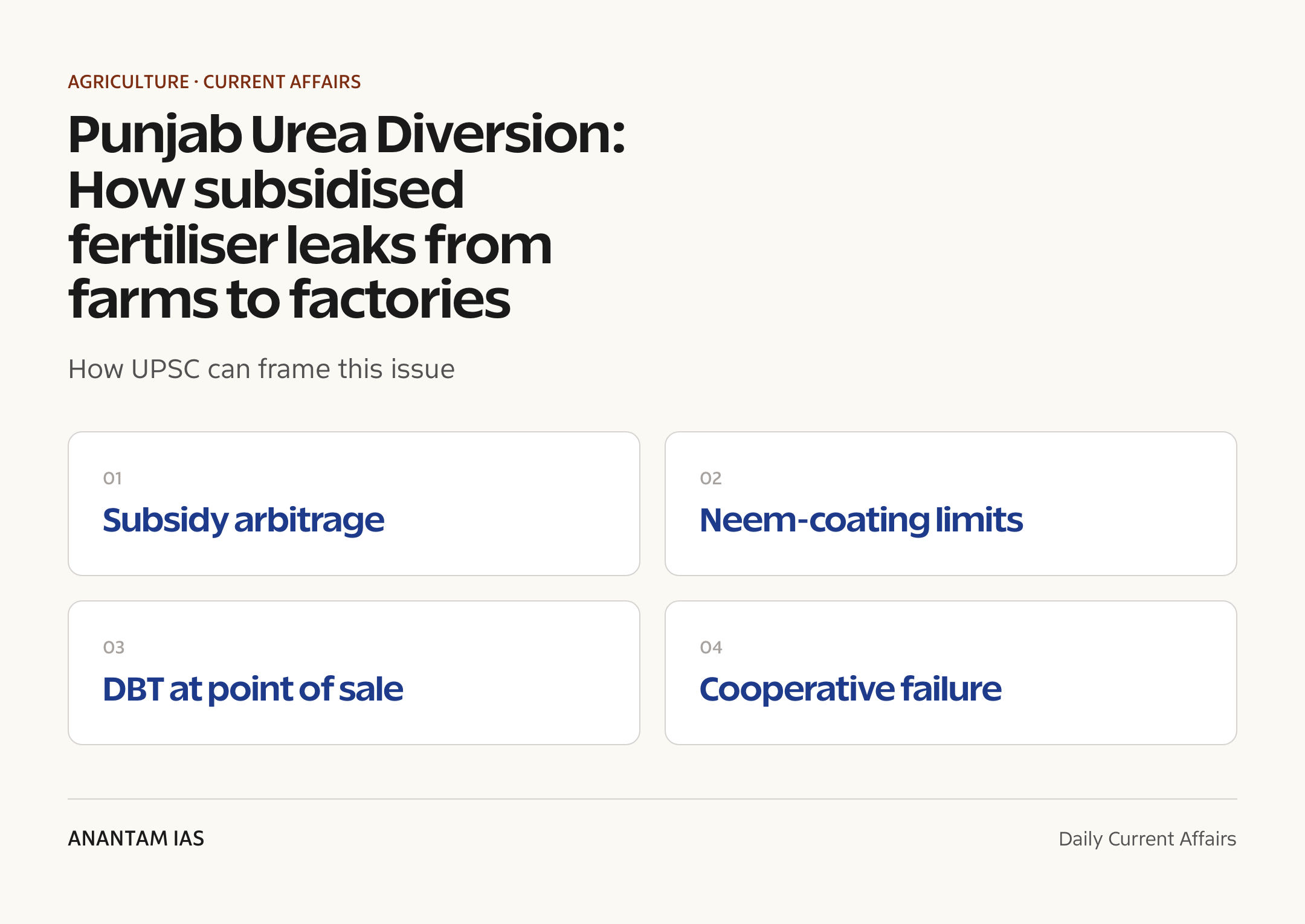
- Fertiliser subsidy design and leakages: price-gap arbitrage as the root cause of diversion.
- Limits of technological fixes — neem coating, PoS-based DBT, QR tracking — without structural pricing reform.
- Fiscal cost: subsidy leakage versus targeted support to farmers; implications for public expenditure quality.
- Impact on legitimate industry — unfair competition, informal supply chains and tax evasion.
GS Paper 2
- Governance and accountability in cooperative institutions (Markfed, Milkfed) delivering public schemes.
- Centre-state enforcement coordination under the Essential Commodities Act and Fertiliser (Control) Order.
Essay
- Good economics of a subsidy can be undone by bad price design — the gap between intent and incentive.
- Technology can raise the cost of corruption but cannot substitute for institutional integrity.
Background and Context
Two ureas, one molecule
Agricultural and industrial urea are chemically the same compound sold under two different regulatory and price regimes.
- Agricultural urea is a nitrogen fertiliser — heavily subsidised, mandatorily neem-coated, and regulated under the Fertiliser (Control) Order, 1985.
- Technical-grade urea feeds industry: resins, plywood adhesives, melamine, textiles, dyes, moulding compounds and some cattle-feed formulations. It carries no subsidy and sells at market price.
- Packaging is the visible marker: farm urea comes in yellow bags with mandatory fertiliser markings and a neem-coating declaration; technical-grade urea ships in plain white bags with industrial specifications.
- Punjab investigators treated this bag-swap — subsidised yellow-bag material re-emerging as white-bag ‘technical’ urea — as key evidence of diversion.
The arbitrage that drives diversion
The subsidy creates a ten-fold price gap between the farm gate and the factory gate, and that gap finances the entire illegal chain.
- A 45-kg bag of farm urea costs the farmer about ₹266.50 — roughly ₹5.92 per kg — because the Union government bears most of the production cost.
- Technical-grade urea sells for about ₹55–65 per kg (₹2,700–3,000 a bag); Punjab investigators cite around ₹61 per kg.
- Even after paying for transport, repackaging and de-coating (removing neem oil), diverted subsidised urea stays far cheaper than legally procured industrial urea.
- India uses roughly 35–38 million tonnes of urea a year, almost all for agriculture; industrial demand is only 15–16 lakh tonnes — so even a small percentage diverted means a large subsidy loss.
- The gap sustains a parallel economy of middlemen who profit simply by moving bags from the farm distribution chain into industrial channels.
How India subsidises urea
Urea is the most tightly price-controlled fertiliser in India, and that control is precisely what makes it the most diverted.
- Urea’s MRP is statutorily fixed — ₹242 per 45-kg bag excluding taxes and neem-coating charges — while the government reimburses producers the difference between cost and price.
- Urea sits outside the Nutrient Based Subsidy (NBS) regime introduced in 2010 for phosphatic and potassic fertilisers, whose retail prices are decontrolled.
- The Budget 2026-27 provides about ₹1.71 lakh crore for fertiliser subsidy — nearly ₹1.17 lakh crore for urea alone and about ₹54,000 crore under NBS.
- Because the subsidy is paid on the bag, not the beneficiary, anyone who controls the bag captures the subsidy — the structural flaw at the heart of diversion.
- Cheap urea also skews the NPK nutrient balance in Indian soils, since decontrolled P&K fertilisers cost far more per bag than urea.
Safeguards built so far — and their limits
The Centre has layered technological and administrative checks over a decade, yet the Punjab case shows determined networks can still route around them.
- 100% neem coating became mandatory for all subsidised urea from May 2015 under the New Urea Policy — to slow nitrification, raise nitrogen-use efficiency, and make urea unfit for industrial processes.
- DBT in fertilisers rolled out nationally in March 2018: subsidy is released to companies only after actual sale to the buyer through PoS devices at over 2.6 lakh retail points, with Aadhaar-based authentication.
- After the 2022 estimates of 10–12 lakh tonnes diverted annually (about ₹6,000 crore of leakage), the Department of Fertilisers created dedicated Flying Squads to inspect warehouses, transport, retail outlets and industrial units.
- Those inspections found illegal stockpiles, repackaging operations and farm urea moving into plywood, resin, textile and cattle-feed units.
- One Nation One Fertiliser (October 2022) standardised all subsidised bags under the ‘Bharat’ brand, making stray subsidised bags easier to spot outside the farm chain.
- The Punjab investigation indicates diversion networks now de-coat or mislabel the product — technology raised the cost of diversion but the arbitrage still pays for it.
What makes the Punjab case different
Earlier crackdowns mostly caught private traders; this case implicates the cooperative delivery system itself.
- Markfed (marketing) and Milkfed (dairy) are apex state cooperatives that farmers deal with routinely — their alleged involvement is a breach of institutional trust, not just a market crime.
- Officials were chargesheeted and FIRs registered against cooperative officers along with private suppliers after laboratory testing exposed the mislabelling.
- The suspected destination — cattle-feed plants — sits inside the agricultural economy, showing how blurred the farm-industry boundary can be.
- For a wider view of how India is trying to professionalise its cooperatives, see the National Cooperative Policy 2025.
Who loses when urea leaks
Diversion is not a victimless arbitrage; it taxes farmers, honest industry, the exchequer and the environment at once.
- Farmers: delayed supplies in sowing windows, local shortages, black marketing, and forced purchases at inflated prices — disruptions that alter planting decisions and hit crop productivity.
- Legitimate industry: firms importing or buying technical-grade urea legally face unfair competition from rivals running on subsidised inputs, distorting prices and encouraging tax evasion.
- Taxpayers: every diverted bag is public money that never reached its intended beneficiary — the subsidy becomes an industrial input discount.
- Environment: replacing leaked farm urea can force extra fertiliser production and imports, adding energy and emissions costs.
- Alternatives that shrink the physical bag itself — such as nano urea and nano DAP — are partly pitched as diversion-proof delivery.
Way Forward
Shrink the arbitrage, not just police it
- Move towards direct benefit transfer to farmers — subsidy per landholding or per-farmer cap with market-priced bags — so the bag itself stops carrying the subsidy.
- Rationalise urea pricing gradually and bring it closer to the NBS framework to reduce the nutrient-price distortion and the ₹6-versus-₹61 gap.
- Cap the number of subsidised bags per buyer per season using the existing PoS purchase history.
Harden the supply chain
- End-to-end track-and-trace — QR-coded bags reconciled from plant to retail sale — with automatic flags for bulk or repeat purchases.
- Regular lab audits of ‘technical-grade’ urea stocks in plywood, resin, textile and cattle-feed units to detect de-coated farm urea.
- Sustained Flying Squad inspections with stringent action under the Essential Commodities Act and the Fertiliser (Control) Order, plus accountability audits of cooperative institutions handling fertiliser.
Structural demand-side measures help too: balanced fertilisation guided by Soil Health Cards, promotion of nano and slow-release formulations, and assured legal supply channels of technical-grade urea for industry so legitimate users are never pushed towards the grey market.
Conclusion
The Punjab case is a reminder that subsidy leakage is an economics problem before it is a policing problem. Neem coating, DBT at the point of sale and branded bags have made diversion harder, but a ten-fold price gap keeps it profitable enough to corrupt even cooperative institutions meant to serve farmers.
Protecting a ₹1.71 lakh crore subsidy programme needs both arms working: relentless enforcement in the short run, and a redesign that attaches the subsidy to the farmer rather than the bag in the long run. Until the arbitrage shrinks, every safeguard will remain a speed-bump, not a wall.
UPSC Practice Questions
Prelims MCQ 1
With reference to urea in India, consider the following statements:
- Since 2015, the production and distribution of 100% neem-coated urea is mandatory for all subsidised urea, domestic and imported.
- Urea is covered under the Nutrient Based Subsidy (NBS) scheme, and its maximum retail price is market-determined.
- Neem coating slows the nitrification of urea in the soil and improves nitrogen-use efficiency.
How many of the above statements are correct?
(a) Only one (b) Only two (c) All three (d) None
Answer: (b) Only two
Explanation:
Statements 1 and 3 are correct: 100% neem coating is mandatory since May 2015, and the coating slows nitrification, improving nitrogen-use efficiency. Statement 2 is wrong — urea is outside NBS (which covers P&K fertilisers) and its MRP is statutorily fixed by the government.
Prelims MCQ 2
Which of the following best explains why subsidised agricultural urea gets illegally diverted to industrial use in India?
(a) Industrial units are legally barred from importing technical-grade urea (b) The wide gap between the subsidised farm-gate price and the market price of technical-grade urea creates a large arbitrage profit (c) Neem-coated urea is of higher chemical purity than technical-grade urea (d) Agricultural urea and industrial urea are different chemical compounds
Answer: (b) The wide gap between the subsidised farm-gate price and the market price of technical-grade urea creates a large arbitrage profit
Explanation:
Both grades contain the same compound. Farm urea costs about ₹5.92 per kg to farmers while technical-grade urea sells at roughly ₹55–65 per kg; even after de-coating and repackaging costs, diversion stays profitable. Industry can legally buy technical-grade urea — the price gap, not scarcity of legal supply, drives diversion.
UPSC Mains Questions
- India’s urea subsidy prices the same molecule at about ₹6 per kg for farmers and ₹61 per kg for industry. Examine how this price design incentivises diversion of subsidised fertiliser, and suggest reforms that attach the subsidy to the farmer rather than the product.
- Technological safeguards such as neem coating, point-of-sale DBT and standardised bags have made fertiliser diversion harder but not unviable. Critically evaluate the limits of technology-led enforcement in plugging subsidy leakages, with reference to the recent Punjab urea diversion case.
Sources: The Indian Express (Explained) and PIB, Department of Fertilisers (Neem Coated Urea explainer).
Frequently Asked Questions
What is the Punjab urea diversion case?
Punjab chargesheeted seven officials of its cooperatives Markfed and Milkfed and registered FIRs after lab tests showed subsidised neem-coated agricultural urea was repackaged and sold as technical-grade urea for industrial and cattle-feed use, siphoning the Centre’s fertiliser subsidy.
How is agricultural urea different from technical-grade urea?
Chemically both are the same compound. Agricultural urea is subsidised, mandatorily neem-coated, sold in marked yellow bags and regulated under the Fertiliser (Control) Order. Technical-grade urea is unsubsidised, sold in plain white bags at market price for industries like resins, plywood and melamine.
Why is subsidised urea diverted to industry?
Price arbitrage. Farmers buy urea at about ₹5.92 per kg while industrial technical-grade urea costs ₹55–65 per kg. Even after transport, de-coating and repackaging expenses, diverted subsidised urea remains far cheaper, so middlemen earn large margins moving it to factories.
What is neem-coated urea and why was it mandated?
Urea sprayed with neem oil. Mandatory at 100% since May 2015, the coating slows nitrification so crops absorb nitrogen longer, raising nitrogen-use efficiency by an estimated 10–20%, and it makes urea unfit for direct industrial use, deterring diversion.
How does DBT work in fertilisers?
Under the fertiliser DBT system, running nationwide since March 2018, the subsidy goes to fertiliser companies only after actual retail sale to buyers through PoS devices with Aadhaar-based authentication. Farmers still pay the low fixed price; it is not a cash transfer to their accounts.
How big is India’s fertiliser subsidy leakage?
During the 2022 crackdown, government estimates put diversion at 10–12 lakh tonnes of subsidised urea a year — roughly ₹6,000 crore of annual leakage from a fertiliser subsidy budgeted at about ₹1.71 lakh crore for 2026-27, of which urea alone takes nearly ₹1.17 lakh crore.
Tell Google you want more of this.
Add Anantam IAS as a preferred sourceOne tap, and this site shows up more often in your own Top Stories, AI Overviews and AI Mode. Remove it any time.