
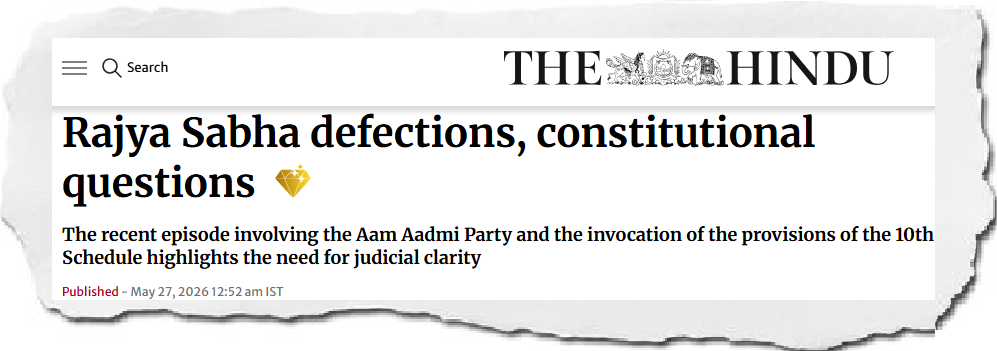
Why in News?
Recent developments involving MPs of the Aam Admi Party (AAP) in the Rajya Sabha have triggered a constitutional debate regarding the interpretation of the anti-defection law under the Tenth Schedule of the Constitution. Seven out of ten Rajya Sabha MPs reportedly claimed that more than two-thirds of the legislature party had decided to merge with the BJP, invoking the merger exception under Paragraph 4 of the Tenth Schedule. The issue raises broader questions regarding the relationship between political parties and legislature parties, and the constitutional limits of defections.
UPSC Relevance
Prelims: Tenth Schedule, 52nd Constitutional Amendment Act, 91st Constitutional Amendment Act, Articles 102–103, anti-defection provisions, role of Speaker/Chairman.
Mains:
GS II – Parliament and State Legislatures, constitutional provisions, anti-defection law, judicial review, parliamentary democracy, role of opposition.
Background/Context
Political defections have long posed a challenge to India’s parliamentary democracy. Frequent switching of party allegiance during the 1960s and 1970s, popularly associated with the phrase “Aya Ram, Gaya Ram”, raised concerns regarding political instability and unethical political practices.
The anti-defection framework was introduced to:
- Promote political stability.
- Prevent elected representatives from changing political loyalties for personal gains.
- Preserve the mandate given by voters.
- Strengthen party discipline.
The current controversy focuses on whether a legislature party can independently claim a merger without the original political party itself formally merging.
Evolution of the Anti-Defection Framework
Original Constitutional Position
Initially, the Constitution dealt with disqualification under Articles 102 and 103.
Article 102 provides grounds for disqualification of MPs, while Article 103 authorises the President to decide such disputes after obtaining the opinion of the Election Commission.
However, the Constitution originally did not specifically address defections.
Introduction of the Tenth Schedule
The anti-defection law was introduced through the 52nd Constitutional Amendment Act.
Major features included:
- Disqualification of legislators who voluntarily give up party membership.
- Disqualification for violating party whip directions.
- Authority vested in Speaker or Chairman to decide disqualification matters.
- Creation of exceptions through split and merger provisions.
What is Split Doctrine and Its Removal?
Initially, Paragraph 3 of the Tenth Schedule recognised the “split doctrine.”
Earlier split provision
- One-third members of a legislature party could form a separate faction.
- Such members were protected from disqualification.
However, this provision led to widespread misuse.
Consequently, the 91st Constitutional Amendment Act deleted Paragraph 3.
Recommendations supporting its removal included:
- Dinesh Goswami Committee
- 170th Law Commission Report
Significance of deleting the split provision
The deletion reflected a shift in constitutional philosophy:
- Greater importance to political parties over temporary legislative factions.
- Reduction of opportunistic defections.
- Reinforcement of collective democratic accountability.
Understanding the Merger Exception
The present issue concerns Paragraph 4 of the Tenth Schedule.
Under Paragraph 4, legislators may avoid disqualification if:
- The original political party merges with another political party.
- At least two-thirds of legislators agree to such merger.
Constitutional issue in the present controversy
The central question is:
Can two-thirds of members of a legislature party independently decide a merger, or must the original political party first merge?
A plain reading of Paragraph 4 suggests emphasis on the “original political party” rather than merely the legislature party.
If only legislative strength becomes decisive:
- Legislature parties could effectively control the fate of political parties.
- Internal dissent could override organisational identity.
- The deletion of the split doctrine could become meaningless.
Legislature Party vs Political Party
This distinction is crucial for understanding the constitutional issue.
| Political Party | Legislature Party |
|---|---|
| Registered organisation outside legislature | Members elected under party banner within legislature |
| Determines ideology and political identity | Functions inside legislative institutions |
| Continuous organisational existence | Exists only during legislative tenure |
The Tenth Schedule generally prioritises the political party as the principal democratic unit.
Supreme Court Judgments Relevant to Anti-Defection
Kihoto Hollohan vs Zachillhu
Key observations:
- Upheld constitutional validity of the Tenth Schedule.
- Allowed judicial review of Speaker’s decisions.
Subhash Desai vs Principal Secretary, Governor of Maharashtra
Key observations:
- Rejected interpretations that separate legislature parties entirely from political parties.
- Emphasised continuing control of the parent political party.
Nabam Rebia vs Deputy Speaker
Key observations:
- Discussed limitations on Speaker’s powers during pending removal proceedings.
Significance of Opposition in Parliamentary Democracy
The anti-defection law serves purposes beyond regulating individual conduct.
Functions of an effective opposition
- Ensures executive accountability.
- Provides alternative policy perspectives.
- Protects democratic deliberation.
- Prevents concentration of power.
Weakening opposition representation through defections may affect the broader functioning of parliamentary democracy.
Challenges and Criticisms of Anti-Defection Law
Restricts legislative independence: The law sometimes reduces MPs and MLAs to agents of party leadership, limiting deliberative democracy.
Delays in decisions by Presiding Officers: Speakers and Chairpersons often delay disqualification proceedings, creating uncertainty.
Scope for strategic interpretation: Terms such as “voluntarily giving up membership” and “merger” remain open to competing interpretations.
Possibility of partisan conduct: The Speaker or Chairman may be perceived as politically influenced.
Way Forward
Establish time-bound decision-making
Disqualification petitions should be decided within a constitutionally prescribed period.
Independent adjudicatory mechanism
Recommendations have been made by various commissions to shift decision-making from Speakers to independent tribunals or the Election Commission.
Clarify merger provisions
The Supreme Court or Parliament should provide greater clarity regarding the relationship between legislature parties and political parties.
Reconsider the scope of the whip
Party whip provisions may be restricted to confidence motions and critical legislation, allowing greater legislative freedom.
Conclusion
The present controversy extends beyond the immediate issue of Rajya Sabha defections. It concerns the constitutional architecture of parliamentary democracy itself. The anti-defection law was designed not merely to prevent political opportunism but also to preserve the integrity of the party system. Judicial clarification regarding the scope of the merger exception will significantly shape the future balance between political parties, legislators and democratic accountability.
Practice Questions
Prelims Question 1
Consider the following statements regarding the Tenth Schedule of the Constitution:
- It was inserted through the 52nd Constitutional Amendment Act.
- The split provision under Paragraph 3 was removed by the 91st Constitutional Amendment Act.
- Disqualification decisions under the Tenth Schedule are made by the Election Commission.
Which of the statements given above is/are correct?
(a) 1 and 2 only
(b) 2 and 3 only
(c) 1 and 3 only
(d) 1, 2 and 3
Answer: (a)
Explanation: Statements 1 and 2 are correct. Statement 3 is incorrect because decisions under the Tenth Schedule are taken by the Speaker or Chairman, subject to judicial review.
Prelims Question 2
With reference to the anti-defection law, consider the following:
- The merger exception requires support of at least two-thirds of members of a legislature party.
- The split doctrine currently exists in the Tenth Schedule.
- The Supreme Court has upheld judicial review of Speaker’s decisions.
Which of the above statements are correct?
(a) 1 only
(b) 1 and 3 only
(c) 2 and 3 only
(d) 1, 2 and 3
Answer: (b)
Explanation: Statement 2 is incorrect because the split provision was deleted by the 91st Constitutional Amendment Act.
Mains Questions
- Discuss the objectives and limitations of the anti-defection law in preserving parliamentary democracy in India.
- “The relationship between a political party and its legislature party lies at the heart of the constitutional debate on defections.” Examine.
Tell Google you want more of this.
Add Anantam IAS as a preferred sourceOne tap, and this site shows up more often in your own Top Stories, AI Overviews and AI Mode. Remove it any time.