

Why in News?
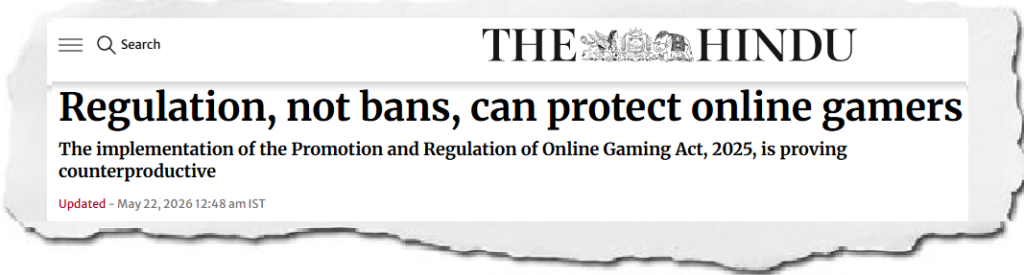
The implementation of the Promotion and Regulation of Online Gaming (PROG) Act, 2025, has triggered debate regarding the effectiveness of blanket prohibitions on online gaming involving money. Studies indicate that instead of reducing participation, many users have shifted toward unregulated offshore platforms, raising concerns about cybercrime, money laundering and consumer protection.
UPSC Relevance
Prelims: Information Technology Act, cybercrime, online gaming regulation, money laundering, digital governance.
Mains:
GS-II: Government policies and interventions; issues relating to governance and digital regulation.
GS-III: Cybersecurity, money laundering, digital economy and internal security.
Background/Context
The rapid expansion of internet penetration, digital payments and smartphone access has transformed online gaming into a large digital industry in India. Concerns over addiction, financial losses, privacy risks and youth vulnerability led to regulatory interventions by States and the enactment of the PROG Act, 2025.
However, restrictions on domestic platforms appear to have encouraged users to migrate to offshore and unregulated networks that function outside India’s legal framework. This has reopened the debate on whether regulation is preferable to outright prohibition.
Understanding Online Gaming Regulation in India
Online gaming broadly includes:
- Games of skill: Outcomes depend predominantly on expertise, strategy and knowledge.
- Games of chance: Outcomes depend primarily on luck and probability.
Indian courts have traditionally distinguished games of skill from gambling activities.
Key constitutional aspects
- Entry 34, State List: Betting and gambling fall under State jurisdiction.
- Entry 31, Union List: Telecommunications and digital communication networks involve Central jurisdiction.
- Article 19(1)(g): Guarantees freedom to practice trade or profession, subject to reasonable restrictions.
The digital nature of online gaming creates overlap between State and Central domains.
Major Concerns Emerging from Blanket Prohibitions
Migration toward offshore platforms
Restrictions on domestic platforms can redirect users toward foreign operators that remain outside regulatory oversight.
- Offshore entities frequently change domains and mirror websites.
- Users access services through VPNs and encrypted channels.
Consumer protection challenges
Unregulated platforms generally lack:
- Grievance redress mechanisms.
- Age verification systems.
- Deposit limits.
- Data protection safeguards.
Users often have limited legal recourse in cases of fraud.
Threat of money laundering and illegal finance
Illegal gaming networks can become channels for:
- Hawala transactions, Money laundering, Terror financing, Cyber-enabled fraud.
The use of “mule accounts” and anonymous digital transactions complicates investigations.
Cybersecurity and privacy risks
Offshore applications may collect sensitive user information without complying with Indian data protection standards.
Administrative limitations
Blocking websites alone may prove ineffective because:
- Domains can rapidly reappear.
- VPNs bypass geographic restrictions.
- Encrypted applications reduce traceability.
Wider Governance Lessons: Why Bans Often Face Limitations
Digital markets differ from conventional markets because digital services can cross borders instantly.
Examples from other sectors show that prohibitory approaches often lead to:
- Expansion of underground markets.
- Reduced regulatory visibility.
- Increased criminal activity.
- Weak enforcement capacity.
Thus, governance increasingly shifts from “prohibition” toward “risk management.”
International Experiences
United Arab Emirates
The UAE introduced a controlled licensing structure with:
- Strict compliance requirements.
- Financial monitoring systems.
- Deposit and spending limits.
- Consumer safeguards.
Sri Lanka
Sri Lanka is moving toward establishing a centralised gambling regulatory authority to monitor online activity.
Broader international trend
Many countries increasingly favour:
- Licensed operators.
- Responsible gaming norms.
- Real-time monitoring systems.
- Strong anti-money laundering measures.
Challenges in Building a Regulatory Framework
Jurisdictional overlap
Coordination between the Centre and States remains difficult because online platforms transcend territorial boundaries.
Technological sophistication of illegal networks
Illegal operators frequently use:
- VPNs
- Proxy servers
- Cryptocurrency payments
- Encrypted messaging services
Social concerns
Excessive online gaming can contribute to:
- Addiction
- Financial distress
- Psychological stress
- Youth vulnerability
Enforcement gaps
Regulatory agencies require stronger technological capabilities for monitoring digital ecosystems.
Key Terms
Offshore platform: A digital platform operating outside India’s legal and regulatory jurisdiction.
Money laundering: The process of concealing the origins of illegally obtained money and presenting it as legitimate income.
Mule account: A bank account used by criminals to transfer or hide illicit funds.
VPN (Virtual Private Network): Technology that masks a user’s location and internet activity.
Challenges/Criticisms
- Blanket bans may produce unintended consequences.
- Excessive restrictions can reduce regulatory visibility.
- Domestic industry and innovation may be adversely affected.
- Enforcement against foreign entities remains difficult.
- Social harms continue despite prohibition.
Way Forward
Develop a calibrated regulatory framework
India should move toward a licensing-based framework with strong accountability standards rather than complete prohibition.
Introduce responsible gaming safeguards
Mandatory age verification, deposit limits, spending caps and self-exclusion options can reduce harm.
Strengthen anti-money laundering mechanisms
Real-time monitoring of suspicious financial transactions and stronger KYC systems should be integrated.
Improve Centre-State coordination
A harmonised national framework with State participation can reduce regulatory fragmentation.
Enhance digital literacy and awareness
Public campaigns should educate users regarding financial risks, addiction and cyber fraud.
Build technological enforcement capacity
Artificial intelligence-based monitoring systems and cyber intelligence tools can strengthen oversight.
Conclusion
Digital governance increasingly requires balancing innovation with public welfare. The challenge before India is not merely whether online gaming should be allowed or banned, but how a transparent and accountable regulatory ecosystem can protect users while preventing the expansion of illegal networks.
Practice Questions
Prelims MCQ 1
With reference to online gaming regulation in India, consider the following statements:
- Betting and gambling fall exclusively under the Union List of the Constitution.
- VPNs can make enforcement against offshore platforms more difficult.
- Money laundering risks may increase through unregulated online platforms.
Which of the statements given above is/are correct?
(a) 1 only
(b) 2 and 3 only
(c) 1 and 3 only
(d) 1, 2 and 3
Correct Answer: (b)
Explanation: Betting and gambling are primarily in the State List. VPNs and unregulated offshore platforms can complicate enforcement and facilitate illegal financial activities.
Prelims MCQ 2
Consider the following:
- Deposit limits
- Age verification
- Self-exclusion mechanisms
- Grievance redress systems
Which of the above can be used as responsible gaming safeguards?
(a) 1 and 2 only
(b) 1, 2 and 3 only
(c) 2, 3 and 4 only
(d) 1, 2, 3 and 4
Correct Answer: (d)
Explanation: All are internationally used safeguards to reduce risks associated with online gaming.
Mains Questions
- “Blanket prohibitions in digital markets often create unintended governance challenges.” Examine in the context of online gaming regulation in India.
- Discuss the challenges involved in regulating offshore digital platforms in India. Suggest a framework that balances innovation, consumer protection and cybersecurity.
Tell Google you want more of this.
Add Anantam IAS as a preferred sourceOne tap, and this site shows up more often in your own Top Stories, AI Overviews and AI Mode. Remove it any time.






