Why in News?
The Union Minister of State (Independent Charge) for Law and Justice launched the revamped India Code Portal on 13 August 2026 at Kartavya Bhavan 2 in New Delhi.
- The portal adds AI-assisted interaction, semantic search and speech-based search alongside improved conventional search and navigation.
- It is designed to connect principal Acts with subordinate legislation, amendment information and legislative history, reducing the need to search across separate document collections.
- The announced revamp includes e-Gazette integration, improved document viewing, QR-enabled access and a structured citizen-feedback mechanism.
- The government says the system seeks to enable AI-assisted multilingual access in all 22 languages in the Eighth Schedule to the Constitution.
- The portal remains an official repository covering Central Acts and subordinate legislation, State Acts and subordinate legislation, and Union Territory legislation and regulations.
- Access to law is not satisfied merely by placing scanned documents online. A citizen must be able to discover the applicable rule, identify amendments and connect an Act with rules, regulations, notifications and orders made.
- A consolidated public platform can reduce information asymmetry between institutions and ordinary users, supporting legal awareness, administrative accountability and more informed participation.
- AI-based discovery can improve usability, but an AI-generated response is a navigation aid. The controlling legal text, commencement notification, amendment status and judicial interpretation still require verification.
UPSC Relevance
Prelims Relevance
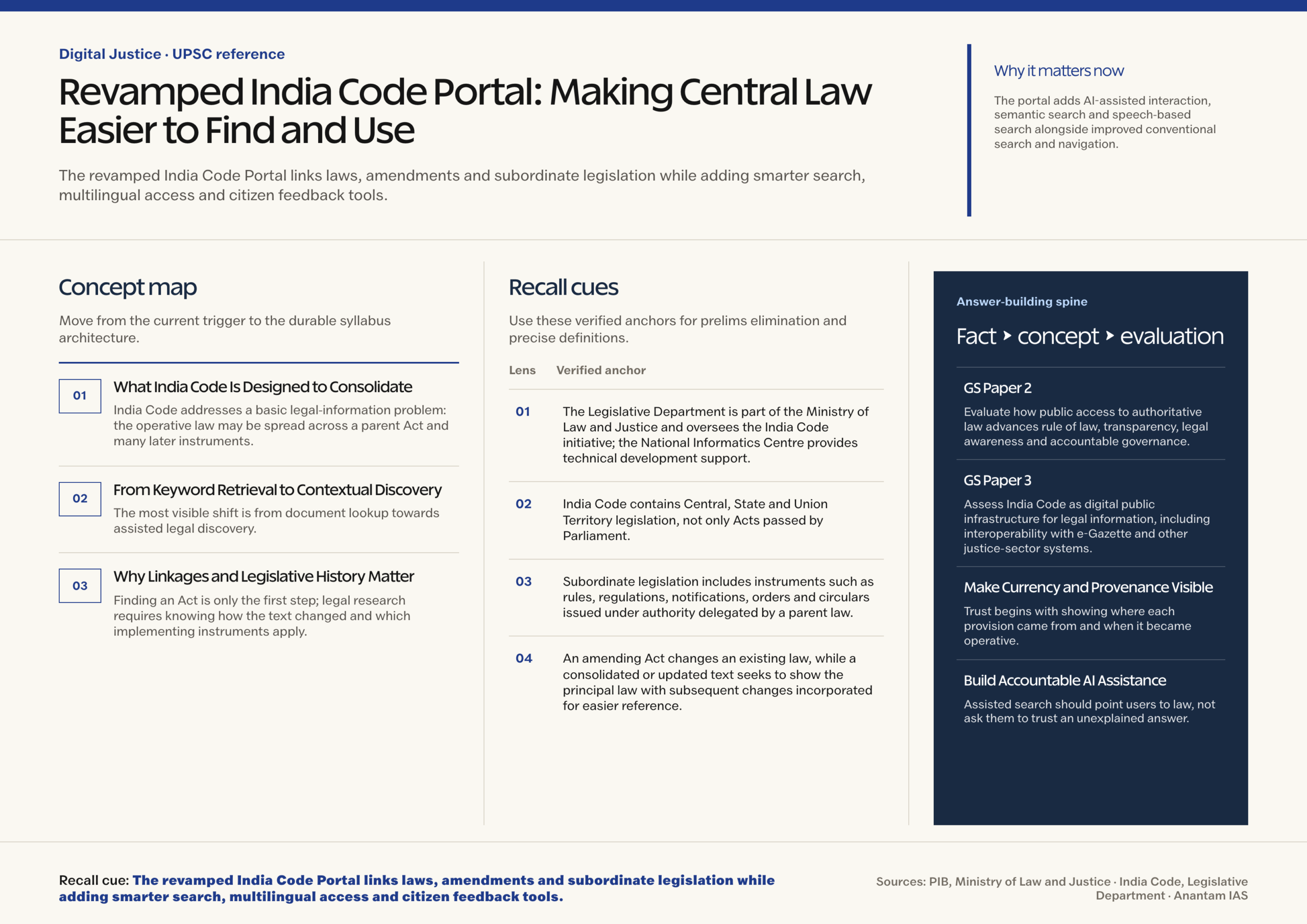
- The Legislative Department is part of the Ministry of Law and Justice and oversees the India Code initiative; the National Informatics Centre provides technical development support.
- India Code contains Central, State and Union Territory legislation, not only Acts passed by Parliament.
- Subordinate legislation includes instruments such as rules, regulations, notifications, orders and circulars issued under authority delegated by a parent law.
- An amending Act changes an existing law, while a consolidated or updated text seeks to show the principal law with subsequent changes incorporated for easier reference.
- The e-Gazette is the official electronic publication system for Gazette notifications; linking it with India Code can improve traceability from consolidated law to official notification.
- The Eighth Schedule to the Constitution lists 22 languages; it is distinct from the provisions on the official language of the Union.
Mains Relevance
GS Paper 2
- Evaluate how public access to authoritative law advances rule of law, transparency, legal awareness and accountable governance.
- Examine the institutional challenge of maintaining a current repository across Parliament, State legislatures, Union Territory administrations and multiple rule-making authorities.
GS Paper 3
- Assess India Code as digital public infrastructure for legal information, including interoperability with e-Gazette and other justice-sector systems.
- Analyse AI governance concerns such as source attribution, version control, hallucinated answers, personal-data minimisation, security and independent audits.
Essay
- Law that cannot be found or understood may exist formally while remaining distant from the citizen in practice.
Background and Context
What India Code Is Designed to Consolidate
India Code addresses a basic legal-information problem: the operative law may be spread across a parent Act and many later instruments.
- A principal Act establishes the legal framework, but its working details may depend on rules, regulations, notifications, orders, schemes and commencement provisions issued later.
- The official portal describes itself as a database of Central enactments in force and their subordinate legislation; it also carries legislation enacted by States and Union Territory administrations and related subordinate instruments.
- Its search fields include short title, Act number, Act year, enactment date, ministry and department, along with free-text search. The revamp adds more intelligent discovery on top of this structured base.
- A unified repository helps users move from knowing a legal issue to locating the relevant statute. It is especially useful when a user knows a concept but not the exact title or section of the law.
From Keyword Retrieval to Contextual Discovery
The most visible shift is from document lookup towards assisted legal discovery.
- Semantic search can connect a natural-language query with conceptually related provisions even when the user’s words do not exactly match the statutory language.
- Speech-based search can lower the barrier for people who find typing difficult, use mobile devices, or are more comfortable asking a question orally.
- AI-assisted interaction may guide users toward relevant Acts, sections or subordinate instruments. Its public value depends on showing the source provision and document version behind every result.
- Search ranking must not make a convenient summary appear more authoritative than the enacted text. A safe design should keep a clear route from every generated explanation to the official legal document.
Why Linkages and Legislative History Matter
Finding an Act is only the first step; legal research requires knowing how the text changed and which implementing instruments apply.
- The revamped portal promises easier access to amendments and legislative history. This can help users distinguish an original enactment from its current form and trace the policy’s evolution.
- Linking an Act to relevant subordinate legislation makes delegated law more visible. This matters because many operational duties, procedures, forms, standards and exemptions are set outside the parent Act.
- Integration with the e-Gazette ecosystem can provide a traceable path to official publication, especially for commencement dates, appointments, rule changes and notifications.
- Version history should state the effective date of each change. Enactment, publication, assent and commencement can occur on different dates, and treating them as interchangeable can produce legal error.
Access to Law as a Governance Capability
Reliable legal information supports both individual rights and institutional performance.
- Citizens can better understand entitlements, duties and procedures when the applicable law is free, searchable and connected to its implementing instruments.
- Officials can use a common reference point across departments, reducing inconsistent reliance on outdated local copies. Lawyers, courts, researchers and businesses gain a faster starting point for due diligence.
- Better access supports the rule-of-law values of publicity, predictability and equality before law. These benefits arise only when the database is accurate, current and usable by people with different abilities and languages.
- A citizen-feedback channel can expose missing documents, broken links or search failures. The platform should publish service standards for acknowledgement, correction and closure so feedback becomes an accountability mechanism.
Way Forward
Make Currency and Provenance Visible
- Display the source Gazette, amendment chain, commencement notification, territorial extent and version date beside every provision.
- Create automatic mismatch alerts between India Code and e-Gazette records, followed by a documented human correction workflow.
- Publish ministry-wise and State-wise dashboards for missing or overdue instruments without presenting an incomplete record as exhaustive.
Conclusion
- The revamped India Code Portal can make the rule of law more practical by connecting citizens with searchable, traceable and multilingual legislative information.
- The decisive test will be trustworthy upkeep .
UPSC Practice Questions
Prelims MCQ 1
With reference to the revamped India Code Portal, consider the following statements:
- It covers only Central Acts passed by Parliament.
- It seeks to link Acts with relevant subordinate legislation.
- It includes semantic and speech-based search among its announced features.
How many of the above statements are correct?
(a) Only one (b) Only two (c) All three (d) None
Answer: (b) Only two
Explanation:
Statements 2 and 3 are correct. India Code is not confined to Central Acts; it also covers State and Union Territory legislation and related subordinate legislation.
Prelims MCQ 2
Which one of the following best describes subordinate legislation?
(a) A constitutional amendment ratified by State legislatures (b) A judgment that overrules an earlier precedent (c) Rules or regulations made under authority delegated by a parent law (d) A private member’s Bill pending before Parliament
Answer: (c) Rules or regulations made under authority delegated by a parent law
Explanation:
Subordinate or delegated legislation is made by an authorised executive or other body under powers conferred by a parent statute. It operates within the limits set by that statute.
UPSC Mains Questions
- Access to law is the first step towards access to justice. Discuss in the context of the revamped India Code Portal and India’s digital-governance architecture.
- AI-assisted legal search can widen access while also creating new risks for accuracy and accountability. Examine the safeguards required for a trustworthy public legal-information system.
Sources: PIB, Ministry of Law and Justice and India Code, Legislative Department.
Frequently Asked Questions
What is the India Code Portal?
India Code is an official digital repository for Central, State and Union Territory legislation and related subordinate legislation. It helps users search Acts and associated legal instruments through structured fields and free text. The revamped portal adds assisted search, stronger.
What changed in the revamped India Code Portal?
The announced features include AI-assisted, semantic and speech-based search, improved navigation and document viewing, amendment and legislative-history access, links between Acts and subordinate legislation, e-Gazette integration, QR-enabled access, multilingual capability and structured citizen feedback.
Does India Code contain only Central laws?
No. The portal states that it contains Central Acts, State Acts and Union Territory legislation, along with relevant subordinate legislation. Coverage and updating still depend on the responsible public authorities supplying and maintaining the underlying records.
What is semantic search in a legal portal?
Semantic search seeks results based on meaning and context, not only an exact keyword. It can help a citizen discover a relevant provision without knowing its formal title, but the user should still open and verify the cited statutory.
Can an AI answer on India Code be treated as legal advice?
No. AI assistance should be treated as a discovery and navigation tool. Legal effect may depend on amendments, commencement, jurisdiction, rules and court interpretation. Users should verify the official text and seek qualified advice where rights or liabilities are.
Tell Google you want more of this.
Add Anantam IAS as a preferred sourceOne tap, and this site shows up more often in your own Top Stories, AI Overviews and AI Mode. Remove it any time.