

Why in News?
The Ministry of Cooperation celebrated its 5th Foundation Day on July 6, 2026, at Bharat Mandapam, New Delhi. PIB released a backgrounder, ‘Sahkar Se Samriddhi: Five Years of Strengthening India’s Cooperative Movement’, taking stock of reforms since the ministry was carved out as a standalone ministry on July 6, 2021.
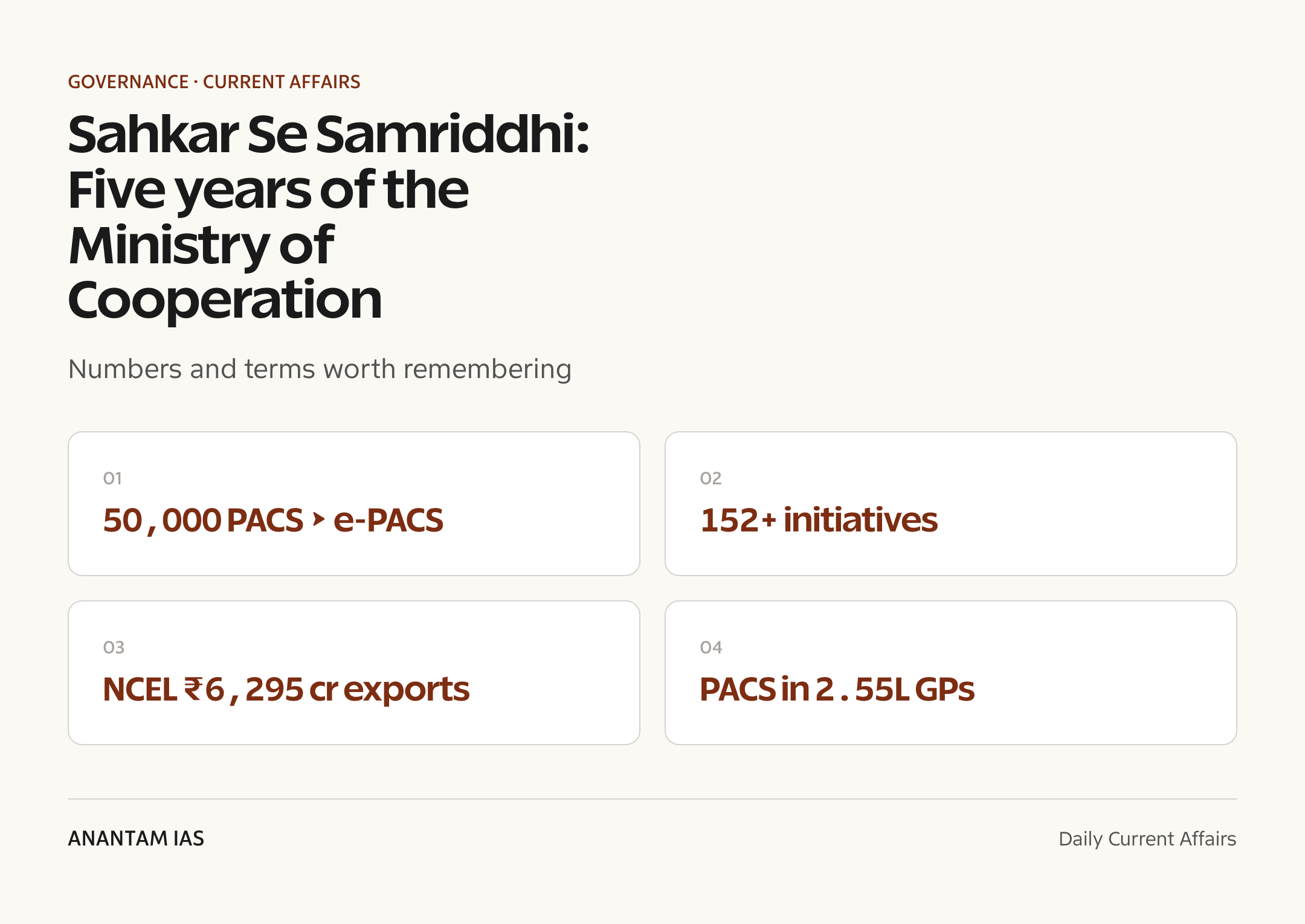
The headline announcement: 50,000 Primary Agricultural Credit Societies (PACS) have been transformed into digital e-PACS, foundation stones were laid for 47 cooperative grain-storage godowns, a Milk Supply Review Dashboard was launched for the National Dairy Development Board, and NUCFDC unveiled Sahakar CBS and Sahakar Sahyogi for urban cooperative banks.
- 50,000 PACS converted into e-PACS — the flagship milestone of the day, part of the drive to computerise 63,000 PACS by March 31, 2027.
- Foundation stones laid for 47 grain-storage godowns under the world’s largest decentralised grain-storage plan run through cooperatives.
- A Milk Supply Review Dashboard Portal launched for the National Dairy Development Board (NDDB) to track milk procurement and distribution.
- Sahakar CBS — a centralised Core Banking Solution for Urban Cooperative Banks — and Sahakar Sahyogi, a conversational AI platform for customer services, unveiled by NUCFDC.
- PIB confirmed that over 152 major initiatives have been launched since the ministry’s creation in 2021.
The development matters in the context of:
- The ministry embodies the ‘Sahkar se Samriddhi’ (prosperity through cooperation) vision — turning cooperatives from narrow credit societies into multi-service engines of the rural economy.
- India runs one of the largest cooperative ecosystems in the world, spanning credit, dairy, fisheries, housing, sugar and marketing — so institutional reform here touches crores of members directly.
- The five-year report card is a ready-made case study for Mains answers on cooperative federalism, rural credit and inclusive growth.
UPSC Relevance
Prelims Relevance
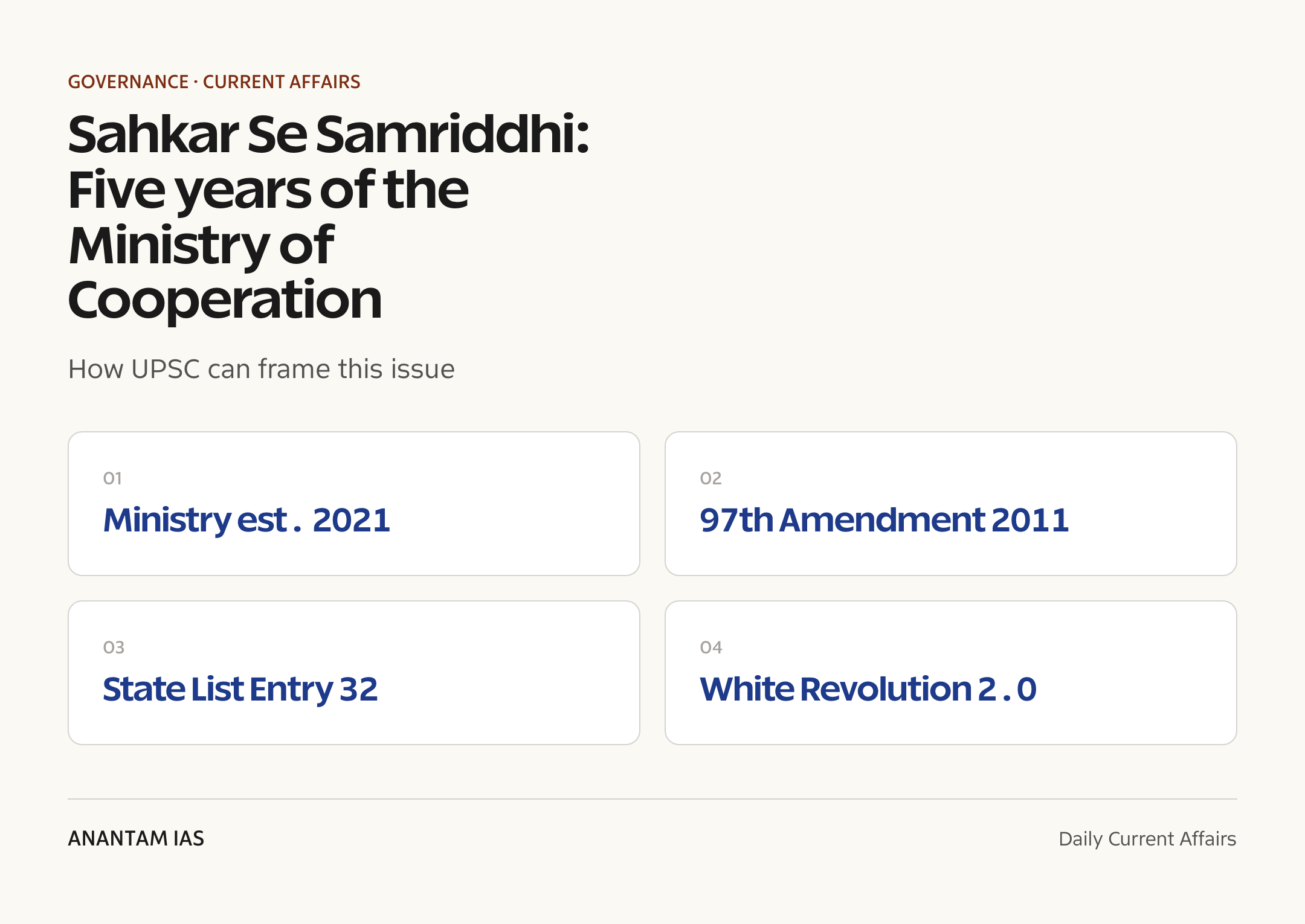
- Ministry of Cooperation — created on July 6, 2021 by carving the cooperation portfolio out of the Ministry of Agriculture and Farmers Welfare.
- PACS — Primary Agricultural Credit Societies, the base tier of the short-term cooperative credit structure; model bye-laws now let them run 25+ business activities in 32 states/UTs.
- e-PACS — PACS running on a common ERP software available in 14 languages; 50,000 transformed so far, target 63,000 by March 2027.
- NUCFDC — National Urban Cooperative Finance and Development Corporation, the umbrella body for urban cooperative banks; launched Sahakar CBS and Sahakar Sahyogi.
- Three new national multi-state cooperatives: NCEL (exports), NCOL (organics), BBSSL (seeds, brand ‘Bharat Beej’).
- Tribhuvan Sahkari University — India’s first national cooperative university.
- White Revolution 2.0 — targets a 50% rise in milk procurement by 2028-29, with a focus on women-led dairy cooperatives.
- Constitutional anchors: 97th Constitutional Amendment Act, 2011 — Article 19(1)(c) (right to form cooperatives), Article 43B (DPSP), Part IXB; ‘Cooperative societies’ is Entry 32, State List.
- NCDC — National Cooperative Development Corporation; sanctioned ₹1.55 lakh crore and disbursed ₹1.27 lakh crore in FY 2025-26.
- Bharat Taxi — India’s first cooperative-based mobility platform, run by Sahakar Taxi Cooperative Limited.
Mains Relevance
GS Paper 2
- Governance reform: a dedicated ministry as an instrument of institutional focus — what changed after cooperation moved out of the Agriculture Ministry.
- Cooperative federalism: cooperation is a State subject (Entry 32, State List); the Centre steers reform through model bye-laws, funding and multi-state legislation rather than direct control.
- Service delivery through PACS — Common Service Centres, Jan Aushadhi Kendras and PM Kisan Samriddhi Kendras as last-mile governance platforms.
GS Paper 3
- Rural credit architecture: digitised PACS, NABARD linkages and the health of the short-term cooperative credit structure.
- Agri-infrastructure: the decentralised grain-storage plan through cooperatives as a fix for post-harvest losses.
- Inclusive growth: cooperatives, FPOs and White Revolution 2.0 as instruments for doubling farm-gate value realisation.
Essay
- Collective ownership as a third path between state and market — the cooperative model in India’s growth story.
- Technology as the great leveller: what digitising a village credit society says about inclusive digital public infrastructure.
Background and Context
The Ministry of Cooperation: why a separate ministry
The ministry was created to give the cooperative sector a dedicated administrative, legal and policy framework of its own.
- Established on July 6, 2021, by carving the cooperation portfolio out of the Ministry of Agriculture and Farmers Welfare, with the motto ‘Sahkar se Samriddhi’.
- Its mandate: streamline processes for ease of doing business for cooperatives, deepen cooperatives as true people-based movements, and develop multi-state cooperative societies (MSCS).
- PIB counts 152+ major initiatives in five years — from model bye-laws and PACS computerisation to three new national-level cooperative bodies and a cooperative university.
- The constitutional frame: the 97th Amendment (2011) made forming cooperatives a fundamental right under Article 19(1)(c) and added Article 43B (DPSP) and Part IXB; the Supreme Court in Union of India v. Rajendra N. Shah (2021) confined Part IXB to multi-state cooperatives, since ‘cooperative societies’ sits in Entry 32 of the State List.
- The Multi-State Co-operative Societies (Amendment) Act, 2023 tightened governance, elections and audit norms for MSCS.
PACS 2.0: from credit windows to rural growth centres
PACS — the village-level base of the cooperative credit pyramid — are being re-engineered into multi-service hubs.
- Model bye-laws adopted in 32 states/UTs now allow PACS to take up 25+ business activities — retail, storage, healthcare, fuel and digital services — beyond lending.
- 54,117 PACS function as Common Service Centres (CSCs), delivering e-governance services in villages.
- 39,177 PACS operate as PM Kisan Samriddhi Kendras; 4,248 PACS are approved as Jan Aushadhi Kendras (843 ready to function).
- 394 PACS have applied for retail fuel outlets, with 3 already commissioned.
- Coverage push: 37,454 new multipurpose PACS, dairy and fisheries societies registered; PACS now present in over 2.55 lakh Gram Panchayats, dairy cooperatives in 87,159 and fisheries cooperatives in 29,964 panchayats.
Digitising the base tier: the e-PACS project
Computerisation is the backbone reform — a common ERP that plugs every PACS into the NABARD-linked credit system.
- Financial outlay raised to ₹2,925.39 crore (2025) from the initial ₹2,516 crore approved in 2022; the target is 63,000 PACS by March 31, 2027.
- 79,630 PACS sanctioned for computerisation; 63,428 already run the common ERP software, available in 14 languages.
- Hardware delivered to over 65,000 PACS; online audits completed in more than 42,700 PACS — a direct transparency gain.
- The 50,000 e-PACS milestone announced on Foundation Day marks the visible face of this transformation: standardised accounting, real-time monitoring and faster credit delivery.
Storage, dairy and urban cooperative banking
Three sectoral pushes anchor the second phase of reforms — grain storage, White Revolution 2.0 and urban cooperative banks.
- The world’s largest decentralised grain-storage plan is being executed through PACS: godowns completed in 145 PACS with over 68,702 MT capacity, and foundation stones for 47 more godowns laid on Foundation Day — cutting post-harvest losses and letting farmers time the market.
- White Revolution 2.0 targets a 50% increase in milk procurement by 2028-29; 25,282 dairy cooperative societies registered so far, with an explicit focus on women-led dairy cooperatives. The new NDDB Milk Supply Review Dashboard gives real-time visibility into procurement and distribution.
- For urban cooperative banks, NUCFDC launched Sahakar CBS — a shared, centralised Core Banking Solution — and Sahakar Sahyogi, a conversational AI-powered platform for customer service and banking operations, addressing the technology gap that has long weakened this segment.
New national institutions and export muscle
Three multi-state cooperative societies created in 2023 give the sector national-scale aggregation for the first time.
- National Cooperative Exports Limited (NCEL) — umbrella exporter for cooperative produce; recorded 15.4 LMT of exports worth ₹6,295 crore to 38 countries as of June 2026.
- National Cooperative Organics Limited (NCOL) — aggregates, certifies and markets organic produce; 14,286 member cooperatives.
- Bharatiya Beej Sahakari Samiti Limited (BBSSL) — produces and distributes quality seeds under the ‘Bharat Beej’ brand; 38,665 member cooperatives.
- Tribhuvan Sahkari University — India’s first cooperative university — anchors education, research and skilling, alongside training by the National Council for Cooperative Training (NCCT) and NABARD.
- Bharat Taxi, run by Sahakar Taxi Cooperative Limited, extends the model to urban mobility — a driver-owned alternative to aggregator platforms.
Finance and tax: easing the money side
Financing and tax parity reforms have improved cooperative liquidity and competitiveness against companies.
- NCDC sanctioned ₹1.55 lakh crore and disbursed ₹1.27 lakh crore in FY 2025-26 — the sector’s principal development financier.
- ₹2,320 crore disbursed to FPOs and Cluster-Based Business Organisations under the 10,000 FPOs scheme (as of May 2026); 1,863 FPOs formed in the cooperative sector, 1,117 of them through PACS, plus 1,070 fisheries FPOs supported with ₹98 crore.
- Tax relief: surcharge cut from 12% to 7% for cooperatives earning ₹1–10 crore; MAT reduced from 18.5% to 15%, matching companies.
- The TDS-free cash withdrawal limit raised from ₹1 crore to ₹3 crore, with higher cash transaction limits for PACS and primary cooperative agriculture and rural development banks.
Way Forward
Deepen, don't just digitise
- Move from hardware roll-out to usage quality — regular online audits, credit-history building for members, and interoperability of PACS ERP with banks and government platforms.
- Extend viable PACS coverage to the remaining uncovered Gram Panchayats, prioritising the Northeast and hill states where cooperative density is thin.
Governance and federal trust
- Professionalise boards and audits so cooperatives shed the legacy of political capture and dormancy; the model bye-laws work only if states enforce them.
- Since cooperation is a State subject, sustained Centre-state coordination — not central direction — must drive the next phase; states need capacity support to match the reform pace.
- Ensure new national bodies like NCEL and NCOL pass gains back to member societies transparently, so aggregation doesn’t become a new layer of middlemen.
Conclusion
Five years in, the Ministry of Cooperation has converted a neglected sector into a visible reform theatre: a digitised PACS base, national aggregators for exports, organics and seeds, a cooperative university, and a decentralised storage network. The 50,000 e-PACS milestone shows the plumbing is being rebuilt, not just repainted.
The test now shifts from creation to performance — whether member incomes rise, urban cooperative banks stabilise on shared technology, and states co-own the reform. If they do, ‘Sahkar se Samriddhi’ becomes more than a motto; it becomes India’s third engine of growth beside the state and the market.
UPSC Practice Questions
Prelims MCQ 1
With reference to India’s cooperative sector, consider the following statements:
- The Ministry of Cooperation was created in 2021 by carving the cooperation portfolio out of the Ministry of Agriculture and Farmers Welfare.
- Sahakar CBS is a centralised core banking solution developed for Regional Rural Banks.
- Tribhuvan Sahkari University is India’s first cooperative university.
How many of the above statements are correct?
(a) Only one (b) Only two (c) All three (d) None
Answer: (b) Only two
Explanation:
Statements 1 and 3 are correct. Sahakar CBS, launched by NUCFDC, is a centralised Core Banking Solution for Urban Cooperative Banks, not Regional Rural Banks — statement 2 is wrong.
Prelims MCQ 2
The brand ‘Bharat Beej’, in the news recently, is associated with which of the following organisations?
(a) National Cooperative Exports Limited (NCEL) (b) National Cooperative Organics Limited (NCOL) (c) Bharatiya Beej Sahakari Samiti Limited (BBSSL) (d) National Dairy Development Board (NDDB)
Answer: (c) Bharatiya Beej Sahakari Samiti Limited (BBSSL)
Explanation:
BBSSL, one of three national multi-state cooperatives set up in 2023, produces and distributes quality seeds under the ‘Bharat Beej’ brand through the cooperative network; it had 38,665 member cooperatives as of June 2026.
UPSC Mains Questions
- The creation of the Ministry of Cooperation marked a shift from treating cooperatives as credit channels to treating them as engines of rural enterprise. Examine this shift with reference to the PACS reforms undertaken since 2021.
- Cooperation is a State subject, yet the most consequential cooperative reforms of the last five years have come from the Union government. Discuss the tools the Centre has used and the federal tensions this model must manage.
- Digitisation of Primary Agricultural Credit Societies can transform rural credit delivery, but technology alone cannot fix governance deficits in cooperatives. Critically analyse.
Source: PIB, Ministry of Cooperation.
Frequently Asked Questions
What is Sahkar Se Samriddhi?
‘Sahkar se Samriddhi’ — prosperity through cooperation — is the guiding vision of the Ministry of Cooperation, created on July 6, 2021. It aims to strengthen cooperatives as people-owned institutions, streamline their regulation, and expand them into new sectors like exports, organics, seeds and urban mobility.
What are e-PACS?
e-PACS are Primary Agricultural Credit Societies running on a common ERP software, available in 14 languages, that standardises accounting, enables online audits and links them to the cooperative credit system. By the ministry’s 5th Foundation Day in July 2026, 50,000 PACS had been transformed into e-PACS, against a target of 63,000 by March 2027.
What are Sahakar CBS and Sahakar Sahyogi?
Both were launched by NUCFDC, the umbrella body for urban cooperative banks. Sahakar CBS is a centralised Core Banking Solution that lets urban cooperative banks share modern banking technology, while Sahakar Sahyogi is a conversational AI-powered platform for customer services and banking operations.
Which new national cooperative bodies were set up?
Three multi-state cooperatives were created: National Cooperative Exports Limited (NCEL) for exports (₹6,295 crore to 38 countries by June 2026), National Cooperative Organics Limited (NCOL) for organic produce, and Bharatiya Beej Sahakari Samiti Limited (BBSSL) for quality seeds under the ‘Bharat Beej’ brand.
Is cooperation a Union or State subject?
Cooperative societies fall under Entry 32 of the State List, so states legislate for ordinary cooperatives. The Union governs multi-state cooperative societies. The 97th Constitutional Amendment (2011) added Part IXB, which the Supreme Court in 2021 confined to multi-state cooperatives only.
What is White Revolution 2.0?
White Revolution 2.0 is the cooperative dairy strategy targeting a 50% increase in milk procurement by 2028-29. It emphasises registering new dairy cooperative societies — 25,282 so far — expanding coverage to uncovered villages, and promoting women-led dairy cooperatives.
Tell Google you want more of this.
Add Anantam IAS as a preferred sourceOne tap, and this site shows up more often in your own Top Stories, AI Overviews and AI Mode. Remove it any time.





