
Why in News?
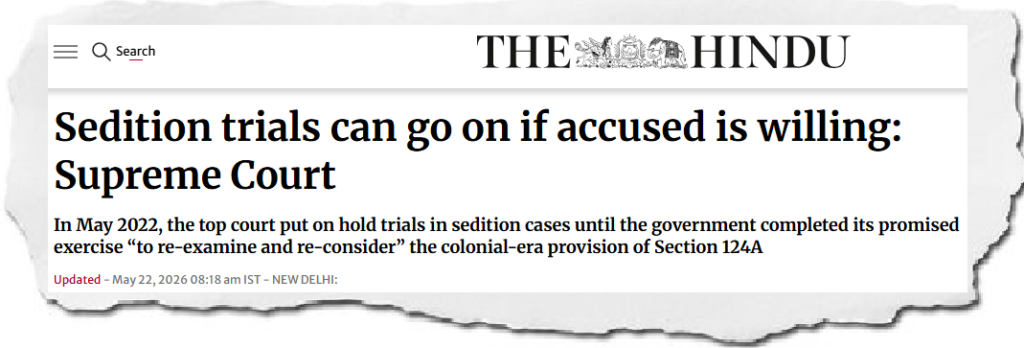
The Supreme Court recently clarified that trials, appeals, and related proceedings involving sedition under Section 124A of the Indian Penal Code (IPC) may continue if the accused has no objection. The clarification comes four years after the Court had put a stay on pending sedition proceedings while the Union government reconsidered the colonial-era provision.
UPSC Relevance:
Prelims: Sedition law, Article 19, Article 21, UAPA,
Mains: GS II (Fundamental Rights, Judiciary, Criminal Justice Reforms).
Background/Context
The offence of sedition under Section 124A IPC was introduced by the British colonial administration in 1870 to suppress dissent and nationalist movements.
The law criminalised acts or speech that brought or attempted to bring hatred, contempt, or disaffection against the government established by law.
Several freedom fighters including Mahatma Gandhi and Bal Gangadhar Tilak were prosecuted under this provision.
Following independence, the provision continued in the IPC and became the subject of constitutional debate due to concerns regarding freedom of speech and expression.
In May 2022, the Supreme Court, while hearing challenges to Section 124A, suspended ongoing sedition proceedings and expected governments to refrain from filing new cases until the Union government completed a review of the provision.
The latest order clarifies that proceedings can continue if the accused voluntarily seeks continuation of trial or appeal.
Understanding Sedition under Section 124A IPC
Section 124A of IPC punished actions or expressions that attempted to create:
- Hatred against the government.
- Contempt toward the government.
- Disaffection against the government.
Punishment included:
- Life imprisonment, or
- Imprisonment up to three years along with fines.
The law was criticised because of broad and vague expressions that could potentially criminalise legitimate criticism and dissent.
Judicial Evolution of Sedition Law
Kedar Nath Singh v. State of Bihar
The Supreme Court upheld the constitutional validity of Section 124A while limiting its scope.
The Court held that sedition applies only when speech:
- Incites violence; or
- Creates public disorder.
Mere criticism of government policies was held insufficient to constitute sedition.
Supreme Court Interim Order (2022)
The Court observed that there was a need to balance:
- National security and sovereignty concerns.
- Protection of civil liberties and fundamental rights.
The Court accordingly:
- Suspended ongoing proceedings.
- Expected governments to avoid registering fresh cases.
- Directed reconsideration of the provision.
Present Clarification (2026)
The Supreme Court has clarified that:
- Trials may proceed if the accused consents.
- Courts may decide cases on merits according to law.
- Judicial review of sedition provisions remains pending.
Sedition and Bharatiya Nyaya Sanhita (BNS)
Though Section 124A IPC has effectively ceased to operate after replacement of IPC by BNS, concerns continue regarding Section 152 of the BNS.
Section 152 criminalises acts involving:
- Endangering sovereignty.
- Endangering unity and integrity of India.
- Encouraging separatist activities.
- Subversive actions against the State.
Critics argue that some provisions resemble or expand the scope of the earlier sedition framework.
Supporters contend that the provision focuses more directly on threats against national integrity rather than criticism of government.
Constitutional Dimensions
Article 19(1)(a): Freedom of speech and expression
Citizens have the right to express opinions and criticise the government.
Article 19(2): Reasonable restrictions
Restrictions may be imposed in the interests of:
- Sovereignty and integrity of India
- Security of the State
- Public order
- Friendly relations with foreign states
Article 21: Right to life and personal liberty
The right includes:
- Fair procedure
- Protection against arbitrary detention
- Speedy trial
Challenges and Concerns
Vagueness and Broad Interpretation
Terms such as “disaffection” or “subversive activity” may be interpreted broadly, increasing risks of misuse.
Prolonged Undertrial Detention
Individuals accused under national security laws often remain incarcerated for extended periods before trial completion.
Chilling Effect on Free Speech
Fear of prosecution may discourage criticism, debate and democratic participation.
Balancing Security and Liberty
The State has a legitimate responsibility to protect national integrity, but this must be balanced against constitutional freedoms.
Continuity of Colonial Legal Legacy
Retention of colonial-era provisions raises questions regarding compatibility with democratic constitutional values.
Way Forward
Clear Legislative Definitions
Parliament should ensure precise and narrow definitions of offences affecting sovereignty and national security to avoid misuse.
Strengthening Judicial Safeguards
Courts should continue applying strict standards requiring evidence of incitement to violence or public disorder.
Ensuring Speedy Trials
Cases involving national security offences should be fast-tracked to avoid prolonged incarceration.
Periodic Review of Criminal Laws
Criminal provisions affecting civil liberties should be periodically reassessed according to constitutional principles.
Protecting Democratic Dissent
Legal frameworks should distinguish between legitimate criticism of government and genuine threats to national security.
Conclusion
Democratic systems require both national security and constitutional freedoms. The Supreme Court’s clarification reflects continuing attempts to balance these competing concerns. As India reforms its criminal justice architecture through new legislation, ensuring that security laws do not suppress legitimate dissent remains essential to preserving constitutional democracy.
Practice Questions
Prelims Question 1
With reference to sedition law in India, consider the following statements:
- Section 124A of the IPC was introduced during British rule.
- The Supreme Court in the Kedar Nath Singh case held that mere criticism of the government amounts to sedition.
- Article 19(2) permits reasonable restrictions on freedom of speech.
Which of the statements given above is/are correct?
(a) 1 only
(b) 1 and 3 only
(c) 2 and 3 only
(d) 1, 2 and 3
Correct Answer: (b)
Explanation:
Statement 2 is incorrect because the Supreme Court restricted sedition to acts involving incitement to violence or public disorder.
Prelims Question 2
Consider the following rights:
- Freedom of speech and expression
- Right to life and personal liberty
- Right against arbitrary detention
Which of the above are associated with debates surrounding sedition laws?
(a) 1 only
(b) 1 and 2 only
(c) 1, 2 and 3
(d) 2 and 3 only
Correct Answer: (c)
Explanation:
Debates over sedition involve free speech protections under Article 19 and personal liberty protections under Article 21, including concerns over arbitrary detention.
Mains Question
- Discuss the constitutional issues surrounding sedition laws in India. How can national security concerns be balanced with freedom of expression?
- Examine whether criminal law reforms under the Bharatiya Nyaya Sanhita adequately address concerns regarding misuse of sedition provisions.
Tell Google you want more of this.
Add Anantam IAS as a preferred sourceOne tap, and this site shows up more often in your own Top Stories, AI Overviews and AI Mode. Remove it any time.