Why in News?
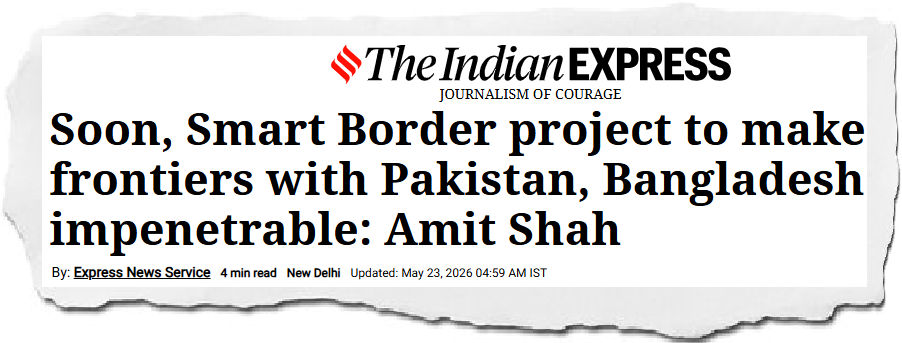
Union Home Minister Amit Shah announced that India is preparing to introduce a “Smart Border” concept aimed at strengthening security along the India-Pakistan and India-Bangladesh borders. The proposed model seeks to combine surveillance technologies such as drones, radars and sensors with coordinated intelligence mechanisms to prevent infiltration, illegal migration, smuggling and emerging security threats.
UPSC Relevance
Prelims: Border Security Force (BSF), Smart Border Management, India’s international borders, illegal migration, border infrastructure initiatives.
Mains:
GS II: Governance, federalism, migration and internal security;
GS III: Border management, security challenges, technology in internal security.
Background/Context
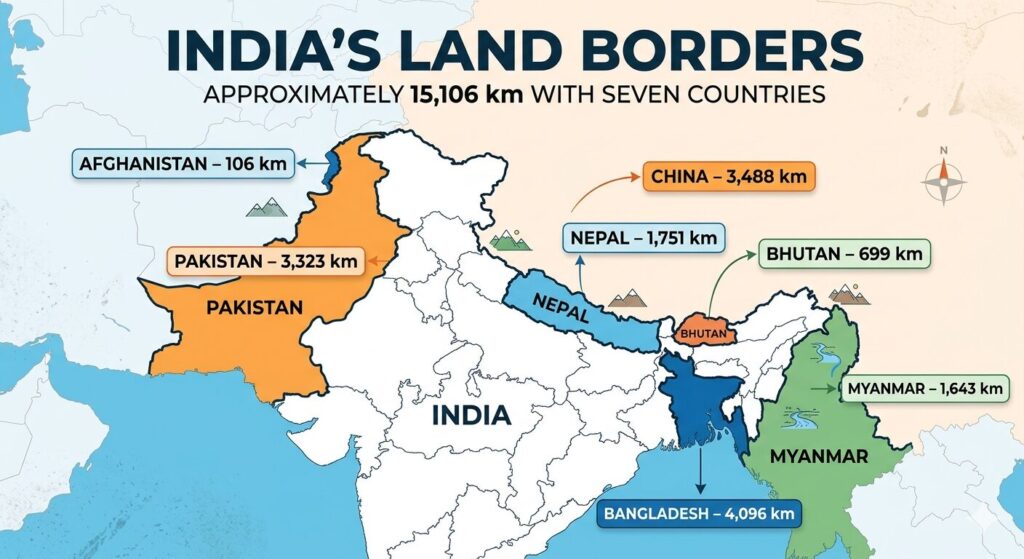
India shares a land border of approximately 15,106 km with seven countries:
- Bangladesh – 4,096 km
- China – 3,488 km
- Pakistan – 3,323 km
- Nepal – 1,751 km
- Myanmar – 1,643 km
- Bhutan – 699 km
- Afghanistan – 106 km
India’s border regions have historically faced challenges such as: Illegal migration, Cross-border terrorism, Smuggling of narcotics and cattle, Fake currency circulation, Arms trafficking, Human trafficking, Emerging drone-based threats
Traditional border management depended largely on physical fencing, patrols and human intelligence. However, technological advances and evolving security threats have made integrated and technology-based systems increasingly important.
Understanding the Smart Border Concept
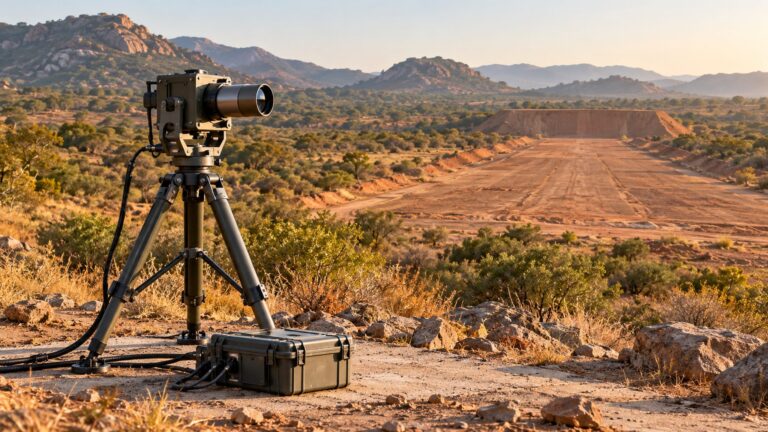
The Smart Border model refers to an integrated technological system designed to strengthen border surveillance and management.
Key components may include:
Drone Surveillance
Unmanned Aerial Vehicles (UAVs) can monitor difficult terrain and provide real-time information.
Advantages:
- Continuous surveillance
- Detection of infiltration attempts
- Reduced human risk
Radar Systems
Ground surveillance radars help detect movement of individuals, vehicles and drones.
Functions:
- Monitoring night movements
- Tracking suspicious activities
- Supporting military and border forces
Sensor Networks
Different sensors can identify unusual activities.
Examples:
- Seismic sensors for underground movement
- Thermal sensors for body heat detection
- Motion sensors for movement alerts
Artificial Intelligence and Data Analytics
AI systems can:
- Detect abnormal movement patterns
- Process large volumes of surveillance data
- Improve threat prediction
Command and Control Centres
Integrated centres can connect:
- BSF
- State police
- Intelligence agencies
- District administration
- Revenue authorities
This supports quicker decision-making.
Existing Border Management Initiatives in India
Comprehensive Integrated Border Management System (CIBMS)
CIBMS was introduced as a technology-driven security framework.
Major components include:
- Thermal imagers
- Laser barriers
- CCTV cameras
- Underground sensors
- Communication systems
BOLD-QIT Project
(Border Electronically Dominated QRT Interception Technique)
Features:
- Installed on riverine stretches of India-Bangladesh border
- Uses sensors and communication systems
- Helps monitor difficult terrains
Border Area Development Programme (BADP)
Objectives:
- Infrastructure development in border regions
- Improve local livelihoods
- Increase integration of border populations
Vibrant Villages Programme
Launched to improve border village development through:
- Better connectivity
- Economic opportunities
- Infrastructure support
Why There is a Need for a Smart Border System?
Emerging Security Challenges
Traditional threats are now being supplemented by newer challenges:
Drone-based threats
Drones have increasingly been used for:
- Arms delivery
- Drug smuggling
- Intelligence gathering
More than 300 drones were reportedly neutralised by BSF within one year, reflecting changing patterns of security threats.
Hybrid Warfare
Hybrid warfare combines:
- Military pressure
- Cyber attacks
- Information warfare
- Economic disruption
- Proxy actors
Illegal Migration and Demographic Concerns
Large-scale illegal migration can create challenges relating to:
- Identity documentation
- Resource allocation
- Social tensions
- Internal security
Difficult Geography
India’s borders pass through:
- Deserts
- Rivers
- Mountains
- Forests
- Marshlands
Human surveillance alone may be inadequate in such regions.
Importance of Cooperative Border Management
The proposed framework emphasises coordination among multiple stakeholders.
Role of BSF
Primary responsibilities:
- Guarding international borders with Pakistan and Bangladesh
- Preventing infiltration
- Controlling smuggling
Role of State Governments
States contribute through:
- Police intelligence
- Local information gathering
- Administrative coordination
Role of Local Administration
Officials such as:
- District Magistrates
- Revenue officers
- Local bodies
can help identify:
- Illegal settlement patterns
- Smuggling routes
- Vulnerable areas
What are the Challenges Associated with Smart Borders?
Financial Constraints
Advanced surveillance infrastructure requires:
- Large capital investment
- Regular maintenance
- Skilled manpower
Privacy and Civil Liberty Concerns
Extensive surveillance systems may raise issues regarding:
- Data protection
- Privacy rights
- Potential misuse of collected data
Difficult Terrain
Extreme weather conditions can affect Sensors, Drones, Communication systems
Dependence on Technology
Over-reliance on technological systems may create vulnerabilities if: Systems fail, Networks are hacked, Equipment becomes obsolete
Coordination Issues
Multiple agencies may face:
- Information-sharing barriers
- Institutional overlap
- Administrative delays
Global Examples of Smart Borders
United States
The U.S. uses:
- Drone surveillance
- Motion sensors
- Biometric identification systems
along sections of the Mexico border.
Israel
Israel uses integrated smart fencing systems equipped with: Sensors, Cameras, AI-based surveillance
European Union
The Schengen Information System integrates border management and security databases across member countries.
Constitutional and Governance Dimensions
Article 355
It places a duty on the Union government to protect States against:
- External aggression
- Internal disturbances
Seventh Schedule
Union List
Border management, defence and national security fall within Union jurisdiction.
Key Terms
Hybrid Warfare: A combination of conventional military methods and non-conventional tools such as cyber attacks, disinformation and proxy actors.
Illegal Migration: Movement of individuals across borders without legal authorisation.
Smart Border: Technology-enabled integrated border surveillance and management system.
What are the Challenges in Balancing Security and Rights?
While national security remains essential, measures must also ensure:
- Human rights protection
- Due legal processes
- Prevention of profiling
- Humanitarian considerations for refugees and vulnerable populations
Way Forward
Strengthen Integrated Intelligence Networks
Real-time information sharing among BSF, police and intelligence agencies should be institutionalised through unified platforms.
Expand Indigenous Technology Development
Encouraging domestic development of surveillance systems under initiatives such as Make in India can reduce dependence on foreign technologies.
Improve Border Area Development
Security measures should be combined with better infrastructure, education and livelihood opportunities in border regions.
Strengthen Cybersecurity Infrastructure
As border management becomes increasingly technology-driven, cybersecurity systems must be upgraded to protect surveillance networks.
Enhance International Cooperation
Border management requires sustained diplomatic engagement with neighbouring countries to tackle migration and transnational crimes.
Conclusion
India’s evolving security environment demands a transition from traditional border guarding methods towards integrated and technology-driven systems. Smart borders can strengthen national security and improve surveillance efficiency, but sustainable success will depend on balancing technological innovation with cooperative governance, local participation and constitutional values.
Practice Questions
Prelims MCQ 1
With reference to Smart Border Management, consider the following statements:
- Smart border systems rely exclusively on physical fencing and personnel deployment.
- Drone technology can assist in real-time border surveillance.
- Artificial Intelligence can help identify suspicious movement patterns.
Which of the statements given above are correct?
(a) 1 only
(b) 2 only
(c) 2 and 3 only
(d) 1, 2 and 3
Correct Answer: (c)
Explanation: Statement 1 is incorrect because smart borders use technology-based integrated systems rather than relying only on physical barriers. Statements 2 and 3 are correct.
Prelims MCQ 2
Which of the following programmes is specifically associated with technology-based border management in India?
- Comprehensive Integrated Border Management System (CIBMS)
- BOLD-QIT
- Border Area Development Programme (BADP)
Select the correct answer using the code below:
(a) 1 and 2 only
(b) 2 and 3 only
(c) 1 and 3 only
(d) 1, 2 and 3
Correct Answer: (d)
Explanation: CIBMS and BOLD-QIT directly involve technological border management, while BADP supports border infrastructure and development.
Mains Question
- “Border management in the twenty-first century requires a shift from traditional approaches towards integrated technology-based systems.” Examine in the context of India’s internal security challenges.
- Discuss the opportunities and challenges associated with the adoption of Smart Border systems in India. How can India balance national security requirements with constitutional and humanitarian concerns?
Tell Google you want more of this.
Add Anantam IAS as a preferred sourceOne tap, and this site shows up more often in your own Top Stories, AI Overviews and AI Mode. Remove it any time.