Why in News?
The Centre for Science and Environment (CSE) and its magazine Down To Earth have released the State of India’s Environment (SOE) 2026 report, an annual stocktake published since 1982 and unveiled at the Anil Agarwal Dialogue. The headline finding is stark: seven of the nine planetary boundaries that keep the Earth system stable have now been transgressed, with ocean acidification the latest to cross its safe limit.
The report also documents a behavioural shift in India’s tigers. With reserves saturated and the invasive shrub Lantana camara hollowing out prey-rich habitat, big cats are venturing into shared landscapes, losing their fear of humans, and turning to livestock and, in rare cases, people. It links these wildlife stresses to a wider pattern of extreme weather, flood risk, and ecological breakdown across India in 2025.
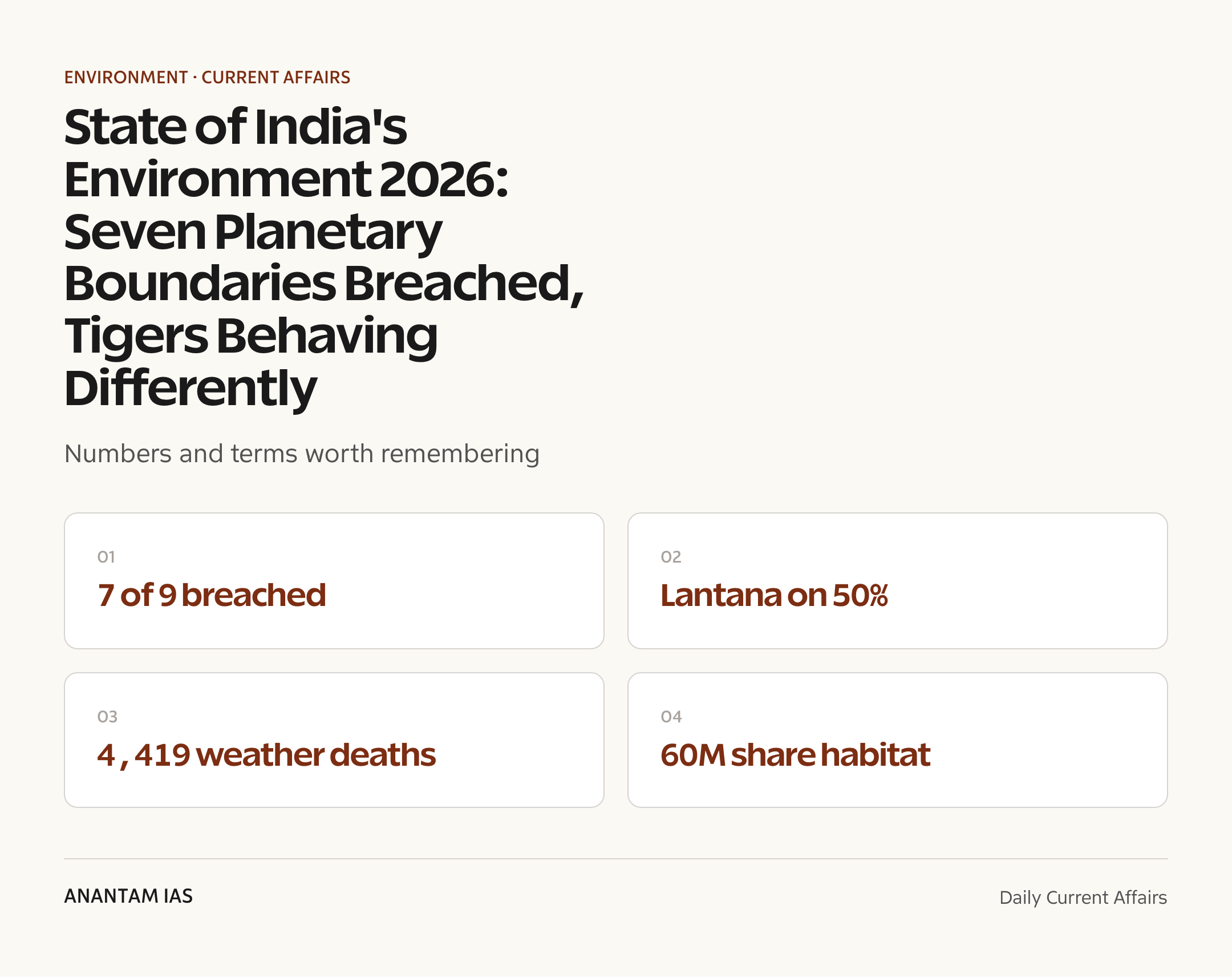
- SOE 2026 by CSE/Down To Earth says 7 of 9 planetary boundaries are breached.
- Ocean acidification is the newest boundary to be crossed, with ocean acidity up 30-40% since the industrial era.
- Invasive Lantana camara now occupies nearly 50% of India’s forest and scrubland, fuelling human-tiger conflict.
- Extreme weather struck on 99% of days in 2025 (Jan 1-Nov 30), killing 4,419 people and hitting 17.41 million hectares of cropland.
The development matters in the context of:
- The planetary boundaries framework was proposed in 2009 by Johan Rockstrom and colleagues at the Stockholm Resilience Centre to define a “safe operating space” for humanity across nine Earth-system processes.
- SOE is India’s longest-running independent environment audit; this edition stitches together global Earth-system science with on-the-ground Indian data on weather, forests, and wildlife conflict.
UPSC Relevance
Prelims Relevance
- Nine planetary boundaries: climate change, biosphere (genetic and functional) integrity, land-system change, freshwater change, biogeochemical flows (nitrogen and phosphorus), ocean acidification, novel entities, atmospheric aerosol loading, stratospheric ozone depletion.
- Boundaries currently breached per SOE 2026: climate change, biosphere integrity, land-system change, freshwater, biogeochemical flows, novel entities, ocean acidification.
- Boundaries still within safe limits: aerosol loading and stratospheric ozone.
- The framework originated at the Stockholm Resilience Centre (2009), not under any UN treaty.
- Lantana camara is an invasive alien shrub of the Verbenaceae family, native to tropical America, listed among the world’s worst invasive species.
- Novel entities as a boundary covers human-made substances such as plastics, synthetic chemicals, and radioactive materials.
- Project Tiger (1973) and the National Tiger Conservation Authority (NTCA) are the statutory backbone of India’s tiger conservation.
- Ocean acidification results from oceans absorbing excess atmospheric CO2, lowering seawater pH and harming calcifying marine life.
Mains Relevance
GS Paper 3
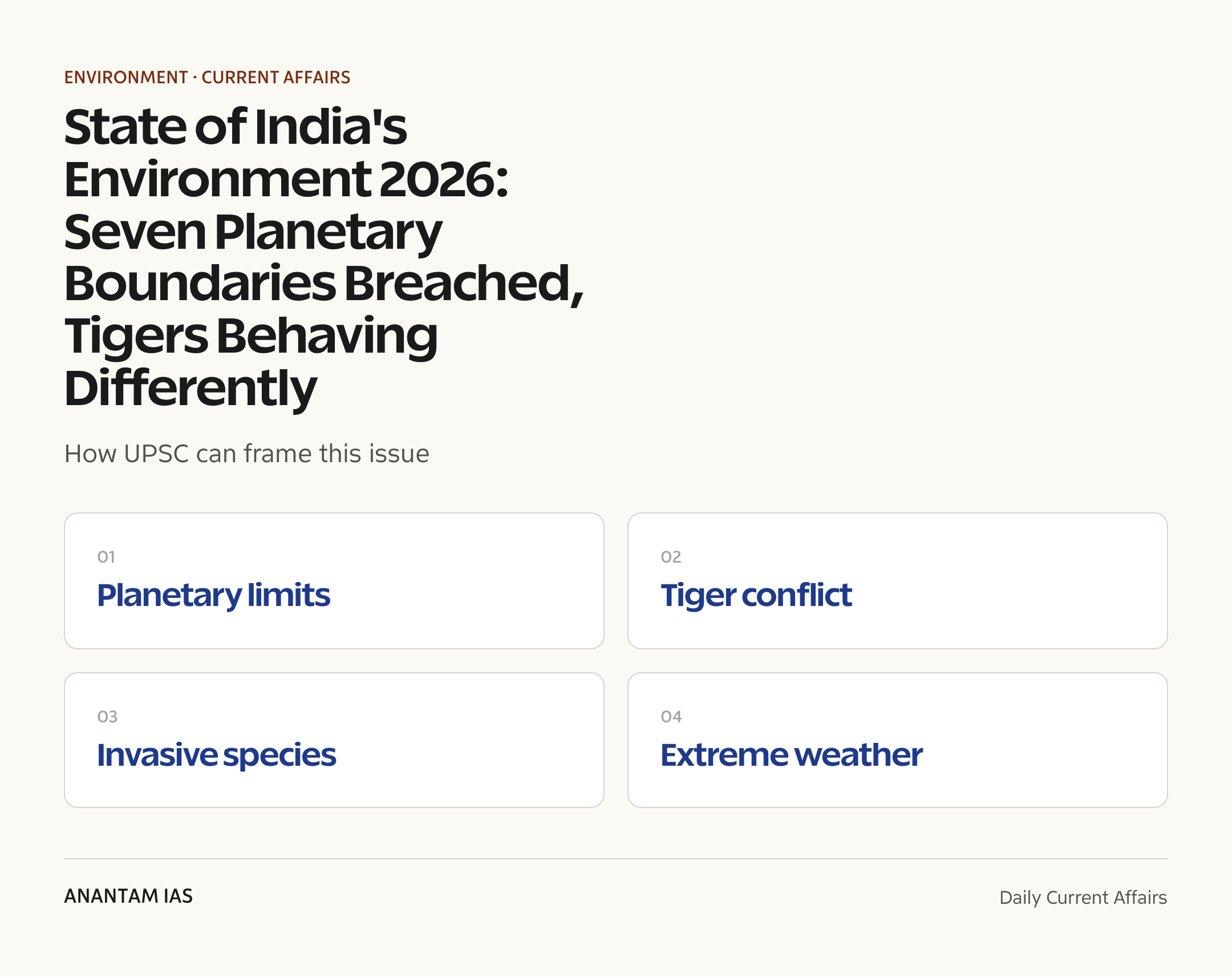
- Conservation success breeding new conflict: how rising tiger numbers, habitat saturation, and invasive species reshape the human-wildlife interface.
- Translating the global planetary boundaries framework into India’s climate, biodiversity, and disaster-management policy.
Essay
- Themes on living within ecological limits, the cost of growth without guardrails, and coexistence between people and wildlife.
Background and Context
What the planetary boundaries framework measures
Nine control variables that define a safe operating space for humanity.
- Devised in 2009 at the Stockholm Resilience Centre, the framework sets quantitative limits for nine Earth-system processes; staying within them keeps the planet in a stable, Holocene-like state.
- The nine boundaries: climate change, biosphere integrity, land-system change, freshwater change, biogeochemical flows (nitrogen and phosphorus), ocean acidification, novel entities, atmospheric aerosol loading, and stratospheric ozone depletion.
- Crossing a boundary raises the risk of abrupt, large-scale, possibly irreversible environmental change.
- It is a scientific assessment tool, not a binding treaty, and is updated as Earth-system science evolves.
Seven boundaries breached, ocean acidification the newest
SOE 2026 marks ocean acidification as freshly transgressed.
- SOE 2026 reports that seven of nine boundaries are now crossed; only aerosol loading and stratospheric ozone remain within safe limits.
- The newly breached boundary is ocean acidification as oceans absorb excess CO2; surface-ocean acidity has risen by an estimated 30-40% since the industrial era.
- Acidifying seas weaken corals, shellfish, and plankton, threatening fisheries and the ocean’s role as a carbon sink.
- The other breached boundaries span climate change, biosphere integrity, land-system change, freshwater, biogeochemical flows, and novel entities (plastics and synthetic chemicals).
Why India's tigers are behaving differently
Saturated reserves and degraded habitat push big cats outward.
- With tiger numbers rising and reserves at carrying capacity, animals are spilling into unprotected, shared landscapes; nearly 60 million people across 20 states live in areas overlapping tiger territory.
- Conservation biologist K. Ullas Karanth notes big cats are “losing their fear of humans,” a shift tied to habitat degradation and proximity.
- Between January and June 2025, at least 43 people were killed near tiger reserves (against 44 in the same months of 2024), with human remains consumed in four attacks.
- Roughly 40% of tiger territory in these states overlaps zones of dense human settlement, amplifying encounter risk.
Lantana camara: the invasive shrub at the heart of the conflict
An ornamental import now reshapes predator-prey dynamics.
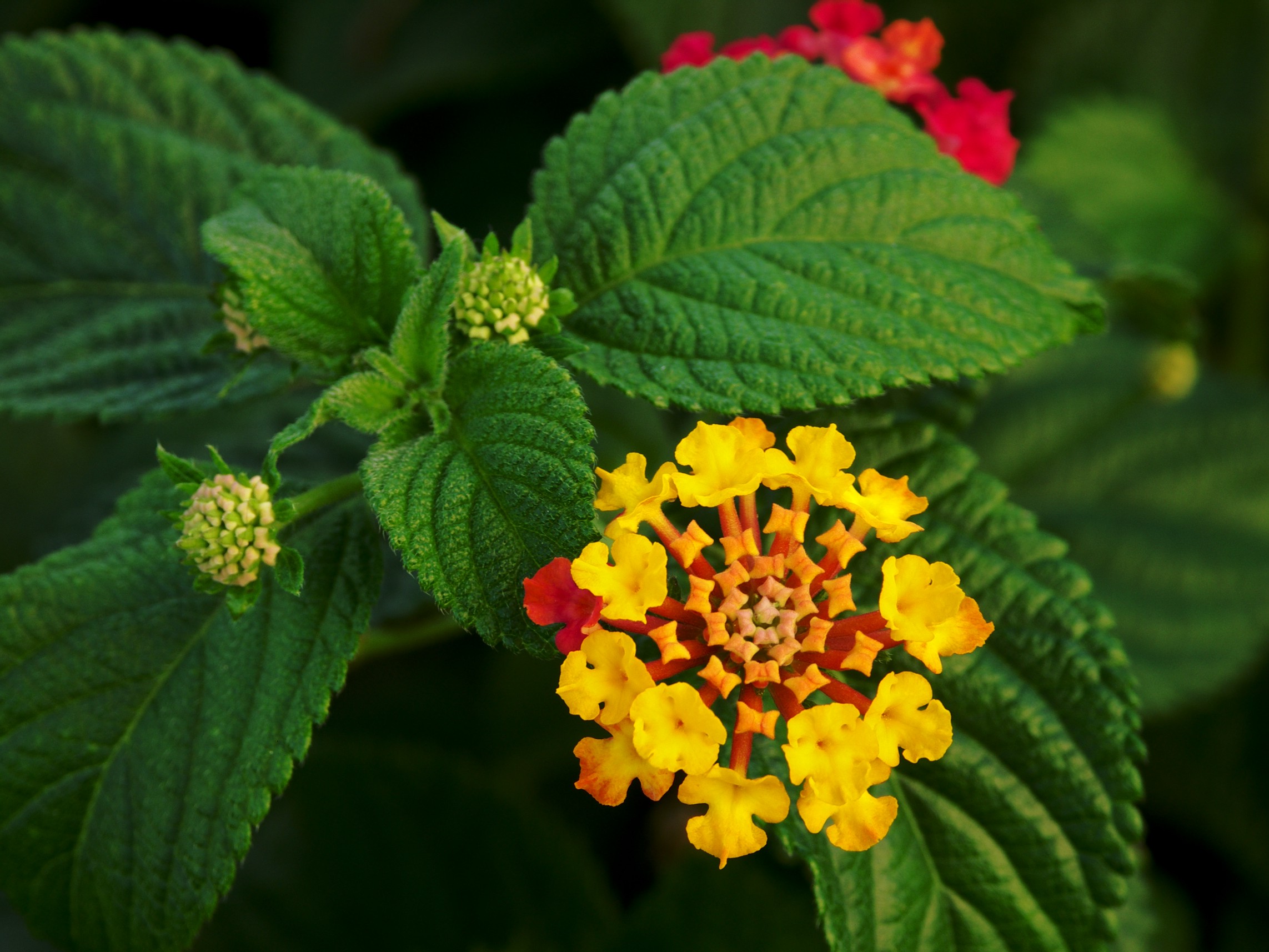
- Lantana camara, introduced in the 19th century as an ornamental, now occupies nearly 50% of India’s forest and scrubland.
- It suppresses native grasses and undergrowth that herbivore prey depend on, hollowing out the food base inside many habitats.
- Dense Lantana thickets create “predator-friendly habitat in prey-poor landscapes” – cover for ambush while restricting prey escape routes, pushing tigers toward easier targets like cattle.
- A policy paradox follows: livestock-loss compensation sustains cattle-rearing near forests, inadvertently subsidising tiger-human proximity rather than reducing it.
A year of extreme weather and flood risk
2025 saw weather extremes on nearly every day.
- Extreme weather events occurred on 99% of days between 1 January and 30 November 2025, killing 4,419 people.
- These events damaged about 17.41 million hectares of cropland, threatening rural incomes and food security.
- The worst-hit states by extreme-weather days were Himachal Pradesh (267), Kerala (173), and Madhya Pradesh (162).
- Land-system change, deforestation, and degraded catchments magnify flood risk, linking the boundary crossings directly to disaster-management stress on the ground.
Blind spots in monitoring
Much of India lacks reliable environmental data.
- Only about 15% of India’s population (~200 million) lives within 10 km of a continuous air-quality monitoring station.
- The remaining 85% (~1.2 billion people) lack measurable, real-time pollution coverage, weakening evidence-based action.
- Patchy monitoring of forests, freshwater, and biodiversity makes it harder to detect boundary crossings early and respond.
- SOE 2026 frames better data and independent audits as preconditions for credible environmental governance.
Way Forward
Treat planetary boundaries as policy guardrails
- Anchor India’s climate, biodiversity, and water targets to the boundaries that are most stressed – land-system change, freshwater, and biogeochemical flows.
- Mainstream ocean-acidification monitoring along India’s coasts within the blue-economy and fisheries agenda.
Restore habitat and manage invasives
- Scale up scientific Lantana camara removal and native-grassland restoration inside and around reserves to rebuild the prey base.
- Link removal to livelihoods through Lantana-craft and bioenergy uses so eradication is durable.
Redesign human-wildlife coexistence
- Reform livestock-compensation so it rewards prevention (predator-proof enclosures, herding practices) rather than sustaining cattle near forest edges.
- Invest in rapid-response teams, early-warning systems, and corridor protection for dispersing tigers.
Close the data gap
- Expand continuous air, water, and biodiversity monitoring beyond the 15% of the population currently covered.
- Build a disaster-management calendar of extreme-weather hotspots like Himachal, Kerala, and Madhya Pradesh into state planning.
Conclusion
The State of India’s Environment 2026 reframes a familiar conservation success as a warning. Seven of nine planetary boundaries breached, ocean acidification newly crossed, and tigers behaving differently are not separate stories but symptoms of the same overshoot – an environment pushed past the limits that once kept it stable.
For India, the lesson is that protecting a species or hitting a target is not enough if the surrounding habitat, water, and climate keep degrading. Living within ecological limits, managing invasives like Lantana, and building genuine coexistence are now the test of whether conservation gains can survive the pressures the report documents.
UPSC Practice Questions
Prelims MCQ 1
With reference to the planetary boundaries framework, consider the following statements:
- It was developed by the Stockholm Resilience Centre to define a safe operating space for humanity.
- Ocean acidification is one of the nine planetary boundaries.
- Stratospheric ozone depletion is one of the boundaries that has been transgressed, according to the State of India’s Environment 2026.
How many of the above statements are correct?
(a) Only one (b) Only two (c) All three (d) None
Answer: (b) Only two
Explanation:
Statements 1 and 2 are correct. Statement 3 is wrong: SOE 2026 places stratospheric ozone (with aerosol loading) among the two boundaries still within safe limits, not breached.
Prelims MCQ 2
Consider the following with reference to Lantana camara:
- It is an invasive alien shrub native to tropical America.
- The State of India’s Environment 2026 links its spread to rising human-tiger conflict.
- It is reported to occupy nearly half of India’s forest and scrubland.
How many of the above statements are correct?
(a) Only one (b) Only two (c) All three (d) None
Answer: (c) All three
Explanation:
All three are correct. Lantana camara is a tropical-American invasive that SOE 2026 says occupies nearly 50% of forest and scrubland, suppressing prey habitat and intensifying tiger conflict.
UPSC Mains Questions
- “Conservation success can create new ecological conflicts.” Examine this statement in the light of rising human-tiger conflict and the spread of invasive species in India. (250 words)
- Discuss the planetary boundaries framework and assess how the State of India’s Environment 2026 findings should shape India’s climate and disaster-management policy. (250 words)
Sources: Centre for Science and Environment (Down To Earth) and Down To Earth.
Frequently Asked Questions
What are planetary boundaries?
Planetary boundaries are nine Earth-system limits defined by the Stockholm Resilience Centre in 2009. Staying within them keeps the planet stable. They cover climate change, biosphere integrity, land-system change, freshwater, biogeochemical flows, ocean acidification, novel entities, aerosol loading, and ozone depletion.
How many planetary boundaries are breached per SOE 2026?
The State of India’s Environment 2026 by CSE reports that seven of the nine planetary boundaries have been transgressed. Only atmospheric aerosol loading and stratospheric ozone depletion remain within safe limits, with ocean acidification the newest boundary to be crossed.
Why are India’s tigers behaving differently?
With reserves saturated and habitat degraded by invasive Lantana, tigers are venturing into shared landscapes and losing their fear of humans. Nearly 60 million people across 20 states share tiger territory, and at least 43 people were killed near reserves in January-June 2025.
How does Lantana camara worsen human-tiger conflict?
Lantana camara, an invasive shrub occupying nearly half of India’s forest and scrubland, suppresses native grasses that prey animals need. It creates dense ambush cover in prey-poor areas, pushing tigers toward cattle and human-dominated zones and intensifying conflict.
What does SOE 2026 say about extreme weather in India?
It records extreme weather on 99% of days between January and November 2025, killing 4,419 people and damaging about 17.41 million hectares of cropland. Himachal Pradesh, Kerala, and Madhya Pradesh saw the most extreme-weather days.
Who releases the State of India’s Environment report?
It is published annually by the Centre for Science and Environment (CSE) and its magazine Down To Earth, an effort running since 1982. The 2026 edition was unveiled at the Anil Agarwal Dialogue.
Tell Google you want more of this.
Add Anantam IAS as a preferred sourceOne tap, and this site shows up more often in your own Top Stories, AI Overviews and AI Mode. Remove it any time.