

Why in News?
The Defence Minister of India visited Seoul from May 19-21, 2026, for extensive bilateral talks with the Republic of Korea’s Defence Minister. This high-level visit came just weeks after the South Korean President visited India in April 2026.
Both sides signed multiple MoUs on defence cyber security, academic cooperation, and UN peacekeeping. This signals accelerating momentum in the India-South Korea Special Strategic Partnership.
| UPSC Relevance: GS-2 International Relations: Bilateral relations Prelims: Korea-India Defence Accelerator (KIND-X) Mains: India-South Korea Defence Ties: Significance and Challenges. |
Defence Minister’s Visit to South Korea:
- Extensive discussions were held to review the full spectrum of bilateral defence cooperation and deepen collaboration in the defence industry, joint production, maritime security, emerging technologies, and regional security.
- The two sides acknowledged the growing convergence between India’s Act East Policy and South Korea’s regional vision, reaffirming their shared commitment to a free, open, inclusive, and rules-based Indo-Pacific.
MoUs & Agreements Signed:
- Defence Cyber Security Cooperation: Bilateral MoU between India’s Ministry of Defence and the RoK’s MOD to strengthen the cyber resilience of military infrastructure and share threat intelligence on cyber-attacks targeting defence systems.
- Academic & Institutional Exchange: MoU between India’s National Defence College and South Korea’s Korea National Defence University to facilitate officer-level strategic education, doctrine exchange, and joint research programmes.
- UN Peacekeeping Cooperation: Agreement to enhance interoperability in multinational UN peacekeeping missions through joint training, shared doctrine, and coordinated deployment frameworks.
- L&T-Hanwha Defence Technology Agreements: Two agreements were signed between Larsen & Toubro and Hanwha covering industrial collaboration, technology cooperation, and capacity building in defence manufacturing.
- KIND-X Roadmap Advancement: Both sides discussed and agreed to advance a roadmap for the Korea-India Defence Innovation Accelerator Ecosystem (KIND-X), aimed at integrating the innovation ecosystems of the two countries.
India-South Korea Defence Ties: Evolution of the Partnership
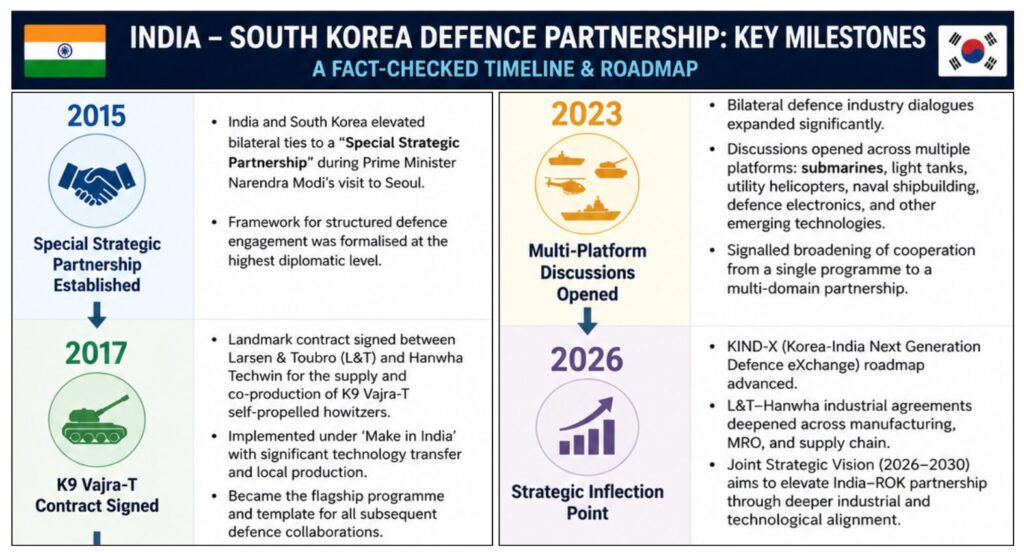
Key Dimensions of Defence Cooperation:
Bilateral defence cooperation is expanding rapidly across several domains, with multiple projects under active consideration and negotiation.
- Submarine & Underwater Systems: South Korea’s expertise in conventional submarines, lithium-ion battery systems, and air-independent propulsion (AIP) technologies aligns closely with India’s P75-India programme requirements. This represents one of the most strategically significant and technically demanding areas of potential collaboration.
- Fighter Aircraft & Aerospace: South Korea’s advancing aerospace sector (including the KF-21 Boramae fighter programme and the FA-50 light combat aircraft) has opened new avenues for collaboration in fighter technologies, engines, avionics, missile integration, and maintenance systems. India’s need to diversify its aerospace supply chain makes this a natural fit.
- Naval Shipbuilding & Maritime Power: South Korea can significantly contribute to India’s growing maritime ambitions in the Indo-Pacific through cooperation in destroyers, logistics vessels, submarine support systems, smart shipyards, and naval propulsion technologies.
- Land Systems & Defence Electronics: Following the K9 Vajra-T success, discussions are progressing on light tanks, utility helicopters, future-ready combat vehicles, military lithium batteries, and defence electronics. Indian and Korean firms are actively pursuing joint ventures across multiple platform categories under the Make in India framework.
- Defence Innovation: The proposed Korea-India Defence Accelerator (KIND-X) aims to link startups, incubators, and universities from both countries to foster co-development and co-design of advanced military systems. Reinvigorating the 2020 Roadmap for Defence Industry Cooperation and connecting South Korean innovation clusters with India’s Defence Industrial Corridors.
- Cyber, AI & Emerging Technologies: The newly signed cyber defence MoU marks the formal beginning of cooperation in military cyber security. Broader discussions cover AI-enabled platforms, autonomous systems, quantum technologies, semiconductors, and space-based capabilities.
- Military Exchanges & Interoperability: At the operational level, bilateral military exchanges, naval exercises, coast guard cooperation, and structured defence dialogues are strengthening interoperability and mutual trust.
The Strategic Context of Indo-Pacific:
The rapidly evolving Indo-Pacific geopolitical environment provides urgency for deepening India-South Korea defence ties beyond mere industrial collaboration. The geopolitical landscape around the Korean Peninsula is changing rapidly.
- China’s growing naval assertiveness around the Korean Peninsula, and its expanding presence in the South China Sea, through which a significant share of South Korea’s energy imports and maritime trade passes, has created new strategic anxieties in the country. This resonates with India’s own concerns about Chinese naval expansion in the Indian Ocean Region.
- North Korea’s growing missile and nuclear capabilities continue to pose a direct threat to South Korea.
- Expanding Russia-North Korea military cooperation is reshaping Northeast Asia’s security architecture in ways that have implications for both South Korea and India.
India’s broader Indo-Pacific interests depend on regional stability, open sea lanes, and the resilience of like-minded partners. A vulnerable South Korea undermines the very framework of a stable Indo-Pacific that India seeks to uphold.
Challenges & Constraints:
- Technology Transfer Limits: South Korean firms face constraints under MTCR, Wassenaar Arrangement, and domestic export control laws when transferring cutting-edge propulsion, fighter, and submarine technologies to third countries.
- North Korea & Peninsula Instability: Growing North Korean nuclear and missile capabilities, combined with Russia-DPRK military cooperation, create a volatile security environment that can divert South Korean defence resources and attention.
- India’s Strategic Autonomy: India’s tradition of strategic autonomy and its absence from formal US-led alliances (unlike South Korea’s US-ROK alliance) may limit operational defence convergence in sensitive regional scenarios.
- South Korea’s Demographic Decline: A shrinking military recruitment pool weakens the long-term sustainability of South Korea’s conventional defence posture, creating structural vulnerabilities that affect its capacity for sustained bilateral cooperation.
- Partnership Breadth vs. Depth: The risk of confining cooperation solely to defence-industrial domains without evolving a shared security framework for the Indo-Pacific would limit the partnership’s strategic potential.
Way Forward:
- Institutionalised Defence Road Map: Both countries should formalise a bilateral defence framework to encompass emerging security threats across the wider Indo-Pacific. This includes addressing North Korean proliferation, Chinese naval expansion, and non-traditional security challenges in a coordinated manner.
- Fast-Track KIND-X Operationalisation: The Korea-India Defence Accelerator must move from a proposed framework to a functioning ecosystem, with dedicated funding, a joint secretariat, and clear timelines for co-development milestones linking startups, universities, and defence investors.
- Submarine & Aerospace Deals: Advance negotiations for P75-India collaboration with Hanwha Ocean and formalise engagement on fighter component production, leveraging KF-21 and FA-50 programme expertise for co-development and MRO cooperation.
- Maritime Security Collaboration: Expand naval exercises, coast guard cooperation, and joint patrols in the Indian Ocean Region and beyond to strengthen interoperability and signal shared commitment to a stable maritime order.
The partnership between the two nations must move beyond defence-industrial ties toward a broader partnership grounded in shared security interests and Indo-Pacific stability.
Also Read: https://anantamias.com/current-affairs/advancing-india-south-korea-defence-innovation-ties/
Practice Question for Mains:
Q. Discuss the geopolitical imperatives driving India-South Korea convergence in the context of the evolving Indo-Pacific security architecture.
Tell Google you want more of this.
Add Anantam IAS as a preferred sourceOne tap, and this site shows up more often in your own Top Stories, AI Overviews and AI Mode. Remove it any time.






