Why in News?
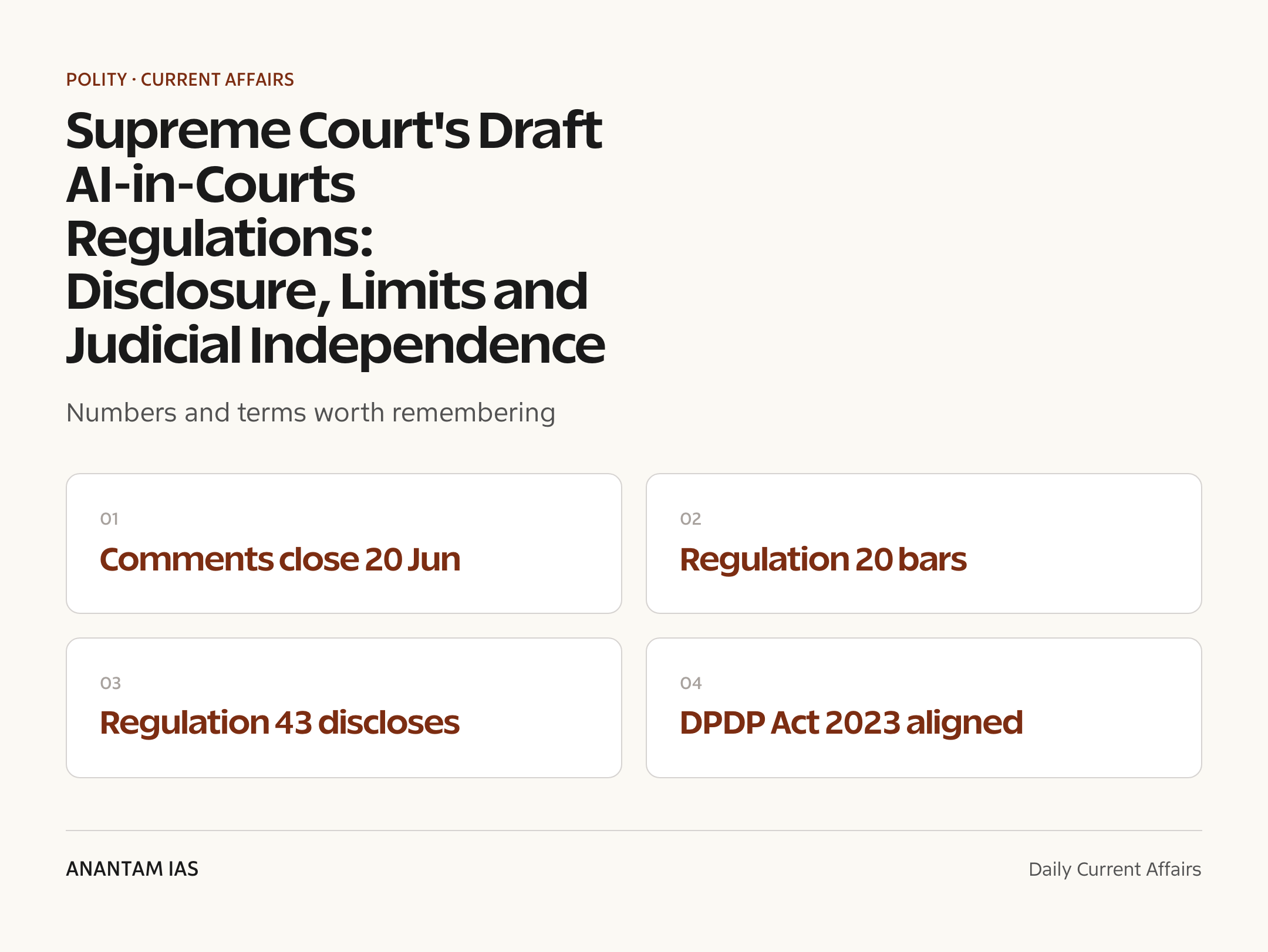
The Supreme Court of India‘s AI Committee, chaired by Justice P.S. Narasimha, has released a draft ‘Regulations for Use of Artificial Intelligence in Courts, 2026’, with the public-comment window closing on 20 June 2026. The framework is the first court-wide attempt in India to set guardrails on how judges, registries, lawyers and litigants may use generative and predictive AI inside the justice system.
The draft permits AI for assistive work such as legal research, document summarisation and translation, but draws a hard line at adjudication, sentencing, risk-scoring for bail or recidivism, and surveillance of court participants. A mandatory disclosure rule (Regulation 43) requires parties to declare when filings are AI-assisted, keeping the judge as the final authority on law, facts and justice.
- Draft titled Regulations for Use of Artificial Intelligence in Courts, 2026; comments invited until 20 June 2026 ([email protected]).
- Issued by the Supreme Court’s AI Committee under Justice P.S. Narasimha; applies to the Supreme Court, High Courts, subordinate courts, tribunals and adjudicatory commissions.
- Regulation 20 bars AI-only judicial decisions, sentencing, bail/recidivism risk-scoring, credibility assessment and predictive profiling.
- Regulation 43 mandates disclosure of AI-assisted documents; courts may demand the tool name and the nature and extent of use.
- Surveillance of judges, lawyers and litigants, and ‘black-box’ systems affecting legal rights, are prohibited.
- The framework expressly aligns with the Digital Personal Data Protection (DPDP) Act, 2023.
The development matters in the context of:
- Indian courts already run AI tools such as SUVAS (translation) and SUPACE (research assistance), but no binding use-policy existed until now.
- The move follows global concern over AI ‘hallucinations’ producing fabricated case citations in court filings.
- It sits within the e-Courts Mission Mode Project drive to digitise and modernise the judiciary while protecting due process.
UPSC Relevance
Prelims Relevance
- Draft is titled ‘Regulations for Use of Artificial Intelligence in Courts, 2026’; issuing body is the Supreme Court’s AI Committee.
- Justice P.S. Narasimha chairs the AI Committee that released the draft.
- Regulation 20 lists prohibited uses; Regulation 43 covers the disclosure mandate.
- Permitted uses: legal research, document summarisation, transcription, translation, case management, accessibility tools.
- Barred uses: adjudication, sentencing, bail/recidivism risk-scoring, credibility/profiling, surveillance.
- The framework aligns with the Digital Personal Data Protection Act, 2023.
- SUVAS = Supreme Court Vidhik Anuvaad Software (AI translation); SUPACE = Supreme Court Portal for Assistance in Courts Efficiency.
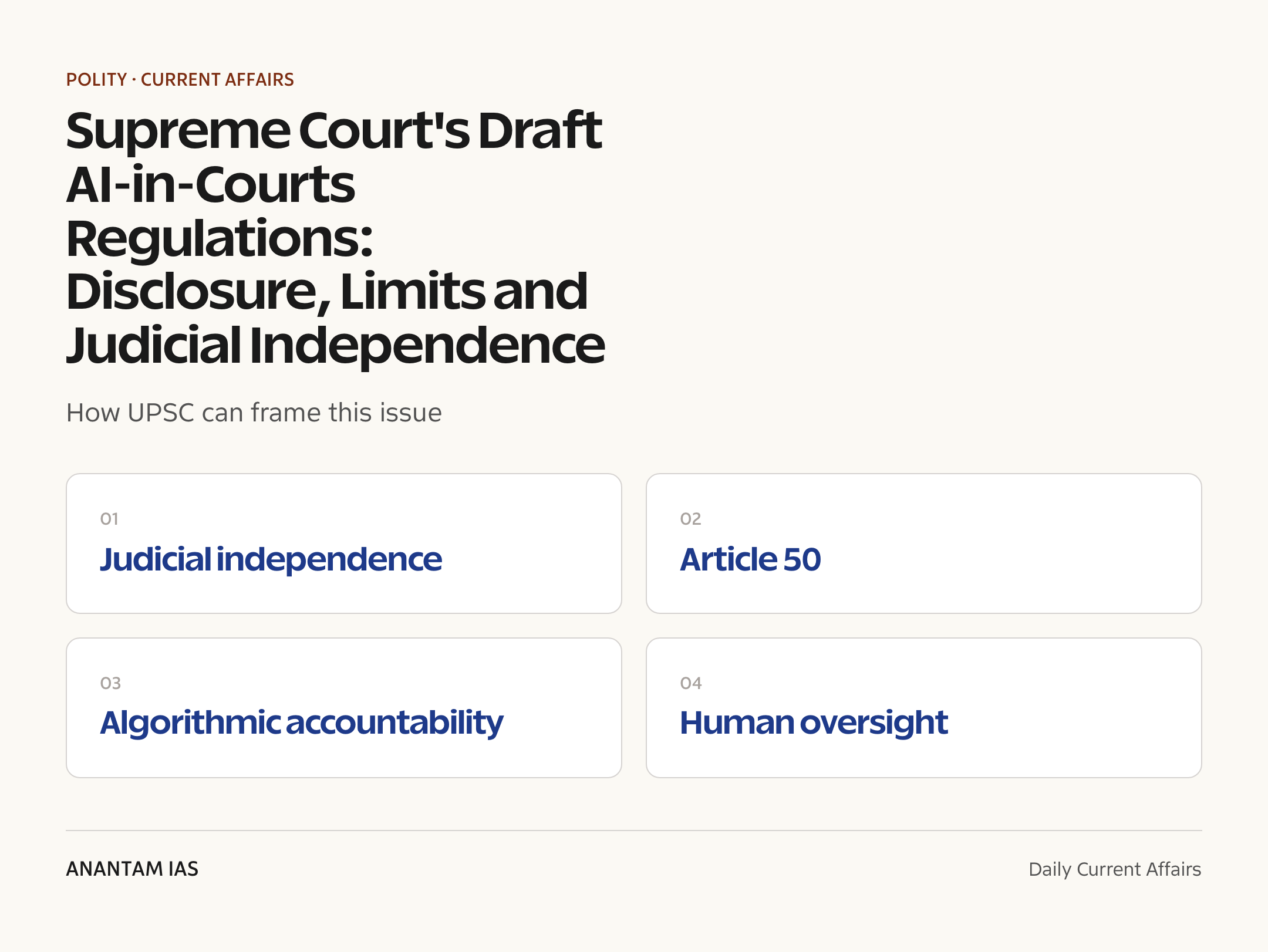
- Article 50 of the Constitution provides for separation of the judiciary from the executive (a Directive Principle).
- The e-Courts project is a Mission Mode Project under the National e-Governance Plan.
- Public-comment deadline for the draft: 20 June 2026.
Mains Relevance
GS Paper 2
- Examine how AI regulation in courts protects judicial independence and the separation of powers (Article 50).
- Assess governance challenges of integrating AI into the justice system while preserving due process and access to justice.
GS Paper 3
- Discuss algorithmic accountability, transparency and the risks of ‘black-box’ AI in public decision-making.
Essay
- Can machines deliver justice, or only assist those who do?
- Technology must serve the rule of law, not replace the rule-maker.
Background and Context
What the draft regulations actually do
The framework treats AI as a tool that assists humans, never one that decides for them.
- Core principle: AI stays strictly subservient to human judgment and judicial authority, functioning only in an assistive capacity.
- Scope covers the Supreme Court, all High Courts, subordinate courts, tribunals and statutory commissions with adjudicatory functions.
- Judges remain the final authority on law, facts and justice; AI output cannot substitute reasoned judicial application of mind.
- Comments were invited until 20 June 2026, signalling a consultative rather than top-down rule-making approach.
Permitted versus prohibited uses
The draft separates back-office efficiency gains from front-line decision-making.
- Permitted: legal research and precedent retrieval, document review and summarisation, case management and scheduling, transcription (with human verification), and translation of pleadings and judgments.
- Prohibited under Regulation 20: AI-only judicial decisions, sentencing, risk assessment for bail/flight risk/recidivism, and credibility assessment of parties or witnesses.
- Also barred: predictive profiling of litigants or advocates, opaque ‘black-box’ systems affecting legal rights, and surveillance of court participants unless legally authorised.
- Other assistive uses flagged include chatbots for litigant guidance, accessibility services and fraud or document verification.
The disclosure mandate
Transparency about AI use is the framework’s central safeguard against fabricated content.
- Regulation 43(3): the AI-assisted character of any document must be disclosed to the court at the time of submission.
- Regulation 43(4): courts may ask for the tools used and the nature and extent of AI involvement.
- Those who submit false or fabricated AI-assisted material are held personally liable, deterring ‘hallucinated’ citations.
- Disclosure preserves the court’s ability to test and verify, rather than banning AI assistance outright.
Existing AI tools in Indian courts
The regulations build on tools the judiciary already uses, without naming them as exceptions.
- SUVAS (Supreme Court Vidhik Anuvaad Software) translates judgments into regional languages.
- SUPACE (Supreme Court Portal for Assistance in Courts Efficiency) helps judges process case files and research.
- Both fit the ‘assistive’ category the draft endorses, while the new bars target decision-making and profiling.
- The framework gives these ad-hoc deployments a clear, court-wide rule-book for the first time.
Data protection and accountability
AI in courts handles sensitive personal data, so the draft hard-wires safeguards.
- Personal data cannot be processed for AI training without appropriate approval, aligning with the DPDP Act, 2023.
- The draft proposes impact assessments, regular audits and an AI incident database before and after deployment.
- A multi-layered governance structure is envisaged: an apex body at the Supreme Court and AI committees at each High Court.
- Special protections are extended to women, children, persons with disabilities and marginalised groups against discriminatory outputs.
Why it matters for judicial independence
Outsourcing adjudication to opaque algorithms would quietly erode the separation of powers.
- Article 50 directs the State to separate the judiciary from the executive; ungoverned AI could let private vendors shape outcomes.
- Barring risk-scoring and profiling guards against bias being laundered through code, which is hard to challenge on appeal.
- Mandatory human oversight keeps reasoned judgment, the bedrock of natural justice, with the judge.
- Clear rules also build public trust that digitisation does not dilute the right to a fair hearing.
Way Forward
Finalise with stakeholder buy-in
- Incorporate Bar, civil-society and technical feedback before notifying the rules, then phase in across High Courts.
- Issue model declaration formats so disclosure under Regulation 43 is uniform and easy to comply with.
Build audit and capacity
- Operationalise the AI incident database and mandate periodic third-party audits of approved tools.
- Train judges, registry staff and lawyers on safe AI use and on spotting fabricated AI output.
Anchor to data law
- Align deployment with DPDP Act, 2023 rules on consent, data minimisation and purpose limitation.
- Insist on explainability standards so no rights-affecting decision rests on a ‘black-box’ system.
Conclusion
India’s draft AI-in-courts regulations strike a careful balance: they welcome AI as a productivity tool for research, translation and case management while ring-fencing the act of judging itself. By mandating disclosure, barring risk-scoring and surveillance, and aligning with the DPDP Act, 2023, the framework keeps reasoned human judgment at the centre of justice.
The real test will be implementation. Robust audits, explainability standards and judicial capacity-building will decide whether the rules genuinely protect judicial independence and due process, or remain aspirational. Done well, India could set a template for AI governance in the justice systems of the developing world.
UPSC Practice Questions
Prelims MCQ 1
With reference to the draft ‘Regulations for Use of Artificial Intelligence in Courts, 2026’, consider the following statements:
- They were released by a Supreme Court AI Committee chaired by a sitting judge.
- They permit AI to be used for sentencing provided a judge later reviews the outcome.
- They mandate disclosure of AI-assisted documents to the court.
How many of the above statements are correct?
(a) Only one (b) Only two (c) All three (d) None
Answer: (b) Only two
Explanation:
Statements 1 and 3 are correct. Statement 2 is wrong: the draft bars AI-only adjudication and sentencing outright under Regulation 20, not merely subject to later review.
Prelims MCQ 2
SUVAS and SUPACE, sometimes seen in the news, are best described as:
(a) Data-protection authorities set up under the DPDP Act, 2023 (b) AI-based tools used in the Indian judiciary for translation and case assistance (c) Tribunals constituted to hear cyber-crime appeals (d) Centrally Sponsored Schemes for legal aid
Answer: (b) AI-based tools used in the Indian judiciary for translation and case assistance
Explanation:
SUVAS (Supreme Court Vidhik Anuvaad Software) translates judgments; SUPACE (Supreme Court Portal for Assistance in Courts Efficiency) assists judges with research and case files.
UPSC Mains Questions
- The draft Regulations for Use of AI in Courts, 2026 try to harness artificial intelligence without surrendering judicial decision-making. Discuss how such a framework protects judicial independence and the separation of powers. (250 words)
- Algorithmic opacity poses a distinct challenge to accountability in public decision-making. In the context of AI use in courts, examine the safeguards needed to reconcile efficiency with fairness and due process. (250 words)
Sources: Supreme Court of India (AI Committee) and The Federal.
Frequently Asked Questions
What are the Supreme Court’s draft AI-in-courts regulations?
They are the draft ‘Regulations for Use of Artificial Intelligence in Courts, 2026’, released by a Supreme Court AI Committee. They allow AI for assistive tasks like research, summarisation and translation, but bar adjudication, sentencing, risk-scoring and surveillance, while requiring parties to disclose AI-assisted filings. Public comments closed on 20 June 2026.
Which AI uses are prohibited under the draft?
Regulation 20 prohibits AI-only judicial decisions, sentencing, risk assessment for bail, flight risk or recidivism, credibility assessment of parties and witnesses, predictive profiling, opaque ‘black-box’ systems affecting legal rights, and surveillance of judges, lawyers and litigants unless legally authorised.
What does the disclosure mandate require?
Under Regulation 43, anyone filing an AI-assisted document must disclose its AI-assisted character to the court at submission. Courts may ask which tools were used and the nature and extent of that use. Submitting false AI-assisted material attracts personal liability, deterring fabricated or ‘hallucinated’ citations.
How do SUVAS and SUPACE fit in?
SUVAS (Supreme Court Vidhik Anuvaad Software) translates judgments into regional languages, and SUPACE (Supreme Court Portal for Assistance in Courts Efficiency) helps judges with research and case files. Both are assistive tools the draft endorses, while its new bars target decision-making, profiling and surveillance.
How does the draft connect to data protection?
The framework aligns with the Digital Personal Data Protection (DPDP) Act, 2023. It bars processing personal data for AI training without proper approval and proposes impact assessments, audits and an incident database, ensuring sensitive litigant data is handled lawfully and securely.
Why does this matter for judicial independence?
Outsourcing adjudication to opaque algorithms could let private vendors shape outcomes, undermining Article 50’s separation of judiciary and executive. By keeping reasoned human judgment central and barring biased risk-scoring, the rules protect due process, fair hearing and public trust in the courts.
Tell Google you want more of this.
Add Anantam IAS as a preferred sourceOne tap, and this site shows up more often in your own Top Stories, AI Overviews and AI Mode. Remove it any time.