Why in News?
On August 27, 2026, the foundation ceremony was held for a new T-72 and T-90 tank overhaul facility at Vehicle Factory Jabalpur, an Armoured Vehicles Nigam Limited unit.
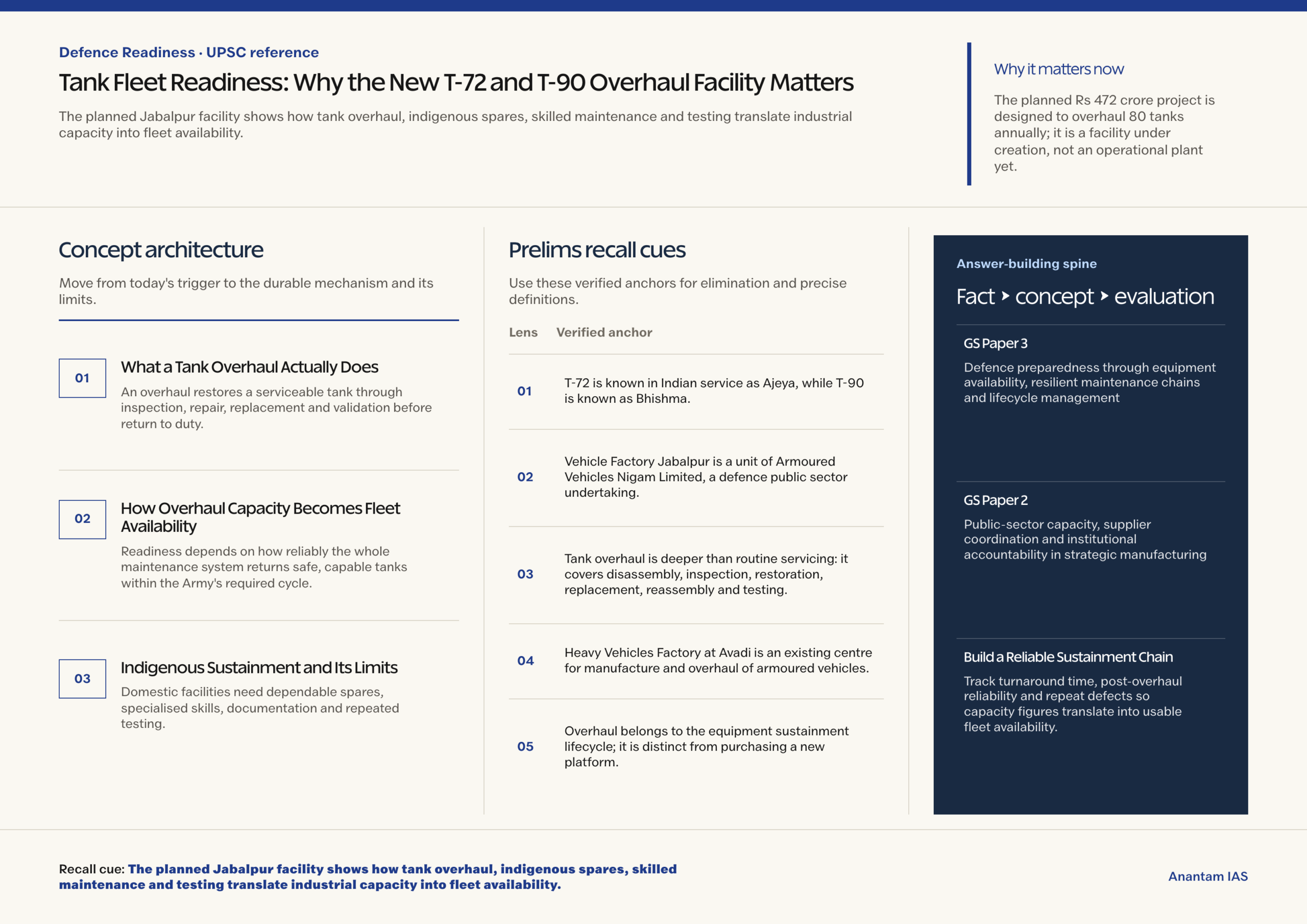
- The planned Rs 472 crore project is designed to overhaul 80 tanks annually; it is a facility under creation, not an operational plant yet.
- The Ministry of Defence states that the Army needs 230 tank overhauls each year, while Heavy Vehicles Factory, Avadi, can currently handle 150.
- The new capacity is intended to improve the timely return of serviced tanks to the Army and strengthen operational readiness.
- Officially identified supply needs span mechanical, electrical, electronic and hydraulic components, assemblies and subsystems.
- Fleet strength on paper differs from available combat strength: a tank undergoing maintenance cannot be fielded until restoration and acceptance are complete.
- Domestic overhaul capacity links maintenance, spares, testing and skills, making sustainment a core part of defence self-reliance rather than an after-sales activity.
- The Jabalpur project expands capacity beyond Avadi and may create a wider MSME supplier base for recurring overhaul requirements.
UPSC Relevance
Prelims Relevance
- T-72 is known in Indian service as Ajeya, while T-90 is known as Bhishma.
- Vehicle Factory Jabalpur is a unit of Armoured Vehicles Nigam Limited, a defence public sector undertaking.
- Tank overhaul is deeper than routine servicing: it covers disassembly, inspection, restoration, replacement, reassembly and testing.
- Heavy Vehicles Factory at Avadi is an existing centre for manufacture and overhaul of armoured vehicles.
- Overhaul belongs to the equipment sustainment lifecycle; it is distinct from purchasing a new platform.
Mains Relevance
GS Paper 3
- Defence preparedness through equipment availability, resilient maintenance chains and lifecycle management
- Indigenous capability in spares, quality assurance, skilled labour and industrial support for legacy platforms
GS Paper 2
- Public-sector capacity, supplier coordination and institutional accountability in strategic manufacturing
Essay
- Strategic autonomy depends as much on sustaining existing capabilities as on acquiring new technology.
Background and Context
What a Tank Overhaul Actually Does
An overhaul restores a heavily used but serviceable platform through controlled inspection, repair, replacement and validation before its return to operational duty.
- The tank is stripped into major assemblies so technicians can inspect wear, damage and defects that routine servicing cannot adequately assess.
- Repairable assemblies are dismantled and checked component by component; items that cannot meet safe and economical repair criteria are replaced.
- Time-limited parts such as seals, gaskets, rings, bearings, fasteners and washers receive planned attention before hidden deterioration becomes an operational failure during service.
- The hull and systems for cooling, fuel, lubrication, air induction, exhaust and transmission are examined, repaired or revalidated according to their condition.
- Major assemblies are tested before reintegration, followed by quality checks that confirm whether the restored tank can safely return to service.
How Overhaul Capacity Becomes Fleet Availability
Readiness depends on how reliably the whole maintenance system returns safe, capable tanks within the Army’s required cycle, not on nominal workshop capacity alone.
- A tank in a workshop remains part of the inventory but not the available fleet; turnaround time directly affects formations that can be equipped for operations.
- Planned Jabalpur capacity complements Avadi rather than replacing it, creating a second industrial node for the Army’s stated annual workload and maintenance schedule.
- Additional capacity can reduce maintenance backlogs only when components, trained workers, test equipment and quality assurance remain available in the same production rhythm without bottlenecks.
- Overhaul preserves the value of platforms already acquired, extending useful service while avoiding premature replacement of fundamentally usable equipment and conserving scarce industrial effort.
- Availability is the correct exam lens: the strategic output is not a repaired machine alone, but a verified combat asset returned on schedule to its unit.
Indigenous Sustainment and Its Limits
Domestic facilities matter only when dependable spares, specialised skills, documentation and rigorous testing support every repeated overhaul cycle.
- T-72 and T-90 fleets require recurring access to specialised parts; external supply disruption can lengthen downtime even when a workshop has adequate physical capacity and labour.
- Local sourcing must cover repeatable design, manufacture, inspection and delivery, not merely the one-time substitution of an imported component without assured quality.
- The project can provide sustained demand for Indian MSMEs across mechanical, electrical, electronic and hydraulic systems, widening the maintenance ecosystem beyond a single factory.
- Skills are a strategic asset: technicians need platform knowledge, fault diagnosis, assembly discipline and familiarity with acceptance standards to produce consistent outcomes across repeated overhaul cycles.
- Mechanical restoration does not automatically equal battlefield modernisation; any new sensors or communications need separate technical integration, testing and configuration control to prevent incompatibility.
Way Forward
Build a Reliable Sustainment Chain
The facility’s value will depend on measurable readiness outcomes after construction and commissioning.
- Track turnaround time, post-overhaul reliability and repeat defects so capacity figures translate into usable fleet availability.
- Develop multiple qualified suppliers for critical spares while preserving traceability, testing standards and configuration consistency.
- Create structured training and knowledge-retention systems for technicians, inspectors and Army maintenance personnel across the platform lifecycle.
- Plan upgrades separately from restoration, with clear requirements and trials for any sensor, communication or protection change.
Conclusion
- The Jabalpur project highlights a durable defence lesson: maintenance capacity is combat capacity only when spares, skills, testing and turnaround work as one accountable, repeatable system.
- In a Mains answer, connect indigenous overhaul to fleet availability and supply-chain resilience, distinguish lifecycle extension from procurement or automatic modernisation, and judge capacity by actual turnaround.
UPSC Practice Questions
Prelims MCQ 1
With reference to the planned T-Series Tanks Overhaul Project at Vehicle Factory Jabalpur, consider the following statements:
- It is intended to handle both T-72 and T-90 tanks.
- Vehicle Factory Jabalpur is a unit of Armoured Vehicles Nigam Limited.
- The foundation ceremony means the planned facility has already begun full annual operations.
How many of the above statements are correct?
(a) Only one (b) Only two (c) All three (d) None
Answer: (b) Only two
Explanation:
Statements 1 and 2 are correct. The August 2026 event marked the foundation ceremony for facilities under creation; it did not establish that full annual operations had begun.
Prelims MCQ 2
Which one of the following best distinguishes a comprehensive tank overhaul from routine servicing?
(a) It only replenishes fuel and lubricants (b) It changes the tank’s national designation (c) It restores major assemblies through disassembly, inspection, repair or replacement, reassembly and testing (d) It necessarily replaces the tank with a newly manufactured platform
Answer: (c) It restores major assemblies through disassembly, inspection, repair or replacement, reassembly and testing
Explanation:
A comprehensive overhaul is a lifecycle-restoration process. It reaches major assemblies and concludes with validation; it is deeper than routine servicing and does not itself mean purchasing a new tank.
UPSC Mains Questions
- Defence preparedness depends on lifecycle sustainment as much as on new acquisition. Discuss with reference to indigenous overhaul capacity for armoured fleets.
- Explain how domestic spares, technical skills and quality assurance convert an overhaul facility into improved fleet availability. What implementation risks must be addressed?
Sources: Press Information Bureau, Ministry of Defence and The Hindu Explained.
Frequently Asked Questions
What is a tank overhaul?
It is a comprehensive restoration process involving disassembly, inspection, repair or replacement of parts, reassembly, testing and quality assurance before a serviceable tank returns to duty.
Why does the Jabalpur facility matter for readiness?
It is planned to add annual overhaul capacity, complement Avadi and help return maintained T-72 and T-90 tanks to operational units within required timelines.
Is the new facility already operational?
No. The August 27, 2026 event was the foundation ceremony for the project. The announced annual capacity describes the planned facility, not completed output.
How can overhaul support defence self-reliance?
Domestic repair, spares, testing and skilled labour reduce dependence on external sustainment chains and build the industrial capability needed to keep existing platforms available.
Does overhaul automatically modernise a tank?
No. Overhaul restores serviceability and life. New sensors, communications or protection systems require separately defined integration, testing and configuration-control work.
Tell Google you want more of this.
Add Anantam IAS as a preferred sourceOne tap, and this site shows up more often in your own Top Stories, AI Overviews and AI Mode. Remove it any time.