

Why in News?
Why in news: The Supreme Court heard the Shiv Sena factions’ dispute over the party and its symbol.
- The Supreme Court heard the Shiv Sena factions’ dispute over the party and its symbol.
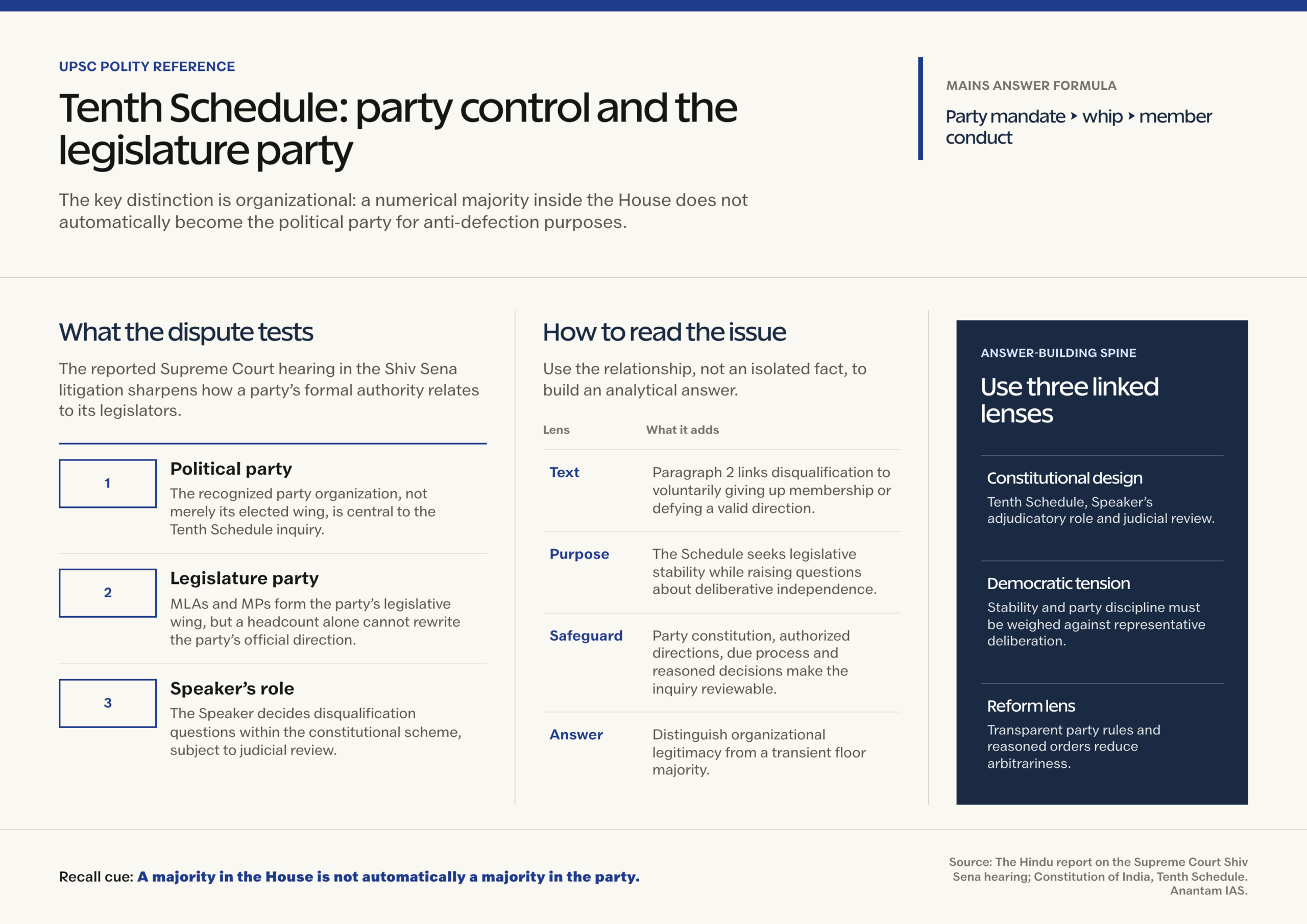
- The Court observed that a majority among legislators cannot by itself override the official political party’s directives.
- The hearing revisits the distinction between the political party and the legislature party.
- The Tenth Schedule’s merger exception requires a constitutionally relevant inquiry, not a simple headcount among legislators.
- Separate the current event from the durable constitutional, economic or governance concept it activates.
- Use the evidence with its limits; a single headline or reported number is not a complete policy verdict.
- Frame the way forward around capacity, accountability, equity and implementation.
UPSC Relevance
Prelims Relevance
- The Supreme Court heard the Shiv Sena factions’ dispute over the party and its symbol.
- The Court observed that a majority among legislators cannot by itself override the official political party’s directives.
- The hearing revisits the distinction between the political party and the legislature party.
- The Tenth Schedule was added by the Fifty-second Amendment to address political defections that destabilise elected governments.
- Disqualification can follow voluntary giving up of membership or voting or abstaining contrary to a whip, subject to the Schedule’s conditions.
- A legislature party is the group of elected members, while the political party is the wider organisation that fields candidates and sets its authorised structure.
Mains Relevance
GS Paper 2
- Use the issue to assess constitutional morality, representative mandate and anti-defection law.
- Link institutional design with rights, transparency and accountable implementation.
GS Paper 3
- Explain how evidence, technology or fiscal capacity changes delivery outcomes.
Essay
- Public policy succeeds when institutional capability and humane safeguards grow together.
Background and Context
The Current Development
This topic is best understood through constitutional morality, representative mandate and anti-defection law, not as an isolated headline.
- The Supreme Court heard the Shiv Sena factions’ dispute over the party and its symbol.
- The Tenth Schedule was added by the Fifty-second Amendment to address political defections that destabilise elected governments.
- Disqualification can follow voluntary giving up of membership or voting or abstaining contrary to a whip, subject to the Schedule’s conditions.
- A robust assessment should connect the current trigger with institutional capacity, implementation safeguards and the public consequence.
- The relevant authority should publish clear criteria, disclose the basis of important decisions and allow timely correction when implementation departs from the stated objective.
The Core Concept
This topic is best understood through constitutional morality, representative mandate and anti-defection law, not as an isolated headline.
- The Court observed that a majority among legislators cannot by itself override the official political party’s directives.
- Disqualification can follow voluntary giving up of membership or voting or abstaining contrary to a whip, subject to the Schedule’s conditions.
- A legislature party is the group of elected members, while the political party is the wider organisation that fields candidates and sets its authorised structure.
- A robust assessment should connect the current trigger with institutional capacity, implementation safeguards and the public consequence.
- The relevant authority should publish clear criteria, disclose the basis of important decisions and allow timely correction when implementation departs from the stated objective.
Institutions and Design
This topic is best understood through constitutional morality, representative mandate and anti-defection law, not as an isolated headline.
- The hearing revisits the distinction between the political party and the legislature party.
- A legislature party is the group of elected members, while the political party is the wider organisation that fields candidates and sets its authorised structure.
- The Speaker’s role in disqualification disputes and the Election Commission’s role in symbol disputes arise from different legal settings.
- A robust assessment should connect the current trigger with institutional capacity, implementation safeguards and the public consequence.
- The relevant authority should publish clear criteria, disclose the basis of important decisions and allow timely correction when implementation departs from the stated objective.
Evidence and Limitations
This topic is best understood through constitutional morality, representative mandate and anti-defection law, not as an isolated headline.
- The Tenth Schedule’s merger exception requires a constitutionally relevant inquiry, not a simple headcount among legislators.
- The Speaker’s role in disqualification disputes and the Election Commission’s role in symbol disputes arise from different legal settings.
- A useful answer must hold two values together: stable governments and space for genuine legislative deliberation.
- A robust assessment should connect the current trigger with institutional capacity, implementation safeguards and the public consequence.
- The relevant authority should publish clear criteria, disclose the basis of important decisions and allow timely correction when implementation departs from the stated objective.
Way Forward
Design for implementation
- Set clear responsibilities, timelines, transparent data and an accessible grievance route.
- Fund maintenance, trained personnel and independent review rather than only initial announcements.
- Use safeguards that protect affected people and build trust in institutions.
- Measure outcomes, correct gaps and make lessons available for wider replication.
Conclusion
- Tenth Schedule: Party Control and the Legislature Party is a current hook for a larger UPSC lesson: policy legitimacy depends on whether institutions can translate stated intent into fair and reliable outcomes.
- A strong answer should begin with the development, explain constitutional morality, representative mandate and anti-defection law, acknowledge implementation limits and end with accountable, evidence-led reform.
UPSC Practice Questions
Prelims MCQ 1
With reference to Tenth Schedule: Party Control and the Legislature Party, consider the following statements:
- The Supreme Court heard the Shiv Sena factions’ dispute over the party and its symbol.
- The Court observed that a majority among legislators cannot by itself override the official political party’s directives.
- The issue can be analysed without considering institutional design or implementation.
How many of the above statements are correct?
(a) Only one (b) Only two (c) All three (d) None
Answer: (b) Only two
Explanation:
The first two statements reflect the current development. Institutional design and implementation are central to the topic, making the third statement incorrect.
Prelims MCQ 2
Which approach best improves the quality of a public-policy answer?
(a) Treating a headline as the whole policy (b) Ignoring implementation constraints (c) Linking evidence, institutions, rights and outcomes (d) Replacing analysis with a list of slogans
Answer: (c) Linking evidence, institutions, rights and outcomes
Explanation:
UPSC answers are stronger when they connect the current development with durable concepts, capacity, safeguards and measurable outcomes.
UPSC Mains Questions
- Discuss the policy and governance lessons raised by Tenth Schedule: Party Control and the Legislature Party.
- How can institutional design improve outcomes while protecting accountability and equity in the context of Polity?
Sources: The Hindu and Official and constitutional reference material.
Frequently Asked Questions
What is the current issue behind Tenth Schedule: Party Control and the Legislature Party?
The Supreme Court heard the Shiv Sena factions’ dispute over the party and its symbol. The Court observed that a majority among legislators cannot by itself override the official political party’s directives.
Why is this relevant for UPSC?
The issue links a live development with constitutional morality, representative mandate and anti-defection law. It can be used in both Prelims fact revision and Mains answers on institutions, policy design and implementation.
What is the best Mains answer structure?
Start with the current trigger, explain the durable concept, use the relevant evidence, identify a limitation and finish with practical safeguards.
Why should a headline be read cautiously?
A reported development may show a real policy direction without proving final outcomes. Distinguish announcement, design, implementation and measured effect.
What should a way forward include?
Specify responsible institutions, finance, trained capacity, transparent monitoring, grievance redress and safeguards for affected people.
Tell Google you want more of this.
Add Anantam IAS as a preferred sourceOne tap, and this site shows up more often in your own Top Stories, AI Overviews and AI Mode. Remove it any time.






