

Why in News?
The Hindu reported that the All India Primary Teachers’ Federation (AIPTF) and its Andhra Pradesh affiliate, the Andhra Pradesh Primary Teachers’ Association (APPTA), have decided to file a curative petition in the Supreme Court seeking exemption for in-service teachers from the Teacher Eligibility Test (TET). The decision was taken unanimously at an emergency virtual meeting of the federation’s national executive committee.
The move follows the Court’s 29 May 2026 order dismissing a batch of over 65 review petitions against its 1 September 2025 judgment in Anjuman Ishaat-e-Taleem Trust v. State of Maharashtra, which made qualifying the TET mandatory even for teachers already in service. A curative petition is the last judicial remedy available once review fails — making this a live case study of the Rupa Ashok Hurra doctrine.
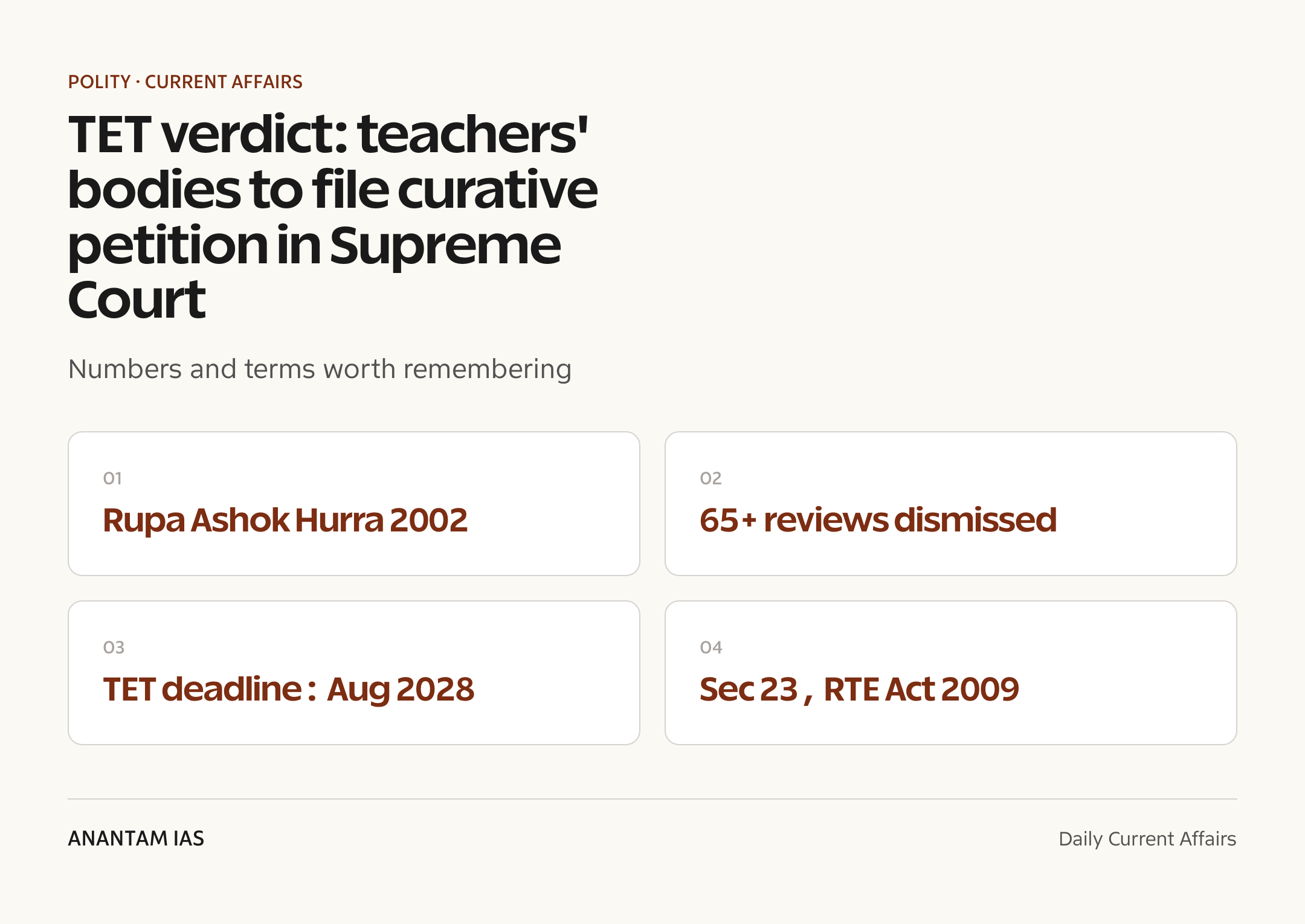
- The Anjuman Ishaat-e-Taleem Trust judgment (1 September 2025, bench of Justices Dipankar Datta and Manmohan) held TET a minimum qualification under Section 23 of the RTE Act, binding on in-service teachers too.
- On 29 May 2026, the same bench dismissed 65+ review petitions filed by States, teachers’ bodies and individual teachers, but used Article 142 to extend the compliance deadline to 31 August 2028 — with no further extension.
- AIPTF has asked its counsel to file the curative petition at the earliest; the federation says it was the first organisation to file a review petition in the case.
- In parallel, the federation is pursuing a political route: it has met Union Education Minister Dharmendra Pradhan three times seeking a parliamentary resolution granting TET exemption to in-service teachers, and plans to lobby MPs in the coming session.
- The teachers’ bodies have clubbed the TET demand with a second long-running one — restoration of the Old Pension Scheme (OPS) — and are running district-level protests across States.
The development matters in the context of:
- Curative petitions succeed extremely rarely — the remedy exists to correct a gross miscarriage of justice, not to re-argue a case. The episode lets aspirants revise the full ladder: judgment → Article 137 review → curative.
- The dispute sits at the junction of two constitutional claims: children’s right to quality education under Article 21A and the livelihood security of nearly a generation of pre-RTE teachers.
- It also tests institutional boundaries — teachers are simultaneously asking the judiciary (curative), the executive (ministerial assurances) and the legislature (parliamentary resolution) to undo the same ruling.
UPSC Relevance
Prelims Relevance
- Curative petition — evolved by a 5-judge Constitution Bench in Rupa Ashok Hurra v. Ashok Hurra (2002); not mentioned in the Constitution; heard after dismissal of a review petition.
- Grounds for curative relief are narrow: violation of natural justice (affected party not heard) or bias/undisclosed conflict of interest of a judge — not mere disagreement with the verdict.
- A curative petition must be certified by a senior advocate and is circulated to the three senior-most judges plus the judges who delivered the original judgment (if available); it is ordinarily decided in chambers, without oral hearing.
- Article 137 — power of the Supreme Court to review its own judgments; review petitions must normally be filed within 30 days.
- Article 142 — power to do ‘complete justice’; used in this case to extend the TET compliance deadline to 31 August 2028.
- Section 23, RTE Act 2009 — minimum qualifications for teachers are laid down by the academic authority, the NCTE; the TET was introduced by NCTE’s 2010 notification.
- TET structure — CTET is conducted by CBSE for central-government schools; States conduct their own TETs; since 2021 the TET qualifying certificate has lifetime validity.
- Judgment rule of thumb: pre-RTE teachers with more than 5 years of service left must clear TET to continue; those with less than 5 years left may serve till superannuation but need TET for promotion.
Mains Relevance
GS Paper 2
- Judiciary: the curative petition as a self-created check on judicial error — balancing finality of judgments against the duty to prevent miscarriage of justice.
- Judicial review vs legislative response: can Parliament ‘exempt’ in-service teachers by resolution when the Court has read TET into the RTE Act itself?
- Education governance: enforcing teacher-quality norms (NCTE qualifications, TET) against ground realities of a large pre-RTE workforce.
- Use of Article 142 to craft calibrated, transition-friendly relief while upholding a statutory standard.
GS Paper 4
- Ethical dilemma: the child-centric reading of the RTE Act (‘service of teachers cannot come at the cost of the educational future of children’) versus fairness to teachers recruited under old rules.
Essay
- Finality of judgments vs the possibility of judicial error — how much correction is too much?
- Quality of the teacher is the ceiling on the quality of education.
Background and Context
The 2025 judgment that started it
The trigger is the Supreme Court’s ruling in Anjuman Ishaat-e-Taleem Trust v. State of Maharashtra (1 September 2025).
- A bench of Justices Dipankar Datta and Manmohan held that the TET is a minimum qualification under Section 23 of the Right of Children to Free and Compulsory Education Act, 2009.
- Passing the TET is mandatory not only for fresh appointment but also for promotion in schools covered by the RTE Act.
- Crucially, the Court extended the requirement to in-service teachers appointed before the RTE Act came into force — the point the associations are contesting.
- Calibrated transition under Article 142: teachers with less than 5 years to superannuation may continue without TET (but cannot be promoted); those with more than 5 years left must qualify within two years or face compulsory retirement with terminal benefits.
- The bench also flagged the separate question of whether RTE norms bind minority institutions (the Pramati exemption) for consideration by a larger bench.
Review dismissed, deadline extended
The review route has already been exhausted — which is what makes a curative petition the only judicial option left.
- On 29 May 2026, the Supreme Court dismissed more than 65 review petitions filed by State governments, teachers’ federations and individual teachers.
- The Court refused to touch the core holding, observing that the RTE Act is a child-centric legislation and that teachers’ service interests cannot override children’s educational future.
- Using Article 142, it extended the deadline for acquiring the TET qualification from 31 August 2027 to 31 August 2028, stating no further extension would be granted.
- AIPTF says it was the first organisation to seek review; with that door shut, its national executive has now authorised a curative petition.
What is a curative petition?
The curative petition is a judge-made remedy of last resort, created in Rupa Ashok Hurra v. Ashok Hurra (2002).
- A 5-judge Constitution Bench held that even after a review is dismissed, the Supreme Court may reconsider its judgment to prevent abuse of its process and cure a gross miscarriage of justice.
- The remedy is not mentioned in the Constitution; the Court sourced it from its inherent powers, and it is now regulated by the Supreme Court Rules, 2013.
- Admissible grounds are deliberately narrow: (a) breach of principles of natural justice — an affected person was not heard; or (b) a judge failed to disclose facts raising an apprehension of bias.
- Safeguards against misuse: certification by a senior advocate, circulation to the three senior-most judges and the judges who passed the verdict, decision normally in chambers, and exemplary costs if the petition is found meritless.
- Success is rare — notable instances include Navneet Kaur (2014), where a death sentence was commuted, and the DMRC–DAMEPL curative (2024), where the Court set aside its own order upholding an arbitral award.
Review vs curative — the ladder of remedies
Aspirants should be able to separate the two post-judgment remedies cleanly.
- Review (Article 137): a constitutional power; filed normally within 30 days; grounds include error apparent on the face of the record or discovery of new evidence; usually decided by circulation by the same bench. Read the anantamias notes on the Supreme Court’s jurisdiction for the fuller picture.
- Curative: a judge-made remedy available only after review fails; grounds restricted to natural-justice violation or judge bias; needs senior-advocate certification; no fixed limitation period, but must be filed within a reasonable time.
- Both remedies qualify the doctrine of finality: Article 141 makes SC law binding on all courts, yet the Court accepts that certainty ‘cannot be at the price of injustice’.
- Article 142 often works alongside these remedies to mould relief — as with the TET deadline extension. See the explainer on Article 142 and complete justice.
TET and the RTE teacher-quality framework
The underlying statute is the RTE Act, 2009, which operationalises Article 21A.
- Section 23(1): a person must possess minimum qualifications laid down by an academic authority authorised by the Central government — that authority is the National Council for Teacher Education (NCTE).
- NCTE’s August 2010 notification made passing the TET an essential qualification for teachers of Classes I–VIII.
- The CTET (Central TET) is conducted by CBSE; States run their own TETs (APTET, UPTET and others); the qualifying mark is 60%, and since 2021 the certificate carries lifetime validity.
- The policy logic: TET screens for subject and pedagogic competence, reinforcing the RTE promise of quality, not just access. The RTE Act and Article 21A notes cover the statute’s design.
- NEP 2020 pushes the same direction — TET strengthening, extension across school stages, and merit-based teacher recruitment. See the NEP 2020 explainer.
The teachers' side and the political track
Alongside the curative petition, the federations are working every non-judicial lever available.
- AIPTF has met Union Education Minister Dharmendra Pradhan on three occasions, seeking a parliamentary resolution granting TET exemption to in-service teachers; the Minister assured the delegation the matter would be raised with the Home Minister and the Prime Minister.
- The federation plans to meet MPs during the upcoming Parliament session to press two demands: TET exemption and restoration of the Old Pension Scheme.
- AIPTF affiliates are running district-level protests across States; the national executive resolved to continue the agitation until OPS is restored.
- The teachers’ core argument: they were recruited under the rules of their time, many have decades of classroom experience, and a fresh eligibility screen so late in their careers threatens livelihood security.
Significance and concerns
The case is a compact lesson in how far post-verdict remedies can stretch.
- For the curative to be even entertained, petitioners must show a Hurra ground — a natural-justice or bias defect — not merely that the judgment is harsh; most curative petitions fail at this threshold.
- A legislative override raises its own questions: a resolution has no statutory force, and an amendment diluting Section 23 could face scrutiny against Article 21A‘s quality mandate.
- Implementation is the real challenge for States: lakhs of pre-RTE teachers must be helped to clear TET by 31 August 2028 — needing preparation support, exam scheduling and contingency staffing.
- The episode illustrates a recurring governance pattern: courts setting hard standards under rights-based statutes, and the political system absorbing the transition costs.
Way Forward
For governments and NCTE
- Run state-funded TET preparation programmes — bridge courses, model papers and exam-fee support — targeted at in-service teachers, with multiple TET sittings before the 2028 deadline.
- Plan contingency recruitment so schools in remote areas are not left teacher-less if some incumbents cannot qualify.
- NCTE can review TET design — testing classroom pedagogy and experience-linked competencies rather than rote recall — without diluting the standard.
For the judicial process
- Any curative petition should be argued strictly on Hurra grounds; using it as a second review invites summary dismissal with costs.
- Clear, early communication of the Court’s timelines to school managements and teachers will reduce panic-driven litigation.
Conclusion
The AIPTF-APPTA decision moves the TET dispute to the very last rung of India’s judicial ladder. A curative petition is not a third bite at the cherry — after Rupa Ashok Hurra (2002), it succeeds only where a judgment was produced by a process that failed the basics of natural justice. On the merits, the Court has twice said the same thing: the RTE Act is child-centric, and teacher quality is non-negotiable.
For aspirants, the takeaway is structural. One news item packages the review–curative distinction, Articles 137 and 142, Section 23 of the RTE Act, NCTE’s role, and a live federalism-and-governance problem of transitioning a legacy workforce to a new standard. Whatever the curative bench decides, the 31 August 2028 deadline is now the operative fact for every pre-RTE teacher in the country.
UPSC Practice Questions
Prelims MCQ 1
With reference to the curative petition in the Supreme Court of India, consider the following statements:
- The remedy of a curative petition was evolved by the Supreme Court in Rupa Ashok Hurra v. Ashok Hurra (2002) and is not expressly mentioned in the Constitution.
- A curative petition can be filed only after a review petition against the judgment has been dismissed.
- A curative petition must be certified by the Attorney-General of India before it is circulated to the judges.
How many of the above statements are correct?
(a) Only one (b) Only two (c) All three (d) None
Answer: (b) Only two
Explanation:
Statements 1 and 2 are correct: the curative petition is a judge-made remedy from Rupa Ashok Hurra (2002), available only after review fails. Statement 3 is wrong — certification is by a senior advocate, not the Attorney-General; the petition is then circulated to the three senior-most judges and the judges who delivered the verdict.
Prelims MCQ 2
The Supreme Court’s 2025 ruling in Anjuman Ishaat-e-Taleem Trust v. State of Maharashtra, recently in news, relates to which one of the following?
(a) Regularisation of contractual teachers in minority institutions (b) Mandatory Teacher Eligibility Test (TET) qualification for in-service teachers under the RTE Act (c) Reservation in teacher recruitment for economically weaker sections (d) Validity of the no-detention policy under the RTE Act
Answer: (b) Mandatory Teacher Eligibility Test (TET) qualification for in-service teachers under the RTE Act
Explanation:
The judgment held TET to be a minimum qualification under Section 23 of the RTE Act, mandatory for appointment, promotion and — with calibrated timelines — for teachers already in service. Review petitions were dismissed in May 2026, with the compliance deadline extended to 31 August 2028 under Article 142.
UPSC Mains Questions
- The curative petition reconciles the finality of judgments with the Supreme Court’s duty to prevent miscarriage of justice. Explain the origin, grounds and procedure of the curative jurisdiction, and assess whether its narrow design serves this balance. (250 words)
- The Supreme Court’s mandatory-TET ruling pits children’s right to quality education against the livelihood claims of pre-RTE teachers. Examine the governance challenges in implementing the ruling and suggest measures to manage the transition. (250 words)
- “A judge-made remedy correcting judge-made error is both a strength and a paradox of the Indian judiciary.” Discuss with reference to review and curative jurisdictions of the Supreme Court. (150 words)
Source: The Hindu.
Frequently Asked Questions
What is a curative petition?
A curative petition is the last judicial remedy in the Supreme Court, created in Rupa Ashok Hurra v. Ashok Hurra (2002). It’s heard after a review petition is dismissed, on narrow grounds — violation of natural justice or bias of a judge — and needs certification by a senior advocate.
Why are teachers’ bodies filing a curative petition now?
The Supreme Court’s September 2025 Anjuman Ishaat-e-Taleem Trust judgment made TET mandatory for in-service teachers, and in May 2026 the Court dismissed over 65 review petitions against it. With review exhausted, AIPTF and APPTA have authorised a curative petition seeking exemption for serving teachers.
What did the Supreme Court’s TET judgment hold?
It held TET is a minimum qualification under Section 23 of the RTE Act, 2009 — required for appointment, promotion, and continuation in service. Pre-RTE teachers with over five years of service left must clear TET; those with less may serve till retirement but can’t be promoted without it.
What is the current TET compliance deadline?
While dismissing the review petitions on 29 May 2026, the Supreme Court used Article 142 to extend the deadline for in-service teachers to qualify TET from 31 August 2027 to 31 August 2028, and made clear that no further extension will be granted.
How is a curative petition different from a review petition?
A review under Article 137 challenges a judgment for error apparent on record, normally within 30 days. A curative comes only after review fails, on stricter grounds — natural-justice violation or judge bias — and is usually decided in chambers by the senior-most judges along with the original bench.
Who conducts the Teacher Eligibility Test?
The Central TET (CTET) is conducted by CBSE for central-government schools, while States conduct their own TETs. The test flows from NCTE’s 2010 notification under Section 23 of the RTE Act, and since 2021 the qualifying certificate has lifetime validity.
Tell Google you want more of this.
Add Anantam IAS as a preferred sourceOne tap, and this site shows up more often in your own Top Stories, AI Overviews and AI Mode. Remove it any time.






