Why in News?
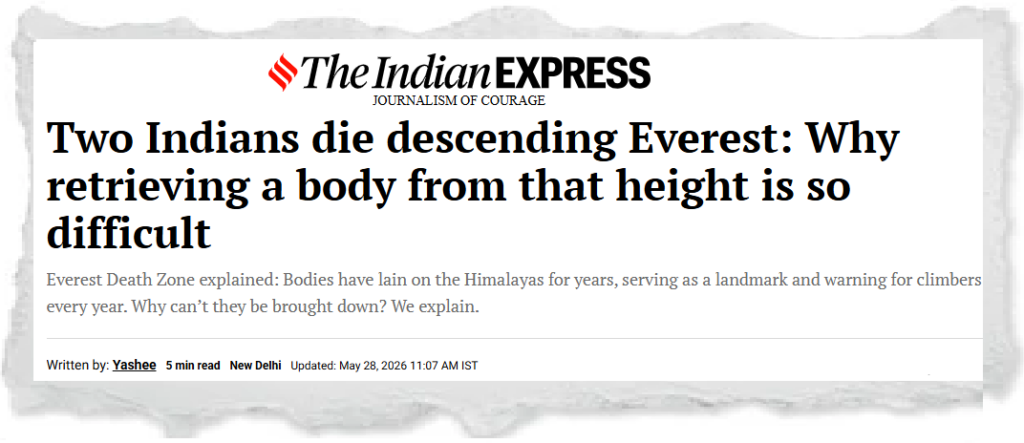
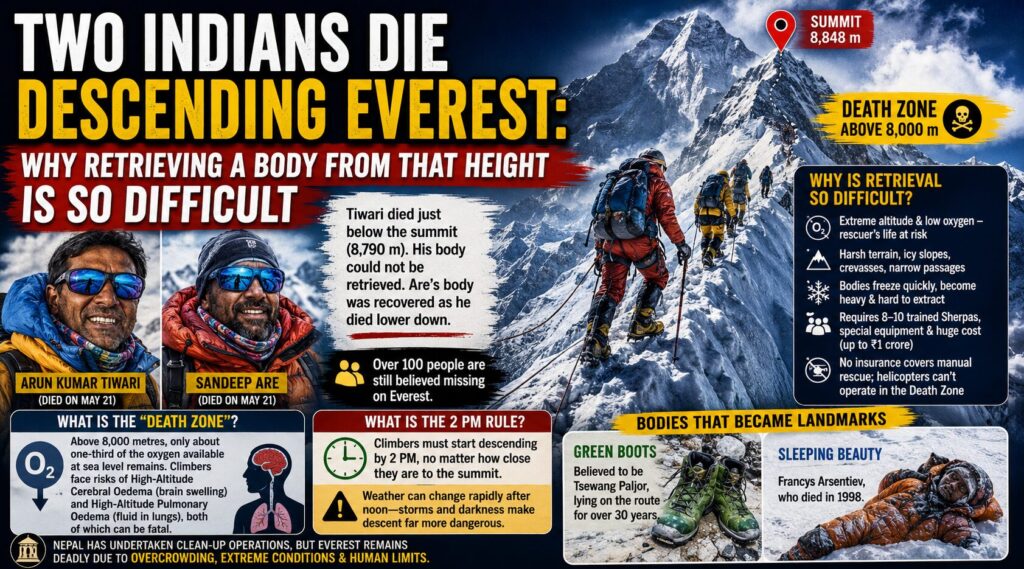
Two Indian climbers died while descending Mount Everest during the 2026 climbing season. While the body of one climber could be recovered, another climber who died close to the summit could not be retrieved because of the extreme conditions prevailing in the “Death Zone”.
The incident has once again highlighted the dangers of high-altitude mountaineering, the immense logistical challenges involved in rescue operations above 8,000 metres, and growing concerns regarding overcrowding and environmental degradation on Everest.
UPSC Relevance
Prelims: Mount Everest, Death Zone, High-Altitude Cerebral Oedema (HACE), High-Altitude Pulmonary Oedema (HAPO), Sherpas, Himalayan ecology.
Mains:
GS I – Physical geography of the Himalayas;
GS III – Disaster management, environmental sustainability, tourism management and mountain ecology.
Background/Context
Mount Everest, located on the Nepal-China border in the Himalayas, stands at 8,848 metres and is the highest mountain peak in the world. Every year, hundreds of climbers attempt to scale the mountain despite extreme weather conditions and severe physiological risks.
However, Everest is also associated with recurring fatalities caused by oxygen deprivation, exhaustion, avalanches, frostbite and overcrowding near the summit route. Bodies of climbers often remain on the mountain for years because recovery operations in the upper reaches are technically difficult, financially expensive and highly dangerous.
Several climbers who died on Everest have become grim landmarks for mountaineers. One of the most famous examples is “Green Boots”, believed to be the body of Indian climber Tsewang Paljor, whose remains remained visible along a summit route for decades. Another well-known case is that of American climber Francys Arsentiev, often referred to as “Sleeping Beauty”.
What is the “Death Zone”?
The region above 8,000 metres on Mount Everest is known as the “Death Zone”. At this altitude, atmospheric pressure falls drastically and oxygen availability declines to nearly one-third of sea-level concentration.
Even acclimatised climbers cannot survive there for prolonged periods because the human body gradually begins to deteriorate under conditions of severe oxygen scarcity and extreme cold.
Physiological Challenges in the Death Zone
Climbers in the Death Zone often experience severe physical and mental stress. Reduced oxygen levels impair judgement, weaken muscular coordination and increase fatigue.
One of the major medical risks is High-Altitude Cerebral Oedema (HACE), a condition in which fluid accumulates in the brain due to oxygen deprivation. It may lead to confusion, hallucinations, loss of coordination and unconsciousness.
Another serious condition is High-Altitude Pulmonary Oedema (HAPO), where fluid accumulates in the lungs, causing severe breathlessness and respiratory distress. Both conditions can become fatal if immediate descent is not possible.
Combined with freezing temperatures, high wind speeds and frostbite risks, these factors make survival in the Death Zone extremely difficult.
Why is Retrieving Bodies from Everest So Difficult?
Extreme altitude and oxygen scarcity
Rescuers themselves face life-threatening risks in the Death Zone because prolonged exposure to low oxygen levels can impair both physical and mental functioning.
Harsh terrain and weather conditions
The upper reaches of Everest contain steep ice walls, slippery rock faces, narrow ridges and deep crevasses, making coordinated rescue operations extremely difficult. In several sections, only one climber can move at a time.
The freezing temperatures further worsen conditions, while sudden storms and poor visibility make descent operations highly risky.
Bodies freeze rapidly at high altitude
At such extreme altitudes, bodies freeze quickly and often become embedded in snow and ice. Rescue teams may need to dig bodies out under hostile weather conditions where even handling tools becomes difficult.
Bodies also become extremely heavy during recovery because they are frozen stiff, making transportation through narrow mountain passages extremely challenging.
Limited rescue infrastructure
Helicopters struggle to operate effectively at such high altitudes because thin air reduces lift generation. As a result, recovery missions largely depend on manual efforts by Sherpas and rescue teams.
According to mountaineering experts, retrieving a body from near the summit may require 8–10 trained Sherpas, specialised ropes, oxygen cylinders and multiple expedition days. Consequently, the cost of such an operation can reach nearly ₹1 crore.
The Role of Sherpas in Everest Expeditions
Sherpas play a central role in Himalayan mountaineering expeditions. They assist climbers in route fixing, carrying supplies, setting up camps, rescue operations and body recovery missions.
Despite their expertise, Sherpas face disproportionate risks because they repeatedly move through hazardous sections of the mountain while supporting commercial expeditions.
What is the 2 PM Rule on Everest?
To reduce fatalities during summit attempts, the Nepal government and expedition agencies increasingly enforce the “2 PM Rule”. Under this rule, climbers are expected to begin descending by 2 PM irrespective of whether they have reached the summit.
The rationale behind the rule is that weather conditions on Everest can deteriorate rapidly during the afternoon. Storms may develop suddenly, temperatures may fall sharply and darkness can reduce visibility, making the already dangerous descent even riskier.
Studies and rescue data suggest that more deaths occur during descent than ascent because climbers are physically exhausted after summit attempts and often continue climbing despite deteriorating health conditions.
Environmental and Governance Concerns on Everest
The increasing commercialisation of Everest expeditions has raised serious environmental and governance concerns. Overcrowding near summit routes frequently creates traffic bottlenecks, increasing climbers’ exposure time in the Death Zone.
The mountain has also witnessed growing accumulation of discarded oxygen cylinders, plastic waste, abandoned tents and human remains, threatening the fragile Himalayan ecosystem.
In response, Nepal has launched several clean-up campaigns aimed at removing waste and recovering bodies from Everest and nearby peaks. However, many climbers are still believed to be missing in the Himalayan region.
Broader Lessons from Everest Fatalities
The recurring fatalities on Everest underline the severe physiological limitations humans face in extreme environmental conditions. They also highlight the tensions between adventure tourism, commercial mountaineering and ecological sustainability.
The rising number of climbers attempting Everest every year has intensified debates regarding stricter safety regulations, better rescue infrastructure and limits on overcrowding.
At a broader level, these incidents demonstrate the importance of balancing tourism revenue with environmental conservation and human safety in fragile mountain ecosystems.
Way Forward
Strengthening safety regulations
Authorities should enforce stricter acclimatisation protocols, oxygen requirements and turnaround-time rules to reduce preventable deaths.
Improving rescue capabilities
Investment in specialised high-altitude rescue training, weather forecasting systems and emergency infrastructure can improve survival outcomes.
Regulating overcrowding
Limiting permits during peak climbing seasons may help reduce congestion near summit routes and minimise exposure in the Death Zone.
Promoting sustainable mountain tourism
Environmentally responsible expedition practices, effective waste-management systems and stronger ecological conservation measures are essential for protecting the Himalayan ecosystem.
Conclusion
The deaths of climbers on Mount Everest once again reveal the immense dangers associated with high-altitude mountaineering. The “Death Zone” represents one of the harshest environments faced by humans, where oxygen scarcity, freezing temperatures and difficult terrain make survival itself uncertain.
Beyond individual tragedies, the issue raises broader concerns regarding sustainable tourism, environmental protection and governance of the Himalayan ecosystem. As commercial mountaineering continues to expand, balancing adventure tourism with ecological sustainability and human safety will become increasingly important.
Practice Questions
Prelims Question 1 (Inference-based)
Consider the following statements with reference to the “Death Zone” on Mount Everest:
I. The Death Zone refers to altitudes above 8,000 metres where oxygen availability becomes critically low for human survival.
II. Rescue and body retrieval operations in the Death Zone are highly risky because extreme altitude and terrain severely constrain human functioning and logistics.
III. Safety regulations such as the “2 PM Rule” aim to reduce fatalities associated with high-altitude climbing.
Which of the following relationships among the above statements is/are correct?
- Statement II explains the operational challenges arising from the environmental conditions mentioned in Statement I.
- Statement III represents an administrative response intended to mitigate risks associated with the conditions described in Statements I and II.
- Statement I contradicts Statement III because climbers above 8,000 metres cannot be subjected to safety regulations.
(a) 1 only
(b) 1 and 2
(c) 2 and 3
(d) 3 only
Answer: (b)
Explanation: Statement II logically explains why rescue operations become extremely difficult in the Death Zone. Statement III further shows how administrative measures seek to reduce the risks associated with extreme-altitude climbing. Statement 3 is incorrect.
Prelims Question 2
Consider the following pairs:
| Term | Description |
|---|---|
| 1. High-Altitude Cerebral Oedema (HACE) | Fluid accumulation affecting the brain at high altitude |
| 2. High-Altitude Pulmonary Oedema (HAPO) | Fluid accumulation in lungs due to altitude-related oxygen deficiency |
| 3. Sherpas | Indigenous Arctic rescue community specialised in polar expeditions |
Which of the pairs given above are correctly matched?
(a) 1 and 2 only
(b) 2 and 3 only
(c) 1 and 3 only
(d) 1, 2 and 3
Answer: (a)
Explanation: Pair 3 is incorrect because Sherpas are a Himalayan ethnic community associated with mountaineering expeditions in Nepal and surrounding Himalayan regions.
Mains Questions
- Discuss the environmental and governance challenges associated with increasing commercialisation of Mount Everest expeditions.
- Examine the physiological and logistical challenges involved in high-altitude rescue operations in the Himalayas.
Tell Google you want more of this.
Add Anantam IAS as a preferred sourceOne tap, and this site shows up more often in your own Top Stories, AI Overviews and AI Mode. Remove it any time.