
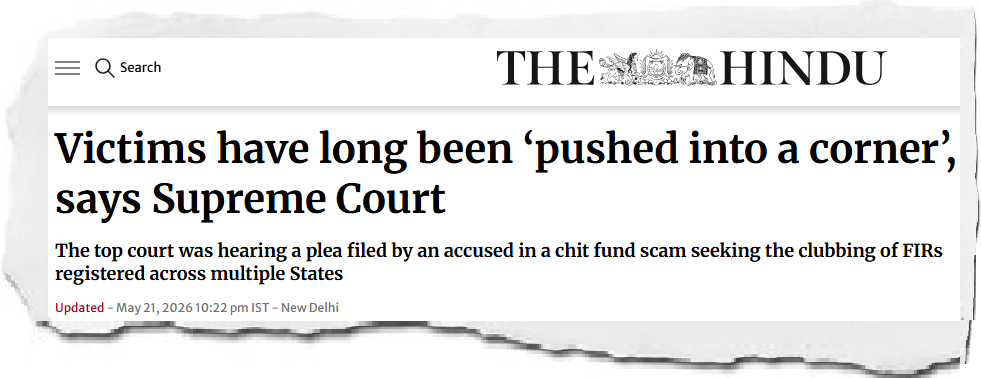
Why in News?
The Supreme Court, while hearing a plea in a multi-crore chit fund scam involving Micro Finance Limited, emphasised the need for a more victim-centric criminal justice system. Refusing to club FIRs registered across different States for the convenience of the accused, the Court observed that victims have historically been “pushed into a corner” and that criminal jurisprudence has largely remained accused-centric.
UPSC Relevance
Prelims: Victim-Centric Criminal Justice, FIR provisions, territorial jurisdiction, Bharatiya Nagarik Suraksha Sanhita (BNSS), Article 21.
Mains:
GS -II: Judiciary, criminal justice reforms, victim rights and access to justice.
Background/Context
India’s criminal justice framework historically evolved around safeguarding the rights of the accused against arbitrary state action. Constitutional guarantees such as protection against self-incrimination, the presumption of innocence, and fair trial provisions aimed to prevent misuse of state power.
However, over time concerns emerged that while accused rights received substantial attention, victims frequently remained peripheral participants in the process. Victims often face financial burdens, prolonged litigation, inadequate compensation, and limited participation in proceedings.
The Supreme Court’s recent observations indicate an attempt to recalibrate this balance by integrating victim rights into the criminal justice framework.
Understanding Victim-Centric Justice
Victim-centric justice refers to an approach where the interests, dignity, protection, and rehabilitation of victims become integral components of criminal proceedings.
It aims to ensure that victims are not treated merely as witnesses but as stakeholders in the justice process.
Key elements include:
Recognition of victims as rights holders
Victims should possess procedural rights during investigation and trial rather than remaining passive observers.
Access to justice
Legal procedures should not impose excessive economic or geographical burdens on victims.
Compensation and rehabilitation
Victims may require financial assistance, psychological support, and rehabilitation measures.
Participation in proceedings
Victims should have opportunities to present concerns and participate in judicial processes where permitted.
Supreme Court’s Observations in the Chit Fund Case
The Court rejected the argument that multiple FIRs should be clubbed into one proceeding solely for the convenience of the accused.
The Court highlighted several concerns:
Burden on poor victims
The Court observed that many investors were labourers, senior citizens and economically weaker individuals who invested their life savings.
Forcing them to travel long distances for hearings would disproportionately affect access to justice.
Territorial jurisdiction and multiple offences
The Bench noted that when a conspiracy results in separate overt acts across different locations, each act creates independent jurisdiction for trial.
Shift from accused-centric jurisprudence
The Court acknowledged that criminal law traditionally focused heavily on accused rights while victim concerns often remained neglected.
Constitutional and Legal Dimensions
Article 21
Article 21 guarantees protection of life and personal liberty.
The judiciary has progressively interpreted Article 21 broadly to include:
- Right to fair trial, Right to speedy justice, Right to dignity, Rights of victims and survivors
The Supreme Court has increasingly recognised that Article 21 protects victims as much as accused persons.
Directive Principles of State Policy
Though non-justiciable, several principles support welfare-oriented justice:
- Article 38: Promotion of social justice
- Article 39A: Equal justice and free legal aid
Victim Compensation Framework
Section 396 of the Bharatiya Nagarik Suraksha Sanhita (earlier Section 357A of CrPC) provides for victim compensation schemes.
States are expected to establish funds for compensating victims suffering loss or injury.
Evolution of Victim Rights in India
Early criminal justice approach
The colonial criminal justice system largely viewed crime as an offence against the State rather than against individual victims.
Judicial expansion of victim rights
The Supreme Court gradually expanded victim rights through various judgments:
- Victims can challenge acquittals.
- Victims can seek compensation.
- Victims may participate in certain stages of proceedings.
Recent legislative developments
The new criminal laws attempt to provide greater visibility to victim rights through:
- Expanded compensation mechanisms
- Witness protection provisions
- Speedier investigation procedures
Challenges in India’s Existing Criminal Justice System
Limited role of victims: Victims often remain dependent upon prosecutors and have minimal direct influence over proceedings.
Financial constraints: Court appearances involve travel expenses, loss of wages and legal costs.
Delays in justice delivery: Lengthy trials can reduce confidence in the judicial system.
Poor rehabilitation mechanisms: Psychological counselling and long-term support structures remain inadequate.
Witness intimidation: Victims and witnesses often face threats and pressure from accused persons.
Low awareness: Many victims remain unaware of compensation schemes and procedural rights.
Global Practices in Victim-Centric Justice
Several countries have institutionalised victim rights:
United States
Victim Rights Acts provide: Right to information, Right to participation, Right to restitution
United Kingdom
Victim Charters specify standards for treatment and support.
European Union
The EU Victims’ Rights Directive establishes minimum standards for protection and participation.
Significance of a Victim-Centric Framework
A stronger victim-oriented system can generate multiple benefits:
Enhancing trust in institutions
Citizens are more likely to trust justice systems that visibly protect vulnerable individuals.
Improving access to justice
Reducing procedural hardships encourages reporting and participation.
Strengthening social legitimacy
Justice should not merely punish offenders but also restore faith among victims.
Balancing constitutional protections
Protection of accused rights should coexist with protection of victims.
Challenges in Moving Towards a Victim-Centric Model
Maintaining balance with accused rights
Excessive emphasis on victims should not undermine principles such as presumption of innocence.
Institutional capacity constraints
Courts, prosecutors and legal aid institutions remain overburdened.
Financial implications
Compensation and rehabilitation systems require sustained funding.
Risk of emotional influence
Criminal justice should remain evidence-based and not become driven solely by public emotion.
Way Forward
Strengthen victim participation mechanisms
Victims should be given meaningful opportunities to engage with proceedings while preserving fair trial principles.
Improve compensation delivery
Compensation schemes should operate efficiently with simplified procedures.
Expand legal aid and counselling
Victims require legal, psychological and social support systems.
Establish stronger witness protection
Robust protection mechanisms can reduce intimidation and improve trial outcomes.
Use technology for accessibility
Virtual hearings and digital systems can reduce financial burdens on victims.
Build institutional sensitivity
Police, prosecutors and judges should receive regular training on victim rights and trauma-sensitive approaches.
Conclusion
The Supreme Court’s observations indicate an evolving philosophy within India’s criminal justice system. While constitutional safeguards for accused persons remain indispensable, justice cannot ignore those who suffer the consequences of crime. A balanced system requires moving beyond an exclusively accused-centric model and ensuring that victims become active participants rather than forgotten stakeholders in the pursuit of justice.
Practice Questions
Prelims Question 1
With reference to victim compensation in India, consider the following statements:
- Victim compensation provisions were introduced only under the Bharatiya Nagarik Suraksha Sanhita (BNSS).
- States are required to establish victim compensation schemes.
- Victims have no right to appeal against acquittal.
Which of the statements given above is/are correct?
A) 1 only
B) 2 only
C) 1 and 3 only
D) 2 and 3 only
Correct Answer: B
Explanation: Victim compensation existed earlier under CrPC Section 357A and continues under BNSS. Victims can challenge acquittals under specified provisions.
Prelims Question 2
Article 39A of the Constitution primarily deals with:
A) Protection of minorities
B) Free legal aid and equal justice
C) Uniform Civil Code
D) Local self-government
Correct Answer: B
Explanation: Article 39A directs the State to ensure equal justice and provide free legal aid.
Mains Question 1
- “India’s criminal justice system has historically remained accused-centric rather than victim-centric.” Examine in the context of recent judicial developments.
- Discuss the constitutional, legal and institutional challenges in developing a victim-centric criminal justice system in India.
Tell Google you want more of this.
Add Anantam IAS as a preferred sourceOne tap, and this site shows up more often in your own Top Stories, AI Overviews and AI Mode. Remove it any time.