Why in News?
On 13 October 2026, the science ministry reported an INST Mohali membrane that combines light and mechanical vibration to treat dye-contaminated wastewater.
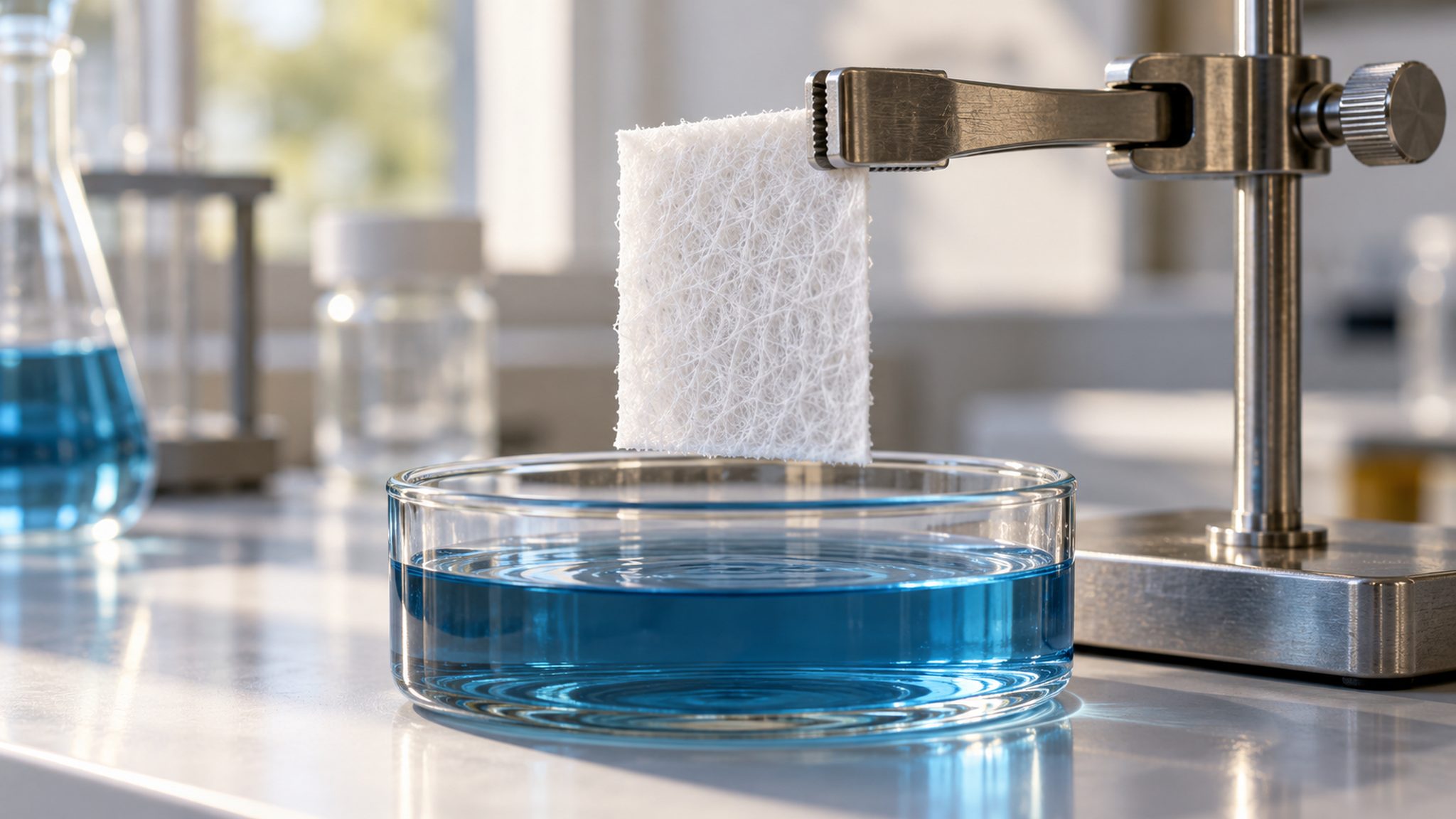
- The PLA–ZnO membrane embeds zinc oxide nanoparticles in porous polylactic acid nanofibres, keeping the catalyst within a recoverable structure.
- Laboratory tests reported 98.6% MB and 96.7% CR decolorisation within 120 minutes under combined light and ultrasonic excitation.
- Machine learning predicted dye-decolorisation behaviour from experimental conditions; it did not replace the physical treatment mechanism.
- Persistent industrial dyes can resist natural degradation, making pollutant destruction different from simply separating coloured material from water.
- This is research-stage evidence, not proof of safe drinking water, complete pollutant mineralisation or commercial-scale performance.
UPSC Relevance
Prelims Relevance
- Photocatalysis: light activates a catalyst and generates charge carriers.
- Piezoelectric polarisation: mechanical stress produces electrical polarisation in a suitable material.
- Immobilisation: fixing catalyst particles within a supporting structure.
- Electrospinning: fabrication route used for the porous PLA–ZnO nanofibres.
- Decolorisation: loss of colour, distinct from proof of complete mineralisation.
Mains Relevance
GS Paper 3
- Nanomaterials and combined-energy approaches to industrial wastewater treatment.
- Evidence requirements for translating laboratory results into environmentally safe treatment systems.
Essay
- An environmental innovation must be judged by its entire treatment outcome, not its most impressive laboratory metric.
Background and Context
Why Embed Zinc Oxide in a Fibrous Membrane?
The new design changes how the catalyst contacts polluted water and how it can be handled after treatment, rather than merely adding another filter layer.
- Zinc oxide supplies the catalytic component, while polylactic acid forms the fibrous support. Their combination creates a treatment membrane whose role extends beyond physically trapping suspended matter at a barrier.
- Immobilisation addresses a practical weakness of freely dispersed nanoparticle powders: separating the catalyst from treated water. Holding particles in a membrane supports recovery, although actual particle release still requires measurement during repeated operation.
- Electrospinning produced porous nanofibres with high surface area and mechanical stability, according to the release. The open structure provides contact between pollutants and catalytic surfaces, a requirement for reactions to occur efficiently.
- Turmeric extract supplied compounds used during nanoparticle synthesis as reducing and stabilising agents. This describes the preparation route; it does not, by itself, establish that the finished composite is harmless in every environment.
- The relevant distinction is separation versus degradation: adsorption transfers a pollutant onto a surface, whereas catalytic treatment seeks chemical breakdown. A treatment train may still need both functions rather than treating them as interchangeable.
How Light and Vibration Work Together
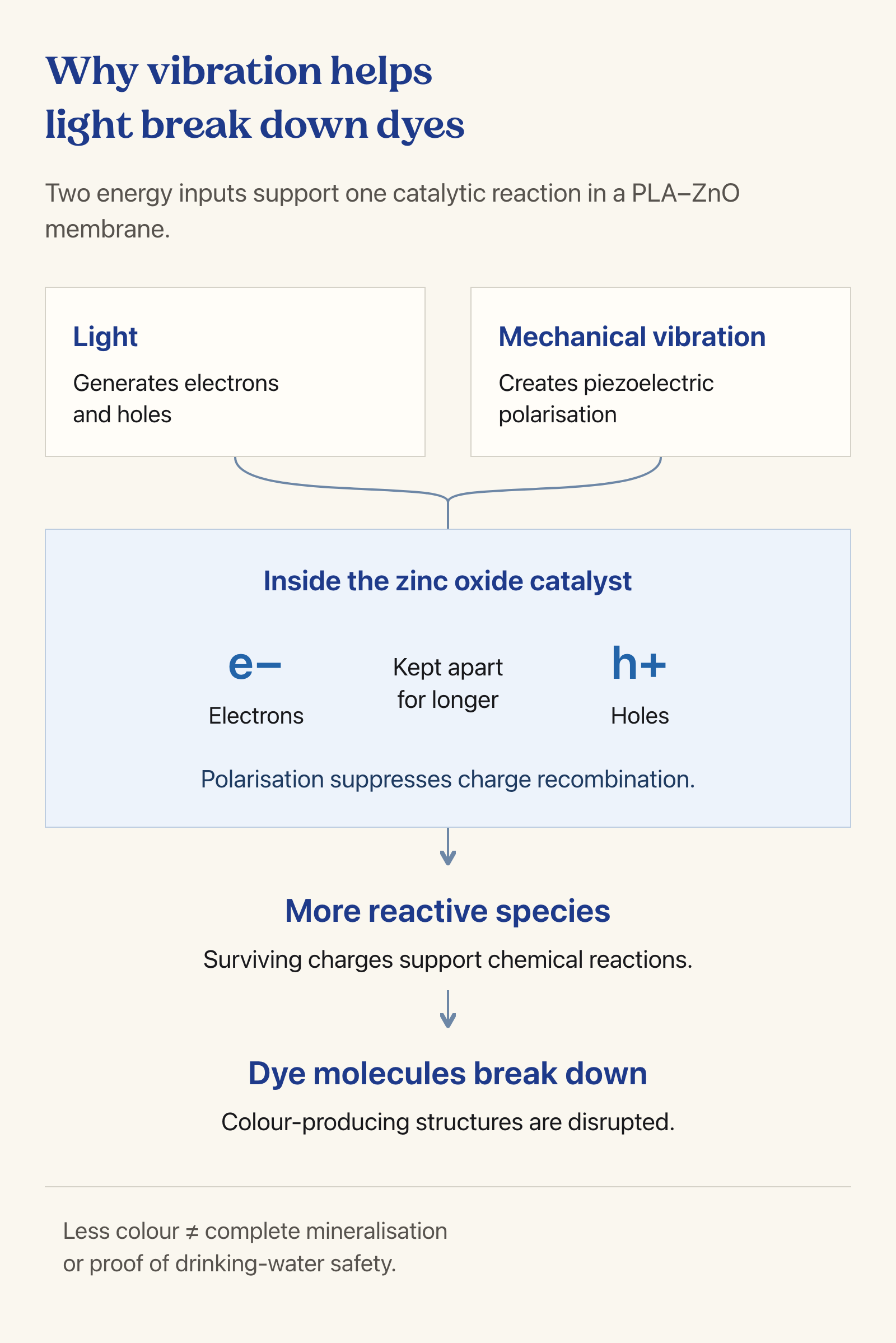
The reported advantage comes from preserving useful electrical charges long enough to drive chemical reactions, with two energy inputs supporting the same catalytic process.
- Under light excitation, the catalyst generates electrons and holes. These charge carriers can participate in reactions that form reactive species, but their usefulness falls when they recombine before contributing to pollutant breakdown.
- Mechanical vibration produces piezoelectric polarisation in the material. The reported experiments used ultrasonic excitation alongside light; ordinary water flow should not be assumed to reproduce the same controlled laboratory energy input.
- The resulting polarisation suppresses electron–hole recombination, according to the researchers. More surviving charges support reactive-species formation, explaining why combining the inputs can improve the catalytic response rather than merely shaking the water.
- Reactive species attack dye molecules and can disrupt the structures responsible for their colour. The mechanism explains the decolorisation result, but identifying every reaction product requires separate chemical analysis of the treated liquid.
- Machine learning connected conditions such as illumination, treatment time, catalyst amount and dye concentration with experimental decolorisation behaviour. Its role was prediction within the study, not an autonomous system that physically removes pollutants.
What the Results Establish and What They Leave Open
The strongest reading is a promising laboratory mechanism with clear next tests, not a claim that visibly clearer water has become safe for unrestricted use.
- Decolorisation measures the disappearance of colour. Mineralisation means much more extensive conversion of organic pollutants into simple inorganic end products; high colour removal alone cannot demonstrate that this endpoint has been reached.
- Toxicity can depend on transformation products as well as the original dye. Assessing treated effluent requires examining residual compounds and biological effects, rather than using transparency or a colour-removal percentage as a safety certificate.
- Real industrial effluent contains mixtures that differ from controlled dye solutions. Competing substances, changing concentrations and operating conditions can alter performance, so laboratory results should not be presented as guaranteed outcomes at textile facilities.
- Energy demand matters because the experiment combines light with ultrasound. Practical assessment must compare treatment benefits with the electricity required, while testing catalyst durability, membrane fouling and performance across repeated treatment cycles.
- PLA biodegradability is not a licence to discharge the composite into waterways. End-of-life assessment must consider disposal conditions and the embedded zinc oxide separately, including potential release during use and after the membrane is discarded.
Way Forward
Test the Whole Treatment Outcome
- Measure transformation products and residual toxicity alongside colour removal before making water-quality claims.
- Run real-effluent trials with repeated cycles, particle-release measurements and membrane-fouling checks.
- Compare energy use and treatment cost against established processes at equivalent effluent-quality endpoints.
Conclusion
- The study illustrates how material design and complementary energy inputs can address charge recombination and catalyst recovery together. Its educational value lies in the mechanism, not in treating one laboratory metric as universal success.
- In an answer on environmental nanotechnology, connect the innovation to its verification burden: dye decolorisation, pollutant destruction, toxicity reduction and practical deployment are related but separate claims requiring their own evidence.
UPSC Practice Questions
Prelims MCQ 1
With reference to the PLA–ZnO membrane research, consider the following statements:
- Mechanical excitation can generate piezoelectric polarisation.
- Immobilising a catalyst can assist its recovery from treated water.
- High dye decolorisation necessarily proves complete mineralisation.
How many of the above statements are correct?
(a) Only one (b) Only two (c) All three (d) None
Answer: (b) Only two
Explanation:
The first two statements describe the reported mechanism and design. Colour removal alone does not prove complete mineralisation.
Prelims MCQ 2
What was the role of machine learning in the reported study?
(a) Replacing the zinc oxide catalyst (b) Certifying drinking-water safety (c) Predicting dye-decolorisation behaviour from experimental parameters (d) Generating ultrasonic energy without electricity
Answer: (c) Predicting dye-decolorisation behaviour from experimental parameters
Explanation:
Machine learning predicted experimental behaviour; the physical treatment relied on the membrane, light and mechanical excitation.
UPSC Mains Questions
- Explain how combining photocatalysis and piezoelectric effects can improve pollutant treatment. What separates a laboratory result from a viable wastewater-treatment technology?
- Why is decolorisation insufficient to establish the environmental safety of treated industrial effluent? Discuss appropriate evidence for evaluating catalytic membranes.
Source: PIB, Ministry of Science & Technology.
Frequently Asked Questions
What is the PLA–ZnO membrane?
It is a porous nanofibre membrane combining polylactic acid with zinc oxide nanoparticles. INST Mohali researchers used it to study dye treatment under combined light and mechanical excitation.
Why add mechanical vibration to light?
Mechanical excitation generates piezoelectric polarisation that suppresses electron–hole recombination. This supports reactive-species formation, allowing more of the light-generated charges to contribute to the catalytic reaction in the reported study.
Does removing dye colour make water safe to drink?
No. Decolorisation is a specific experimental result, not a drinking-water safety test. Residual pollutants, transformation products, toxicity and other water-quality requirements need separate assessment before any such claim is justified.
Did artificial intelligence treat the water?
No. Machine learning predicted decolorisation behaviour from experimental parameters. The treatment mechanism remained physical and chemical, involving the composite membrane, illumination, mechanical excitation and the resulting reactive species.
Tell Google you want more of this.
Add Anantam IAS as a preferred sourceOne tap, and this site shows up more often in your own Top Stories, AI Overviews and AI Mode. Remove it any time.