A generative AI system has one property that no earlier office tool had. It will produce a confident, fluent, well-formatted answer that is entirely invented — and it will not tell you which of its answers those are. Spellcheck never fabricated a word. A calculator never quietly returned a plausible wrong sum. This is a genuinely new problem, and it lands hardest on the professions that run on trust rather than output: law, medicine, journalism, teaching, research and public administration.
The ethical response is not complicated to state. If you put your name to something, you own every claim in it. What is hard is that verification takes longer than generation, so the incentive runs the wrong way — and a professional under deadline pressure will feel the pull. In July 2026, India’s Supreme Court decided a case that turned that abstract pull into a disciplinary standard, and it is now the clearest reference point any Indian professional has.
What Professional Ethics Actually Demands
A profession is not just an occupation with a licence. It is a bargain: society grants a group monopoly powers and privileged access — to courts, to bodies, to public records, to children — and in exchange that group accepts duties heavier than the ordinary duty not to lie. Three of those duties matter here.
Competence means you possess the skill you hold yourself out as having. It includes knowing the limits of your tools. A lawyer who does not understand that a language model predicts plausible text rather than retrieving verified authority is not merely unlucky when it invents a citation; they are practising beyond their competence.
Candour means the person relying on you can trust your representations about your own work. When you file a document, you implicitly certify you checked it. When a doctor records a history, the next doctor reads it as observed fact.
Non-delegable responsibility is the one AI stresses most. You may delegate the work — to a junior, a clerk, a machine — but you cannot delegate the accountability. A partner who signs a junior’s brief owns its errors. The rule does not change when the junior is a model.
Set against this, the appeal of generative AI is obvious. It compresses drudgery. It drafts. It summarises. Used well it can raise quality, and refusing it wholesale is its own failure of competence. The ethical question is never “AI or not” — it is where in the workflow a human judgement must remain irreducible, and who answers when it does not.
The Case That Set the Standard
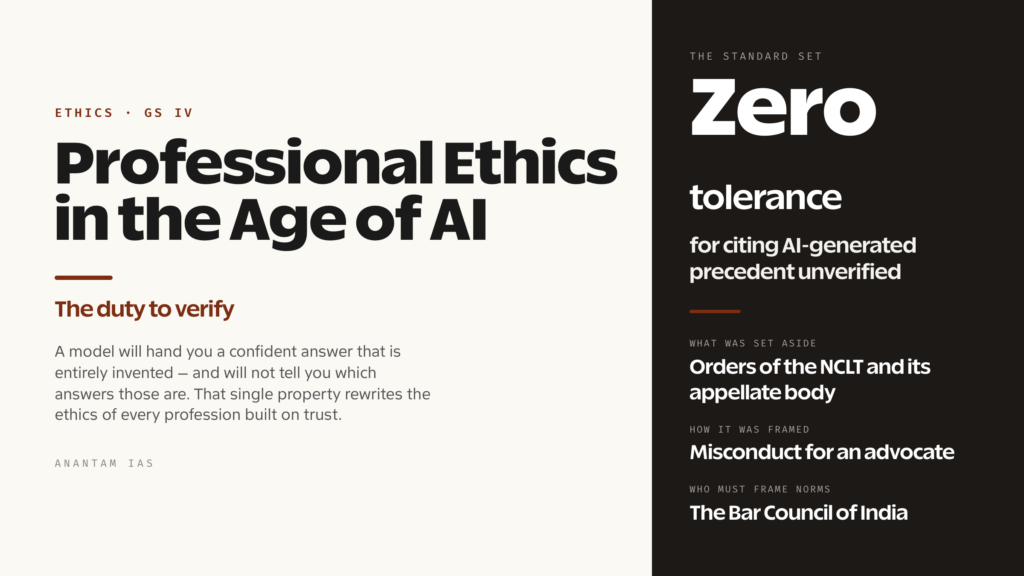
On 2 July 2026, the Supreme Court set aside orders of the National Company Law Tribunal and the National Company Law Appellate Tribunal in an insolvency matter concerning Essel Infraprojects. The reason was not a misreading of law. Both forums had relied on judicial precedents that did not exist — AI-generated fabrications presented as authority.
A Bench of Justice P.S. Narasimha and Justice Alok Aradhe did something more consequential than correcting the error. It quashed the decisions outright, holding that a judgment touched by even an iota of fabricated material is irretrievably contaminated. The Court’s image for it was stark: such contamination behaves like methyl isocyanate, the gas that caused the 1984 Bhopal disaster — invisible, insidious, and catastrophic by the time anyone notices.
Two holdings give this teeth. First, the Court prescribed a zero-tolerance approach to producing, citing or relying on AI-generated precedent without verification. Second, it characterised the conduct precisely: citing unverified AI-generated judgments is professional misconduct for an advocate, and a serious lapse for an adjudicator. It then directed the Bar Council of India to constitute a committee to examine AI use in adjudication and frame guiding principles, including disciplinary consequences for breach.
Read as ethics rather than news, three things are being said. Responsibility attaches to the person who submitted the material, not the tool that produced it. The harm is to the integrity of the process, not merely to the losing party — which is why correction was insufficient. And good faith is not a defence: the duty is to verify, so not knowing is precisely the breach.
Why AI Breaks the Older Assumptions
Professional codes were written for a world with a useful correlation: confident, well-formed work usually came from someone who had done the work. Fluency was weak evidence of diligence. Generative AI severs that link — it produces the surface features of expertise at near-zero cost, detached from any underlying verification.
Four failure modes follow, and each maps onto a recognised ethical concept.
Automation bias. People over-trust machine output, especially when it is fast, articulate and matches expectation. A citation formatted correctly looks checked. This is a failure of objectivity — accepting a conclusion because of how it arrived rather than what supports it.
Moral outsourcing. When a system produces the recommendation, the human can feel like a conduit rather than an author. “The model flagged it” becomes the reason a file moved. This is the mechanism behind what Hannah Arendt described as thoughtlessness — not malice, but the absence of the act of judging. It is also the oldest excuse in administrative ethics wearing new clothes, and it connects directly to accountability and responsibility.
Diffusion of responsibility. A model was built by one firm, fine-tuned by another, procured by a department, and used by an official. Each can plausibly point elsewhere. Diffuse responsibility is unowned responsibility.
Deskilling. If juniors never draft, they never learn to spot what is wrong. The competence needed to supervise the tool is produced by doing the work the tool now does. This is a slow, structural harm that no single decision causes.
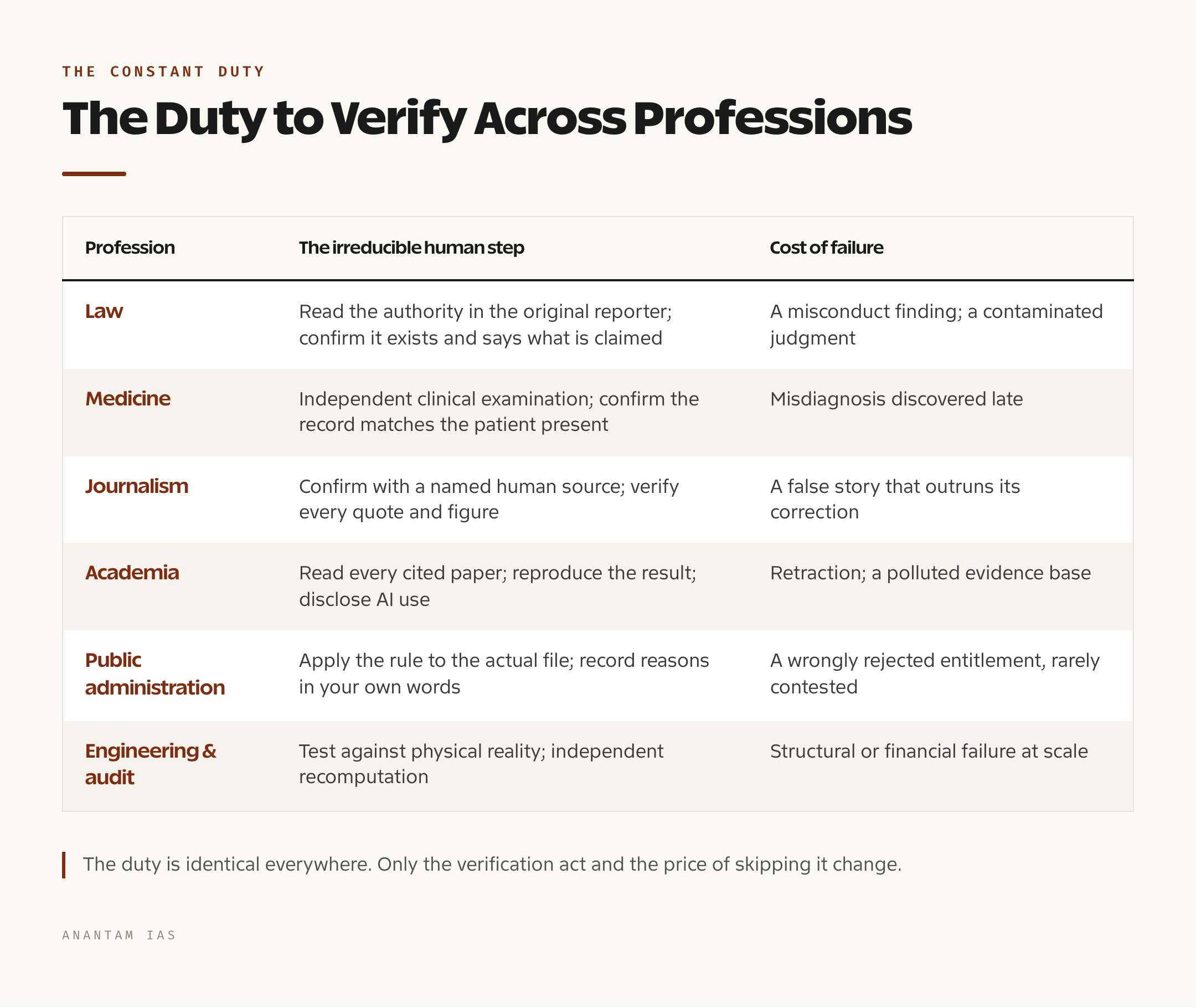
The Duty to Verify Across Professions
The duty is the same everywhere; what differs is the verification act it requires and what breach costs.
| Profession | Typical AI use | The irreducible human step | Cost of failure |
|---|---|---|---|
| Law | Research, drafting, summarising records | Read the authority in the original reporter; confirm it exists and says what is claimed | Misconduct finding; a contaminated judgment; a wrongly decided case |
| Medicine | Triage, notes, imaging support, differentials | Independent clinical examination; confirm the record matches the patient in front of you | Misdiagnosis; harm that is discovered late |
| Journalism | Research, transcription, first drafts | Confirm with a named human source; verify every quote and figure | Defamation; a false story that travels further than its correction |
| Academia and research | Literature review, drafting, code | Read every cited paper; reproduce the result; disclose AI use | Retraction; a polluted evidence base others build on |
| Public administration | Note-drafting, scheme screening, grievance triage | Apply the rule to the actual file; record reasons in your own words | A wrongly rejected entitlement; a decision that cannot be defended |
| Engineering and audit | Modelling, code generation, sampling | Test against physical reality; independent recomputation | Structural or financial failure at scale |
Two rows deserve emphasis for anyone entering public service. In administration, the harm is asymmetric and invisible: a citizen wrongly denied a pension rarely knows an automated screen produced the rejection, and rarely has the means to contest it. And unlike a litigant, they usually have no appellate forum with the appetite to quash. That is precisely the terrain covered in algorithmic governance and algorithmic bias.
Where Responsibility Sits
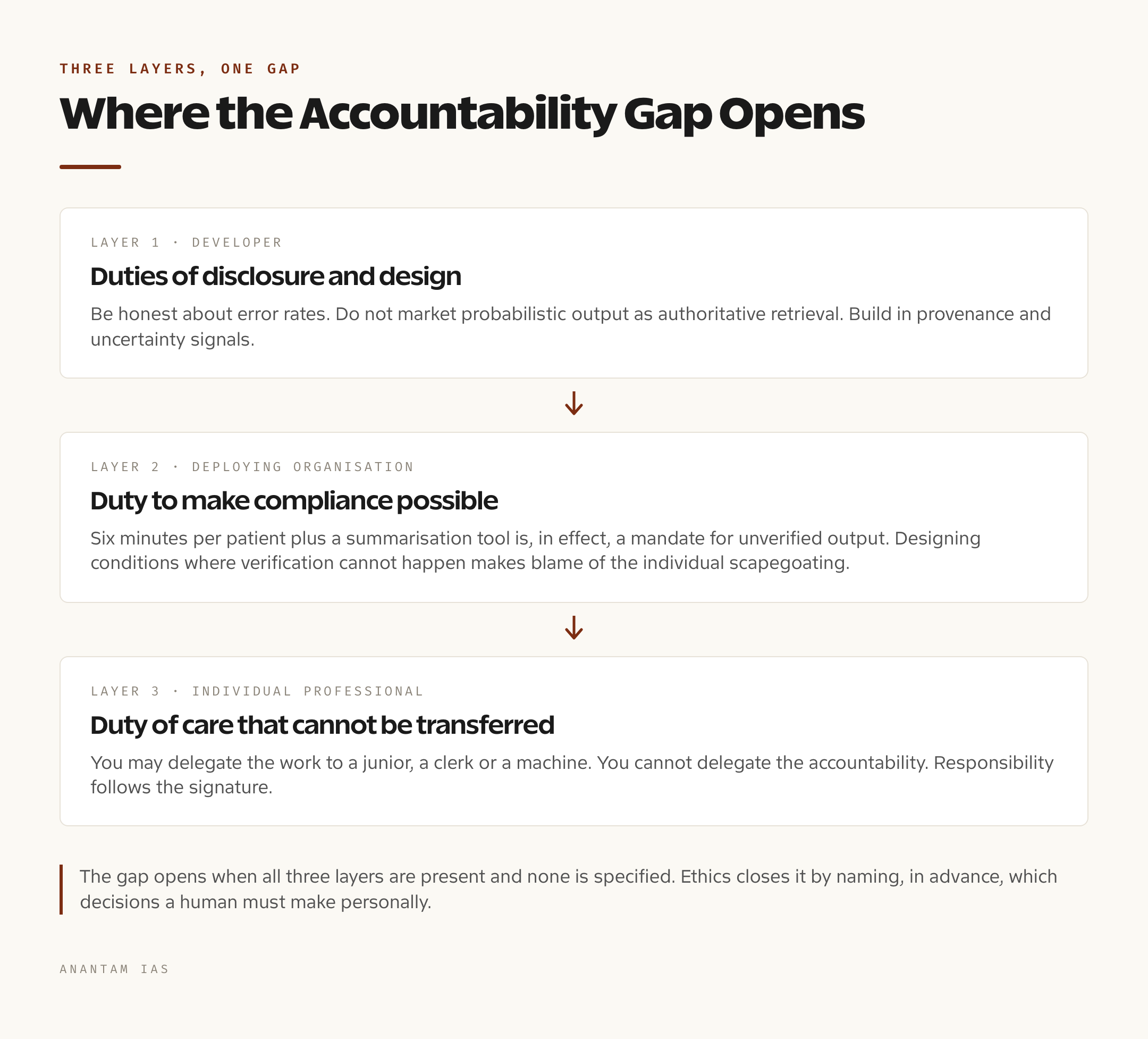
The recurring policy question is whether liability should rest with the developer, the deploying institution, or the individual. Ethically, the answer is not a single choice but a layered one.
The individual professional holds the duty of care to the person in front of them. This layer cannot be transferred, because it is the whole basis of the professional bargain. The Supreme Court’s insistence that the advocate is answerable is a statement about this layer.
The deploying organisation holds the duty to make the individual’s compliance possible. A hospital that gives clinicians six minutes per patient and a summarisation tool has, in effect, mandated unverified output. A registry that rewards disposal rates creates the same pressure. Where an institution designs conditions in which verification cannot happen, blaming the individual is scapegoating. This is an institutional-integrity question of the kind explored in management of ethics in administration.
The developer holds duties of disclosure and design — being honest about error rates, not marketing probabilistic output as authoritative retrieval, and building in provenance and uncertainty signals.
The accountability gap opens when all three are present and none is specified. Ethics closes it by naming, in advance, which decisions a human must make personally — and then protecting the time to make them.
What India Is Building
India’s institutional response is taking shape faster in the judiciary than anywhere else.
The Supreme Court’s AI Committee, chaired by Justice P.S. Narasimha, released a draft Regulations for Use of Artificial Intelligence in Courts, 2026, with the public-comment window closing on 20 June 2026. Its architecture is instructive because it separates permitted assistance from prohibited substitution. Legal research, summarisation and translation are allowed. Adjudication, sentencing, risk-scoring for bail or recidivism, and surveillance of court participants are not. A mandatory disclosure rule requires parties to declare when a filing is AI-assisted — transparency doing the work that trust alone can no longer do.
Chief Justice of India Surya Kant put the principle plainly at a summit organised by the Indian Institute of Arbitration and Mediation in New Delhi on 11 July 2026: AI may triage a dispute, organise evidence or draft a translation, but the moment it begins weighing one party’s equities against another’s, it has stopped assisting and started deciding — and no algorithm has earned that authority.
The same logic — label the synthetic, keep a human answerable — now runs through content regulation as well, where the amended intermediary rules require synthetically generated material to be disclosed rather than banned. Across both domains the regulatory instinct is identical: disclosure plus a named human decision-maker, rather than prohibition.
What is still missing is the equivalent for administration. There is no general rule requiring an officer to disclose that a note, a screening decision or a grievance response was AI-assisted, and no cooling-off requirement before an automated recommendation becomes an order. Existing instruments — the conduct rules, the codes of ethics and codes of conduct framework — predate the problem.
What an Ethical Practitioner Does Differently
The practical translation is short, and it is deliberately unglamorous.
- Never let generated text be the last word on a fact. Treat model output as an unverified lead, at the evidentiary level of an anonymous tip.
- Verify at the source, not with a second model. Asking another system to check the first compounds the error; both are predicting plausibility.
- Disclose AI assistance where it could affect how your work is weighed — in filings, in research, in anything a colleague will build on.
- Keep the reasoning yours. If you cannot restate why the conclusion follows, in your own words, you have not made the decision.
- Refuse the conditions that make verification impossible, and say so on the record. This is where integrity becomes concrete: the ethical act is often the awkward note stating that the timeline does not permit checking.
- Protect the training of juniors. Deliberately assign work the tool could do, because supervision capacity has to be manufactured.
None of this is technophobia. A professional who refuses useful tools serves clients worse. The line that matters is between assistance, where a human judgement remains irreducible and identifiable, and substitution, where nobody is left who actually decided. Every code now being written, from the Bar Council’s committee to the courts’ draft regulations, is an attempt to draw that line before the harm becomes invisible.
FAQ
Is using AI to draft a document unethical in itself? No. Drafting assistance is ordinary tool use, no different in principle from a precedent bank or a template. The breach is putting your name to unverified claims — and, in contexts where disclosure is required, concealing that assistance.
What did the Supreme Court actually hold about AI-generated citations? That courts must take a zero-tolerance approach to citing or relying on AI-generated precedent without verification, that a decision touched by even an iota of fabricated material must be set aside rather than corrected, and that citing unverified AI-generated judgments is professional misconduct for an advocate. It directed the Bar Council of India to frame guiding principles including disciplinary action.
If the model made the error, why is the professional blamed? Because the duty breached is the duty to verify, which was always the professional’s. The tool cannot hold a duty — it has no standing, no licence to lose and no one to answer to. Responsibility follows the signature.
Does disclosing AI use solve the problem? It solves part of it. Disclosure lets others calibrate how much scrutiny to apply, which is why the draft court regulations require it. It does not discharge the duty to verify — a disclosed fabrication is still a fabrication.
How is this different from an ordinary human mistake? Scale, plausibility and detectability. Human error is usually random and often visibly wrong; fabricated output is systematically plausible, arrives formatted as authority, and can be produced faster than anyone can check it. That combination is what makes it a structural problem rather than an individual one.
Where does this fit in the ethics syllabus? It sits across three areas at once: codes of ethics and codes of conduct as sources of ethical guidance, accountability and ethical governance, and the professional-integrity dimension of ethics in public and private institutions.
Practice Questions
Prelims MCQs
- In the July 2026 matter concerning AI-generated citations, the Supreme Court set aside the orders of which forums? (a) High Court and District Court (b) NCLT and NCLAT (c) NGT and its appellate bench (d) CAT and the High Court — Answer: (b) The Court quashed orders of the National Company Law Tribunal and the National Company Law Appellate Tribunal in an insolvency matter.
- As held by the Court, citing unverified AI-generated judgments amounts to: (a) a clerical irregularity (b) contempt of court only (c) professional misconduct for an advocate (d) no breach if made in good faith — Answer: (c) The Court characterised it as misconduct for an advocate and a serious lapse for an adjudicator, and good faith is no defence because the duty is to verify.
- The draft Regulations for Use of Artificial Intelligence in Courts, 2026 expressly permit AI for which purpose? (a) Sentencing (b) Bail risk-scoring (c) Legal research and summarisation (d) Surveillance of court participants — Answer: (c) The draft allows assistive uses such as research, summarisation and translation while prohibiting adjudication, sentencing, risk-scoring and surveillance.
- “Automation bias” in professional decision-making refers to: (a) a model trained on skewed data (b) excessive trust in machine-generated output (c) the cost of automating a workflow (d) preference for manual processes — Answer: (b) It is the tendency to over-trust automated output, particularly when it is fluent and matches expectation.
- The body directed to constitute a committee on AI use and frame guiding principles including disciplinary action was: (a) the Law Commission of India (b) the Bar Council of India (c) the National Judicial Academy (d) the Ministry of Law and Justice — Answer: (b) The Court directed the Bar Council of India to examine the issue and prescribe guiding principles.
Mains Practice Questions
- “You may delegate the work, but you cannot delegate the accountability.” Examine this proposition in the context of professional use of artificial intelligence, with reference to recent judicial pronouncements in India. (15 marks, 250 words)
- Distinguish between assistance and substitution in the professional use of AI. Suggest criteria an institution could use to decide which decisions must remain irreducibly human. (15 marks, 250 words)
- An officer relies on an automated screening system that wrongly rejects a large number of welfare applications. Discuss where ethical responsibility lies between the developer, the deploying department and the officer, and how the accountability gap can be closed. (15 marks, 250 words)
- “Disclosure is doing the work that trust can no longer do.” Critically evaluate mandatory AI-disclosure requirements as an instrument of professional ethics. (10 marks, 150 words)
- Deskilling caused by automation is a harm no single decision causes. Discuss the ethical obligations of senior professionals towards the training of juniors in an AI-assisted workplace. (10 marks, 150 words)
Tell Google you want more of this.
Add Anantam IAS as a preferred sourceOne tap, and this site shows up more often in your own Top Stories, AI Overviews and AI Mode. Remove it any time.