Two officers, identical in intellect, training and rank, can produce dramatically different administrative outcomes. The variable that most reliably explains the difference, after years of research, is emotional intelligence. Daniel Goleman's Emotional Intelligence (1995) brought the concept into the mainstream; Indian civil-service training institutions have steadily integrated it since. The UPSC GS IV syllabus now lists emotional intelligence as a topic in its own right.
This article works through the advantages and the attributes of the emotionally intelligent civil servant — what such an officer does differently in office, in field, in crisis, and in the long arc of a career.
What emotional intelligence means
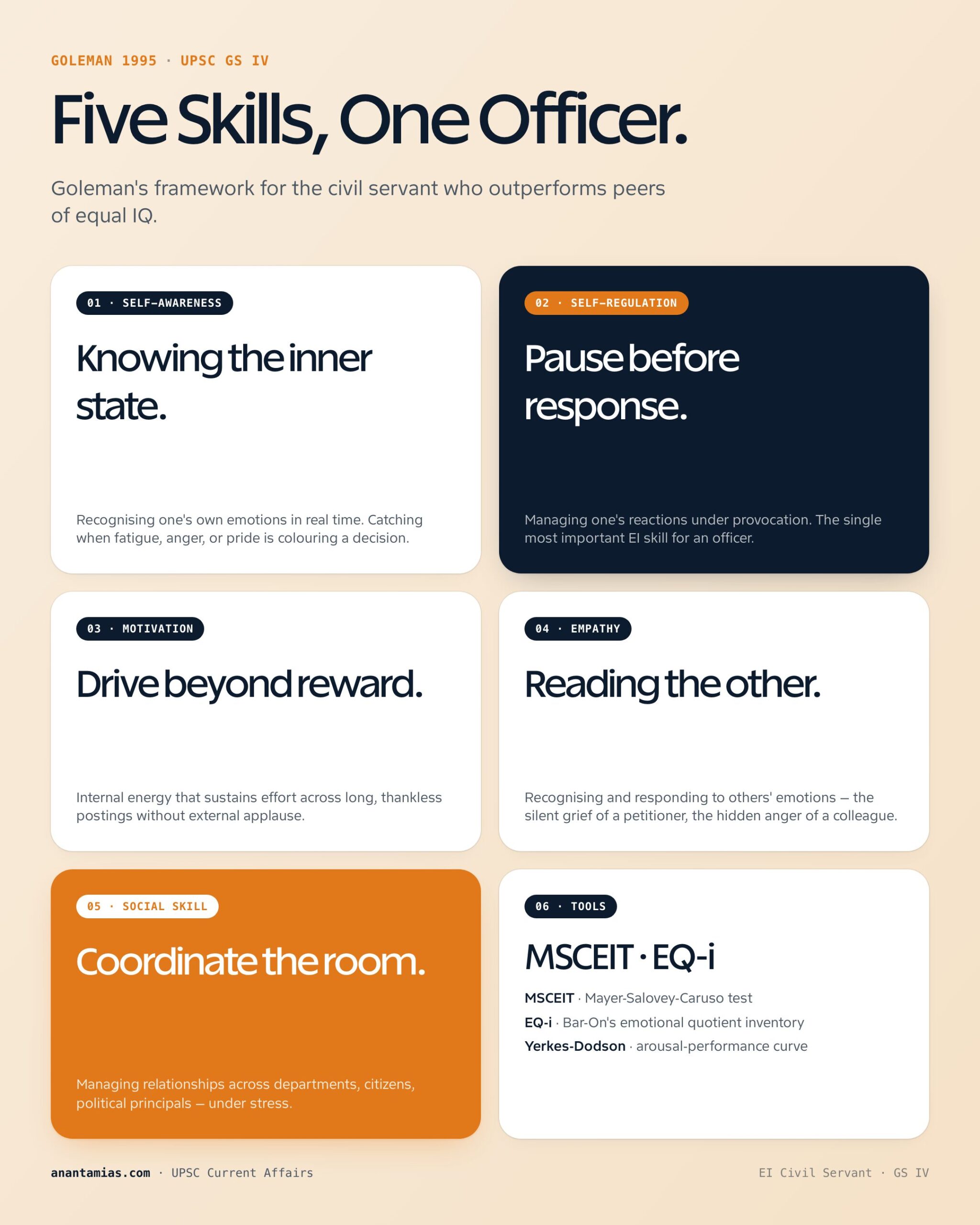
Emotional intelligence is the ability to recognise, understand, manage and use emotion — one's own and others' — to guide thinking and behaviour. Goleman's five-component framework remains the standard.
| Component | Definition | Civil-service application |
|---|---|---|
| Self-awareness | Recognising one's own emotions in real time | Knowing when fatigue is colouring a decision |
| Self-regulation | Managing one's own emotional responses | Pausing before responding to a provocation |
| Motivation | Internal drive that goes beyond external reward | Sustaining effort during a long, thankless posting |
| Empathy | Recognising and responding to others' emotions | Reading the silent grief of a petitioner |
| Social skill | Managing relationships, building networks | Coordinating across departments under stress |
Each component is trainable. Each pays dividends in administration. Together they constitute the difference between the technically competent officer and the genuinely effective one.
Advantages of emotional intelligence in administration
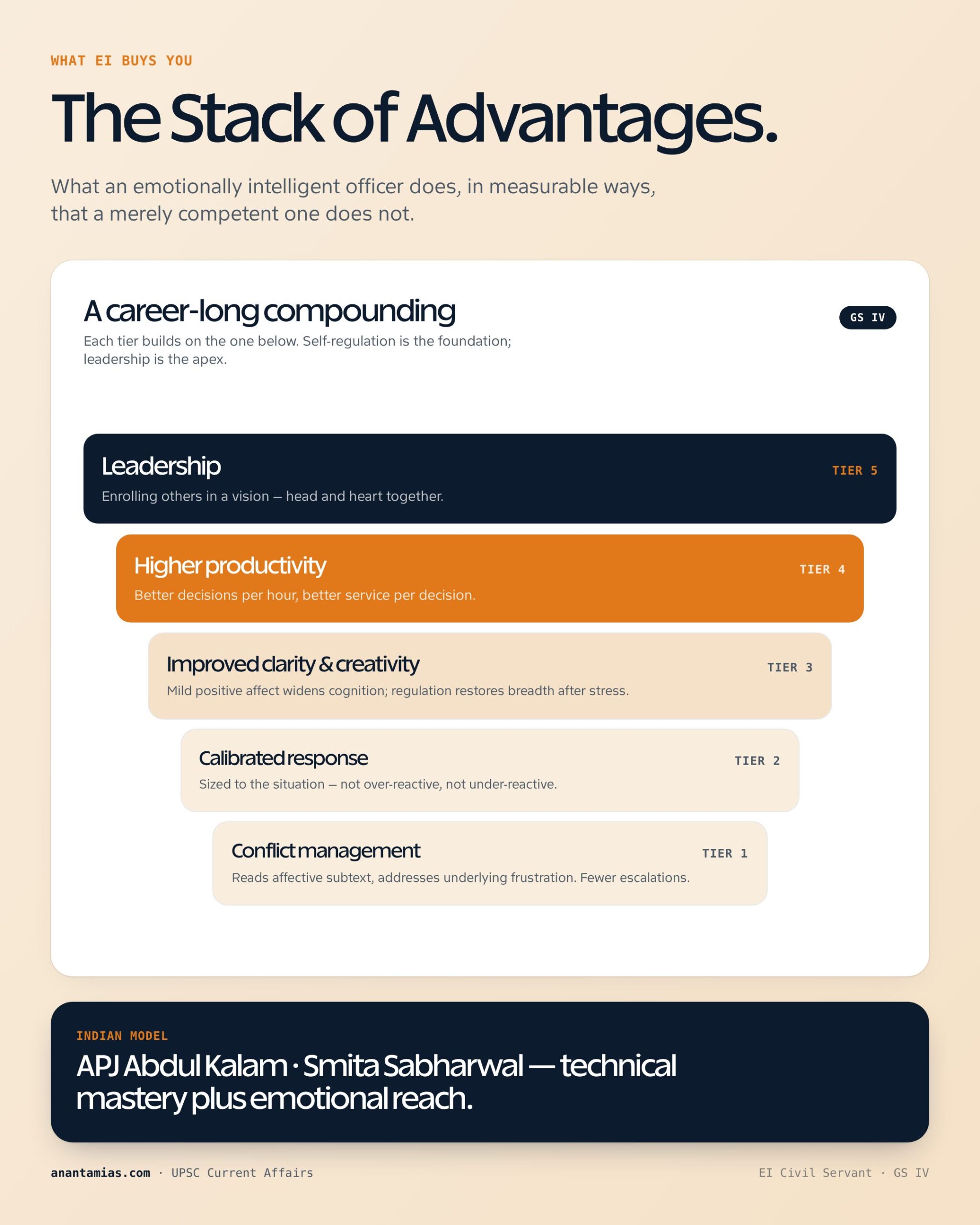
The advantages are observable across the day's work.
Effective conflict management
Administration is a conflict-rich environment — between line departments, between political and bureaucratic priorities, between citizens with competing claims. The emotionally intelligent officer reads the affective subtext, addresses underlying frustrations, and resolves conflicts that pure procedural management would only suppress. Outcomes: fewer cases escalating to court, less staff turnover, faster decisions.
Enthusiastic work environment
Offices led by emotionally intelligent officers feel different. There is more discretionary effort — the work people do beyond contract. Subordinates are willing to surface bad news early. Innovation is tolerated. The office stops being a place to survive and starts being a place to perform.
Improved responses
Under pressure, the emotionally intelligent officer's response is calibrated — not too quick, not too slow, sized to the situation. The emotionally untrained officer over-reacts to small provocations and under-reacts to genuine threats. Calibration is what training in emotion teaches.
Higher creativity
Affective neuroscience shows that mild positive affect widens the scope of cognition and supports creative association. The officer who can sustain a positive emotional climate generates more options for stuck problems. Innovative scheme implementation often originates in offices where the emotional climate permits proposing the unusual.
Improved clarity of thinking
Excess negative arousal narrows attention; emotional regulation restores breadth. The officer who can damp her anxiety after a tense meeting returns to clear, structured analysis faster than one who carries the affect into the next file.
Increased productivity
Productivity in administration is not just hours worked. It is decisions made and citizens served. Emotional intelligence improves both — better decisions per hour, and better service per decision.
Leadership
Goleman's research, repeated across multiple studies, finds that emotional intelligence accounts for the lion's share of the difference between competent managers and outstanding leaders. In the civil services, the difference is the same — technical competence is the entry ticket, emotional intelligence is what produces a leader.
Key attributes of the emotionally intelligent civil servant
Beyond the advantages, ten attributes characterise the emotionally intelligent officer.
1. De-personalising the anger of others
When a citizen, MLA or angry colleague directs hostility at the officer, the emotionally intelligent response is to recognise the anger as expressing the other's state, not as a fact about oneself. This depersonalisation is what allows the officer to remain composed and to address the underlying issue rather than retaliate to the affect.
2. Comfort with uncertainty and change
Public administration is increasingly a domain of uncertainty — climate shocks, pandemics, technological disruption, social transformation. The emotionally regulated officer does not need every decision to feel safe. She tolerates ambiguity, decides in incomplete information, revises when facts change.
3. Identifying and abiding by core values
The emotionally intelligent officer knows what she stands for and uses that knowledge as a stabiliser during emotional storms. When pressure mounts, the values function as a compass.
4. Empathy across difference
The capacity to understand and respect positions different from one's own — political, religious, generational — is a foundational attribute. It does not require agreement; it requires recognition of the reality of the other's experience.
5. The capacity to enrol others in a vision
Leadership is the ability to make others want to act on a vision. This is not commanded; it is communicated through emotional resonance. The emotionally intelligent officer can paint the picture of what the work is for, in language that reaches both head and heart.
6. Physical and mental health
Sustained emotional regulation translates into measurable health outcomes. Lower cortisol baseline, better sleep, lower cardiovascular risk, lower incidence of depression. The officer who attends to her emotional life is, on average, healthier across a long career.
7. Enhanced relationships and interpersonal skills
Marriages, friendships, mentor relationships, professional networks — all are strengthened by emotional competence. The officer's support system, on which her career depends, is itself emotion-mediated.
8. Understanding the difference between needs and wants
Maslow's hierarchy clarifies this. Needs are the basic level — safety, survival, sustenance. Once met, attention can shift to wants — the larger house, the better car, the smartphone. Emotionally intelligent people know the difference, and establish needs before fulfilling wants. In the civil-service context, this maps onto a familiar discipline: serve the citizen's needs (food, water, education, security) before optimising for wants. Officers who confuse the two — or who let their personal want for promotion override the citizen's basic need — drift from public service.
9. Resilience after setback
Emotional intelligence includes the capacity to recover from defeat — a transfer order, a failed scheme, a public criticism — without bitterness. Resilient officers stay in service longer and contribute more across a career.
10. Integrity under emotional load
The truest test of emotional intelligence is what happens under pressure. The officer who maintains integrity, courtesy and judgement when tired, frustrated, threatened or grieving has fully integrated emotional skill into character.
Two Indian case studies
Case study 1 — APJ Abdul Kalam, the people's scientist
Kalam combined extraordinary technical capability with extraordinary emotional intelligence. His leadership at DRDO, his mentoring of junior scientists, his presidency, his lifelong engagement with schoolchildren — all rested on an empathetic and self-regulated emotional life. The image of the missile scientist patiently answering a child's question is the image of emotional intelligence in public service.
Case study 2 — Smita Sabharwal in Telangana
IAS officer Smita Sabharwal, known for innovative work in maternal health (Amma Lalana, Aarogya Lakshmi), modelled key emotionally intelligent behaviours. She read the emotional reasons women avoided institutional delivery, addressed them through scheme design, built buy-in among staff through visible empathy, and absorbed political pushback without losing focus on the maternal-health objective. The improvement in indicators rested as much on emotional intelligence as on technical scheme design.
Civil services application
Practical disciplines for cultivating emotional intelligence on the job.
- Daily reflection. Five minutes at the end of the day — what did I feel today, what did I notice, what would I do differently? Self-awareness compounds.
- Naming the emotion in the room. Especially in tense meetings, simply naming the affect ("I sense some frustration here") often lowers temperature.
- Pause rule. Before responding to a provocation — written or oral — wait. Email drafts, in particular, are improved by overnight delay.
- Mentor relationships. Senior officers known for equanimity are the best teachers of emotional regulation in real conditions.
- Mindfulness practice. Even short daily meditation has measurable effects on emotional regulation; many state administrative academies now include it.
UPSC past-year question references
- 2018 GS IV: emotional intelligence components and their administrative use.
- 2017 GS IV: case study where emotional regulation determines an outcome.
- 2014 GS IV: "Emotional intelligence is helpful in decision making."
- 2020 GS IV: empathy and compassion as emotional capabilities.
Mains answer hook
An emotionally intelligent civil servant differs from a merely competent one in measurable ways. The advantages include better conflict management, sharper decisions, stronger leadership, healthier work environments and lower personal burnout. The attributes include depersonalised response to others' anger, comfort with uncertainty, value-anchored stability, the capacity to enrol others in a vision, and the discipline of distinguishing needs from wants. Each is trainable; each pays dividends across a career. The investment in emotional intelligence is an investment in administrative capability that no amount of cognitive training alone can substitute for.
Prelims pointers
- Daniel Goleman — Emotional Intelligence (1995); five components.
- Yerkes-Dodson curve — performance and arousal.
- Maslow's hierarchy of needs — needs before wants.
- Antonio Damasio — somatic marker hypothesis.
FAQ
Is emotional intelligence the same as soft skills?
Soft skills include emotional intelligence but are broader. EI is the specific capacity to recognise, understand, manage and use emotion.
Can emotional intelligence be measured?
Yes — instruments such as the MSCEIT (Mayer-Salovey-Caruso Emotional Intelligence Test) and the EQ-i provide validated measures, though no measure is perfect.
Is high IQ enough without high EI?
In most leadership roles, no. Goleman's research finds EI explains much of the difference between competent managers and outstanding leaders even when IQ is controlled.
What is the most important EI attribute for a civil servant?
Self-regulation comes first — without it, the other attributes are unreliable. Empathy comes a close second.
Can EI be over-developed?
Excessive empathy without self-regulation produces burnout; excessive self-regulation without expression produces emotional numbness. The integrated profile, not any single component, is what matters.
The emotionally intelligent civil servant is not a softer version of the competent civil servant. She is the more durable, more effective, more humane version. Cultivating these attributes is not a deviation from administrative work; it is the work, done as well as it can be done.
Tell Google you want more of this.
Add Anantam IAS as a preferred sourceOne tap, and this site shows up more often in your own Top Stories, AI Overviews and AI Mode. Remove it any time.