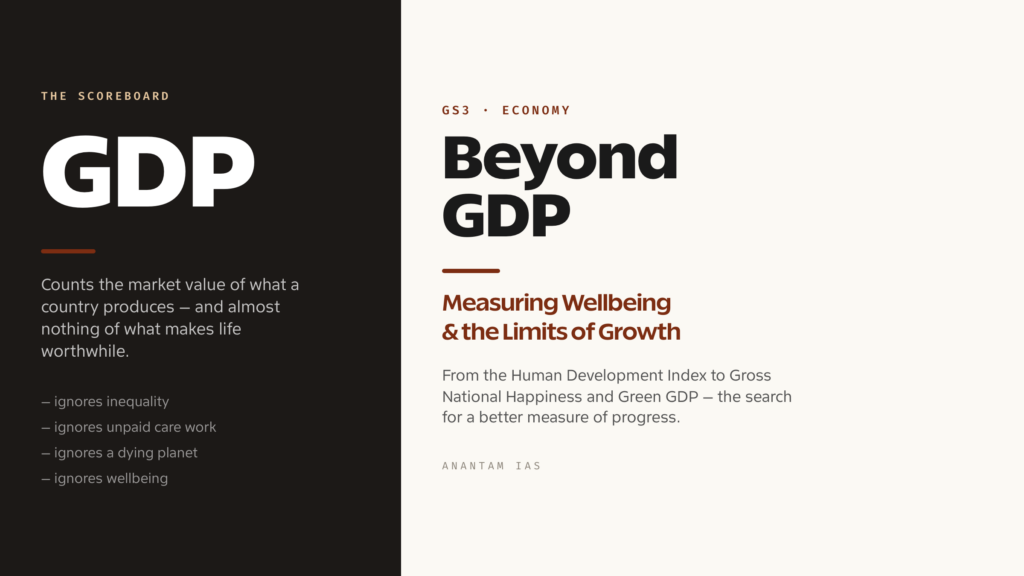
In March 1968, on a campus stage at the University of Kansas, a presidential candidate did something economists rarely manage — he made a national accounting statistic sound like a moral failure. Gross national product, Robert Kennedy told the crowd, counts air pollution and cigarette advertising and the locks we put on our doors and the jails for the people who break them. It counts napalm and nuclear warheads. And yet it leaves out the health of children, the joy of their play, the beauty of poetry, the strength of marriages. “It measures everything,” he said, “except that which makes life worthwhile.” The line still stings because it is still true. The single number governments treat as the scoreboard of progress was never designed to measure progress at all.
That gap between what GDP counts and what actually makes a society better off is the whole subject of the “beyond GDP” debate, and it has moved from seminar rooms to the centre of policy. The United Nations is building a high-level expert group to find official measures of progress that go beyond output. New Zealand has rewritten its national budget around wellbeing. India’s statisticians now publish environment accounts alongside the economic ones, and Chhattisgarh has become the first Indian state to put a price on what its forests do for free. For a UPSC aspirant, this is one of those rare themes that threads through the whole GS3 economy syllabus and spills into environment, governance and ethics — and it rewards anyone who can explain, with a few sharp examples, why the most famous number in economics is also the most misleading.
What GDP Measures and the Five Things It Misses
Start with what GDP actually is, because the critique only bites once the definition is precise. Gross Domestic Product is the market value of all final goods and services produced within a country’s borders in a year. That is its entire job — to add up production that passes through a market at a price. It was built in the 1930s, largely by the economist Simon Kuznets for the US Congress, to give a depression-era government a single handle on how much the economy was producing. It did that brilliantly, and it remains indispensable for short-run macro management — tracking recessions, setting interest rates, comparing the size of economies. The mistake is not having GDP. The mistake is treating a production gauge as a wellbeing gauge.
And here is the part that should be quoted in every answer: the man who built it said so first. In his 1934 report to Congress, Kuznets warned that “the welfare of a nation can scarcely be inferred from a measurement of national income.” The inventor handed over the tool with a label that read, in effect, do not use this to measure how well people are living. The world ignored the label. Once you see GDP for what it is — a count of priced output — its blind spots line up almost mechanically, and there are five worth knowing cold.
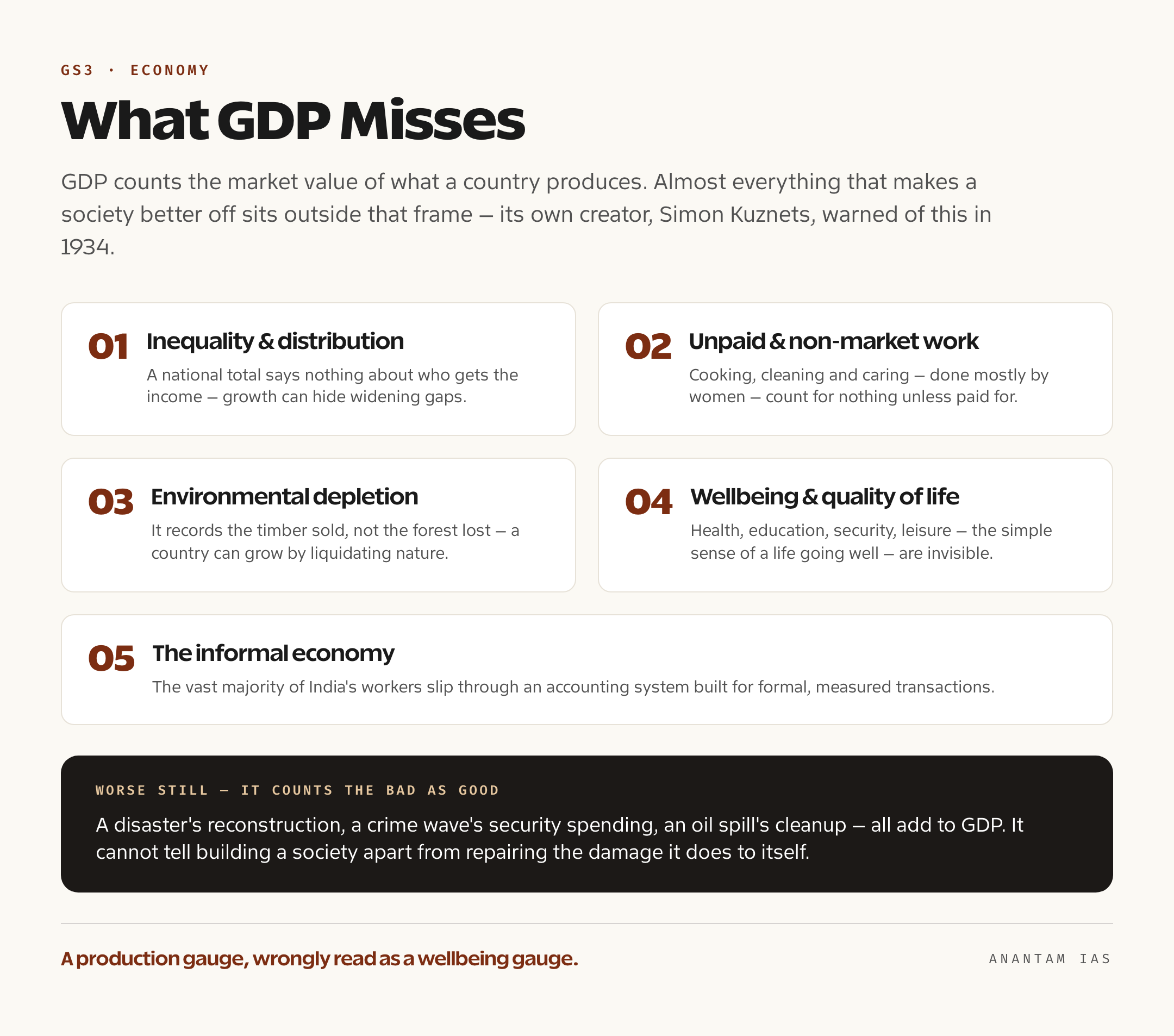
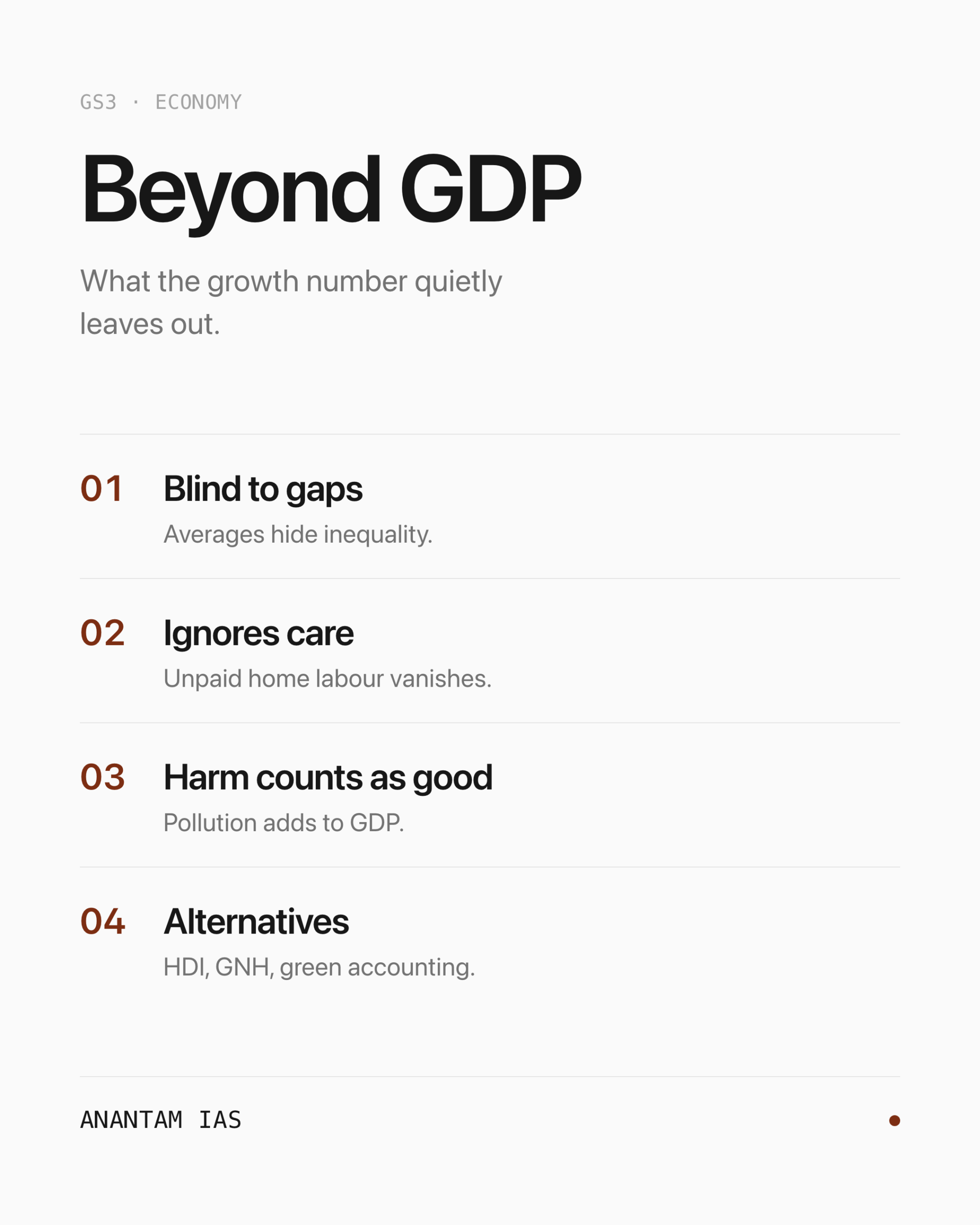
First, it ignores distribution. GDP is a national total and an average; it says nothing about who gets the income. A country where a tiny elite captures most of the gains and a country where prosperity is widely shared can post identical GDP per capita. Rising output alongside rising inequality looks like pure success on the GDP scoreboard. Second, it misses non-market and unpaid work. The enormous labour of cooking, cleaning, caring for children and the elderly — work done overwhelmingly by women — is invisible to GDP because no money changes hands. Pay someone to do it and GDP rises; do it yourself for love and it counts for nothing. Third, it is blind to environmental cost. GDP records the timber sold but not the forest lost, the fish landed but not the fishery collapsing, the coal burned but not the air poisoned. Cutting down a rainforest registers as income; the depletion of the natural capital that produced it registers as nothing — so a country can grow its GDP precisely by liquidating the assets its future depends on. Fourth, it says nothing about wellbeing and quality of life — health, education, security, leisure, the simple sense of a life going well. And fifth, the informal economy, which in a country like India employs the vast majority of workers, slips through the cracks of an accounting system built for formal, measured transactions.
Worse than missing these things, GDP sometimes counts the bad as good. A natural disaster that flattens a city shows up as a boom once reconstruction begins. A rise in crime that fills the jails and the security industry adds to output. An oil spill lifts GDP through the cost of the cleanup. This is the deep flaw Kennedy was pointing at — a measure that cannot tell the difference between activity that builds a society and activity that merely repairs the damage it does to itself.
The Alternatives: From Human Development to Happiness
If GDP is the wrong yardstick, what are the right ones? The honest answer is that no single number has replaced it, and a big reason GDP keeps its crown is that its challengers are many and disagree with each other — one recent review in The Lancet Planetary Health counted dozens of competing “beyond GDP” metrics and traced exactly this lack of consensus as the reason the old measure survives. But a handful of alternatives matter enough to know by name, and each one is best understood as a fix for a specific blind spot.
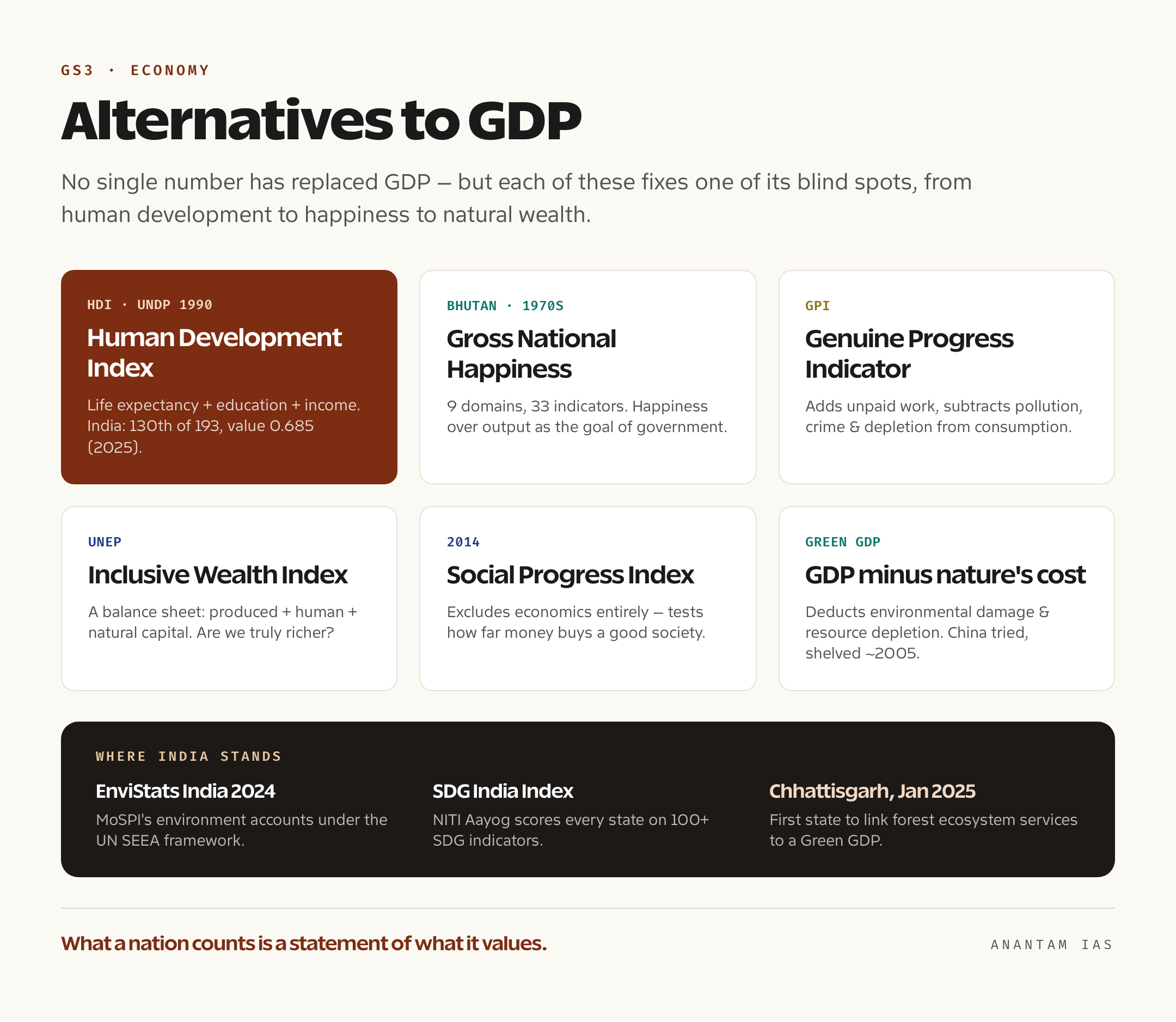
The most successful is the Human Development Index, launched by the UN Development Programme in 1990 and built by the Pakistani economist Mahbub ul Haq with Amartya Sen. Its insight was to widen the lens from income alone to the things income is supposed to buy — a long and healthy life, knowledge, and a decent standard of living — combining life expectancy, years of schooling and gross national income per head into a single score between 0 and 1. The HDI deliberately demotes money to one ingredient among three, and it has reshaped how the world talks about development. In the UNDP’s 2025 report India ranked 130th of 193 countries with an HDI value of 0.685, sitting just below the threshold for “high” human development and rising steadily — a far richer picture than a GDP-growth figure alone would give.
Then there is the most radical reframing of all, from a small Himalayan kingdom. Bhutan’s Gross National Happiness, coined by its fourth king in the 1970s on the principle that happiness matters more than gross national product, is not a slogan but a measured index. It scores citizens across nine domains — psychological wellbeing, health, education, time use, cultural diversity, good governance, community vitality, ecological resilience and living standards — broken into 33 indicators, and counts a person as happy only if they reach sufficiency in a weighted two-thirds of them. It is the clearest statement anywhere that a government’s job is to nurse the conditions for a good life, not just to grow output.
Other indices each attack a different weakness. The Genuine Progress Indicator starts from consumption like GDP but then adds the value of things GDP ignores — household and volunteer work — and subtracts the costs it hides, such as pollution, crime, commuting and resource depletion, so that “growth” that destroys more than it creates can actually show up as a fall. The Inclusive Wealth Index, championed by the UN Environment Programme, takes a balance-sheet view rather than an income view: it adds up a nation’s stock of produced capital, human capital and natural capital, asking whether a country is genuinely getting wealthier or merely selling off its assets to inflate this year’s income. The OECD Better Life Index, launched in 2011, refuses to collapse wellbeing into one number at all — it lets users weigh eleven dimensions, from housing and jobs to health, environment and life satisfaction, for themselves. The Social Progress Index goes furthest in one direction by excluding economic variables entirely, scoring countries only on social and environmental outcomes — basic human needs, foundations of wellbeing, and opportunity — precisely to test how far money actually buys a good society. And the Sustainable Development Goals, the 17 global targets agreed at the UN in 2015 with their 169 sub-targets, are in effect the world’s negotiated dashboard of progress, the closest thing we have to an agreed answer to the question GDP cannot address.
Green GDP and the Wellbeing-Budget Turn
Two ideas deserve a closer look because they show “beyond GDP” moving from measurement into the machinery of government. The first is Green GDP, an attempt to keep the familiar number but correct its worst environmental lie. The method is straightforward in principle: take conventional GDP and subtract the costs of environmental damage — pollution, soil and forest degradation — and the depletion of natural resources, while crediting the services nature provides. The aim is a figure that no longer rewards a country for burning through the natural capital its economy stands on. The difficulty is just as real. China famously tried it: a 1990s study suggested green GDP could shave a large slice off headline growth, and when the politically inconvenient numbers landed, the project was quietly shelved around 2005. Putting a credible price on a clean river or a living forest is genuinely hard, and the lower the green figure, the more political resistance it draws — which is why Green GDP has been easier to admire than to adopt.
The second idea is the wellbeing budget, and here New Zealand wrote the landmark case. In 2019 it delivered the world’s first national budget built explicitly around wellbeing rather than GDP growth, forcing every spending bid to justify itself against a Living Standards Framework of human, social, natural and financial capital, and channelling money to priorities — child poverty, mental health, indigenous Māori aspirations — that a growth-first budget tends to starve. The logic was simple and damning: New Zealanders kept being told the economy was succeeding even as the things they valued, from warm dry homes to swimmable rivers, got worse. A wellbeing budget makes those things the point of the exercise rather than a hoped-for side effect. The wider lesson is that going beyond GDP is not only about inventing better indices; it is about wiring those measures into how a state actually decides to spend.
Where India Stands: From EnviStats to Chhattisgarh’s Forests
India’s place in this story is more advanced than many aspirants assume, and it makes for a strong, specific case study. On the human side, India has long been shaped by the HDI — fitting, since the index was co-designed by an economist of the subcontinent — and the country pairs it with homegrown dashboards. The government’s Ease of Living Index, run by the housing ministry, ranks cities on quality of life, economic ability and sustainability rather than output alone, while NITI Aayog’s SDG India Index tracks every state and union territory against more than a hundred indicators drawn from the Sustainable Development Goals, turning the global beyond-GDP framework into a federal scorecard. India also sits among the more sobering entries in the World Happiness Report, ranked 118th in the 2025 edition — a reminder that fast growth and rising life satisfaction do not automatically move together.
On the environmental side, India has quietly become a leader in green accounting. The Ministry of Statistics and Programme Implementation now publishes EnviStats India every year, its latest 2024 edition released that September, building environment accounts under the UN’s System of Environmental-Economic Accounting and through the NCAVES project — valuing ecosystems, tracking forests, water, land and minerals, and in 2024 adding ocean accounts and state soil-nutrient indices. This is the statistical plumbing a real Green GDP would need. The intellectual case behind it was sharpened by the 2021 Dasgupta Review, commissioned by the UK government and led by the Cambridge economist Partha Dasgupta, which argued that economics has treated nature as a free and limitless input and that prosperity must instead be measured as a portfolio of assets — produced, human and natural — much like the Inclusive Wealth Index.
The most concrete Indian step came in January 2025, when Chhattisgarh became the first state to formally link its forests to a Green GDP. With forests covering some 44 per cent of its land, the state began valuing the ecosystem services those forests provide — carbon absorption and oxygen, water conservation, biodiversity, and the cultural and livelihood value of forest produce for its large tribal population — so that a standing forest finally appears as an economic asset rather than as land “wasted” until it is cleared. It is a small, regional experiment, but it captures the whole beyond-GDP project in miniature: the attempt to make the invisible value of nature and wellbeing show up on the ledger that governments actually read.
For Your Mains Answer
This is a high-value, high-flexibility topic for GS Paper 3, where it maps onto the Indian economy, inclusive growth, sustainable development and environmental conservation, and onto GS Paper 1 social-issues questions on development versus equity. It is also tailor-made for the Essay paper — on themes of progress, growth versus development, and what a good society owes its people — and it touches GS Paper 4 ethics through the idea that what we choose to measure reveals what we value. The skill examiners reward is the one this article uses: name the flaw, name the fix, and ground both in a precise example.
How to Build the Answer
Move in a clean arc: define GDP and concede its genuine uses, then expose its blind spots with the Kuznets caveat and the Kennedy line, then present the alternatives as fixes — HDI for human development, GNH for wellbeing, GPI and the Inclusive Wealth Index for sustainability, Green GDP and wellbeing budgets for the policy turn — and finally bring it home to India with EnviStats, the SDG India Index and Chhattisgarh. Close by judging the trade-off: better measures versus the practical pull of one simple, comparable number.
Common Mistakes to Avoid
Don’t argue for scrapping GDP — the mature position is that GDP is necessary but not sufficient, a good production gauge wrongly used as a wellbeing gauge. Don’t list alternative indices without saying which weakness each one fixes; a bare list earns little. Don’t forget the killer detail that Kuznets himself issued the warning. And don’t treat India as a laggard here — EnviStats and Chhattisgarh show the opposite, and naming them lifts an answer above the textbook.
A Compact Answer Spine
GDP = market value of final output, vital for macro management → but blind to distribution, unpaid work, environmental depletion, wellbeing and the informal sector; even counts disasters and pollution-cleanup as gains → Kuznets (1934) and Kennedy (1968) flagged this at the start → alternatives: HDI (1990, India 130th, 0.685), Bhutan’s GNH (9 domains, 33 indicators), GPI, Inclusive Wealth Index, OECD Better Life Index, Social Progress Index, the SDGs → policy turn: Green GDP (China tried, shelved ~2005), New Zealand’s 2019 wellbeing budget → India: EnviStats 2024 under UN SEEA, SDG India Index, Ease of Living, Chhattisgarh’s forest-linked Green GDP (2025) → verdict: complement GDP with a wellbeing-and-sustainability dashboard.
Diagram or Flowchart Idea
Sketch GDP as a single bar at the centre, with five arrows pointing to what it leaves out (inequality, unpaid work, environment, wellbeing, informal economy), and beside it a small ladder of alternatives — HDI, GNH, GPI, Green GDP — each labelled with the gap it fills. A composition-plus-fixes visual like this tells the whole story at a glance.
A Balanced-Conclusion Line
A line that lands the marks: “GDP measures the size of the pie, not how it is shared, what it costs the planet, or whether it leaves people better off — so the task is not to abandon it but to surround it with measures of wellbeing and natural wealth, because what a nation chooses to count is, in the end, a statement of what it values.”
How to Use Data Without Cramming
You need only a few anchors: Kuznets’ 1934 warning, India’s HDI rank of 130 with a value of 0.685 (2025), Bhutan’s nine GNH domains, New Zealand’s 2019 wellbeing budget, and Chhattisgarh’s 2025 forest-linked Green GDP. Attribute them plainly — “as the UNDP’s 2025 report showed”, “under the UN’s environmental-economic accounting framework” — rather than scattering figures loose.
Frequently Asked Questions
What does “beyond GDP” actually mean?
It is the movement to measure a country’s progress by more than its economic output. GDP captures the market value of goods and services produced, but it ignores how income is shared, the unpaid care work that holds society together, the environmental cost of growth, people’s actual wellbeing, and the large informal economy. “Beyond GDP” refers to the alternative measures — like the Human Development Index, Gross National Happiness and Green GDP — and the policy reforms, like wellbeing budgets, that try to capture what GDP leaves out.
Why is GDP considered a poor measure of wellbeing?
Because it was never designed to measure wellbeing — it counts priced output, full stop. Its own creator, Simon Kuznets, warned in 1934 that national welfare cannot be inferred from national income. GDP treats an oil spill’s cleanup, a crime wave’s security spending and a disaster’s reconstruction as additions to output, while the unpaid work of raising children and the depletion of forests and clean air count for nothing. So a country can post strong GDP growth while inequality widens, the environment degrades and people feel worse off.
What are the main alternatives to GDP?
The best known is the Human Development Index, which blends life expectancy, education and income. Bhutan’s Gross National Happiness scores nine domains of wellbeing. The Genuine Progress Indicator and the Inclusive Wealth Index build in environmental and social costs and the value of a nation’s natural and human capital. The OECD Better Life Index, the Social Progress Index and the UN’s Sustainable Development Goals offer broader dashboards, while Green GDP and wellbeing budgets try to embed these ideas in government accounting and spending.
What is India doing to measure progress beyond GDP?
Quite a lot. India is shaped by the HDI, ranking 130th in 2025, and runs its own Ease of Living Index for cities and NITI Aayog’s SDG India Index for states. Its statistics ministry publishes EnviStats India each year under the UN’s System of Environmental-Economic Accounting, valuing forests, water, land and, recently, oceans. And in January 2025 Chhattisgarh became the first Indian state to link its forests’ ecosystem services to a Green GDP, putting an economic value on the clean air, water and biodiversity its forests provide.
Practice Questions
Prelims MCQs
- With reference to Gross Domestic Product (GDP), consider the following statements.
(a) It measures the market value of all final goods and services produced within a country in a year
(b) It was designed by Simon Kuznets as a measure of national welfare
(c) It includes the value of unpaid household and care work
(d) It deducts the cost of environmental degradation. Which is correct?
Answer: (a) GDP is the market value of final output produced within a country; Kuznets explicitly warned it should not be read as welfare, and it excludes both unpaid work and environmental costs. - The Human Development Index (HDI) combines which of the following dimensions?
(a) Income, inequality and carbon emissions
(b) Life expectancy, education and gross national income per capita
(c) Happiness, governance and ecological resilience
(d) Produced capital, human capital and natural capital
Answer: (b) The HDI, launched by the UNDP in 1990, blends a long and healthy life (life expectancy), knowledge (education) and a decent standard of living (GNI per capita). Option
(d) describes the Inclusive Wealth Index; option
(c) echoes Gross National Happiness. - The concept of “Gross National Happiness” is most closely associated with which country?
(a) New Zealand
(b) Costa Rica
(c) Bhutan
(d) Norway
Answer: (c) Gross National Happiness was coined by the fourth king of Bhutan in the 1970s and is measured across nine domains and 33 indicators. - Which Indian state became the first to link its forest ecosystem services to a “Green GDP”?
(a) Madhya Pradesh
(b) Chhattisgarh
(c) Uttarakhand
(d) Sikkim
Answer: (b) In January 2025, Chhattisgarh — with forests over about 44 per cent of its area — became the first state to value forest ecosystem services within a Green GDP framework. - “EnviStats India,” which builds environment accounts to complement economic data, is published by which body?
(a) NITI Aayog
(b) The Reserve Bank of India
(c) The Ministry of Statistics and Programme Implementation
(d) The Ministry of Environment, Forest and Climate Change
Answer: (c) EnviStats India is compiled by the Ministry of Statistics and Programme Implementation under the UN’s System of Environmental-Economic Accounting.
Mains Practice Questions
- “GDP measures everything except that which makes life worthwhile.” Critically examine the limitations of GDP as a measure of national progress and discuss the alternatives that seek to go beyond it. (15 marks, 250 words)
- Distinguish between economic growth and human development. How far do indices such as the Human Development Index and Gross National Happiness succeed in capturing what GDP leaves out? (15 marks, 250 words)
- “What a nation chooses to measure is a statement of what it values.” Discuss this proposition in the context of the global movement to go beyond GDP. (15 marks, 250 words)
- Examine the rationale and the practical difficulties of adopting “Green GDP.” In this light, evaluate India’s progress in environmental and natural-capital accounting. (15 marks, 250 words)
- New Zealand’s 2019 “wellbeing budget” sought to reorient public spending away from growth and towards wellbeing. Discuss whether such an approach is desirable and feasible for a developing economy like India. (10 marks, 150 words)
Tell Google you want more of this.
Add Anantam IAS as a preferred sourceOne tap, and this site shows up more often in your own Top Stories, AI Overviews and AI Mode. Remove it any time.