
Opens in a new tab
Join Anantam IAS Channel on Telegram

Daily Digest · Wednesday

15 April 2026 Current Affairs for UPSC

2 current affairs published on Wednesday, 15 April 2026

15 April 2026 Current Affairs for UPSC — every Why-in-News article AnantamIAS published on Wednesday, 15 April 2026, broken down with Why in News?, the exact GS paper it feeds, sub-topic mapping, MCQ-ready facts and a UPSC-style practice question. 2 articles in total, covering Polity, Economy, Environment, S&T, IR, Geography, History, Society and Internal Security — the same Why-in-News + GS-paper-mapping + practice-question format the Compass uses across every daily digest on the site.

Daily current affairs for UPSC is where new material enters your prep stream. Read this 15 April 2026 digest end-to-end in 25–35 minutes, attempt the practice question at the foot of each article (it's MCQ for some, 10/15-marker for others), then bookmark the entries that fall inside your active revision window. Everything stays cross-linked: tap any subject pill to jump to that subject's hub, or use the table of contents above to skip straight to a specific story.

Use this page three ways. Read sequentially for a one-sitting scan of everything that mattered on 15 April 2026. Download the 15 April 2026 PDF below for offline study or print revision. Or use the April 2026 Current Affairs compilation to see this day in the month's full context. For the previous day's reading, see 14 April 2026 Current Affairs; the next day's is 16 April 2026 Current Affairs.

Why we publish daily current affairs separately from the monthly compilation: daily is learning, monthly is revision. Use the daily page to add fresh material to your notes the day it breaks; come back to the April 2026 compilation 60 days before Prelims when the noise has settled and only the lasting takeaway is worth re-reading.

A modest plea for Constitutional Morality

Open article →Download PDF

Why in News?

The concept of constitutional morality has recently been debated in the context of arguments before the Supreme Court, particularly in matters involving religious practices such as Sabarimala. Questions have been raised regarding its scope, judicial application, and potential misuse.

UPSC Relevance

GS Paper II

  • Indian Constitution: Philosophy and Features
  • Judiciary: Role, Activism, Accountability
  • Fundamental Rights vs Religious Freedom
  • Separation of Powers

GS Paper IV

  • Public morality vs Constitutional morality
  • Ethical governance and institutional integrity

What is Constitutional Morality?

Constitutional Morality means not just blindly following the written words of the Constitution, but truly understanding and living by its basic values and spirit.

It is about being loyal to the soul of the Constitution rather than only obeying its literal rules.
Even if something is not clearly written in the Constitution, if it goes against its core values, it is considered wrong under constitutional morality.

It includes a strong commitment to these important values:

  • Liberty: Every person should have the freedom to live, speak, and think freely (without harming others).
  • Equality: All citizens are equal before the law. No one should be treated unfairly because of caste, religion, gender, etc.
  • Justice: Fairness in social, economic, and political matters.
  • Dignity: Every human being deserves respect and self-worth. No one should be humiliated.
  • Rule of Law: Everyone, including the Prime Minister and judges, must obey the law. No one is above the law.
  • Fraternity: Feeling of brotherhood and unity among all Indians, despite our differences.
  • Respect for dissent and diversity: We must respect people who have different opinions, religions, cultures, or lifestyles.

Key Features of Constitutional Morality

  • It makes sure that people in power (government, leaders, officials) exercise their authority only within the limits set by the Constitution. They cannot do whatever they like.
  • It promotes reason (logical thinking), open debate, and accountability (leaders must answer for their actions).
  • It stops arbitrariness (random, unfair decisions) and authoritarianism (dictator-like rule).
  • It acts as a guiding light for judges when they interpret the Constitution in new or difficult situations.

Constitutional Morality vs Societal Morality

AspectConstitutional MoralitySocietal Morality
BasisBased on the values written in the ConstitutionBased on old traditions, customs, and practices
FocusProtects individual rightsOften reflects what the majority community wants
NatureDynamic – supports change and reformUsually conservative – resists change
Effect on peopleEnsures dignity and equality for everyoneMay sometimes justify discrimination


In a constitutional democracy like India, societal morality (old traditions) cannot be used to take away a person’s Fundamental Rights. Constitutional morality acts as a protective shield against unjust or harmful traditions. For example, even if society believes in something for centuries, if it violates equality or dignity, the Constitution can strike it down.
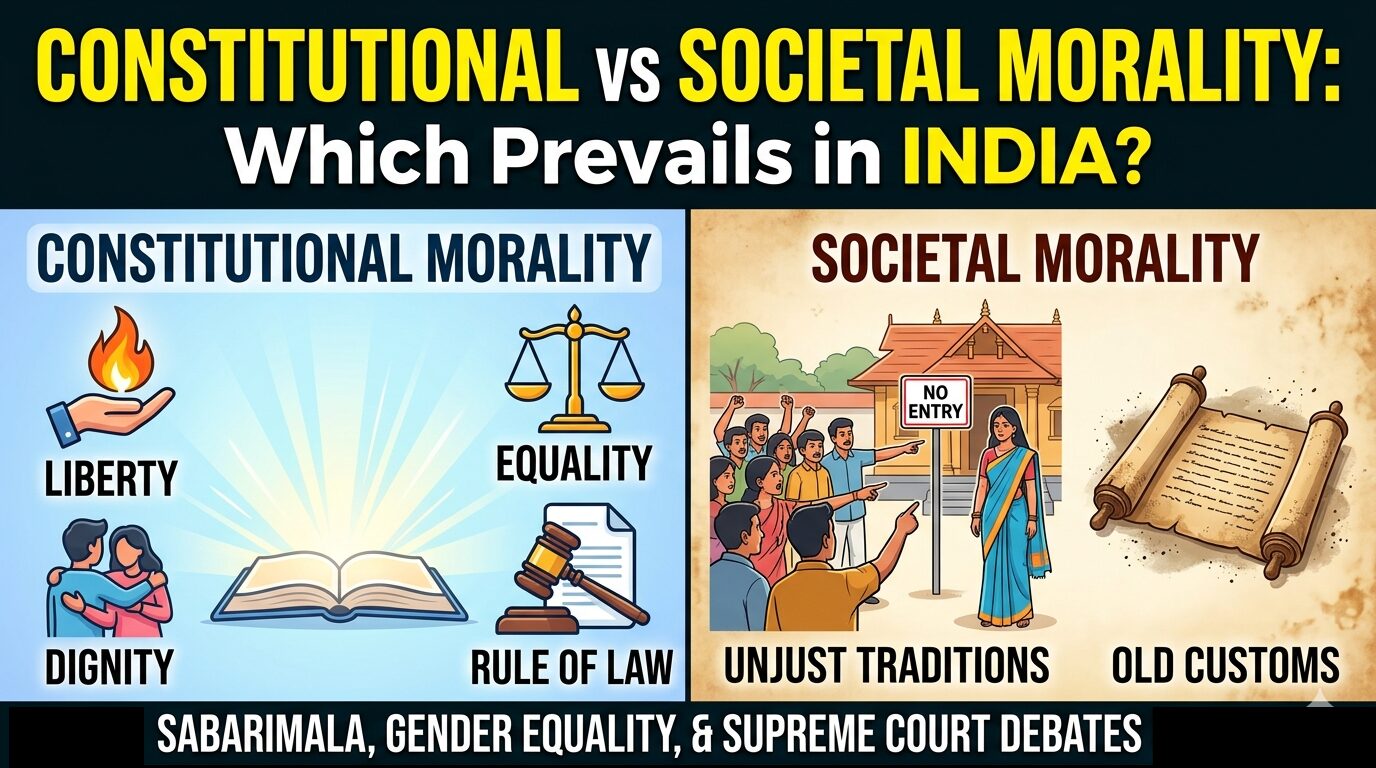
Constitutional Morality 1

Role of Constitutional Morality in the Judiciary

The courts (especially the Supreme Court) use constitutional morality to decide tough cases. It helps judges answer important questions such as:

  • Can old traditions be allowed to override the principle of equality?
  • At what point does “religious freedom” become unfair discrimination against others?
  • How should we balance an individual’s dignity with the customs of a religious or social group?

What it ensures:

  • Fundamental Rights always win over old customs.
  • Reason and logic win over blind prejudice or bias.

Important Supreme Court Cases:

  1. Kesavananda Bharati Case (1973)
    This is one of the most important cases in Indian history. The Supreme Court said that Parliament cannot change the basic structure of the Constitution. It established the Basic Structure Doctrine. This case strongly reinforced that the core values of the Constitution are supreme.
  2. Navtej Singh Johar Case (2018)
    The Court decriminalised homosexuality by striking down parts of Section 377. It declared that every person has the right to live with dignity and privacy. The judgment clearly said that constitutional morality is more important than social morality.
  3. Sabarimala Temple Case (2018)
    The Supreme Court allowed women of all ages to enter the Sabarimala temple. It held that the right to equality and dignity is more important than religious customs that exclude women.
  4. Joseph Shine Case (2018)
    The Court struck down the old law that made adultery a criminal offence. It recognised that women have equal autonomy and dignity. A woman cannot be treated as the property of her husband.
  5. NCT of Delhi Case (2018)
    The Court applied constitutional morality to decide the power-sharing dispute between the Central Government and the Delhi Government. It emphasised cooperative federalism and constitutional values in governance.

Core Constitutional Debates

1) Majority Rule vs Constitutionalism

  1. True democracy is not just whatever the majority wants.
  2. The Constitution puts strong limits on even popular practices if they violate basic rights.
  3. Examples of practices that were declared unconstitutional:
    • Untouchability (discriminating against Dalits)
    • Gender discrimination
    • Exclusion of LGBTQ+ persons

2) Judicial Activism vs Judicial Restraint

  1. Judicial Activism: The court actively protects Fundamental Rights, safeguards minorities, and corrects failures of the government.
  2. Judicial Restraint: The court should not interfere too much. It should respect the decisions of the elected government and maintain separation of powers.

Balanced View: Courts must step in when basic rights are seriously violated, but they should not start making policies or running the government themselves.

Criticisms of Constitutional Morality

  • Vagueness: There is no single clear definition. Different people may understand it differently.
  • Judicial Overreach: It sometimes gives too much power to judges.
  • Inconsistency: Different benches of the court may interpret it in different ways.
  • Selective Use: Sometimes it is used only in certain cases, which reduces its credibility.

Institutional Concerns

Constitutional morality is not only for the government — it also applies to the judiciary itself. It requires judges to:

  • Give consistent judgments
  • Provide clear and transparent reasoning
  • Follow due process (proper legal procedure)

Emerging Issue – Judicial Arbitrariness


If court decisions become unpredictable, lack clear standards, or appear arbitrary, it can weaken the Rule of Law.

Significance (Why Constitutional Morality is Important)

  • It protects minorities from the unfair dominance of the majority (majoritarianism).
  • It ensures every citizen is treated with dignity and equality.
  • It helps bring positive social reforms in society.
  • It strengthens real democracy.
  • It promotes healthy, rational, and respectful public discussions.

Way Forward

For Institutions (Courts, Government, Parliament):

  • Use constitutional morality only with clear and logical reasoning.
  • Maintain consistency in judgments.
  • Strengthen law-making (legislative reforms) to support constitutional values.

For Society:

  • Promote constitutional literacy — teach students and citizens about the Constitution.
  • Encourage respect for diversity and different opinions.

Structural Improvements:

  • Develop clearer standards and guidelines for applying constitutional morality.
  • Ensure all institutions remain accountable.
  • Try to balance individual rights with healthy traditions wherever possible

Conclusion

Constitutional morality represents the ethical foundation of India’s constitutional democracy. While the concept may be abstract, it plays an important role in ensuring that constitutional rights prevail over discriminatory social practices.

The real challenge is not whether constitutional morality exists, but how responsibly institutions interpret and apply it. A weakening of constitutional morality risks replacing constitutional governance with majoritarian impulses and institutional arbitrariness, thereby undermining the democratic project envisioned by the framers of the Constitution.

Practice Questions

Which of the following best describes the concept of “constitutional morality”?

A. Adherence to traditions and customs of society
B. Following only the written provisions of the Constitution
C. Upholding the spirit, values, and principles of the Constitution
D. Obedience to parliamentary sovereignty in all situations

Answer: C

Which of the following elements are part of constitutional morality?

  1. Respect for plurality
  2. Judicial supremacy over all institutions
  3. Commitment to individual liberty
  4. Openness to criticism

Select the correct answer:

A. 1, 3 and 4 only
B. 1 and 2 only
C. 2 and 3 only
D. 1, 2, 3 and 4

Answer: A

Match List I with List II:

List I (Concept)List II (Meaning)
A. Constitutional Morality1. Traditions and customs
B. Societal Morality2. Constitutional values
C. Judicial Review3. Power to examine laws

Select the correct answer:

A. A-2, B-1, C-3
B. A-1, B-2, C-3
C. A-2, B-3, C-1
D. A-3, B-1, C-2

Answer: A

Mains Questions:

  1. Constitutional morality is indispensable for protecting Fundamental Rights. Discuss.
  2. Examine the conflict between societal morality and constitutional morality.
  3. Critically analyse the role of judiciary in applying constitutional morality.

Sabarimala reference: Modi government vs Hindu outfits over control of temples

Open article →Download PDF
Sabarimala

Why in News?

The ongoing hearings in the Supreme Court of India on the Sabarimala reference have reopened fundamental constitutional questions regarding the relationship between religion, the state, and individual rights.

The issue has also exposed internal contradictions within the ruling establishment, particularly between the Government of India and various Hindu religious organisations over the demand to free temples from state control.

At its core, the debate is not merely about Sabarimala but about the interpretation of Articles 25 and 26 and the limits of state intervention in religious affairs.

UPSC Relevance:

GS-II: Fundamental Rights, Role of Judiciary, Judicial activism, religious freedom, Secularism, State vs Religion, Judicial Overreach,

Background: From Sabarimala Judgment to Constitutional Reference

The controversy originates from the landmark judgment in:

  • Indian Young Lawyers Association v. State of Kerala

In this case, the Supreme Court:

  • Struck down the ban on entry of women of menstruating age
  • Upheld equality and individual rights over religious custom

However, due to broader constitutional questions, the Court referred key issues to a nine-judge bench to clarify:

  • Scope of religious freedom
  • Rights of denominations
  • Limits of judicial review in religious matters

Core Constitutional Issue: Article 25 vs Article 26

The central debate revolves around the interplay between Article 25 and Article 26.

Article 25: Individual Religious Freedom

  • Guarantees freedom of conscience and right to profess, practice and propagate religion
  • Subject to:
    • Public order
    • Morality
    • Health
  • Allows the State to:
    • Introduce social reform
    • Open religious institutions to all sections

Article 26: Rights of Religious Denominations

  • Grants religious groups the right to:
    • Manage their own religious affairs
    • Own and administer property
  • Also subject to:
    • Public order, morality, and health

What is the Conflict?

The issue arises when:

  • Individual rights (Article 25) clash with
  • Group autonomy (Article 26)

Example:
Women’s entry into Sabarimala involves:

  • Individual right to worship
    vs
  • Denominational claim to preserve tradition

Position of the Government

The Government of India has taken a balanced but cautious stance.

Key arguments:

1) The government opposes complete withdrawal of state control over temples, despite political narratives supporting it.

2) Govt argues that:

  • Appointment of priests (archakas) is not a secular activity
  • Religious functions should remain within the domain of the denomination

3) Govt maintains that:

  • Article 26 rights are important
  • But cannot be treated as absolute or isolated

Thus, the government supports a middle path, avoiding both:

  • Total state control
  • Absolute denominational autonomy

Position of Hindu Religious Organisations

Various Hindu groups argue for greater autonomy of temples.

Key demands:

  • End state control over temple administration
  • Allow denominations to manage:
    • Finances
    • Rituals
    • Appointments

Constitutional argument:

They assert that:

  • Article 26(b) gives fundamental right to manage religious affairs
  • Article 25(2) is only an enabling provision, not superior to Article 26

Thus, they argue that: Denominational rights should prevail over individual claims in certain contexts

Judicial Concerns and Observations

Judges of the Supreme Court of India have raised important concerns.

Key issues highlighted:

First, if Article 26 is given absolute primacy:

  • It may justify exclusion of certain groups (e.g., Dalits, women)
  • This could violate constitutional equality

Second, the Court emphasized:

  • Religious institutions must remain inclusive
  • Exclusionary practices may harm the broader interests of religion itself

Thus, the judiciary is attempting to maintain a balance between:

Broader Constitutional Themes

1. Secularism in India

Indian secularism is not strict separation but principled distance.

  • State can intervene in religion for:
    • Social reform
    • Equality

But excessive control may violate religious freedom.

2. Essential Religious Practices Doctrine

The Court often uses this doctrine to decide:

  • What constitutes “essential” religious practice

However, this doctrine has been criticized for:

  • Allowing courts to act as theologians
  • Leading to inconsistency

3. Constitutional Morality

The debate also ties into constitutional morality, as discussed by B. R. Ambedkar.

  • Courts may prioritize:
    • Equality
    • Dignity
    • Individual rights

Over:

  • Traditional practices

4. Temple Administration Issue

Historically many temples are under state control (especially in South India)

Criticism includes:

  • Government control over temple finances
  • Political interference
  • Unequal treatment compared to other religions

Key Constitutional Questions Before the Court

The nine-judge bench is examining:

  • Can denominational rights override fundamental rights?
  • Is Article 25(2) subordinate to Article 26?
  • What is the extent of state regulation in religion?
  • Can courts intervene in religious practices?

These questions have implications beyond Sabarimala, affecting:

  • Mosques
  • Churches
  • Other religious institutions

Implications for Indian Democracy

Positive outcomes (if balanced properly)

  • Protection of minority and individual rights
  • Prevention of discriminatory practices
  • Strengthening constitutional values

Risks

  • Judicial overreach
  • Politicisation of religion
  • Internal conflicts within religious communities
  • Weakening of institutional clarity

Way Forward

A balanced approach is needed to solve the tension between temple control, religious freedom, and constitutional values.

1. Clear Distinction

Clearly separate:

  • Religious practices (core faith matters like rituals and priest qualifications) – these should be protected.
  • Secular activities (money management, property, administration) – these can be regulated by the state.

2. Role of Judiciary

  • Apply consistent principles in all cases.
  • Avoid too much reliance on vague or subjective ideas.
  • Give clear reasons in judgments.

3. Role of the State (Government)

  • Reduce unnecessary and arbitrary control over temples.
  • Ensure transparency and accountability in temple administration.

4. Guiding Principle

Constitutional morality should guide decisions, but in a balanced way. It must promote:

  • Equality
  • Dignity
  • Social reform

without destroying genuine religious traditions.

Conclusion

The Sabarimala reference case represents a defining moment in Indian constitutional law. It is not merely about temple entry but about reconciling faith with constitutional values.

The challenge lies in ensuring that:

  • Religious freedom is respected
  • But not at the cost of equality and justice

Ultimately, the Constitution seeks to create a society where tradition evolves in harmony with fundamental rights, not in conflict with them.

Practice Questions:

Consider the following statements regarding Articles 25 and 26 of the Indian Constitution:

  1. Article 25 guarantees freedom of religion only to Indian citizens.
  2. Article 26 grants rights only to religious denominations, not individuals.
  3. Both Articles are subject to public order, morality, and health.

Which of the statements given above is/are correct?

A. 2 only
B. 2 and 3 only
C. 1 and 3 only
D. 1, 2 and 3

Answer: B

Which of the following situations would most likely fall under the regulatory power of the State under Article 25(2)?

A. Deciding essential rituals of a temple
B. Appointment of priests based on religious customs
C. Regulation of temple finances and administration
D. Determining theological doctrines

Answer: C

Consider the following statements regarding religious denominations:

  1. A religious denomination must have a common faith and organization.
  2. Every temple automatically qualifies as a religious denomination.
  3. Denominational rights can be restricted in the interest of social reform.

Which of the statements given above is/are correct?

A. 1 and 3 only
B. 1 only
C. 2 and 3 only
D. 1, 2 and 3

Answer: A

MAINS QUESTIONS

 “Articles 25 and 26 of the Indian Constitution often come into conflict in matters of religious practice.” Examine in the context of the Sabarimala case.

Case Study

A religious denomination restricts entry of a particular group citing tradition. The State intervenes citing equality and social reform.

  • Identify the constitutional provisions involved.
  • Suggest how the conflict should be resolved.