
Opens in a new tab
Join Anantam IAS Channel on Telegram

Daily Digest · Tuesday

14 April 2026 Current Affairs for UPSC

2 current affairs published on Tuesday, 14 April 2026

14 April 2026 Current Affairs for UPSC — every Why-in-News article AnantamIAS published on Tuesday, 14 April 2026, broken down with Why in News?, the exact GS paper it feeds, sub-topic mapping, MCQ-ready facts and a UPSC-style practice question. 2 articles in total, covering Polity, Economy, Environment, S&T, IR, Geography, History, Society and Internal Security — the same Why-in-News + GS-paper-mapping + practice-question format the Compass uses across every daily digest on the site.

Daily current affairs for UPSC is where new material enters your prep stream. Read this 14 April 2026 digest end-to-end in 25–35 minutes, attempt the practice question at the foot of each article (it's MCQ for some, 10/15-marker for others), then bookmark the entries that fall inside your active revision window. Everything stays cross-linked: tap any subject pill to jump to that subject's hub, or use the table of contents above to skip straight to a specific story.

Use this page three ways. Read sequentially for a one-sitting scan of everything that mattered on 14 April 2026. Download the 14 April 2026 PDF below for offline study or print revision. Or use the April 2026 Current Affairs compilation to see this day in the month's full context. For the previous day's reading, see 13 April 2026 Current Affairs; the next day's is 15 April 2026 Current Affairs.

Why we publish daily current affairs separately from the monthly compilation: daily is learning, monthly is revision. Use the daily page to add fresh material to your notes the day it breaks; come back to the April 2026 compilation 60 days before Prelims when the noise has settled and only the lasting takeaway is worth re-reading.

National Productivity Council to lead Environmental Audits

Open article →Download PDF

Why in News?

The National Productivity Council (NPC) has been officially designated as the Environmental Audit Designated Agency by the Ministry of Environment, Forest and Climate Change (MoEF&CC).

UPSC Relevance: GS-3 Environment and Biodiversity: Environmental Impact Assessment

Prelims: Key facts about the National Productivity Council

About National Productivity Council: 

  • NPC is an autonomous organisation under the Department for Promotion of Industry and Internal Trade (DPIIT), Ministry of Commerce & Industry.
  • It is a think tank for the government and private sectors which focuses on improving efficiency, sustainability, and quality across agriculture, industry, and the service sector.
  • NPC is a member of the Asian Productivity Organisation headquartered in Tokyo.
  • Headquarters: New Delhi

National Productivity Council to lead Environmental Audits:

  • NPC has signed an agreement with the MoEF&CC to act as the Environment Audit Designated Agency (EADA) under the Environment Audit Rules, 2025.
  • Aim: To strengthen environmental compliance mechanisms, enhance transparency and institutionalise standardised environmental auditing practices across the country.
  • NPC will operate in accordance with the provisions of the Environment Audit Rules, 2025, ensuring adherence to prescribed standards, timelines and reporting requirements. 

Key responsibilities of NPC as EADA: 

  • Management of the Environmental Audit Framework, including the development of eligibility criteria, the conduct of examinations for certification, the registration of auditors, monitoring of their performance and capacity building.
  • Certification and registration of Certified Environmental Auditors (CEA) and Registered Environmental Auditors (REA).
  • Development and management of digital systems for environmental audit processes.
  • Support compliance with regulatory approvals such as Environmental Clearance (EC), Consent to Establish (CTE) and Consent to Operate (CTO) issued by the competent authorities. 
Environment Audit Framework: 
The Environment Audit Framework is envisaged as a key instrument to strengthen compliance with major environmental legislations, including: 
• Environment (Protection) Act, 1986
• Water (Prevention and Control of Pollution) Act, 1974
• Air (Prevention and Control of Pollution) Act, 1981
• Forest Conservation Act, 1980
• Wild Life (Protection) Act, 1972, and rules framed thereunder. 

Environmental Impact Assessment: 
• Environmental Impact Assessment (EIA) is the process of examining the environmental, social and health effects of a proposed development.
• Environmental Clearance is mandatory for certain developmental projects listed under the Environment Impact Assessment (EIA) Notification of 2006, which is issued under the Environment (Protection) Act, 1986. 

Significance: 

The establishment of a dedicated agency for environmental audits is expected to improve monitoring, reporting accuracy and regulatory compliance, thereby contributing to better environmental outcomes. 

Critical Analysis of NPC as Environment Audit Agency:
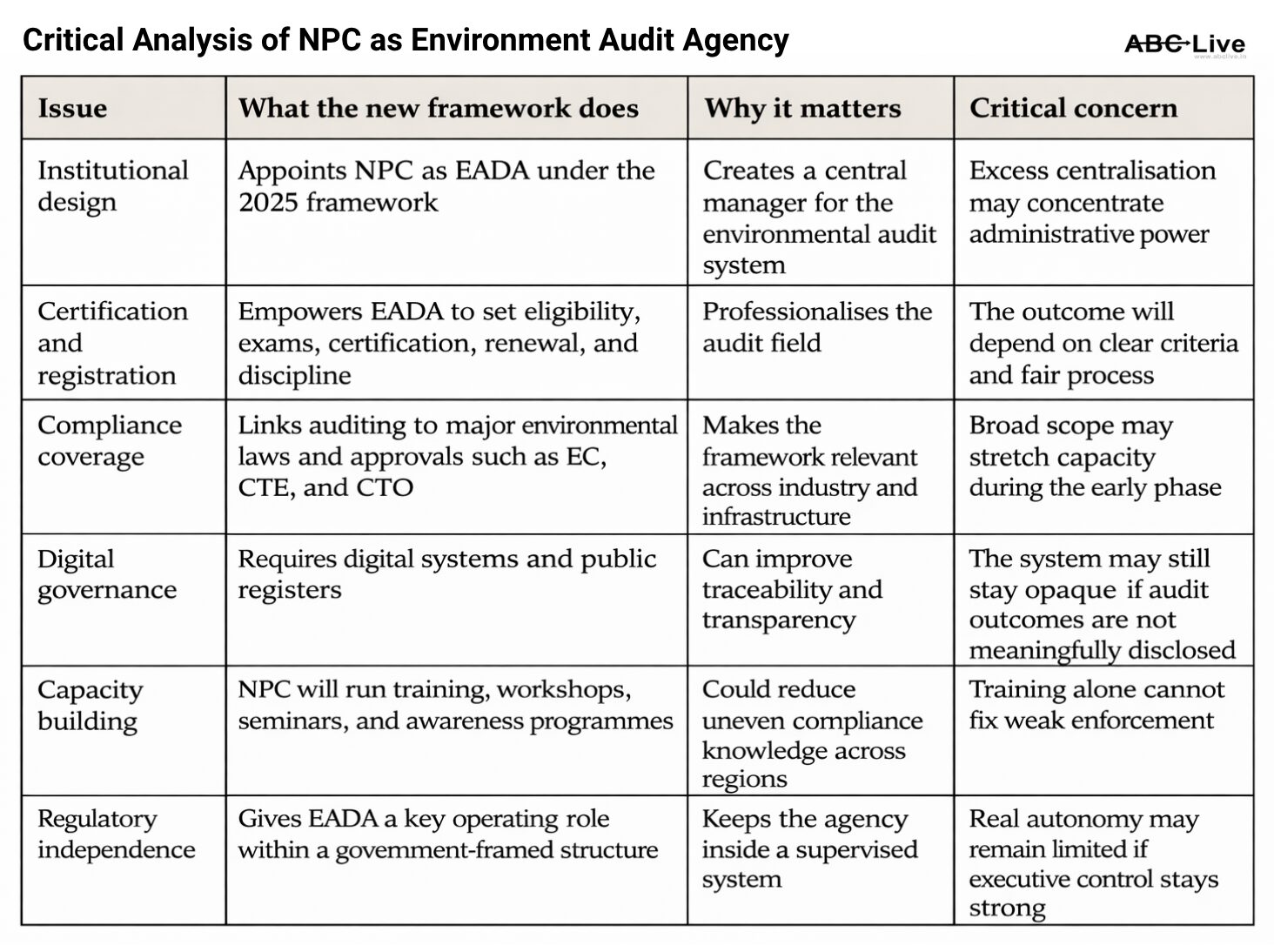
image 43

Practice MCQ:

Q. With reference to the National Productivity Council (NPC), consider the following statements:

1. It is an autonomous organisation under the Ministry of Environment, Forest and Climate Change.

2. It has been designated as the Environmental Audit Designated Agency under the Environment Audit Rules, 2025.

3. It is a member of the Asian Productivity Organisation.

Which of the statements given above are correct?

(a) 1 and 2 only

(b) 2 and 3 only

(c) 1 and 3 only

(d) 1, 2, and 3

Answer: (b) 
Need to reform Fertiliser Policy

Open article →Download PDF

Why in News?

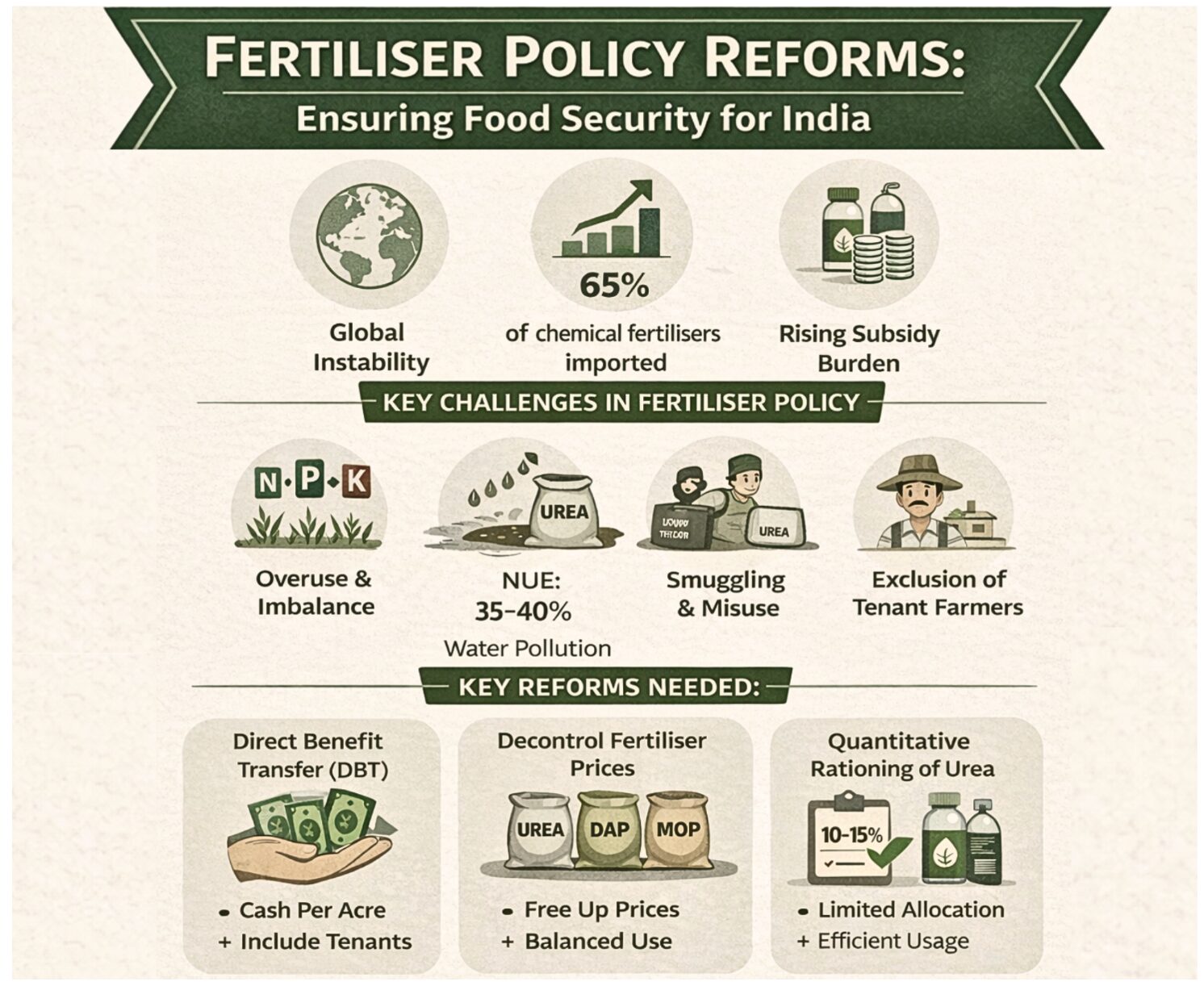
Rising global geopolitical instability (E.g., tensions in West Asia, Russia-Ukraine War) has disrupted fertiliser and energy markets. This has exposed India’s heavy import dependence and inefficiencies in fertiliser subsidies. This necessitates urgent reforms to ensure food security and fiscal sustainability.

UPSC Relevance: GS-3 Economy: Agriculture sector

Mains: Fertiliser Policy: Issues & solutions.

Present Status of Fertilisers in India:

  • India is the second-largest consumer of fertilisers globally (after China). Total fertiliser consumption has increased from ~1.1 million tonnes (1966-67) to about ~32–33 million tonnes (2023-24). 
  • India has limited domestic reserves of rock phosphate and potash, and is mainly dependent on imports for these. Import dependence:
    • Urea: ~20–25%. Even 85% of domestic urea production depends on imported gas.  
    • Phosphatic fertilisers (DAP & raw materials): ~60-70%
    • Potassic fertilisers: ~100% (mainly from Russia, Belarus, Canada)
  • Supply-Side Constraints:
    • Global price volatility (fertilisers + LNG).
    • Geopolitical risks in: Gulf region (phosphates) & Russia-Belarus (potash)
    • China’s export restrictions on phosphates intermittently impact India. 

Key Challenges in the Fertiliser Sector: 

  • Unsustainable subsidy burden: Fertiliser subsidy peaked at ₹2.25 lakh crore (2022-23). Urea subsidy is based on the cost-plus method, which encourages inefficient fertiliser manufacturers.
    • The subsidy amount paid by the Government to the fertiliser companies is the difference between the cost of manufacturing and the market price. The firm receives the subsidy based on its cost of production. Thus, the greater the cost of production, the larger the subsidy amount.
  • Overuse of urea by farmers: As Urea (source of N) is cheaper compared to P&K fertilisers, it has led to overuse of Urea. This has led to an imbalanced fertiliser ratio of N:P:K (7:3:1) against the ideal ratio 4:2:1 for N: P: K.
  • Irrational urea pricing policy (Efficient fertilisers not equally incentivised): Granular urea has a very low Nutrient Use Efficiency (NUE), roughly 35 to 40%. Whereas the liquid urea (N) has an NUE of almost 90% through drip irrigation (fertigation). Ironically, the highly irrational urea pricing policy does not subsidise Liquid urea (N). 
  • Diversion and black marketing: Urea is used both as a fertiliser in agriculture and as a raw material in the chemical industry, explosives, etc. The cheaper urea available as a fertiliser (subsidised) is diverted towards industries or is smuggled across borders. 
  • Slow innovation & regulatory bottlenecks: As per a World Bank 2019 report, registering a new fertiliser product takes over 800 days in India, against 270 days in China. The time taken (filing application, field-testing at multiple locations, state-level approvals) hinders the introduction of new nutrient products into the country. 

Excessive use of fertilisers leads to negative externalities like declining soil fertility, water pollution, etc.

Government Initiatives: 

  • Neem-coating of urea so that it becomes unusable for industrial purposes and hence, diversion would be curbed.
  • Use of Nano Urea and Nano DAP in agriculture. 
  • Introduction of Sulphur-coated Urea (Urea Gold) to address Sulphur deficiency.
  • Aadhaar-authenticated invoice: Sale of all subsidised fertilisers to farmers/buyers is made through Point of Sale (PoS) devices installed at each retailer shop, and the beneficiaries are identified through Aadhaar Card, KCC, Voter Identity Card, etc. The manufacturers only get a subsidy on submission of electronic proof of sale. 
  • PM-PRANAM scheme to reduce synthetic fertiliser usage. It incentivises states to adopt alternative fertilisers (organic/bio-fertilisers) and natural farming, with 50% of subsidy savings given back to states as grants.
image 44

Way Forward:

  • Farmer ID-Based Distribution: Digitised farmer database (fertiliser distribution model pilot in Madhya Pradesh) ensures farmers receive fertilisers based on their land and crop requirements. Tenant farmers will also be able to access fertilisers and other benefits through Farmer ID with the consent of the landowner.
  • Direct Benefit Transfer (DBT) to Farmers: Shift from product subsidy to income support per acre. Clubbing the fertiliser subsidy with PM-KISAN can promote rational fertiliser use and reduce diversion. 
  • Quantitative Rationing of Urea: Under the Essential Commodities Act, allocate limited quantities to states based on land records, crop patterns, previous sales, and recommended doses by their state agriculture universities. 
  • Promote Efficient Fertiliser Use: Shift to Nano urea & Liquid fertilisers (fertigation). 
  • Rebalancing Nutrient Mix: Reducing nitrogen bias and promoting phosphatic fertilisers. E.g., Replace DAP with Triple Super Phosphate (TSP). Encourage domestic production and global partnerships.
  • Strengthening Domestic Production: Diversify import sources. Invest in Green Ammonia, Biofertilisers, and Alternative fertiliser technologies. 
  • Improving Governance & Monitoring: Using GPS-based tracking to prevent diversion and leakages. 
  • Promote judicious use of fertilisers through the Soil Health card and the PM-PRANAM Scheme.

The government needs to secure its fertiliser supplies to ensure food security. The efforts to promote natural farming can not really scale up unless fertiliser pricing or quantities are rationalised. 

Mains Practice Question

Q. India’s high dependence on fertiliser imports makes the agriculture sector vulnerable to global geopolitical disruptions. Critically examine. Suggest a long-term strategy to ensure fertiliser security in India. (250 words)