Opens in a new tab
Join Anantam IAS Channel on Telegram

Daily Digest · Thursday

16 October 2025 Current Affairs for UPSC

2 current affairs published on Thursday, 16 October 2025

16 October 2025 Current Affairs for UPSC — every Why-in-News article AnantamIAS published on Thursday, 16 October 2025, broken down with Why in News?, the exact GS paper it feeds, sub-topic mapping, MCQ-ready facts and a UPSC-style practice question. 2 articles in total, covering Polity, Economy, Environment, S&T, IR, Geography, History, Society and Internal Security — the same Why-in-News + GS-paper-mapping + practice-question format the Compass uses across every daily digest on the site.

Daily current affairs for UPSC is where new material enters your prep stream. Read this 16 October 2025 digest end-to-end in 25–35 minutes, attempt the practice question at the foot of each article (it's MCQ for some, 10/15-marker for others), then bookmark the entries that fall inside your active revision window. Everything stays cross-linked: tap any subject pill to jump to that subject's hub, or use the table of contents above to skip straight to a specific story.

Use this page three ways. Read sequentially for a one-sitting scan of everything that mattered on 16 October 2025. Download the 16 October 2025 PDF below for offline study or print revision. Or use the October 2025 Current Affairs compilation to see this day in the month's full context. For the previous day's reading, see 15 October 2025 Current Affairs; the next day's is 17 October 2025 Current Affairs.

Why we publish daily current affairs separately from the monthly compilation: daily is learning, monthly is revision. Use the daily page to add fresh material to your notes the day it breaks; come back to the October 2025 compilation 60 days before Prelims when the noise has settled and only the lasting takeaway is worth re-reading.

Trade Deficit

Open article →Download PDF

WhatsApp Image 2025 10 16 at 11.01.19 bd2b64c6

Context:

India’s trade deficit (the gap between imports and exports) widened sharply by 93% in September 2025, as imports rose faster than exports. The total trade deficit reached $16.6 billion, compared to $8.6 billion in September 2024.

UPSC Relevance:

Balance of payment(Economy)

UPSC PYQ:

Q1. Consider the following actions which the Government can take: (2011) 

  1. Devaluing the domestic currency. 
  2. Reduction in the export subsidy. 
  3. Adopting suitable policies which attract greater FDI and more funds from FIIs. 

Which of the above action/actions can help in reducing the current account deficit? 

(a) 1 and 2 
(b) 2 and 3 
(c) 3 only 
(d) 1 and 3 

Sectoral Performance:

1. Merchandise Trade (Goods):

  • Exports: Rose 3.02% to $220.12 billion.
  • Imports: Rose 4.53% to $375.11 billion.
  • Despite U.S. tariffs (50%) on Indian goods, exports to the U.S. grew 6.7% to $36.4 billion.

2. Services Trade:

  • Exports: Fell 5.5% to $30.8 billion in September.
  • Reason: Weak global demand in IT, consulting, and financial services.
  • Cumulative (April–Sept): Exports grew 6.12% to $193.18 billion, while imports stayed almost flat.

Balance of Payment:
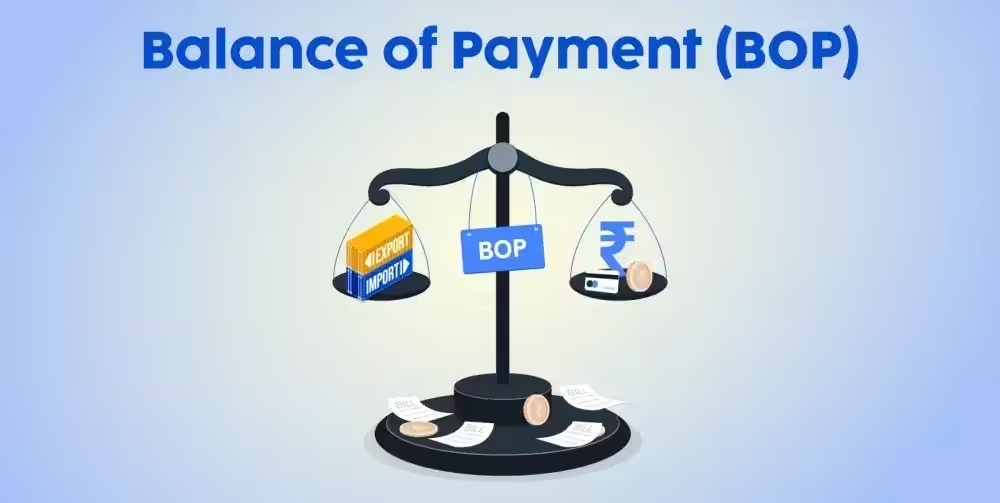
image 34

Balance of Payments (BoP) statistics systematically summaries the economic transactions of an economy with the rest of the World (i.e.transactions between resident & non resident entities) during a given period. It comprises of current and capital & financial accounts.
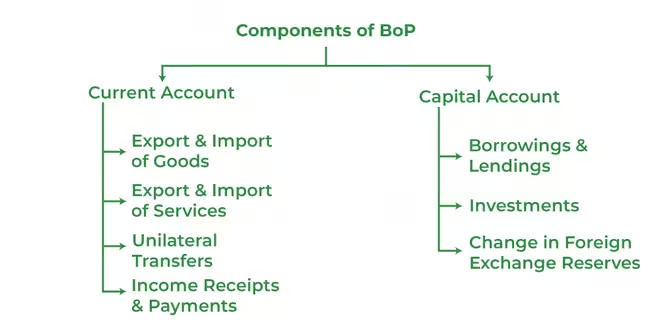
image 35

Reason Behind Trade Deficit:

  • High Import
  • Role of global market dynamics: In recent times, India has seen a drop in the exports of these articles, causing a trade deficit in the Indian economy. 
  • Impact of exchange rates: Changes in the exchange rate of a country can also cause a trade deficit. 

Impact:

  • Effects on employment: trade deficit on the economy is the effect on employment. 
  • Influence on currency value: When a country faces a constant trade deficit it leads to a fiscal deficit which requires the country to attract more foreign investment than usual. As a result, it causes currency inflation, which leads to a dip in currency value.
  • Implications for economic growth: A temporary trade deficit may bring positive outcomes such as increased foreign investment, increased customer satisfaction and higher international spending in the country. On the other hand, a long-term trade deficit can lead to a loss of economy, loss of jobs, and increased outflow in comparison to inflow. 

IMEC

Open article →Download PDF

India-Middle East-Europe Economic Corridor

WhatsApp Image 2025 10 16 at 11.07.20 e8abdb3f

Context:

The India–Middle East–Europe Economic Corridor (IMEC)—announced during the G20 Summit 2023 in New Delhi—is once again in focus due to geopolitical instability in West Asia, especially after the Hamas–Israel conflict. The recent security crisis and shifting regional alliances have raised concerns about the corridor’s feasibility and future direction.

UPSC Relevance:

International Relation

UPSC PYQ:

Q. What is the importance of developing Chabahar Port by India? (2017)

(a) India’s trade with African countries will enormously increase.

(b) India’s relations with oil-producing Arab countries will be strengthened.

(c) India will not depend on Pakistan for access to Afghanistan and Central Asia.

(d) Pakistan will facilitate and protect the installation of a gas pipeline between Iraq and India.

About IMEC:

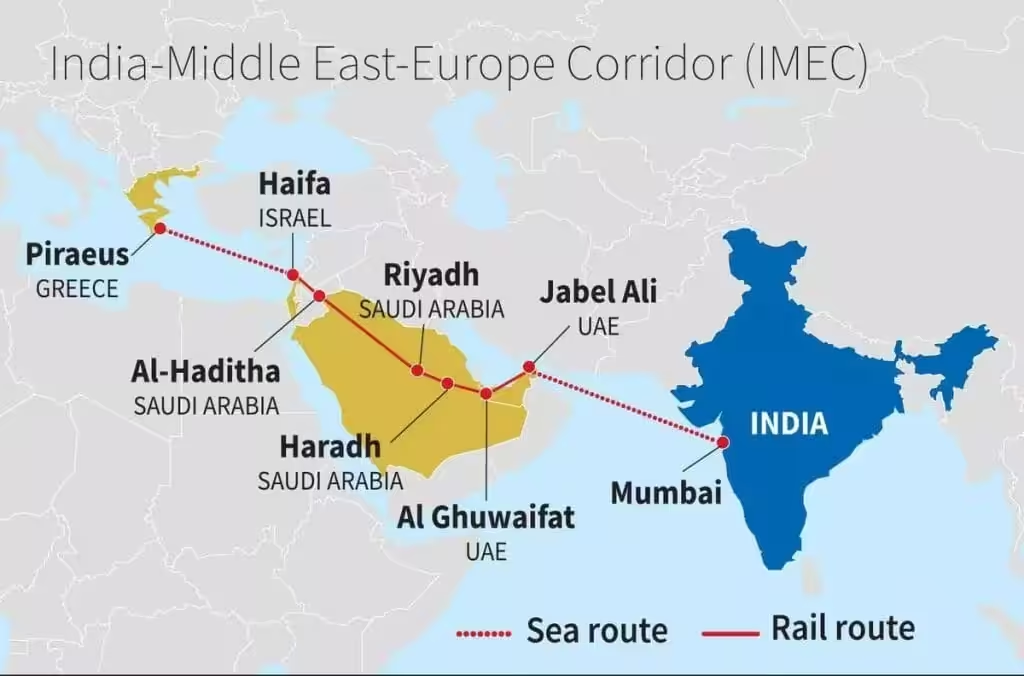
image 36
  • Launched at the 2023 Group of Twenty (G20) summit in New Delhi, the India-Middle East-Europe Economic Corridor (IMEC) features three pillars that integrate existing and future infrastructure: 
    • A transportation pillar—the corridor’s backbone—integrating rail and maritime networks
    • A energy pillar with interconnected energy and electricity infrastructure across continents
    • A digital pillar providing new fiber-optic cables and cross-border digital infrastructure.

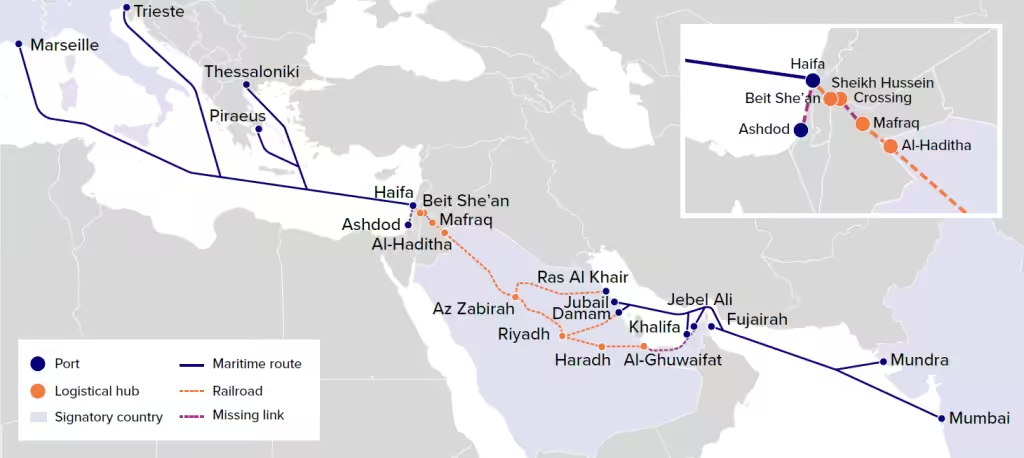
image 37
  • The corridor is well placed to be a consequential regional integration and infrastructure initiative in the coming decades, reinforcing supply chain security and aligning Eurasian policy around open, rules-based connectivity, supported by market-driven, locally funded investment from a diverse set of countries.
  • IMEC also provides an alternative to existing corridors dominated by a single government, particularly the Belt and Road Initiative. 

The transportation corridor plan has a financing gap of approximately $5 billion to become minimally operational, linking Gulf ports to Haifa, Israel. Most of the unmet costs are in Jordan, Israel, and logistics hubs likely at Haradh, in the Kingdom of Saudi Arabia (linking KSA-United Arab Emirates); al-Haditha, KSA (KSA-Jordan); Mafraq, the Jordan logistics hub, and near Beit She’an in Israel (Jordan-Israel).  

  • Transshipment times via the transportation corridor could be reduced by about 40 percent (to twelve-plus days) relative to maritime routes, generating approximately $5.4 billion in annual savings on Asia-Europe trade traveling the route. 

Current Challenges:

  • Security instability
    • Escalating violence in West Asia, particularly between Israel and Hamas, and attacks on Red Sea shipping lanes by the Houthis, threaten IMEC’s viability.
  • Changing Geopolitics:
    • Countries like Saudi Arabia, Iran, and Egypt are recalibrating their foreign policies. Pakistan, too, may seek to counter India’s growing influence in the region.
  • Mediterranean Concerns:
    • Disruptions in the Red Sea have increased shipping costs and time for global trade, pushing the world to look for alternative trade routes.

IMEC’s success depends on peace and stability in the Middle East. The corridor must remain adaptive to evolving geopolitical and security dynamics. India and its partners (Saudi Arabia, UAE, Israel, EU) need innovative diplomatic coordination to sustain progress despite regional tensions.