Why in News?
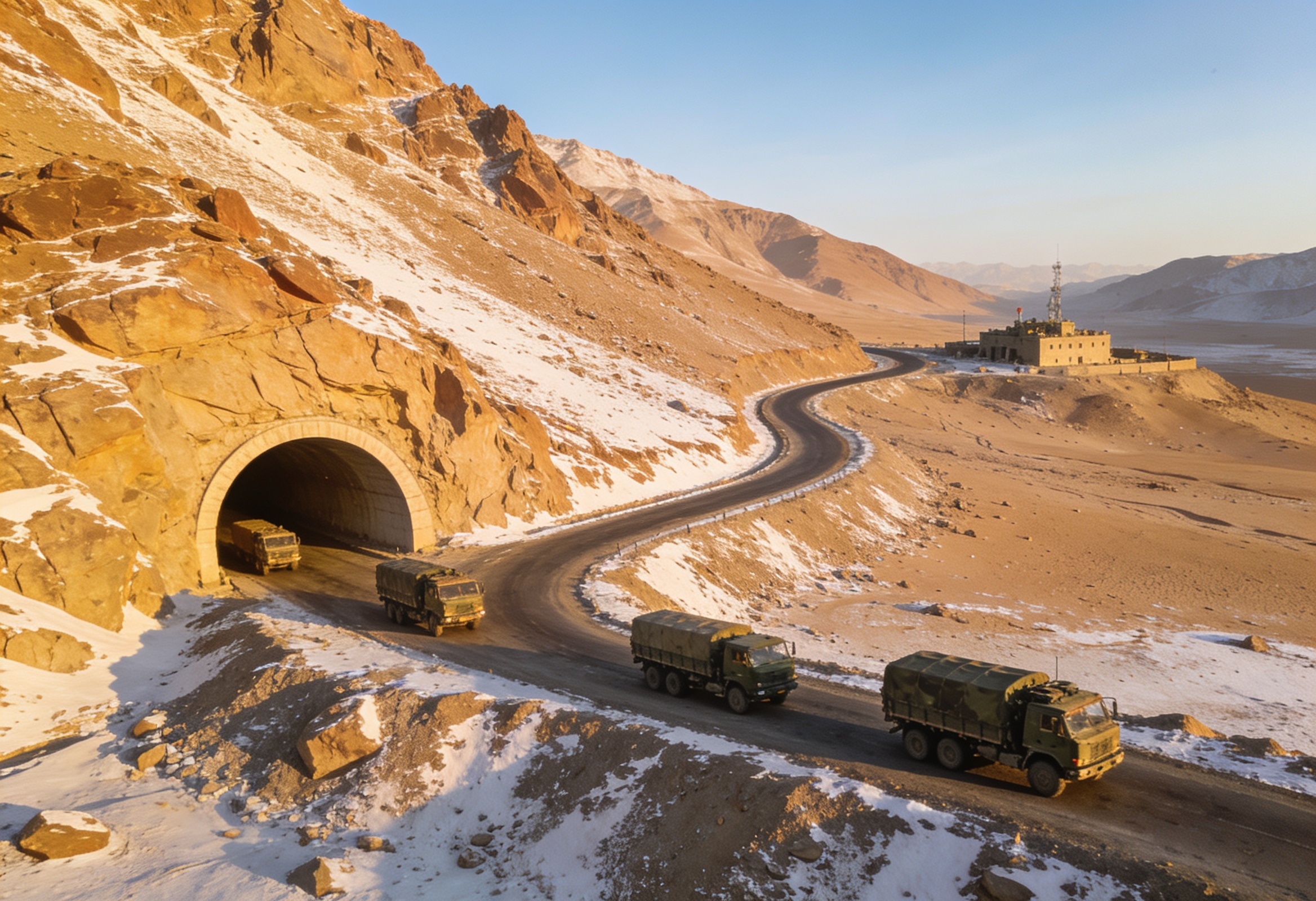
On 7 December 2025 Defence Minister Rajnath Singh dedicated 125 border infrastructure projects built by the Border Roads Organisation (BRO), in what the Ministry of Defence called the agency’s largest-ever single-day launch. The flagship event was held at the strategic Shyok Tunnel on the Darbuk-Shyok-Daulat Beg Oldie (DS-DBO) road in eastern Ladakh.
DD News reported the 125 projects are worth about Rs 5,000 crore and span seven states and two Union Territories along the northern and eastern frontiers, reinforcing all-weather connectivity to forward areas facing China and Pakistan.
- Mix confirmed by DD News: 28 roads, 93 bridges and 4 miscellaneous works, totalling the 125 projects.
- Geography spans Ladakh, Jammu & Kashmir and seven border states, concentrated on the Line of Actual Control (LAC) sectors.
- Centrepiece is the 920-metre Shyok Tunnel, a cut-and-cover tunnel on the DS-DBO road that keeps the route to Daulat Beg Oldie open through winter.
- BRO’s 2025-26 Union Budget allocation was raised to about Rs 7,146 crore (up from roughly Rs 6,500 crore).
- A Galwan war memorial was also dedicated virtually during the event.
The development matters in the context of:
- Forward connectivity is the spine of military logistics — moving troops, fuel and artillery to high-altitude posts in days, not weeks.
- It underpins the Vibrant Villages Programme, which links remote border hamlets to arrest out-migration and assert presence.
- It is India’s structured answer to China’s rapid dual-use infrastructure build-up across the LAC.
UPSC Relevance
Prelims Relevance
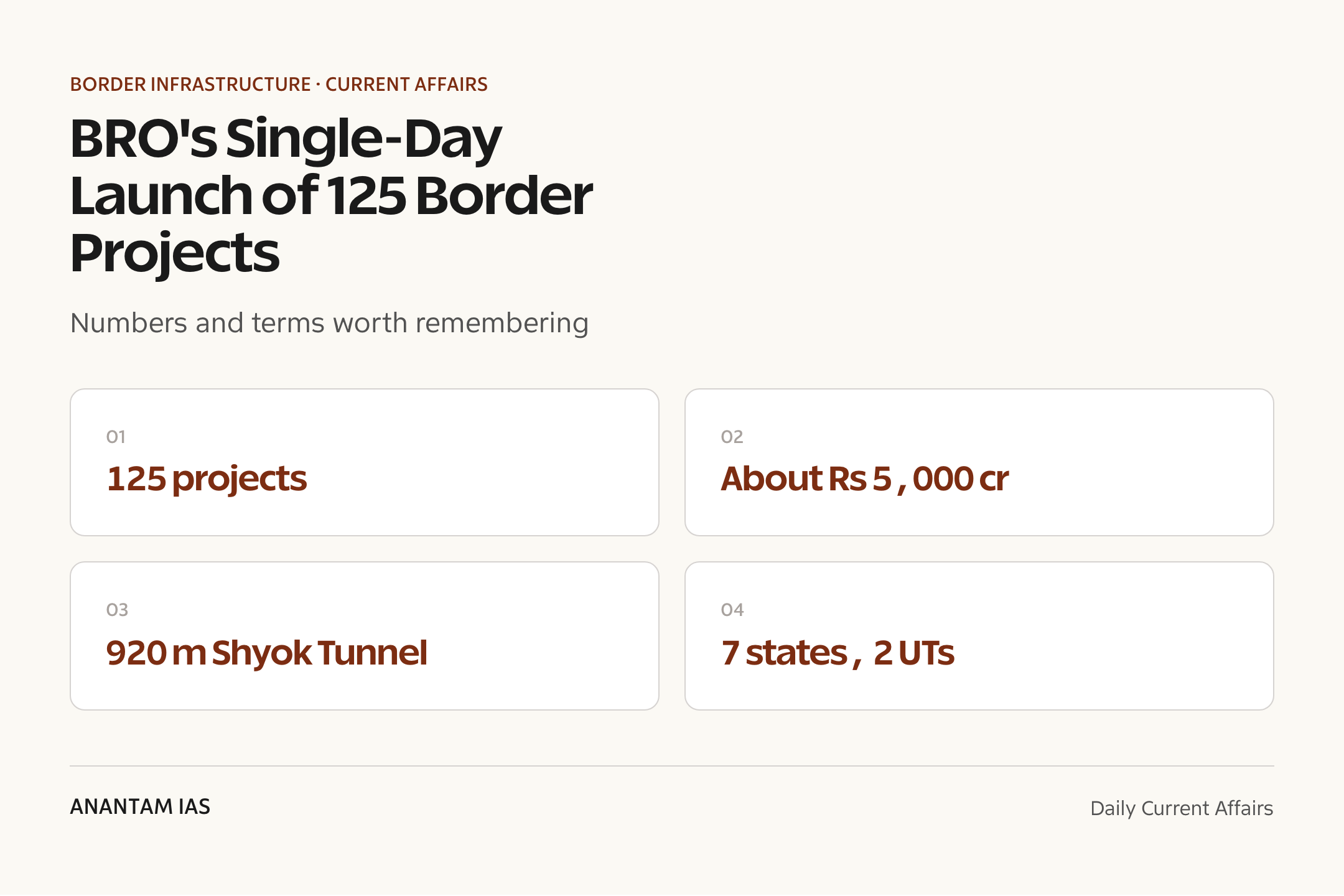
- Border Roads Organisation (BRO) — raised in 1960, executes border roads, bridges and tunnels.
- BRO functions under the Ministry of Defence (administrative control moved to MoD in 2015).
- Shyok Tunnel — 920 m cut-and-cover tunnel on the DS-DBO road, eastern Ladakh.
- Daulat Beg Oldie (DBO) — a forward post near the Karakoram Pass, world’s highest airstrip nearby.
- Sela Tunnel (Arunachal Pradesh) — earlier BRO project on the Tawang axis (do not confuse with Shyok).
- Atal Tunnel (Rohtang) — BRO-built tunnel on the Manali-Leh axis.
- Vibrant Villages Programme — announced in the 2022-23 Budget for border villages.
- Line of Actual Control (LAC) separates India and China; Line of Control (LoC) separates India and Pakistan.
- BRO’s flagship infrastructure brand is Project Vartak, Himank, Dantak (Bhutan) and other named projects.
Mains Relevance
GS Paper 3
- Border-area infrastructure as a force multiplier for defence preparedness and rapid mobilisation.
- Role of the BRO and dual-use connectivity in countering asymmetric border development.
GS Paper 2
- Vibrant Villages Programme — governance and welfare delivery in remote border regions.
GS Paper 1
- Strategic geography of the Himalayan frontier and the challenge of high-altitude connectivity.
Essay
- Development and security are not rivals but partners at the frontier.
- Connectivity as the quiet instrument of national power.
Background and Context
What was launched
A single-day dedication of 125 completed assets, the most BRO has ever opened at once.
- 125 projects worth about Rs 5,000 crore, per DD News.
- Composition: 28 roads, 93 bridges and 4 miscellaneous works.
- Spread across seven states and two Union Territories on the northern and eastern frontiers.
- The dedication was anchored at the Shyok Tunnel in eastern Ladakh, with linked sites joined virtually.
The Shyok Tunnel — the centrepiece
A short tunnel with outsized strategic value on the road to Daulat Beg Oldie.
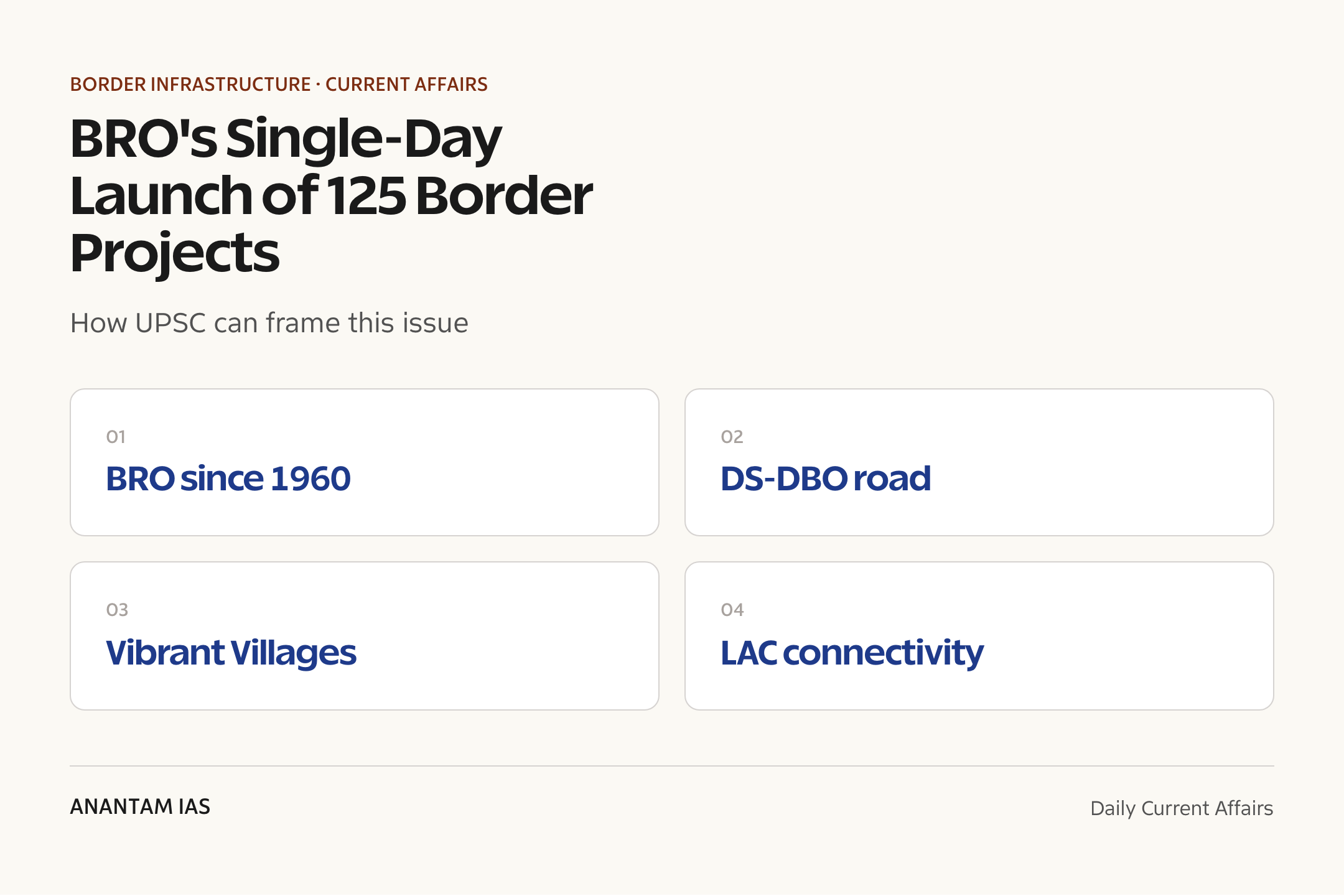
- 920-metre cut-and-cover tunnel on the Darbuk-Shyok-Daulat Beg Oldie (DS-DBO) road.
- Keeps the lifeline to Daulat Beg Oldie (DBO) — a critical forward post near the Karakoram Pass — open through heavy snow, avalanches and extreme cold.
- Enables faster, safer movement of troops and supplies to the LAC during the long winter months.
- DBO sits close to the disputed Depsang plains, making winter access militarily decisive.
What the BRO is
The agency that builds and maintains India’s strategic frontier roads.
- Border Roads Organisation, raised in 1960, builds roads, bridges and tunnels in border and remote regions.
- Administrative control was shifted fully to the Ministry of Defence in 2015 for faster decision-making.
- Works through named projects (for example Vartak, Himank, Dantak) across the Himalayan and northeastern belts.
- Past landmark works include the Atal Tunnel (Rohtang) and the Sela Tunnel (Arunachal Pradesh).
Money behind the build-up
Rising allocations signal a sustained, not one-off, frontier push.
- BRO’s 2025-26 Union Budget allocation rose to about Rs 7,146 crore, up from roughly Rs 6,500 crore.
- DD News noted record BRO capital expenditure in the preceding year and a higher target for 2025-26.
- Hundreds of BRO projects have been opened over the past two years, pointing to a steady delivery pipeline.
- Higher capital spend reflects a shift from maintenance to large new tunnels, bridges and all-weather roads.
Linking roads to villages
Connectivity feeds the larger frontier-development agenda.
- The Vibrant Villages Programme (announced in the 2022-23 Budget) targets remote border villages with roads, power and livelihood support.
- BRO roads make these ‘first villages’ reachable, helping to slow out-migration from the frontier.
- A populated, connected border doubles as the eyes and ears of national security.
- Better access also opens border tourism and local economic activity, raising the cost of any adversary’s encroachment.
The China factor
India’s build-up is partly a response to rapid construction across the LAC.
- China has built extensive dual-use infrastructure — roads, airfields and model border villages — opposite the LAC.
- Faster Indian connectivity narrows the mobilisation gap and improves response in sectors such as Ladakh and Arunachal Pradesh.
- All-weather access reduces dependence on fair-weather windows that earlier limited deployment.
- Frontier roads serve deterrence as much as logistics — presence and reach signal resolve.
Way Forward
Sustain and protect the pipeline
- Hold capital allocations steady so high-altitude tunnels and bridges are completed on schedule.
- Invest in disaster-resilient design given landslide, avalanche and seismic risks in the Himalaya.
Build for dual use
- Plan roads and tunnels to serve both rapid military deployment and civilian border economies.
- Tie new connectivity tightly to the Vibrant Villages Programme so assets translate into living, populated borders.
Balance speed with ecological caution — fragile Himalayan slopes demand careful alignment, drainage and slope-stabilisation rather than purely fair-weather cutting.
Conclusion
The single-day launch of 125 BRO projects marks a visible scaling-up of India’s frontier connectivity, with the Shyok Tunnel showing how a short structure can hold open a winter lifeline to a forward post.
The deeper story is integration — roads, budgets and the Vibrant Villages Programme converging so that the border is at once defended, developed and inhabited. Execution discipline and ecological care will decide how durable the gains prove.
UPSC Practice Questions
Prelims MCQ 1
With reference to the Border Roads Organisation (BRO), consider the following statements:
- It was raised in 1960 to develop infrastructure in border and remote areas.
- It currently functions under the administrative control of the Ministry of Defence.
- The Shyok Tunnel built by it lies on the Manali-Leh highway.
How many of the above statements are correct?
(a) Only one (b) Only two (c) All three (d) None
Answer: (b) Only two
Explanation:
Statements 1 and 2 are correct. The Shyok Tunnel is on the Darbuk-Shyok-Daulat Beg Oldie (DS-DBO) road in eastern Ladakh, not the Manali-Leh highway, so statement 3 is wrong.
Prelims MCQ 2
The Shyok Tunnel, dedicated in December 2025, is significant mainly because it:
(a) Connects India directly to Bhutan (b) Keeps the road to Daulat Beg Oldie open through winter (c) Is the longest railway tunnel in the Himalaya (d) Links the Vibrant Villages of Arunachal Pradesh
Answer: (b) Keeps the road to Daulat Beg Oldie open through winter
Explanation:
The 920-metre cut-and-cover tunnel on the DS-DBO road sustains all-weather access to the forward post of Daulat Beg Oldie in eastern Ladakh despite snow and avalanches.
UPSC Mains Questions
- Border-area infrastructure has shifted from a developmental afterthought to a core element of defence preparedness. Examine this transformation with reference to the role of the Border Roads Organisation along the northern and eastern frontiers.
- Discuss how all-weather connectivity to forward areas advances both national security and the goals of the Vibrant Villages Programme. What ecological cautions should guide such Himalayan infrastructure?
Sources: DD News, Ministry of Defence and PIB, Ministry of Defence.
Frequently Asked Questions
What did Rajnath Singh inaugurate in December 2025?
On 7 December 2025 Defence Minister Rajnath Singh dedicated 125 border infrastructure projects built by the Border Roads Organisation, the agency’s largest single-day launch. DD News reported the projects are worth about Rs 5,000 crore and cover seven states and two Union Territories, with the event anchored at the Shyok Tunnel in eastern Ladakh.
What is the Border Roads Organisation?
The Border Roads Organisation (BRO) is a defence body raised in 1960 to build and maintain roads, bridges and tunnels in India’s border and remote regions. Its administrative control was placed fully under the Ministry of Defence in 2015 to speed up strategic projects along the Himalayan and northeastern frontiers.
Why is the Shyok Tunnel important?
The Shyok Tunnel is a 920-metre cut-and-cover tunnel on the Darbuk-Shyok-Daulat Beg Oldie road in eastern Ladakh. It keeps the lifeline to the forward post of Daulat Beg Oldie, near the Karakoram Pass, open through heavy snow and avalanches, allowing troops and supplies to reach the LAC even in deep winter.
How much was BRO’s 2025-26 budget?
BRO’s allocation in the 2025-26 Union Budget was raised to about Rs 7,146 crore, up from roughly Rs 6,500 crore. The higher capital spending reflects a sustained push for large new tunnels, bridges and all-weather roads rather than routine maintenance along the frontier.
How does this link to the Vibrant Villages Programme?
The Vibrant Villages Programme, announced in the 2022-23 Budget, develops remote border villages with roads, power and livelihoods. BRO connectivity makes these ‘first villages’ reachable, helping slow out-migration. A connected, populated border supports both local economies and national security.
How does border infrastructure relate to China?
China has built extensive dual-use roads, airfields and model villages opposite the Line of Actual Control. India’s faster connectivity narrows the mobilisation gap in sectors like Ladakh and Arunachal Pradesh, improving deterrence and the ability to deploy quickly while reducing dependence on fair-weather windows.