
Introduction
On 18 October 2025, the Union Ministry of Environment, Forest and Climate Change (MoEFCC) released the long-awaited Synchronised All-India Elephant Estimation (SAIEE) 2021–25, pegging India’s wild elephant population at approximately 22,446. The exercise, executed in partnership with the Wildlife Institute of India (WII), marks a definitive methodological break from the decades-old direct count to a scientifically robust mark–recapture and DNA-based estimation framework. Coming three years late owing to the methodology overhaul, the report is the most credible national census of the Asian Elephant (Elephas maximus indicus) ever published in India.
For UPSC aspirants, SAIEE 2021–25 is a high-yield intersection of GS-III Environment & Ecology with cross-cutting links to wildlife law, conservation institutions, and federal coordination. The headline number is only the surface; the deeper story lies in the methodology shift, the geographic redistribution it reveals, and the implications for Project Elephant, elephant corridors, and human–elephant conflict policy. This article unpacks every layer relevant to Prelims and Mains.
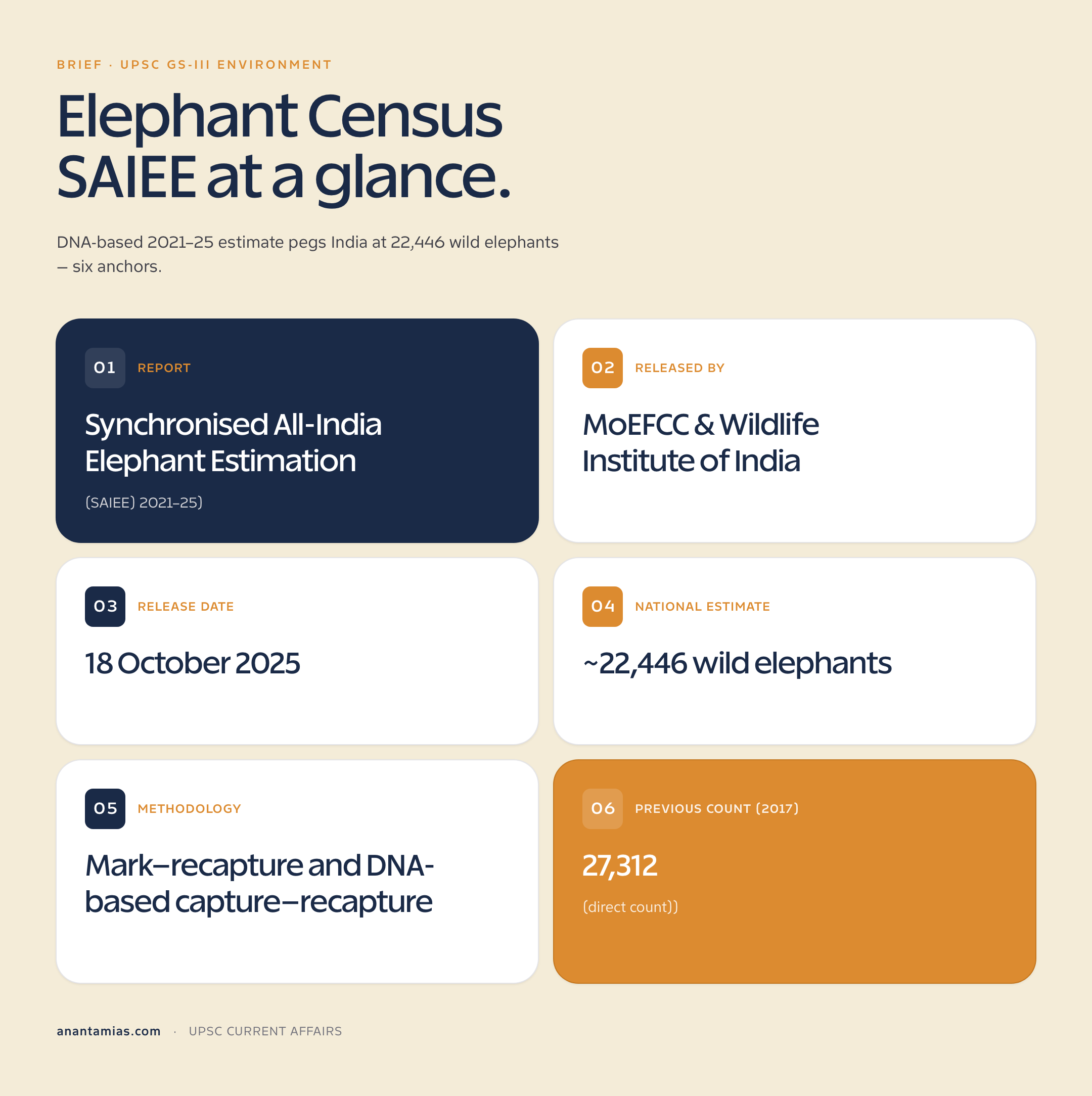
Quick Facts
| Parameter | Detail |
|---|---|
| Report | Synchronised All-India Elephant Estimation (SAIEE) 2021–25 |
| Released by | MoEFCC & Wildlife Institute of India |
| Release date | 18 October 2025 |
| National estimate | ~22,446 wild elephants |
| Methodology | Mark–recapture and DNA-based capture–recapture |
| Previous count (2017) | 27,312 (direct count) |
| Species | Asian Elephant (Elephas maximus indicus) |
| IUCN status | Endangered |
| WPA 1972 status | Schedule I |
| CITES | Appendix I |
| Nodal scheme | Project Elephant (1992) |
Background
India hosts roughly 60% of the global Asian elephant population, making it the keystone range state for the species. The first organised national census traces back to the early 1990s, soon after the launch of Project Elephant in February 1992 as a centrally sponsored scheme. Until 2017, India relied on a direct (block/sample) count method, with state forest departments tabulating sightings across forest beats during a synchronised window. The 2017 count produced a figure of 27,312, but ecologists and the Project Elephant Division itself flagged persistent concerns: double-counting in dense forests, undercounting in fragmented landscapes, and high inter-observer variance.
To resolve these problems, the WII piloted a hybrid scientific protocol modelled on the methodology used in the All-India Tiger Estimation. The new approach integrates line-transect sampling, camera-trap based mark–recapture for individually identifiable elephants, and genetic capture–recapture using DNA extracted from dung samples. Field data collection ran across 2021–24, with analysis and validation completed in 2025. The 2021–25 cycle therefore represents not a year-on-year decline from 27,312 to 22,446 but a recalibration of the baseline using a more conservative and verifiable method.
Key Features
1. Methodological overhaul
SAIEE 2021–25 abandons block counts in favour of a triangulated, statistically defensible protocol. Camera traps deployed across elephant reserves capture identifiable individuals (using ear-notch and tusk patterns), while genetic samples from non-invasively collected dung enable individual ID through microsatellite markers. The two streams feed into a spatially explicit capture–recapture (SECR) model that produces density estimates with confidence intervals — a first for Indian elephant censuses. WII’s report explicitly cautions against treating 22,446 as a population decline; it is a corrected estimate.
2. State-wise redistribution and southern dominance
The new estimate consolidates the southern landscape — particularly the Karnataka–Kerala–Tamil Nadu corridor spanning the Western Ghats and the Nilgiris — as the country’s dominant elephant range. Karnataka alone contributes roughly a quarter of the national population. The northeastern landscape (Assam, Meghalaya, Arunachal Pradesh) remains the second largest, while east-central states (Odisha, Jharkhand, Chhattisgarh) show fragmented but conflict-prone populations.
3. Reserve-level granularity
For the first time, density estimates are available at the level of individual Elephant Reserves (currently 33 notified reserves covering ~80,778 sq km). This allows the Project Elephant Division to allocate funds, anti-depredation infrastructure, and corridor restoration funding using a defensible quantitative basis rather than political negotiation.
Significance for UPSC
- Methodology peg: The shift from direct count to mark–recapture/DNA-based estimation is a textbook case of evidence-based wildlife governance — a frequent Mains theme.
- Federal coordination: SAIEE is executed by states under MoEFCC and WII technical guidance — illustrating cooperative federalism in environment management.
- Corridor conservation: The data strengthens the case for legally protecting the 150+ identified elephant corridors, a long-pending demand.
- Human–wildlife conflict: Reserve-level densities directly inform conflict mitigation and ex-gratia policy.
- International commitments: Feeds into India’s reporting under the CITES MIKE (Monitoring the Illegal Killing of Elephants) programme and the Asian Elephant Range States Meeting.
Detailed Analysis: State-wise Elephant Population
The table below presents the headline state-wise distribution as reported by SAIEE 2021–25 (rounded). The southern cluster’s share — over 45% of the national total — underscores the conservation primacy of the Western Ghats landscape.
| State / Region | Estimated population | Share of national total |
|---|---|---|
| Karnataka | ~6,000 | ~26.7% |
| Assam | ~4,200 | ~18.7% |
| Kerala | ~2,400 | ~10.7% |
| Tamil Nadu | ~2,100 | ~9.4% |
| Odisha | ~1,900 | ~8.5% |
| Meghalaya | ~1,700 | ~7.6% |
| Uttarakhand | ~1,300 | ~5.8% |
| West Bengal | ~700 | ~3.1% |
| Arunachal Pradesh | ~650 | ~2.9% |
| Jharkhand | ~550 | ~2.4% |
| Chhattisgarh | ~300 | ~1.3% |
| Other states | ~646 | ~2.9% |
| India total | ~22,446 | 100% |
Two structural patterns emerge. First, the Western Ghats meta-population (Karnataka + Kerala + Tamil Nadu = ~10,500) functions as a single ecological unit traversing four landscapes — Bandipur–Nagarhole, Mudumalai–Sathyamangalam, Wayanad, and the Nilgiris. Second, the east-central elephant range (Odisha, Jharkhand, Chhattisgarh, southern West Bengal) shows the country’s most fragmented populations, correlating with the highest per-capita conflict mortality.
Challenges
Human–elephant conflict
According to MoEFCC data tabled in Parliament, India has witnessed approximately 500 human deaths annually from elephant encounters over the last five years, with Odisha, Jharkhand, West Bengal and Assam accounting for the majority. Roughly 100 elephants die each year from electrocution, train collisions, poisoning, and retaliatory killings. The Gaj Yatra awareness campaign and the Wildlife (Protection) Amendment provisions on conflict are the two primary policy responses.
Fragmenting corridors
Of 150+ identified elephant corridors, fewer than 30 enjoy any form of legal protection. Linear infrastructure — railways, highways, power lines, mining leases — bisects critical migration paths. The Karnataka–Kerala–Tamil Nadu corridor, despite its high elephant density, is increasingly punctured by tourism pressure, plantation expansion, and the Hassan–Mangaluru rail corridor.
Funding and capacity
Project Elephant’s annual outlay remains a fraction of Project Tiger’s budget, despite covering a comparable spatial footprint. Trained personnel for genetic sampling, camera-trap maintenance, and conflict response remain in chronic short supply at the state level.
Prelims Pointers
- Project Elephant launched in February 1992 as a Centrally Sponsored Scheme.
- Asian Elephant (Elephas maximus) is listed as Endangered on IUCN Red List.
- Listed in Schedule I of the Wildlife (Protection) Act, 1972.
- Listed in Appendix I of CITES.
- India is a party to the MIKE (Monitoring the Illegal Killing of Elephants) programme under CITES.
- India has 33 notified Elephant Reserves covering approximately 80,778 sq km.
- Gaj Yatra is the public awareness campaign launched by MoEFCC for elephant conservation.
- The Asian Elephant is India’s National Heritage Animal (declared in 2010).
- SAIEE 2021–25 used mark–recapture and DNA-based capture–recapture methodologies.
- Karnataka leads the state-wise count; the Western Ghats holds ~45% of the population.
Mains Practice Questions
- “The shift from direct count to mark–recapture and DNA-based estimation in the SAIEE 2021–25 marks a paradigm change in Indian wildlife governance.” Examine. (GS-III, 250 words)
- Discuss the structural drivers of human–elephant conflict in India and evaluate the effectiveness of policy responses such as Project Elephant and Gaj Yatra. (GS-III, 250 words)
- “Elephant corridors, not isolated reserves, are the future of Asian elephant conservation in India.” Critically analyse with reference to the Karnataka–Kerala–Tamil Nadu landscape. (GS-III, 150 words)
- Compare and contrast Project Tiger and Project Elephant in terms of funding, governance architecture, and conservation outcomes. (GS-III, 250 words)
Conclusion
SAIEE 2021–25 is less a snapshot of decline than an exercise in epistemic correction. By replacing inherited count protocols with a triangulated, statistically defensible methodology, India has finally placed its elephant conservation programme on the same scientific footing as Project Tiger. The headline figure of 22,446 should now anchor a new generation of policy decisions — corridor notification under the Wildlife Protection Act, conflict-mitigation funding tied to reserve-level density, and federal–state coordination calibrated to the actual geography of the species. For UPSC candidates, the SAIEE is one of those rare reports where a single document offers methodology, data, governance, and policy debate in a single, examinable package.
Frequently Asked Questions
What is SAIEE 2021–25?
SAIEE stands for the Synchronised All-India Elephant Estimation. The 2021–25 edition, released on 18 October 2025 by MoEFCC and the Wildlife Institute of India, is India’s first national elephant census conducted using mark–recapture and DNA-based methodologies, replacing the older direct count system.
What is India’s wild elephant population per SAIEE 2021–25?
The report estimates approximately 22,446 wild elephants across India, with statistically defensible confidence intervals at both national and reserve levels.
Why is the new figure lower than the 2017 count of 27,312?
The lower figure is largely a methodological correction, not an actual population crash. Direct counts were prone to double-counting and inter-observer error. The mark–recapture and DNA-based protocol produces a more conservative and verifiable estimate, so the two numbers are not directly comparable.
Which Indian state has the most elephants?
Karnataka leads with approximately 6,000 elephants, followed by Assam, Kerala, Tamil Nadu and Odisha. The Karnataka–Kerala–Tamil Nadu corridor in the Western Ghats accounts for nearly 45% of India’s total population.
What is Project Elephant?
Project Elephant is a Centrally Sponsored Scheme launched in February 1992 by the Government of India to ensure the long-term survival of viable populations of elephants in their natural habitats, address human–elephant conflict, and conserve elephant corridors.
What is the conservation status of the Asian elephant?
The Asian elephant (Elephas maximus) is listed as Endangered on the IUCN Red List, included in Schedule I of the Wildlife (Protection) Act 1972, and placed under Appendix I of CITES.
What is the MIKE programme?
MIKE — Monitoring the Illegal Killing of Elephants — is a CITES-administered international programme that tracks elephant poaching trends across Asian and African range states. India contributes data from designated MIKE sites in its elephant reserves.
How many human and elephant deaths occur annually due to conflict in India?
Per MoEFCC data, India sees roughly 500 human deaths and around 100 elephant deaths every year from human–elephant conflict, with Odisha, Jharkhand, West Bengal and Assam accounting for the bulk of human casualties.