Opens in a new tab
Join Anantam IAS Channel on Telegram

Daily Digest · Sunday

19 October 2025 Current Affairs for UPSC

2 current affairs published on Sunday, 19 October 2025

19 October 2025 Current Affairs for UPSC — every Why-in-News article AnantamIAS published on Sunday, 19 October 2025, broken down with Why in News?, the exact GS paper it feeds, sub-topic mapping, MCQ-ready facts and a UPSC-style practice question. 2 articles in total, covering Polity, Economy, Environment, S&T, IR, Geography, History, Society and Internal Security — the same Why-in-News + GS-paper-mapping + practice-question format the Compass uses across every daily digest on the site.

Daily current affairs for UPSC is where new material enters your prep stream. Read this 19 October 2025 digest end-to-end in 25–35 minutes, attempt the practice question at the foot of each article (it's MCQ for some, 10/15-marker for others), then bookmark the entries that fall inside your active revision window. Everything stays cross-linked: tap any subject pill to jump to that subject's hub, or use the table of contents above to skip straight to a specific story.

Use this page three ways. Read sequentially for a one-sitting scan of everything that mattered on 19 October 2025. Download the 19 October 2025 PDF below for offline study or print revision. Or use the October 2025 Current Affairs compilation to see this day in the month's full context. For the previous day's reading, see 18 October 2025 Current Affairs; the next day's is 20 October 2025 Current Affairs.

Why we publish daily current affairs separately from the monthly compilation: daily is learning, monthly is revision. Use the daily page to add fresh material to your notes the day it breaks; come back to the October 2025 compilation 60 days before Prelims when the noise has settled and only the lasting takeaway is worth re-reading.

Kurinji Flower

Open article →Download PDF

WhatsApp Image 2025 10 19 at 08.46.15 c3824842

Context:

After eight years, the kurinji flower (Strobilanthes sessilis) has bloomed again in Gudalur, Nilgiris district, Tamil Nadu — a newly notified reserve forest.

UPSC Relevance:

Environment

UPSC PYQ:

Q. Recently, our scientists have discovered a new and distinct species of banana plant which attains a height of about 11 meters and has orange coloured fruit pulp. In which part of India has it been discovered? (2016)

(a) Andaman Islands
(b) Anaimalai Forests
(c) Maikala Hills 
(d) Tropical rain forests of northeast

Neelakurinji Flower:

The scientific name of the Neelakurinji is named after the Kunthi River in Kerala’s Silent Valley National Park where it is abundantly found.
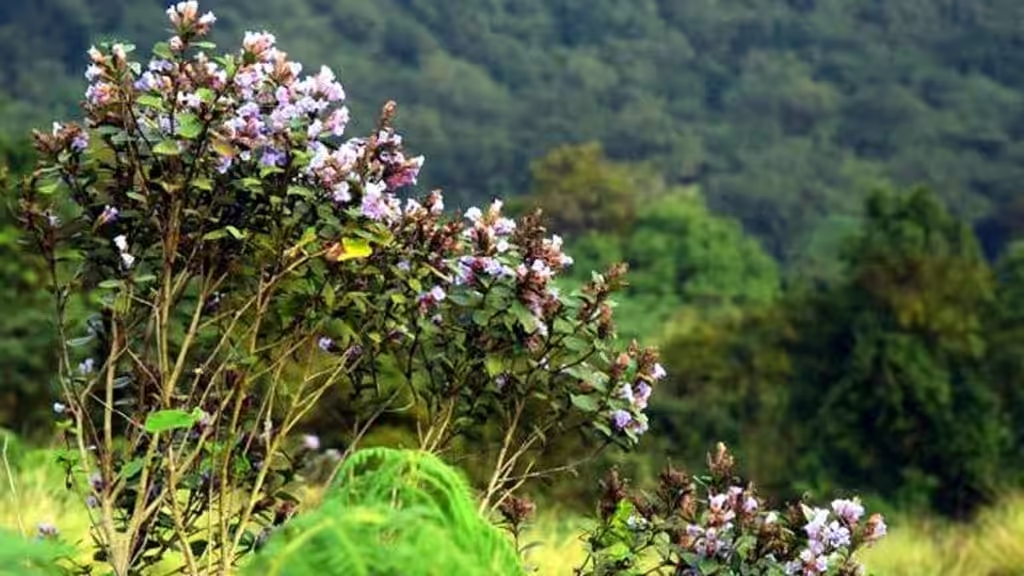
image 38
  • Strobilanthes kunthiana (Nees) T. Anderson ex Benth locally known as Neelakurinji is an endemic to Western Ghat, India and belongs to the Acanthaceae family.
  • It has a unique flowering pattern to bloom every 12 years. 
  • Origin: The origin of this species is Asia. It is native mostly to tropical Asia and Madagascar, but it extends to north temperate regions of Asia.
  • Habitat: is an endemic undershrub that grows above 1800 m in the sholas of the Western Ghats. Plants which bloom like Neelakurinji, i.e., at long intervals are called plietesials.
  • Distribution: It is endemic to Western Ghats, India (Karnataka, Kerala, and Tamil Nadu)
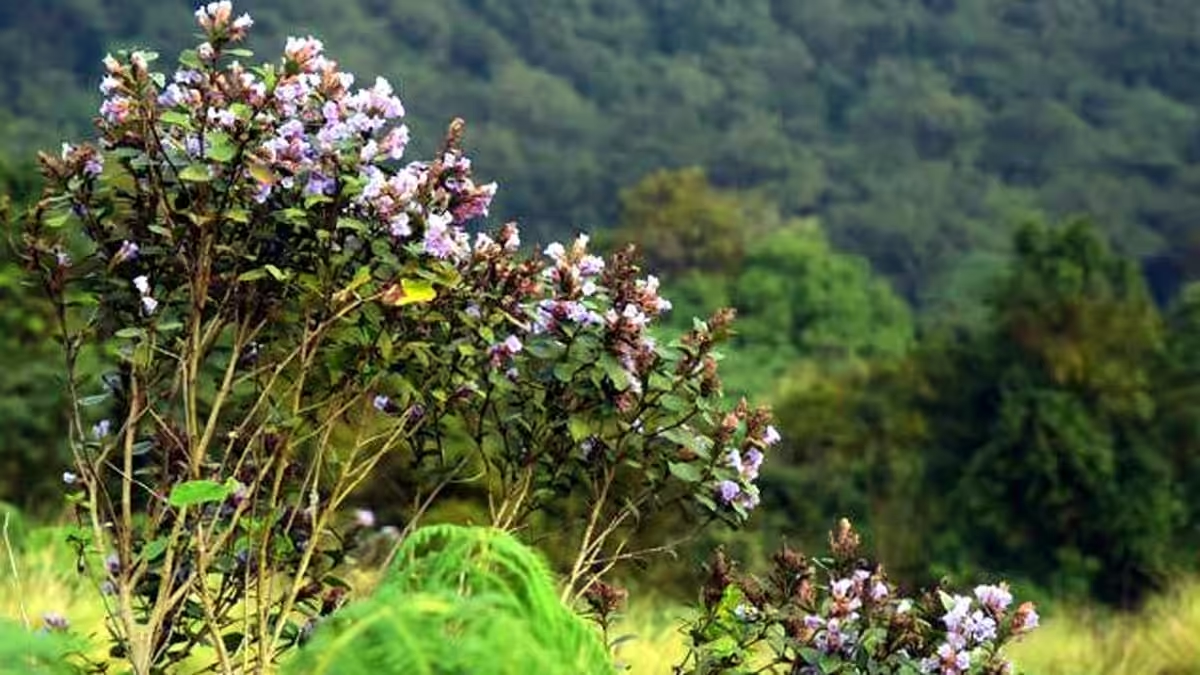
image 38

Neelakurinji (Strobilanthes kunthiana), the purplish flowering shrub, which blooms once in 12 years, has been included on the IUCN (International Union for Conservation of Nature) official Red List of threatened species. 

Tamil Nadu’s ‘Paliyan’ tribe used the Neelakurinji flowers to calculate age.

Indian Wolf

Open article →Download PDF

image 39 1

image 39

Context:

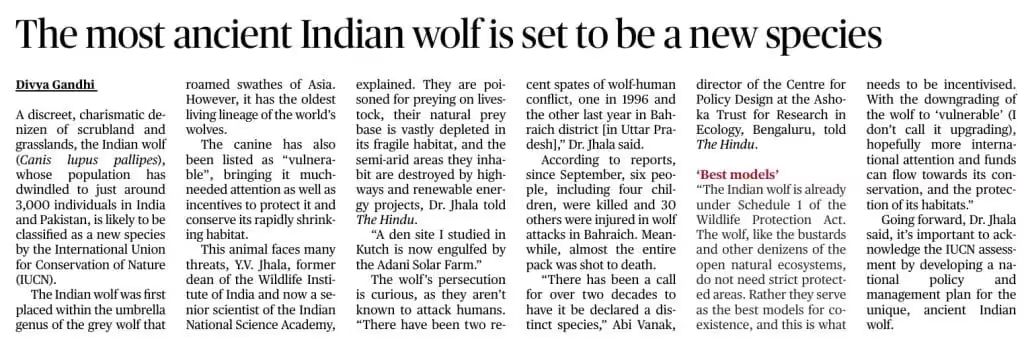
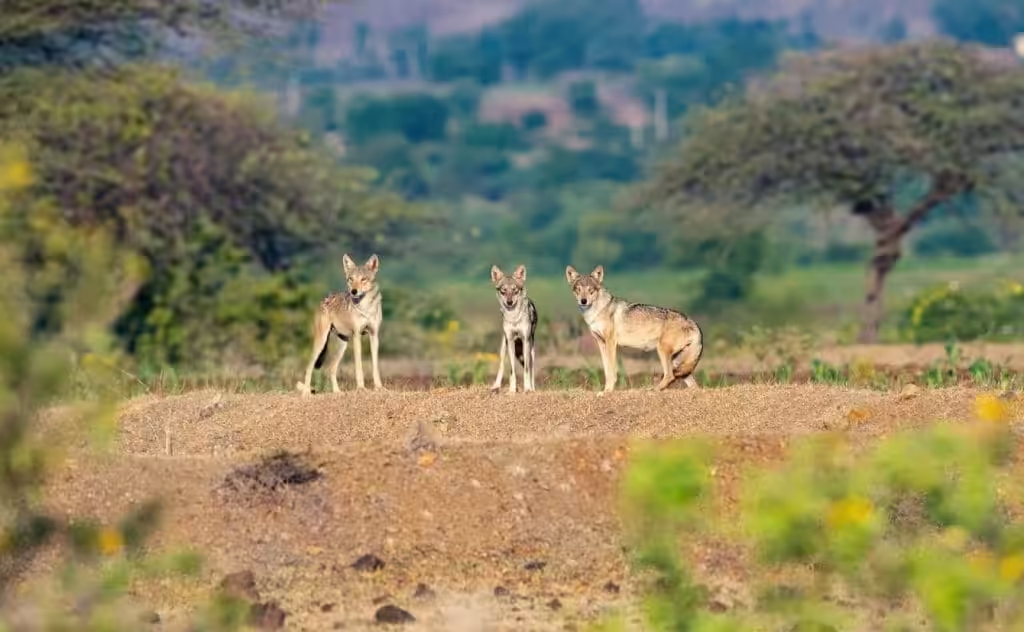
The Indian wolf (Canis lupus pallipes), a species found in India and Pakistan, is likely to be classified as a new distinct species by the International Union for Conservation of Nature (IUCN).

Its population is critically low — only about 3,000 individuals remain — and it has been listed as “Vulnerable” under the IUCN Red List.

UPSC Relevance:

Species in news(Environment)

UPSC PYQ:

Consider the following statements: 

  1. Lions do not have a particular breeding season.
  2. Unlike most other big cats, cheetahs do not roar.
  3. Unlike male lions, male leopards do not proclaim their territory by scent marking.

Which of the statements given above are correct? [UPSC Civil Services Exam – 2024 Prelims]

a) 1 and 2 only

b) 2 and 3 only

c) 1 and 3 only

d) 1, 2 and 3

Indian Wolf:

image 39 2

AttributeDetails
Scientific NameCanis lupus pallipes
Common NameIndian Wolf / Peninsular Wolf
HabitatScrublands and semi-arid grasslands of India and Pakistan
Current DistributionCentral and Western India — Gujarat, Rajasthan, Maharashtra, Madhya Pradesh, Uttar Pradesh
Population Estimate~3,000 individuals
Taxonomic StatusPreviously a subspecies of Grey Wolf (Canis lupus); now considered a distinct lineage — the oldest living lineage of the world’s wolves.

Threats:

  • Semi-arid grasslands and scrublands are being destroyed by renewable energy projects, highways, and agriculture. Example: Adani Solar Farm engulfing wolf den sites in Kutch.
  • Wolves are often poisoned or shot for preying on livestock. Recent cases in Bahraich (U.P.) led to retaliatory killings.
  • Overgrazing and land degradation reduce small herbivore populations (blackbuck, chinkara).
  • The species inhabits non-forest ecosystems, which receive less conservation priority compared to forests and tigers.

IUCN Reassessment and Its Importance:

  • The downgrading to “Vulnerable” (from “Least Concern”) may not be negative — it helps draw international attention and funding.
  • The IUCN species reclassification can catalyze:
  • Better habitat management in semi-arid regions.
  • National policy formulation for open ecosystems.
  • Enhanced monitoring and research on species distribution and behavior.