Why in News?
In late December 2025 the Government of India launched the Market Access Support (MAS) intervention, the operating arm of the umbrella Export Promotion Mission (EPM) that the Union Cabinet had cleared on 12 November 2025. The Ministry of Commerce & Industry confirmed via PIB that MAS sits inside the EPM’s NIRYAT DISHA sub-scheme and is built to push MSMEs, first-time exporters and priority-sector firms into new overseas markets.
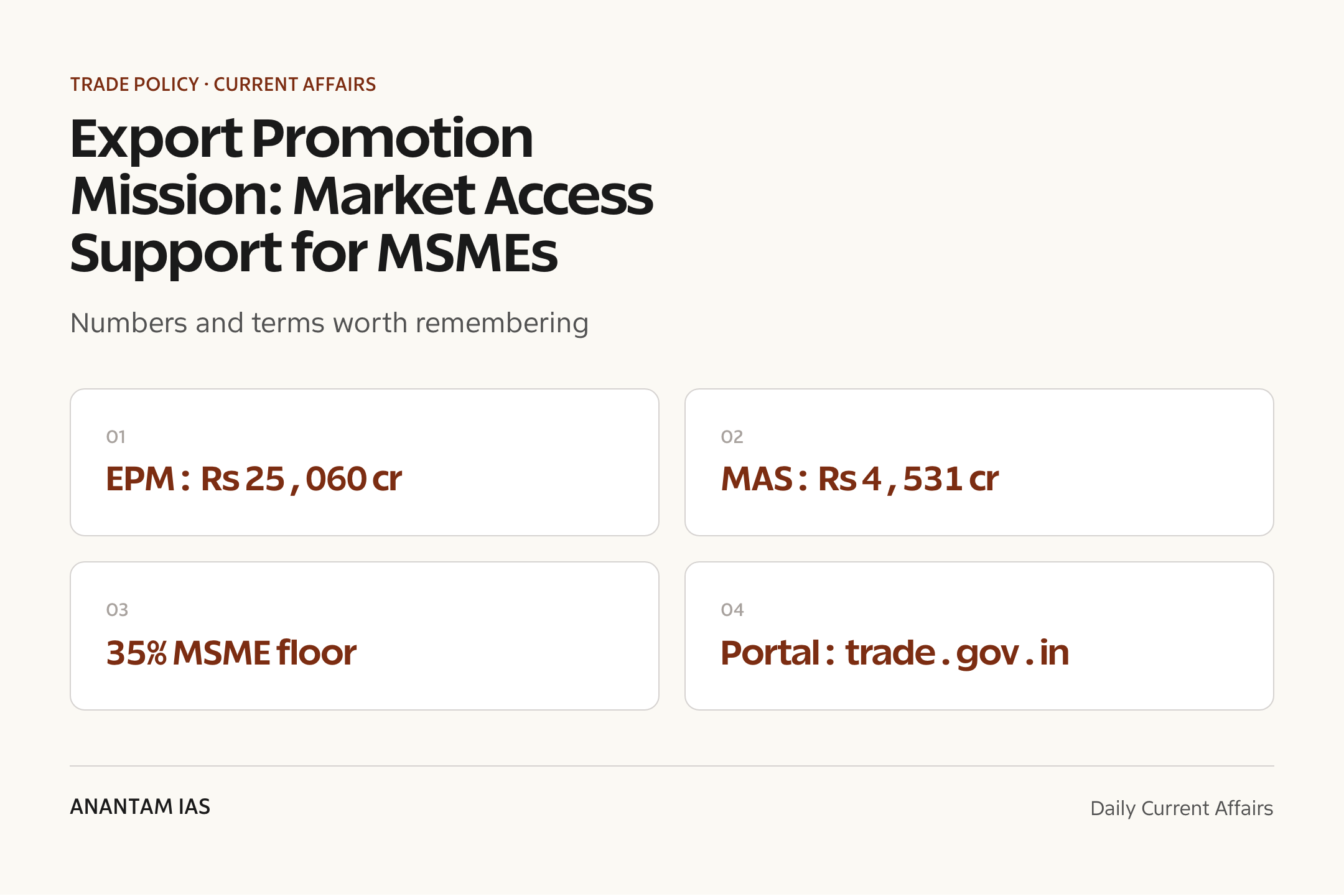
MAS carries a dedicated outlay of Rs 4,531 crore across 2025-26 to 2030-31, inside the EPM’s larger Rs 25,060 crore envelope, and replaces a patchwork of older export-support schemes with a single outcome-based, digitally driven framework.
- EPM approved by the Union Cabinet on 12 November 2025 with a total outlay of Rs 25,060 crore.
- MAS allocation of Rs 4,531 crore spread over six years, FY2025-26 to FY2030-31.
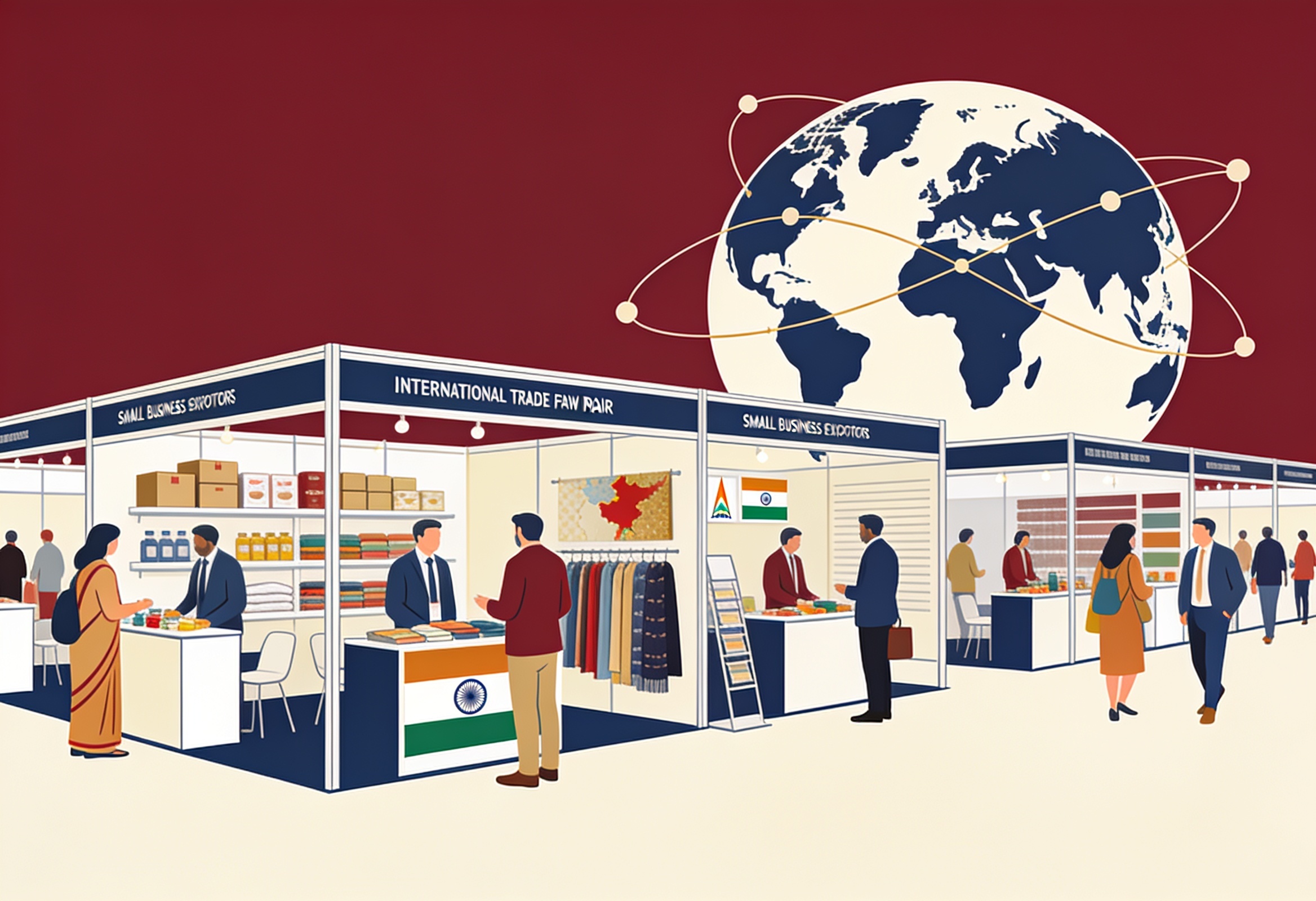
- Funds support Buyer-Seller Meets, international trade fairs and exhibitions, Mega Reverse Buyer-Seller Meets in India, and trade delegations.
- Minimum 35% MSME participation mandated in every supported event.
- Small exporters with turnover up to Rs 75 lakh get partial airfare support to attend events.
- End-to-end approvals and fund release routed through the trade.gov.in portal.
The development matters in the context of:
- India’s export-promotion architecture had grown fragmented across legacy schemes like the Market Access Initiative (MAI); EPM consolidates them under one mission.
- MAS lands amid pressure on Indian exporters from higher US tariffs and the need to diversify away from a few crowded destination markets.
- MSMEs drive a large share of India’s labour-intensive exports but face the steepest cost barriers to entering global value chains.
UPSC Relevance
Prelims Relevance
- Export Promotion Mission (EPM) — umbrella scheme, outlay Rs 25,060 crore.
- Two components: Niryat Protsahan (Rs 10,401 crore) and Niryat Disha (Rs 14,659 crore).
- Market Access Support (MAS) sits under the NIRYAT DISHA sub-scheme; outlay Rs 4,531 crore.
- Nodal ministry: Ministry of Commerce & Industry (Department of Commerce).
- Jointly implemented with the Ministry of MSME and Ministry of Finance.
- Delivery partners: Indian Missions abroad, Export Promotion Councils (EPCs), Commodity Boards.
- Minimum delegation size benchmarked at 50 participants; 35% MSME floor.
- Implementation portal: trade.gov.in.
- Predecessor: the Market Access Initiative (MAI) scheme.
- Approved by the Union Cabinet on 12 November 2025.
Mains Relevance
GS Paper 3
- Government schemes for export promotion and their role in raising India’s export competitiveness.
- MSME growth, integration into global value chains, and trade diversification as economic strategy.
- Outcome-based, digitally monitored public spending versus fragmented legacy subsidy schemes.
GS Paper 2
- Inter-ministerial coordination (Commerce, MSME, Finance) and Centre-EPC-Mission delivery design.
Essay
- Trade as a pathway to inclusive growth: can policy carry the small exporter into world markets?
Background and Context
What the Export Promotion Mission is
EPM is the umbrella under which MAS operates, conceived to unify a scattered export-support landscape.
- Approved by the Union Cabinet on 12 November 2025 with a total outlay of Rs 25,060 crore for FY2025-26 to FY2030-31.
- Built around 11 components spanning credit, insurance, market access and exporter facilitation.
- Two pillars: Niryat Protsahan (Rs 10,401 crore) for credit and financial support, and Niryat Disha (Rs 14,659 crore) for market access and compliance.
- Jointly run by the Department of Commerce, Ministry of MSME and Ministry of Finance.
- Stated aim: lift the competitiveness of Indian exporters, especially MSMEs, and diversify the basket of destination markets.
How Market Access Support works
MAS is the on-the-ground market-entry instrument inside NIRYAT DISHA, funding the events where buyers and Indian sellers meet.
- Dedicated outlay of Rs 4,531 crore over 2025-26 to 2030-31, with funds released event by event.
- Supports Buyer-Seller Meets (BSMs), participation in international trade fairs and exhibitions, and trade delegations to priority and emerging markets.
- Funds Mega Reverse Buyer-Seller Meets (RBSMs) that bring overseas buyers into India.
- A rolling three-to-five-year calendar of major events is approved in advance so exporters can plan ahead.
- Event-level cost-sharing ratios rationalised, with preferential support steered to priority sectors and markets.
Tilting the playing field toward MSMEs
The design embeds hard rules so small and first-time exporters are not crowded out by large firms.
- A minimum of 35% MSME participation is mandated in every supported event.
- Small exporters with turnover up to Rs 75 lakh in the previous year receive partial airfare support.
- Special prioritisation for new geographies and smaller markets to push diversification.
- Delegation sizes benchmarked at a minimum of 50 participants, with flexibility for strategic markets.
- A coming component for proofs-of-concept and product demonstrations targets technology-intensive and sunrise sectors.
Digital, outcome-based delivery
MAS is built to be measured, not just funded, marking a shift from input subsidies to tracked outcomes.
- All listing, approvals, onboarding, fund release and monitoring run through the trade.gov.in portal.
- Mandatory online feedback after each event captures buyer quality, leads generated and market relevance.
- Guidelines are to be progressively refined using implementation feedback.
- Phased rollout of lead-tracking and market-intelligence tools to strengthen outcome measurement.
- Consolidates fragmented legacy support, including the older Market Access Initiative (MAI) scheme.
Why it matters now
The launch responds to a tougher external trade climate and a long-standing structural gap in export reach.
- Indian exporters face headwinds from higher US tariffs and concentrated dependence on a few markets.
- Diversifying into emerging markets reduces exposure to any single trading partner’s policy swings.
- MSMEs supply much of India’s labour-intensive export base but lack the cash to fund overseas exposure.
- Predictable, calendared support lets firms build repeat buyer relationships rather than one-off deals.
- Aligns with India’s broader push for deeper integration into global value chains.
Way Forward
Make the diversification real
- Direct MAS funding measurably toward new geographies, not the same saturated fairs, and report destination spread.
- Tie continued support to verified buyer leads and orders, using the mandatory feedback data.
Lower the entry barrier further
- Ensure the 35% MSME floor and Rs 75 lakh airfare slab actually reach first-time exporters, not just repeat participants.
- Pair event support with handholding on quality standards, certification and compliance so leads convert to exports.
Keep the architecture genuinely consolidated: avoid letting MAS sit alongside revived legacy schemes, and publish outcome dashboards so the outcome-based promise is auditable.
Conclusion
The Market Access Support intervention turns the Export Promotion Mission from an approved outlay into a working instrument, with Rs 4,531 crore aimed squarely at getting Indian MSMEs and first-time exporters in front of overseas buyers.
Its real test is execution: whether the digital portal, the MSME floor and the feedback loops deliver diversified, repeatable export relationships rather than another cycle of subsidised but scattered fair participation.
UPSC Practice Questions
Prelims MCQ 1
With reference to the Export Promotion Mission (EPM), consider the following statements:
- It was approved by the Union Cabinet with a total outlay of Rs 25,060 crore.
- Its two components are Niryat Protsahan and Niryat Disha.
- The Market Access Support intervention is implemented under the Niryat Protsahan component.
How many of the above statements are correct?
(a) Only one (b) Only two (c) All three (d) None
Answer: (b) Only two
Explanation:
Statements 1 and 2 are correct. Statement 3 is wrong — Market Access Support sits under the NIRYAT DISHA sub-scheme, not Niryat Protsahan.
Prelims MCQ 2
Which ministry is the nodal authority for the Market Access Support (MAS) intervention?
(a) Ministry of Finance (b) Ministry of Commerce & Industry (c) Ministry of External Affairs (d) Ministry of Micro, Small and Medium Enterprises
Answer: (b) Ministry of Commerce & Industry
Explanation:
The Department of Commerce under the Ministry of Commerce & Industry anchors MAS, jointly with the Ministry of MSME and the Ministry of Finance.
UPSC Mains Questions
- The Export Promotion Mission seeks to replace fragmented export-support schemes with a single outcome-based framework. Discuss how its Market Access Support intervention is designed to raise the competitiveness of MSMEs and first-time exporters.
- Diversifying export markets is now as important as expanding export volume. Examine the role of targeted, digitally monitored market-access support in helping India reduce its dependence on a few trading partners.
Sources: PIB, Ministry of Commerce & Industry and Business Standard.
Frequently Asked Questions
What is the Market Access Support (MAS) intervention?
MAS is a government scheme launched in December 2025 under the Export Promotion Mission’s NIRYAT DISHA sub-scheme. It gives Indian exporters, especially MSMEs and first-time exporters, structured financial and institutional support to reach overseas markets through trade fairs, buyer-seller meets and trade delegations.
How much money is allocated to MAS?
MAS has a dedicated outlay of Rs 4,531 crore spread over the six years from FY2025-26 to FY2030-31. This sits inside the larger Export Promotion Mission envelope of Rs 25,060 crore approved by the Union Cabinet on 12 November 2025.
What is the Export Promotion Mission?
The Export Promotion Mission (EPM) is an umbrella scheme with a Rs 25,060 crore outlay running from FY2025-26 to FY2030-31. It has two components, Niryat Protsahan (Rs 10,401 crore) and Niryat Disha (Rs 14,659 crore), and is jointly run by the Departments of Commerce, MSME and Finance.
How does MAS specifically help MSMEs?
MAS mandates a minimum 35% MSME participation in every supported event and gives partial airfare support to small exporters with turnover up to Rs 75 lakh. It also prioritises new and smaller markets, helping first-time exporters break into global value chains.
What activities does MAS fund?
It funds Buyer-Seller Meets, participation in international trade fairs and exhibitions, Mega Reverse Buyer-Seller Meets hosted in India, and trade delegations to priority and emerging markets, all planned through a rolling three-to-five-year calendar.
What makes MAS different from earlier export schemes?
MAS is outcome-based and fully digital. Listing, approvals, fund release and monitoring run through the trade.gov.in portal, and mandatory feedback after each event tracks buyer quality and leads, so support is measured and refined rather than handed out as flat subsidies.