Opens in a new tab
Join Anantam IAS Channel on Telegram

Daily Digest · Wednesday

21 January 2026 Current Affairs for UPSC

2 current affairs published on Wednesday, 21 January 2026

21 January 2026 Current Affairs for UPSC — every Why-in-News article AnantamIAS published on Wednesday, 21 January 2026, broken down with Why in News?, the exact GS paper it feeds, sub-topic mapping, MCQ-ready facts and a UPSC-style practice question. 2 articles in total, covering Polity, Economy, Environment, S&T, IR, Geography, History, Society and Internal Security — the same Why-in-News + GS-paper-mapping + practice-question format the Compass uses across every daily digest on the site.

Daily current affairs for UPSC is where new material enters your prep stream. Read this 21 January 2026 digest end-to-end in 25–35 minutes, attempt the practice question at the foot of each article (it's MCQ for some, 10/15-marker for others), then bookmark the entries that fall inside your active revision window. Everything stays cross-linked: tap any subject pill to jump to that subject's hub, or use the table of contents above to skip straight to a specific story.

Use this page three ways. Read sequentially for a one-sitting scan of everything that mattered on 21 January 2026. Download the 21 January 2026 PDF below for offline study or print revision. Or use the January 2026 Current Affairs compilation to see this day in the month's full context. For the previous day's reading, see 20 January 2026 Current Affairs; the next day's is 22 January 2026 Current Affairs.

Why we publish daily current affairs separately from the monthly compilation: daily is learning, monthly is revision. Use the daily page to add fresh material to your notes the day it breaks; come back to the January 2026 compilation 60 days before Prelims when the noise has settled and only the lasting takeaway is worth re-reading.

Atal Pension Yojana Extension to 2030-31: Social Security for Informal Workers

Open article →Download PDF

The Union Cabinet approved continuation of Atal Pension Yojana and extended central funding support for promotional, development and gap-funding activities until 2030-31. The decision keeps India’s flagship pension scheme for informal workers on the policy table at a time when old-age security is becoming a sharper governance question.

For UPSC, APY is useful because it sits at the intersection of welfare design, financial inclusion, demographic transition and fiscal risk. It is not just a scheme to memorise. It is a test case for how India can build a pension floor for workers who do not have formal employer-backed retirement savings.

This article reads the January 2026 APY extension through a GS-II welfare and GS-III economy lens, with attention to design strengths, coverage gaps and the hard question of sustainable old-age income support.

Quick Facts
Atal Pension Yojana Extension to 2030-31: Social Security for Informal Workers quick facts
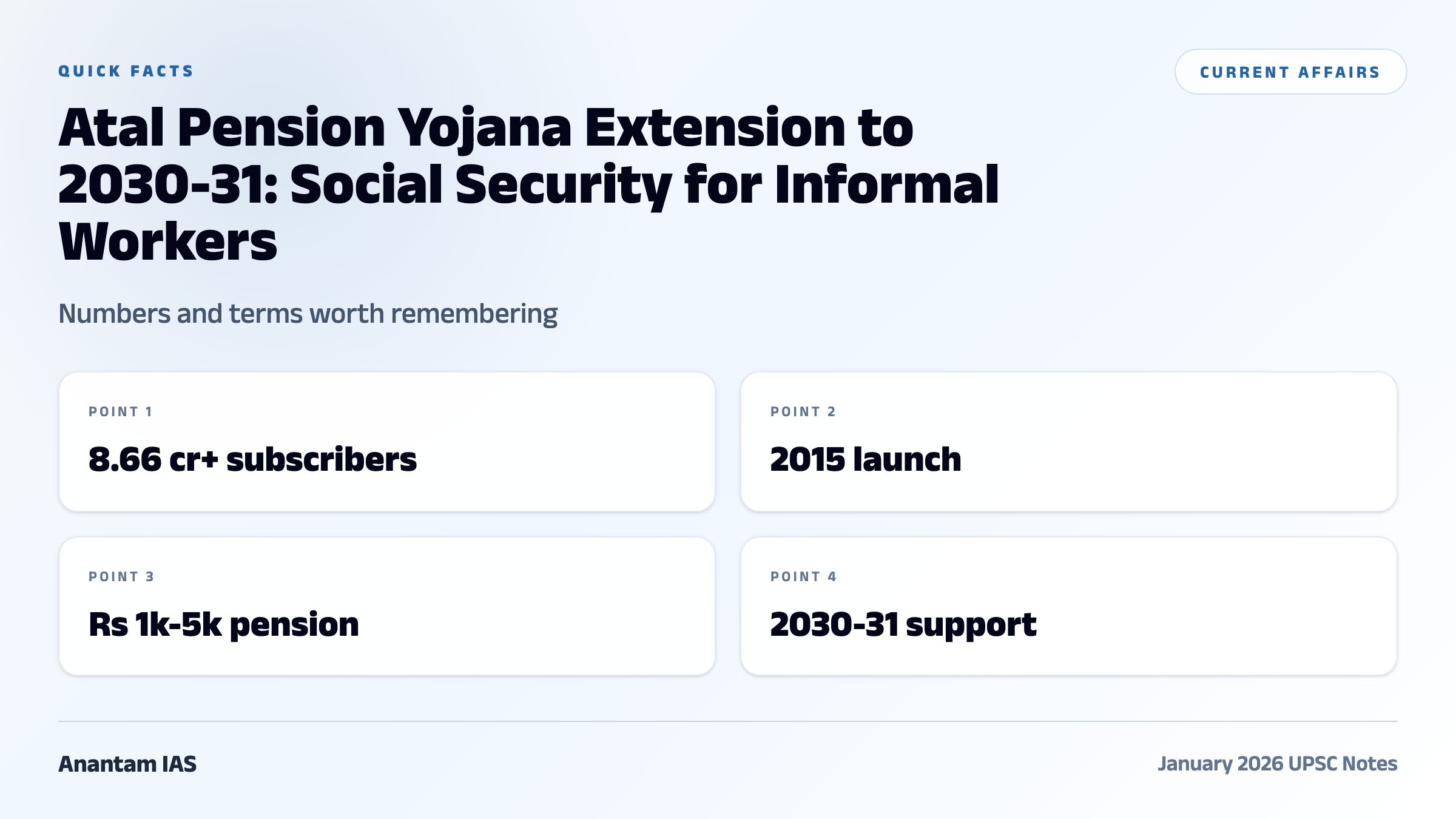
  • Cabinet approval came in January 2026 for continuation and funding support until 2030-31.
  • APY was launched on 9 May 2015 to provide old-age income security, especially to unorganised-sector workers.
  • Subscribers receive a guaranteed monthly pension of Rs 1,000 to Rs 5,000 after the age of 60, depending on contribution.
  • Official data cited over 8.66 crore subscribers as of 19 January 2026.
  • The scheme is administered through banks and post offices with PFRDA oversight.
  • It is part of the Jan Suraksha architecture alongside PMJJBY and PMSBY.
  • Official source: Prime Minister's Office.

What Just Happened

The Cabinet decision continued the Atal Pension Yojana framework and approved support for promotion, development activities and gap funding until 2030-31. The government framed the move as part of its broader effort to deepen financial security among the unorganised workforce.

The timing matters because India is still a young country, but the absolute number of elderly citizens is rising fast. A pension architecture built only around formal employment will miss domestic workers, agricultural labourers, street vendors, gig workers, small traders and other self-employed workers.

APY’s design gives a defined benefit at retirement while requiring regular contributions during working age. The state does not replace household savings. It nudges and supports them through a regulated, low-ticket pension product.

Background and Historical Context

India’s pension system has long been fragmented. Government employees were covered by defined benefits earlier and then by the National Pension System. Formal private-sector workers may access EPFO. The large informal workforce, however, historically relied on family support, land, gold, small savings and community networks.

The National Pension System Lite and Swavalamban attempted to address this gap but could not produce mass traction. APY simplified the proposition by offering a guaranteed pension slab and using the bank-account infrastructure created by Jan Dhan.

The scheme reflects a larger welfare shift: from one-time subsidies to lifecycle social protection. Health insurance, accident insurance, life insurance and pensions are increasingly seen as part of a minimum protection floor.

Key Features of Atal Pension Yojana
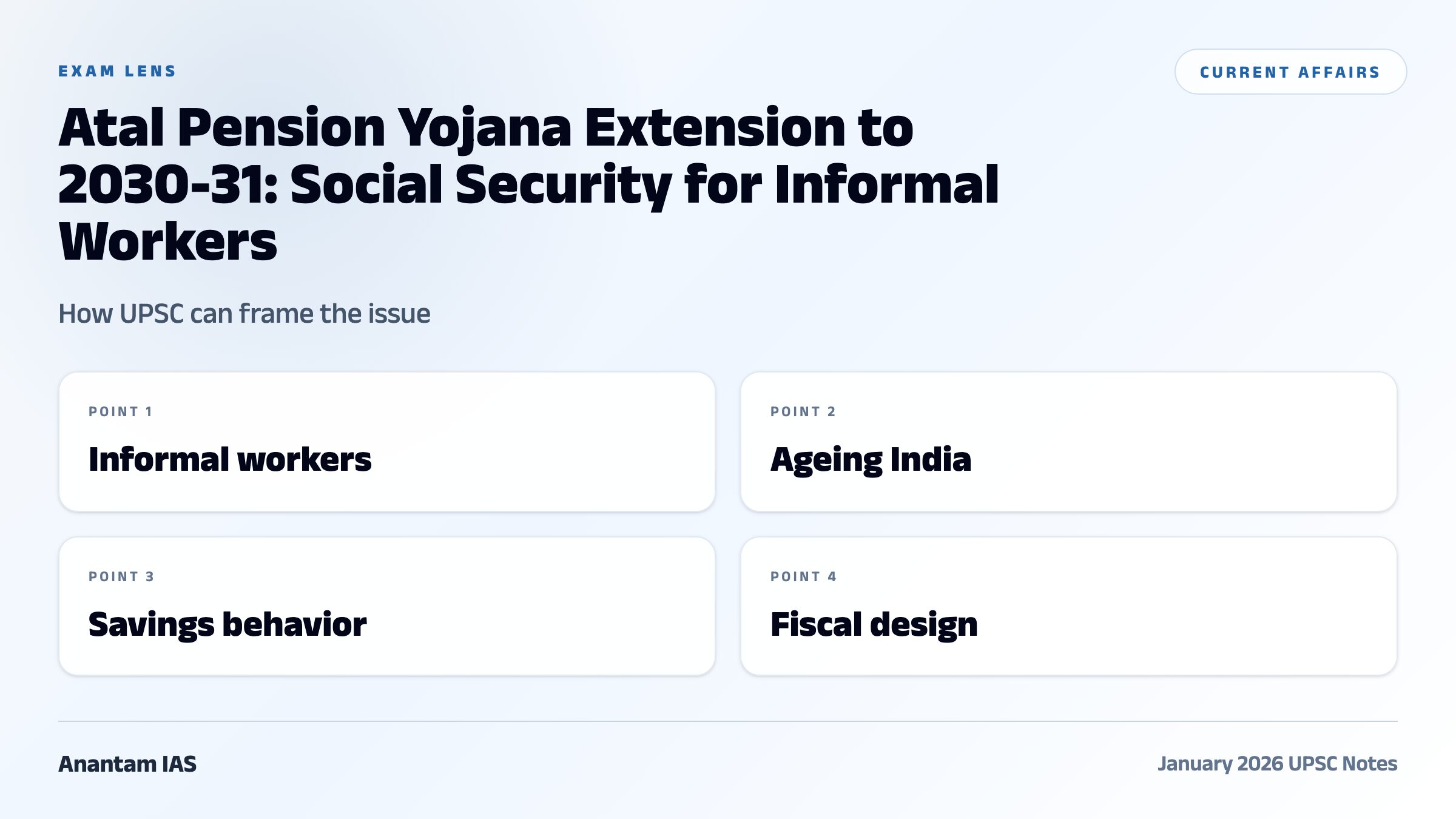
Atal Pension Yojana Extension to 2030-31: Social Security for Informal Workers exam framework

The core policy architecture can be read through these features.

  • Eligibility: Indian citizens in the eligible entry-age band with a savings bank or post-office account can subscribe, subject to scheme rules.
  • Benefit structure: Pension slabs range from Rs 1,000 to Rs 5,000 per month after 60 years of age.
  • Contribution logic: Younger entry lowers the monthly contribution burden and rewards early participation.
  • Institutional anchor: Banks, post offices and PFRDA form the delivery and regulatory backbone.
  • Target group: The main policy focus is workers outside formal pension coverage.
  • Continuation support: The 2026 decision funds promotion and development so that enrolment does not stall after the first decade.

Why It Matters

This is a high-yield UPSC topic because it joins current news with durable syllabus themes.

  • It gives GS-II material on welfare delivery and social justice for informal workers.
  • It gives GS-III material on household savings, financial inclusion and fiscal sustainability.
  • It connects to ageing, demographic dividend and the future burden of non-contributory welfare.
  • It lets aspirants compare contributory and tax-funded social protection models.

Detailed Analysis: Social Security Lens

The design is administratively elegant. APY rides on bank accounts and auto-debit, which keeps transaction costs low. The guaranteed pension also makes the product easier to explain than market-linked retirement savings.

The adequacy question is real. A Rs 1,000-5,000 monthly pension is not enough for urban old-age expenses. APY should be treated as a floor, not a complete retirement solution.

Continuity matters more than enrolment. A pension scheme succeeds only when contributions remain active for decades. Dormancy, irregular income and migration can weaken APY unless banks, post offices and local institutions keep workers engaged.

Comparative Perspective
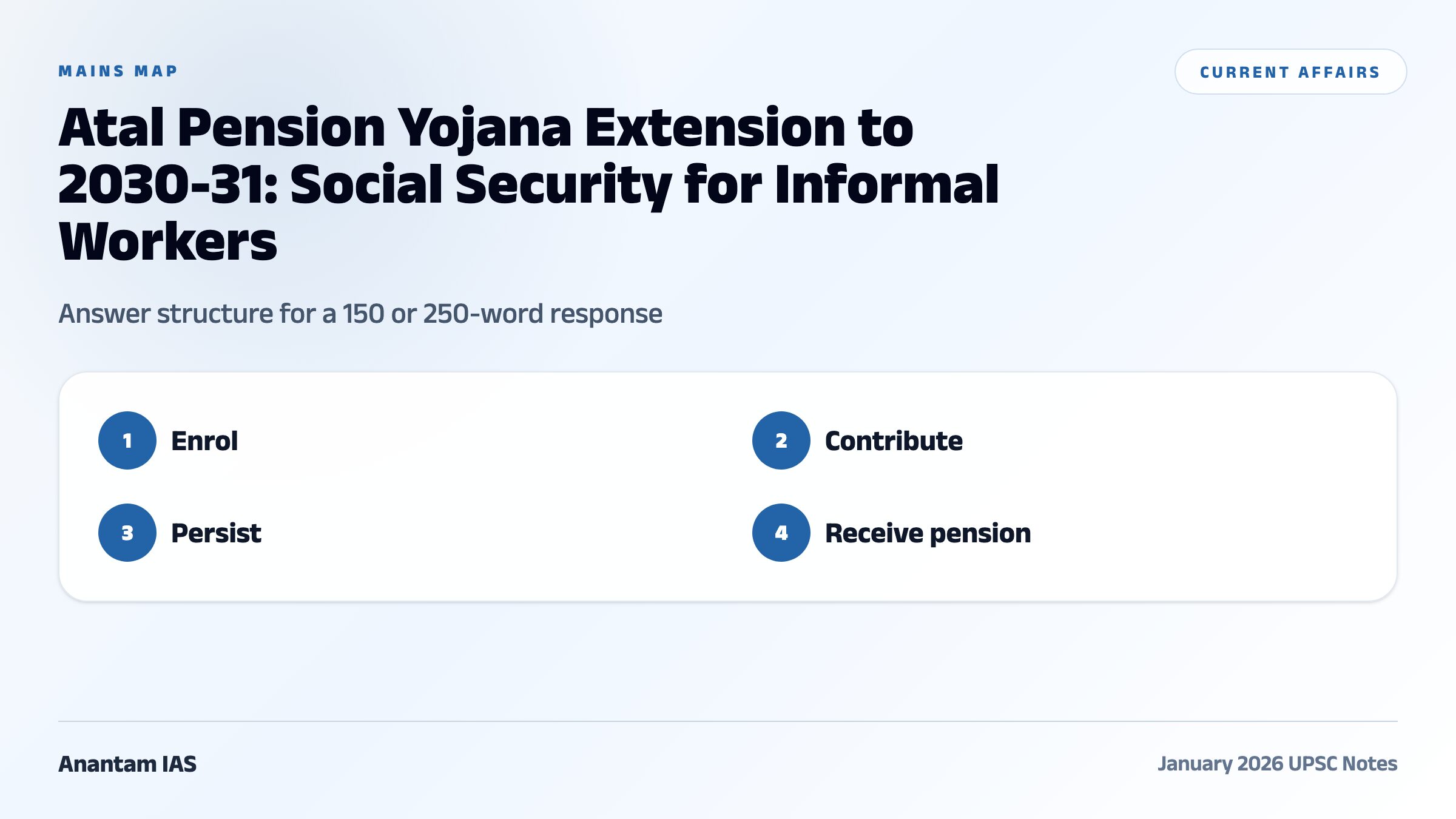
Atal Pension Yojana Extension to 2030-31: Social Security for Informal Workers comparative and mains map

A comparison helps prevent the answer from becoming a one-dimensional news summary.

  • NPS: market-linked, retirement-oriented and suitable for formal or higher-income contributors.
  • EPFO: payroll-based and linked to formal employment.
  • PM-SYM: designed for unorganised workers but with limited uptake compared with APY.
  • APY: simpler, bank-led and built around guaranteed pension slabs.

Challenges

The policy or institutional promise runs into recurring constraints.

  • Pension adequacy is low when compared with expected old-age living costs.
  • Irregular incomes make auto-debit failures common among informal workers.
  • Women workers, migrant workers and seasonal workers need more targeted enrolment support.
  • Financial literacy remains a binding constraint in understanding long-term contribution products.
  • A guaranteed pension creates long-term fiscal exposure if assumptions on returns and longevity change.

Prelims Pointers

  • APY was launched in 2015.
  • The scheme is regulated by PFRDA.
  • It provides guaranteed pension slabs after the subscriber reaches 60 years.
  • It is a contributory pension scheme, not a pure tax-funded pension.
  • Banks and post offices are important enrolment channels.
  • APY is part of India’s wider financial-inclusion architecture.

Mains Questions

  1. Atal Pension Yojana reflects a shift from welfare as relief to welfare as lifecycle risk management. Discuss. (GS Paper II, 250 words)
  2. Evaluate the role of contributory pension schemes in providing old-age security to India’s informal workforce. (GS Paper III, 250 words)
  3. What are the design limitations of APY? Suggest reforms to improve adequacy, continuity and inclusion. (GS Paper II, 150 words)
  4. Financial inclusion must move from account ownership to meaningful financial security. Examine with reference to APY. (GS Paper III, 250 words)

Way Forward

APY needs enrolment drives that are more worker-specific. Street vendors, gig workers, women self-help group members and migrant workers need different communication and contribution-support models.

Contribution flexibility would improve persistence. Informal workers often earn in bursts, so monthly auto-debit alone may not match their income pattern.

The larger goal should be a layered old-age security system: APY as a pension floor, health insurance for medical shocks, and targeted non-contributory assistance for the poorest elderly.

The examiner is unlikely to reward a bare fact dump here. The better answer connects the January 2026 event to institutional design, implementation capacity and India’s long-term development priorities.

Frequently Asked Questions

What did the Cabinet approve in January 2026?

It approved continuation of Atal Pension Yojana and extended funding support for promotional, development and gap-funding activities until 2030-31.

Who is APY mainly designed for?

It is mainly designed for workers outside formal pension coverage, especially unorganised-sector and self-employed workers.

What pension does APY provide?

Depending on contribution and entry age, APY provides a guaranteed monthly pension of Rs 1,000 to Rs 5,000 after the subscriber turns 60.

Which regulator is associated with APY?

The Pension Fund Regulatory and Development Authority is the key regulator for pension architecture, including APY.

Why is APY important for UPSC?

It links financial inclusion with social justice, ageing, informal employment and fiscal sustainability.

What is the main criticism of APY?

The guaranteed pension slabs are useful as a floor, but they may be inadequate for future old-age living costs.
Inclusive Education Summit 2026: CWSN, Accessibility and NEP 2020

Open article →Download PDF

The Ministry of Education’s Inclusive Education Summit in January 2026 highlighted the schooling needs of children with disabilities and other disadvantaged learners. The event placed accessibility, assistive technology and teacher capacity in the spotlight.

For UPSC, inclusive education is not charity. It is a constitutional and developmental obligation linked to equality, dignity, human capital and the right to education.

This article explains the summit through the lens of CWSN inclusion, NEP 2020, RPwD Act and school-level implementation gaps.

Quick Facts

Inclusive Education Summit 2026: CWSN, Accessibility and NEP 2020 quick facts
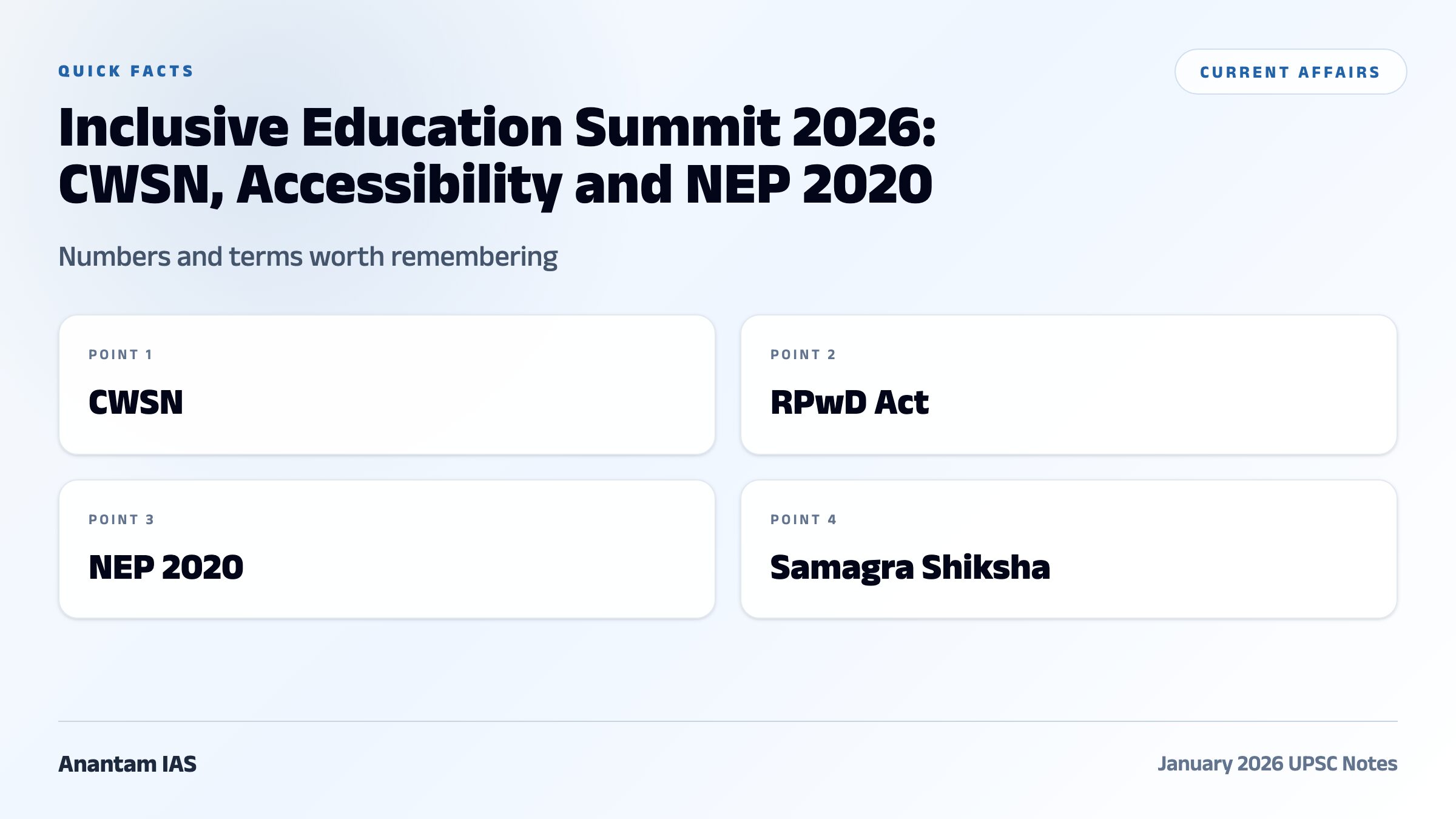
  • The summit was held in January 2026 by the Ministry of Education.
  • CWSN means Children With Special Needs.
  • Inclusive education is linked to NEP 2020 and the Rights of Persons with Disabilities Act, 2016.
  • Accessibility includes infrastructure, learning material, assistive devices and teacher support.
  • Samagra Shiksha supports inclusive education interventions.
  • Official source: PIB Ministry of Education release dated 21 January 2026.
  • Official source: PIB, Ministry of Education.

What Just Happened

The summit brought policy attention to inclusive education and the practical barriers faced by children with disabilities.

The event highlighted the need for accessible schools, trained teachers, assistive technology and social acceptance.

For aspirants, this is a strong GS-II topic because it connects rights-based law with everyday delivery in classrooms.

Background and Historical Context

India’s disability-rights framework includes the RPwD Act, 2016, which expanded recognised disabilities and strengthened rights-based language.

The Right to Education Act and Samagra Shiksha provide school-level frameworks, while NEP 2020 emphasises equitable and inclusive education.

The challenge is implementation. A child may be enrolled but excluded if classrooms, transport, toilets, books, pedagogy and attitudes are inaccessible.

Key Features of Inclusive Education

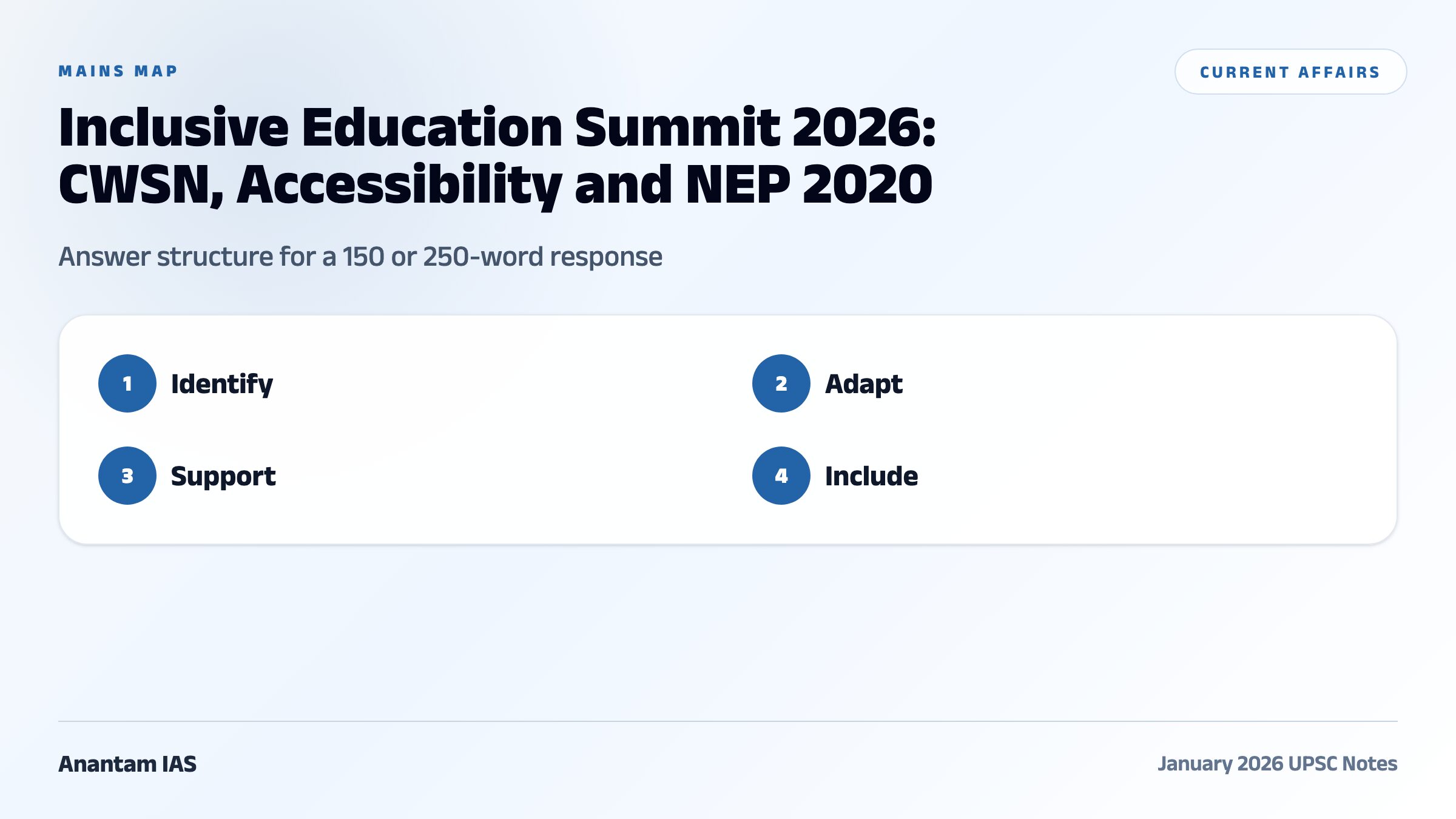
Inclusive Education Summit 2026: CWSN, Accessibility and NEP 2020 exam framework

The core policy architecture can be read through these features.

  • Accessibility: ramps, toilets, transport, digital content and classroom design matter.
  • Assistive technology: devices and software can support learning.
  • Teacher capacity: teachers need training in inclusive pedagogy.
  • Legal anchor: RPwD Act and RTE create rights-based obligations.
  • Social inclusion: stigma and low expectations must be addressed.
  • Data need: states need accurate CWSN identification and tracking.

Why It Matters

This is a high-yield UPSC topic because it joins current news with durable syllabus themes.

  • It connects a January 2026 event with durable UPSC syllabus themes.
  • It gives usable facts for Prelims and analytical hooks for Mains.
  • It helps students move from news recall to policy reasoning.
  • It can be linked with static concepts in polity, economy, governance, science, environment or society.

Detailed Analysis: Inclusive Education Lens

Enrolment is not inclusion. A child sitting in school but unable to access learning material is still excluded.

Universal design is better than afterthought accommodation. Schools should be built for diverse learners from the start.

Teacher training is the decisive variable. Inclusive education fails when responsibility is pushed only to special educators.

Comparative Perspective

Inclusive Education Summit 2026: CWSN, Accessibility and NEP 2020 comparative and mains map

A comparison helps prevent the answer from becoming a one-dimensional news summary.

  • Special schools: separate settings for children with specific disabilities.
  • Inclusive education: mainstream schools adapt to diverse learners.
  • Integrated education: learners enter mainstream settings but support may remain limited.
  • Universal design: designs systems usable by the widest range of learners.

Challenges

The policy or institutional promise runs into recurring constraints.

  • Schools may lack ramps, accessible toilets and transport.
  • Teacher training in inclusive pedagogy is limited.
  • Assistive devices are often delayed or poorly maintained.
  • Disability data can be incomplete.
  • Stigma and low expectations reduce participation.

Prelims Pointers

  • RPwD Act, 2016 expanded recognised disabilities.
  • CWSN means Children With Special Needs.
  • NEP 2020 emphasises equitable and inclusive education.
  • Samagra Shiksha supports inclusive education.
  • Universal Design for Learning is an approach to accessible pedagogy.
  • Reasonable accommodation is a key disability-rights principle.

Mains Questions

  1. Inclusive education requires system redesign, not only special provisions. Discuss. (GS Paper II, 250 words)
  2. How does the RPwD Act strengthen the rights-based approach to education? (GS Paper II, 150 words)
  3. Enrolment without accessibility is not inclusion. Analyse. (GS Paper II, 250 words)
  4. What reforms are needed to make government schools disability-inclusive? (GS Paper II, 250 words)

Way Forward

States should audit school accessibility, train all teachers in inclusive pedagogy and integrate assistive technology procurement with classroom support.

CWSN data should track attendance, learning and transition, not merely enrolment.

For Mains, connect inclusion with dignity, equality, Article 21A, social justice and human capability.

The examiner is unlikely to reward a bare fact dump here. The better answer connects the January 2026 event to institutional design, implementation capacity and India’s long-term development priorities.

Frequently Asked Questions

What is inclusive education?

It means schools adapt so that children with disabilities and diverse needs can learn with others meaningfully.

What does CWSN mean?

Children With Special Needs.

Which law is important?

The Rights of Persons with Disabilities Act, 2016 is central.

How does NEP 2020 connect?

It emphasises equitable and inclusive education.

What is the main implementation gap?

Accessible infrastructure, trained teachers and assistive support remain uneven.

Why is this relevant for UPSC?

It links education, social justice, rights and governance delivery.