Opens in a new tab
Join Anantam IAS Channel on Telegram

Daily Digest · Wednesday

8 October 2025 Current Affairs for UPSC

3 current affairs published on Wednesday, 8 October 2025

8 October 2025 Current Affairs for UPSC — every Why-in-News article AnantamIAS published on Wednesday, 8 October 2025, broken down with Why in News?, the exact GS paper it feeds, sub-topic mapping, MCQ-ready facts and a UPSC-style practice question. 3 articles in total, covering Polity, Economy, Environment, S&T, IR, Geography, History, Society and Internal Security — the same Why-in-News + GS-paper-mapping + practice-question format the Compass uses across every daily digest on the site.

Daily current affairs for UPSC is where new material enters your prep stream. Read this 8 October 2025 digest end-to-end in 25–35 minutes, attempt the practice question at the foot of each article (it's MCQ for some, 10/15-marker for others), then bookmark the entries that fall inside your active revision window. Everything stays cross-linked: tap any subject pill to jump to that subject's hub, or use the table of contents above to skip straight to a specific story.

Use this page three ways. Read sequentially for a one-sitting scan of everything that mattered on 8 October 2025. Download the 8 October 2025 PDF below for offline study or print revision. Or use the October 2025 Current Affairs compilation to see this day in the month's full context. For the previous day's reading, see 7 October 2025 Current Affairs; the next day's is 9 October 2025 Current Affairs.

Why we publish daily current affairs separately from the monthly compilation: daily is learning, monthly is revision. Use the daily page to add fresh material to your notes the day it breaks; come back to the October 2025 compilation 60 days before Prelims when the noise has settled and only the lasting takeaway is worth re-reading.

New START Treaty

Open article →Download PDF

image 14 1

Context:

The USA President has acknowledged the Russian president offer to voluntarily maintain limits for a year on deployed strategic nuclear weapons based on the New START Treaty.

UPSC Relevance:

International organization and important treaties

PYQ:

Q: The “New START” treaty was in the news. What is this treaty? 

A)It is a bilateral strategic nuclear arms reduction treaty between the USA and the Russian Federation 

B)It is a multilateral energy security cooperation treaty among the members of the East Asia Summit 

C)It is a treaty between the Russian Federation and the European Union for the energy security cooperation 

D)It is a multilateral cooperation treaty among the BRICS countries Species richness

What is New START Treaty?

  • New START (Strategic Arms Reduction Treaty) is the last remaining arms reduction pact between the former Cold War rivals and caps to 1,550 the number of nuclear warheads that can be deployed by Russia and United States of America.
  • It entered into force on 5th February, 2011.
  • It continues the bipartisan process of verifiably reducing U.S. and Russian strategic nuclear arsenals by limiting both sides to 700 strategic launchers and 1,550 operational warheads.
  • Its duration is for ten years that is till 2021, but it was extended by five more years till 2026.

What limits did the New START impose on the two countries?

  • 700 deployed intercontinental ballistic missiles (ICBMs), deployed submarine-launched ballistic missiles (SLBMs), and deployed heavy bombers equipped for nuclear armaments.
  • 1,550 nuclear warheads on deployed ICBMs, deployed SLBMs, and deployed heavy bombers equipped for nuclear armaments (each such heavy bomber is counted as one warhead toward this limit).
  • 800 deployed and non-deployed ICBM launchers, SLBM launchers, and heavy bombers equipped for nuclear armaments.

Compliance:

  • Detailed procedures for the implementation and verification of the central limits, and all treaty obligations, are part of the treaty terms.
  • The treaty provides for 18 on-site inspections per year for US and Russian inspection teams. 
  • Type One inspections focus on sites with deployed and non-deployed strategic systems (up to 10 per year), and Type Two inspections focus on sites with only non-deployed strategic systems (up to 8 per year).

What are the various Treaties signed Between USA & Russia?

  • Strategic Arms Limitation Talks-1(SALT):
    • It began in 1969, Under the Interim Agreement, both sides pledged not to construct new Intercontinental Ballistic Missile (ICBM) silos, not to increase the size of existing ICBM silos significantly, and capped the number of Submarine-Launched Ballistic Missile (SLBM) launch tubes and SLBM-carrying submarines.
  • Strategic Arms Reduction Treaty-1 (START):
    • Signed in 1991, the agreement required the destruction of excess delivery vehicles which was verified using an intrusive verification regime that involved on-site inspections, the regular exchange of information (including telemetry), and the use of national technical means (i.e., satellites).
  • Strategic Arms Reduction Treaty-2:
    • Signed in 1993, called for reducing deployed strategic arsenals to 3,000-3,500 warheads and banned the deployment of destabilizing multiple-warhead land-based missiles.
  • Strategic Offensive Reductions Treaty (SORT):
    • Signed in 2004, under which the United States and Russia reduced their strategic arsenals to 1,700-2,200 warheads each.
  • Strategic Arms Reduction Treaty (START):
    • Signed in 2010, a legally binding, verifiable agreement that limits each side to 1,550 strategic nuclear warheads deployed on 700 strategic delivery systems (ICBMs, SLBMs, and heavy bombers) and limits deployed and nondeployed launchers to 800.

Jal Jeevan mission

Open article →Download PDF

image 14 2

Context:

The union government has planned to map all drinking water assets including pipelines created under its Jal Jeevan mission on PM Gati Shakti portal.

UPSC Relevance:

Important government schemes, their features and performance.

PYQ:

Q. Consider the following statements with respect to Jal Jeevan Mission:
1. Objective of the mission is to give functional tap-water to every household in the country by 2024
2. Mission is based up on the principle of source sustainability
3. Jal Jeevan Mission will converge with other Central and State Government Schemes to achieve its objectives of sustainable water supply
Which of the following below given codes are correct?

[A] 1 only

[B] 1 and 2 only

[C] 2 and 3 only

[D] 1, 2 and 3

About Jal Jeevan Mission:

  • Launched on August 15, 2019, Jal Jeevan Mission is a Centrally Sponsored Scheme to provide Functional Household Tap Connections (FHTCs) to all rural households by 2024. 
  • The Scheme has been extended till 2028.
  • Governing Ministry: Ministry of Jal Shakti.
  • Key Target: “Har Ghar Jal”, ensuring 55 litres per capita per day (lpcd) of safe, adequate drinking water to every rural household.
  • The fund-sharing pattern between the Centre and states is:
    • 100% for Union Territories.
    • 90:10 for Himalayan and North-Eastern States,
    • 50:50 for other states.
  • The Mission will converge with other Central and State Government Schemes to achieve its objectives of sustainable water supply management across the country.

Key Features:

  • Emphasises conjunctive use of conserved water; drinking water source augmentation, drinking water supply system, greywater reuse, and local water resource management.
  • Creation of local infrastructure for source sustainability, like rainwater harvesting and groundwater recharge, is undertaken in convergence with other government schemes.
  • Community Involvement: Formation of Pani Samitis (Village Water & Sanitation Committees) and Village Action Plans (VAPs) for decentralised implementation and monitoring.
  • Transparency: Includes a real-time mission dashboard, third-party audits, and public reporting.
  • JJM will also implement source sustainability measures as mandatory elements, such as recharge and reuse through grey water management (used wastewater that has not come into contact with faeces), water conservation, rainwater harvesting, etc.
  • JJM will be based on a community approach to water (Jan Andolan for water — making water everyone’s priority) and will include extensive Information, education, and communication.

Progress and Achievements (As of March 2025):

  • Tap Connections Provided: 14.56 crore rural households have received tap water connections (around 75% coverage).
  • Certified Villages: Over 2.12 lakh villages have been declared “Har Ghar Jal certified”.
  • 100% Coverage: Goa, Haryana, Telangana, Gujarat, Puducherry, Andaman & Nicobar Islands, and Dadra & Nagar Haveli & Daman & Diu.

Jal Jeevan Mission (Urban):

  • Launched in Budget 2021-22 under the Ministry of Housing and Urban Affairs to ensure universal water tap connections in all statutory towns, aligning with SDG-6.
  • Complementary Scheme: Complements Jal Jeevan Mission (Rural).
  • Key Objectives: Focuses on providing tap and sewer connections, rejuvenating water bodies, and promoting a circular water economy.

Central Bank Digital Currency

Open article →Download PDF

image 14 4

image 14 3

Context:

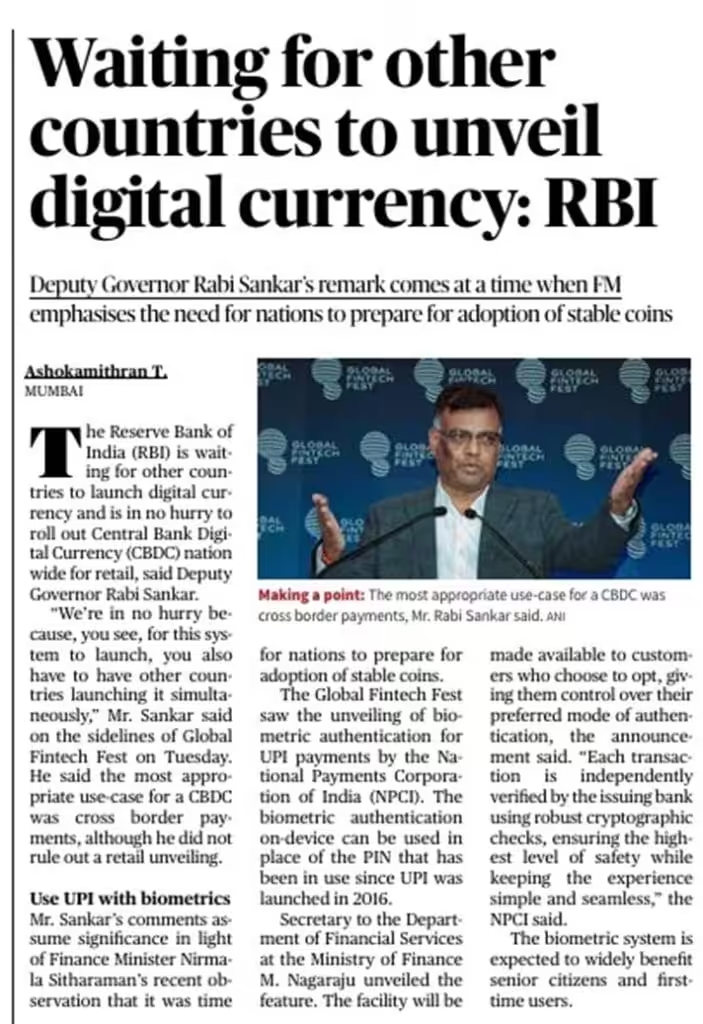
The Reserve Bank of India (RBI) has stated that it is in no hurry to launch the Central Bank Digital Currency (CBDC) for retail use and is waiting for other countries to unveil their own digital currencies.

UPSC Relevance:

Banking sector

UPSC PYQ

Q. With reference to Central Bank digital currencies, consider the following statements : (2023)

  1. It is possible to make payments in a digital currency without using US dollar or SWIFT system.
  2. A digital currency can be distributed with condition programmed into it such as a time-frame for spending it.

Which of the statements given above is/are correct?

(a) 1 only
(b) 2 only
(c) Both 1 and 2
(d) Neither 1 nor 2

What is Digital Rupee?

image 14
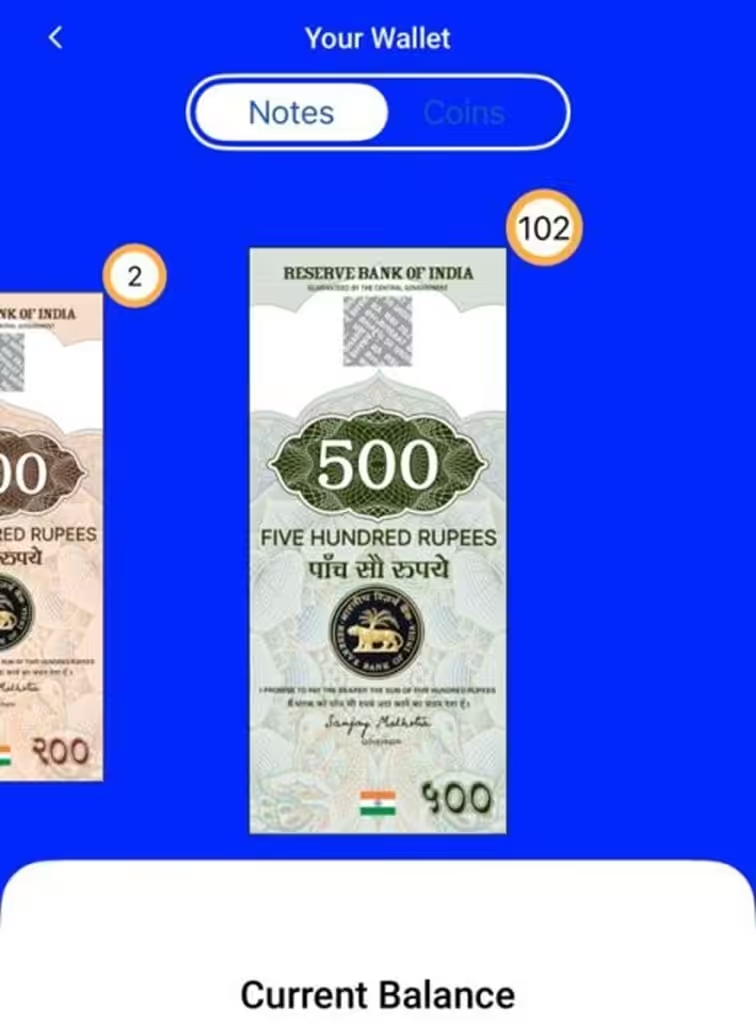
  • Digital Rupee or e₹, is India’s Central Bank Digital Currency (CBDC). It is the digital form of India’s physical currency, the Rupee (₹). 
  •  e₹ is issued by the Reserve Bank of India (RBI) in digital form and offers features similar to physical cash like convenience of use, guarantee of RBI, finality of settlement, etc. e₹ is stored in the user’s digital wallet and can be used to receive / send money, and / or make payment for transactions, just like any physical ₹ note.

How can e₹ be held and used?

  • e₹ can be held and transacted through e₹ wallets offered by banks and non-banks for person-to-person payments or person-to-merchant transactions. 
  • Detailed instructions on using the e₹ wallet can be checked with the banks and non-banks providing the wallet. Payments to merchants can be made by scanning either the CBDC QR code or the UPI QR code available at the respective merchant location.

image 15

The e₹ issuance, distribution, and usage within the retail segment (for members of the public) is live in pilot mode with effect from December 1, 2022. The users and merchants of identified pilot banks and non-banks across the country can use e₹.

  • There is no minimum balance required to open/maintain an e₹ wallet.
  • There are no charges or fees associated with using e₹ or e₹ wallets.

Is there any difference between e₹ and UPI?

  • e₹ is a digital form of ₹ whereas UPI is a means of payment. In addition to being used for payments, e₹ also serves as a ‘store of value’, i.e., e₹ can be withdrawn from one’s bank account and kept separately in the e₹ wallet.

The offline feature of e₹ enables the user to transact in locations with limited or no internet connectivity.

Wholesale CBDC:

Wholesale Central Bank Digital Currency (e₹-W) is designed for use by financial institutions and intermediaries, primarily to streamline interbank settlements and large-value transactions. It operates within a restricted ecosystem and enhances the efficiency, speed, and security of wholesale payment systems by using the functionalities of programming and smart contracts. 

Other countries CBDC:

  • The Bahamas: Launched the “Sand Dollar” in 2020, making it the first country to officially issue a CBDC.
  • Jamaica: Rolled out its CBDC, “Jam-Dex,” in 2022, also recognizing it as legal tender.
  • Nigeria: Introduced the “eNaira” in 2021, the first CBDC in Africa.
  • Eastern Caribbean Currency Union (ECCU): Launched “DCash” in 2021 for its members
  • Brazil: The Central Bank of Brazil is developing “Drex” and aims to release its CBDC.
  • El Salvador: Became the first country in the world to adopt Bitcoin as legal tender in September 2021.
  • Central African Republic (CAR): In 2022, the CAR became the second country to approve Bitcoin as legal tender, though this was later revoked in 2023.