Why in News?
PIB reported on October 3 that more than 1,850 Gram Panchayats and villages observed Jal Arpan during Gandhi Jayanti Gram Sabhas, formally handing completed water schemes to local institutions.
- The October 2 handovers were to Gram Panchayats and Village Water & Sanitation Committees for operation, maintenance and long-term sustainability.
- Schemes were completed and commissioned after the prescribed trial run; the release does not specify a uniform trial-run duration.
- Activities included field-test-kit demonstrations and post-monsoon testing of water sources, with women participating in community water-quality monitoring.
- A tap connection is an infrastructure output; reliable, safe water requires functioning equipment, dependable sources and continuing quality checks.
- Community handover creates a local management responsibility. Its success depends on practical operating capacity rather than a ceremony or certification alone.
UPSC Relevance
Prelims Relevance
- Jal Arpan: formal handover of completed rural water supply schemes.
- VWSC: Village Water & Sanitation Committee.
- Commissioning: bringing a completed system into service after required checks.
- Field Test Kits: tools used in community water-quality monitoring.
- Operation and maintenance: continuing tasks after infrastructure construction.
Mains Relevance
GS Paper 2
- Decentralized service delivery and local institutional capacity.
- Accountability for rural drinking-water operations.
GS Paper 3
- Water security, source sustainability and infrastructure maintenance.
Essay
- Public infrastructure succeeds when institutions can sustain the service it was built to provide.
Background and Context
What Changes When a Scheme Is Handed Over?
Jal Arpan connects physical completion with responsibility for managing the water service that follows.
- Formal handover transfers completed rural water supply schemes to Gram Panchayats and VWSCs for operation and maintenance. The practical question changes from whether construction finished to who keeps the system working tomorrow.
- Commissioning and trial operation come before handover in the reported process. They distinguish a completed asset from a system brought into service; the release gives no basis for prescribing a specific trial-run duration.
- Operation concerns day-to-day functioning: running relevant equipment and organizing supply. Maintenance concerns preserving that functioning through checks and repairs. These are continuing management needs, rather than one-time construction milestones or ceremonial acts.
- Local ownership places responsibility closer to users who experience interruptions. It does not, by itself, establish that every village has trained operators, spare parts, financing or access to technical help when equipment fails.
- A handover record identifies a management transition; it is not evidence that future service will remain uninterrupted. Exam answers should distinguish this institutional step from measured outcomes such as functioning supply and safe water.
Why Pumps, Sources and Water Quality Need Continuing Attention
A piped system works as a service only while its physical components and water-quality safeguards keep functioning together.
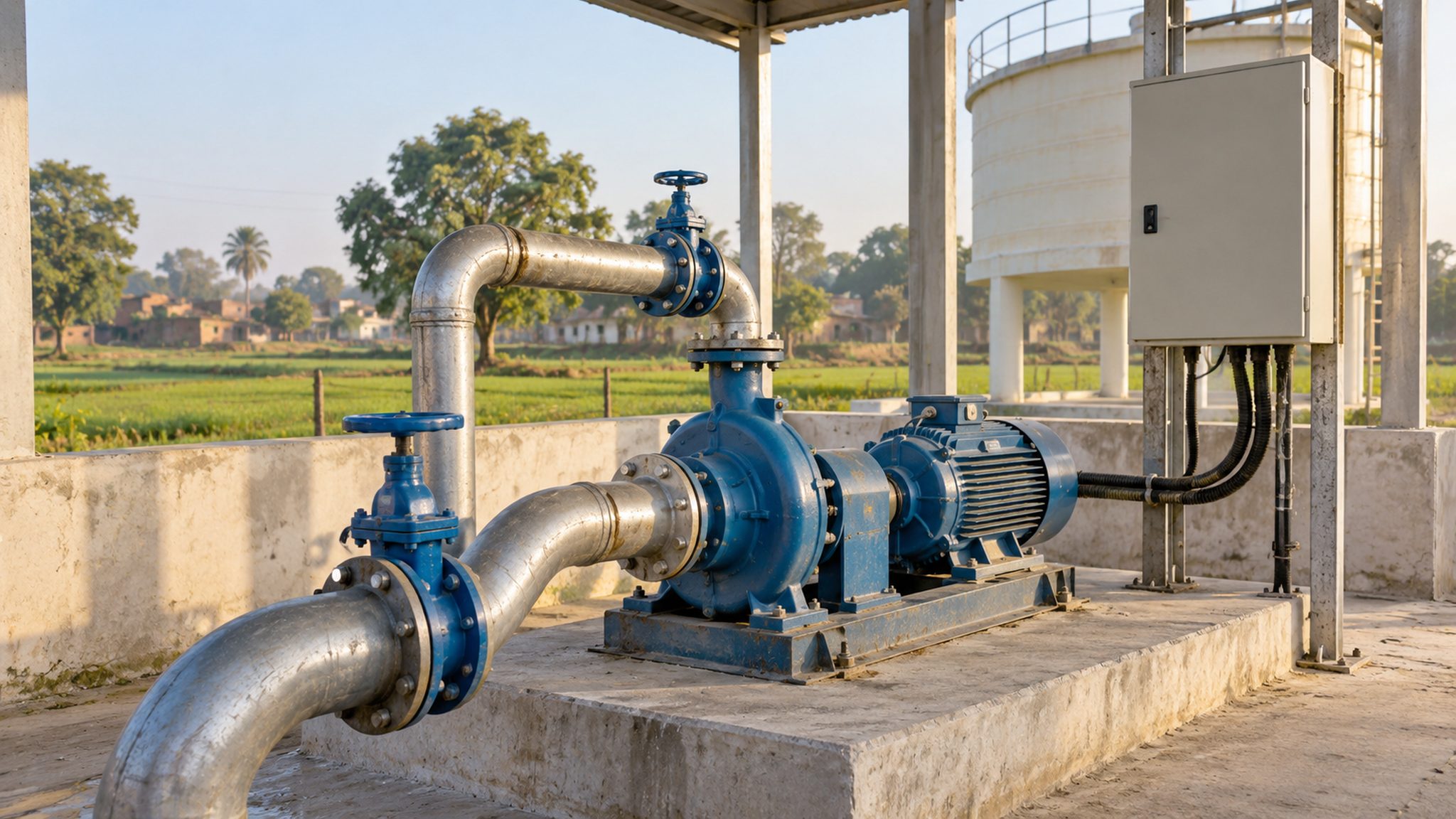
- A pump or distribution fault can interrupt service even where household taps exist. Identifying the responsible operator and arranging repairs are practical governance tasks connecting village institutions with the technical system they manage.
- Source sustainability and equipment upkeep address different vulnerabilities. A functioning pump cannot substitute for an available water source, while an available source cannot compensate for broken equipment or a distribution problem that prevents delivery.
- Water-quality surveillance addresses whether the supplied water is safe, not simply whether it flows. The reported post-monsoon source testing shows why quality checks remain necessary after construction and formal transfer of responsibility.
- Field Test Kit demonstrations support community participation in monitoring. They should be understood as part of a continuing surveillance process, rather than proof that every source or household supply has already passed every safety check.
- Women’s participation in community monitoring was specifically reported. For implementation, participation should translate into usable testing skills and a route for communicating concerns, rather than attendance alone being treated as evidence of effective oversight.
Connection Coverage and Service Reliability Are Different Tests
The useful comparison is between an infrastructure output and the continuing service households actually receive.
- Connection coverage counts access to a physical connection; service reliability concerns whether it delivers as intended over time. An increase in the first cannot alone demonstrate improvement in the second for every household.
- Quality and continuity also need separate assessment. Water may be available but require a safety response, or meet quality requirements when supplied but arrive unreliably. Treating both as one achievement hides different operational failures.
- Community management can make faults visible sooner because users encounter them directly. The policy challenge is converting that information into repair and corrective action, with technical support available when a problem exceeds village capacity.
- Financing arrangements should be assessed for their ability to sustain operations and repairs. The announcement does not establish a uniform tariff, so neither free operation nor a nationally fixed user charge should be inferred.
- Outcome assessment should ask whether failures are resolved and safe supply sustained after handover. Counting ceremonies, certificates or recorded assets alone cannot answer that question, because each measures a different administrative activity.
Way Forward
Make the Handover Operational
- Specify responsibility: identify operators, maintenance contacts and escalation routes before local institutions accept continuing management duties.
- Plan recurring needs: match equipment upkeep, repair arrangements and operating resources to the actual scheme rather than assuming construction funding sustains service indefinitely.
- Close the testing loop: connect community monitoring to reporting, technical investigation and corrective action when water-quality concerns arise.
- Track household experience: review supply interruptions and complaint resolution alongside infrastructure records to assess service after handover.
Conclusion
- Jal Arpan is significant because it makes the transition from building rural water infrastructure to managing it explicit. Its lasting value depends on whether local responsibility is supported by the capacity to deliver safe, dependable water.
- Use this example to connect decentralization with service delivery: the handover is an institutional change, while sustained operation, maintenance and water-quality protection are the outcomes against which that change should be judged.
UPSC Practice Questions
Prelims MCQ 1
With reference to Jal Arpan, consider the following statements:
- It involves formal handover of completed rural water supply schemes to local institutions.
- The reported handovers followed commissioning and the prescribed trial run.
- A handover certificate alone establishes that future household supply will be uninterrupted.
How many of the above statements are correct?
(a) Only one (b) Only two (c) All three (d) None
Answer: (b) Only two
Explanation:
The first two statements describe the reported handover process. A certificate records a transition; future continuity depends on continuing operation and maintenance.
Prelims MCQ 2
Which distinction best explains the governance challenge highlighted by Jal Arpan?
(a) A tap connection and reliable drinking-water service are identical measures. (b) Water-quality surveillance becomes unnecessary after commissioning. (c) Infrastructure completion must be followed by continuing operation, maintenance and quality monitoring. (d) Community ownership removes the need for technical support.
Answer: (c) Infrastructure completion must be followed by continuing operation, maintenance and quality monitoring.
Explanation:
Completed infrastructure is the basis of service delivery. Its continued functioning and safety require operating capacity, repairs and water-quality safeguards.
UPSC Mains Questions
- Explain how community handover of rural water supply schemes changes the governance challenge from infrastructure creation to service delivery.
- Why should tap-connection coverage and reliable drinking-water service be assessed separately? Discuss with reference to operation, maintenance and water-quality surveillance.
Source: PIB, Ministry of Jal Shakti.
Frequently Asked Questions
What is Jal Arpan?
Jal Arpan is the formal handover of completed rural water supply schemes to Gram Panchayats and Village Water & Sanitation Committees for operation, maintenance and long-term sustainability under Jal Jeevan Mission 2.0.
When did the reported handovers take place?
PIB reported the development on October 3, 2026. The handovers described in the release were part of Gandhi Jayanti and special Gram Sabha activities held on October 2.
Does a tap connection guarantee safe and reliable supply?
A connection records physical access to infrastructure. Reliable and safe supply also depends on functioning equipment, source availability, maintenance and continuing water-quality safeguards. Connection coverage cannot establish all these outcomes by itself.
What happens before a scheme is handed over?
The release describes completed schemes being commissioned after the prescribed trial run before formal handover. It does not specify a uniform trial-run duration, and no particular number of days should be inferred.
Tell Google you want more of this.
Add Anantam IAS as a preferred sourceOne tap, and this site shows up more often in your own Top Stories, AI Overviews and AI Mode. Remove it any time.