
Why in News?
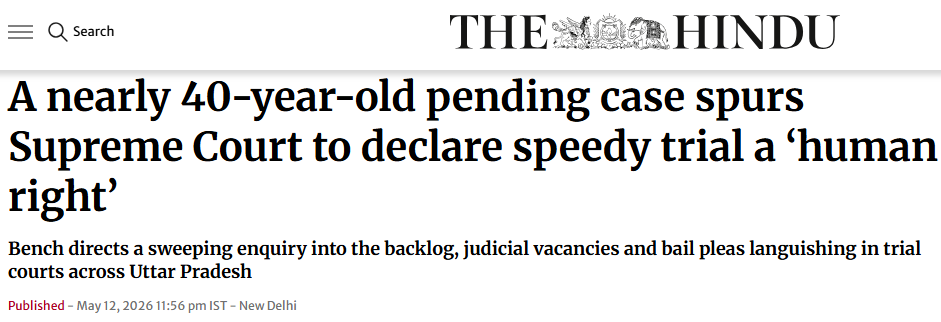
The Supreme Court recently declared that the right to speedy trial is not only a part of the fundamental right to life under Article 21 but also a “human right”. The observation came while quashing a nearly 35-year-old criminal case pending in Uttar Pradesh involving five police constables accused in a minor altercation during Kumbh Mela duty in 1989.
The judgment by a Bench led by Justice J.B. Pardiwala has also triggered a wider judicial inquiry into:
- Pendency of criminal cases in Uttar Pradesh
- Long incarceration of undertrial prisoners
- Judicial vacancies
- Delayed bail applications in subordinate courts
The case has once again highlighted the structural crisis of delays in India’s justice delivery system.
UPSC Relevance
Prelims Relevance
- Article 21, Fundamental Rights, Undertrial prisoners and bail
- Judicial system and subordinate courts, Legal aid and fair trial, Human rights jurisprudence
Mains Relevance
GS Paper 2
- Judiciary and judicial reforms, Access to justice, Pendency of cases and judicial accountability, Undertrial prisoners and prison reforms
GS Paper 1
- Social justice and rights-based governance
Essay
- Justice delayed is justice denied
- Human rights and constitutional governance
- Rule of law and democratic accountability
Background and Context
India’s judicial system faces one of the largest case backlogs in the world. More than five crore cases are pending across various courts:
- Supreme Court
- High Courts
- District and subordinate courts
A significant proportion of these are criminal cases involving:
- Undertrial prisoners
- Bail applications
- Minor offences
- Procedural delays
The present case reflects the extreme consequences of systemic delay. A criminal case involving allegations of “simple hurt” remained pending for 35 years without effective prosecution. During this period:
- Two accused died
- Witnesses were not produced
- The trial remained stagnant for decades
The Supreme Court viewed this as a serious violation of constitutional protections and human dignity.
Evolution of the Right to Speedy Trial in India
The Constitution does not explicitly mention the “right to speedy trial”. However, the Supreme Court has progressively interpreted it as part of the broader guarantee of life and personal liberty under Article 21.
The evolution of this doctrine reflects judicial expansion of procedural fairness and human rights protections.
Constitutional Basis
Article 21
Article 21 states:
“No person shall be deprived of his life or personal liberty except according to procedure established by law.”
Over time, the Supreme Court interpreted “procedure established by law” to mean:
- Fair
- Just
- Reasonable
- Non-arbitrary procedure
A delayed trial undermines fairness because prolonged uncertainty itself becomes a form of punishment.
Article 14
Excessive delay may also violate Article 14 because unequal and arbitrary justice administration undermines equality before law.
Article 39A
The Directive Principle under Article 39A directs the State to ensure:
- Equal justice
- Free legal aid
This implies accessible and timely justice delivery.
Important Supreme Court Judgments
Hussainara Khatoon v. State of Bihar (1979)
This landmark case exposed the plight of undertrial prisoners in Bihar jails who had spent years in custody without trial.
The Supreme Court held:
- Speedy trial is a fundamental right under Article 21.
- Prolonged detention without trial is unconstitutional.
This case became the foundation of India’s speedy trial jurisprudence.
A.R. Antulay v. R.S. Nayak (1992)
The Court clarified:
- No rigid time limits can universally apply to all criminal trials.
- Courts must examine delays case-by-case.
- Nature of offence, conduct of parties and systemic constraints are relevant factors.
Abdul Rehman Antulay Case
The Court emphasised balancing:
- Rights of the accused
- Interests of society
- Administrative realities
P. Ramachandra Rao v. State of Karnataka (2002)
The Supreme Court ruled that courts cannot mechanically terminate proceedings solely based on time duration, but constitutional courts can intervene in cases of oppressive delay.
Satender Kumar Antil v. CBI (2022)
The Court stressed liberal bail principles and highlighted overcrowding of prisons due to excessive incarceration of undertrials.
Speedy Trial as a Human Right
The recent judgment goes a step further by explicitly calling speedy trial a “human right”.
This reflects the influence of international human rights jurisprudence.
International Legal Framework
Universal Declaration of Human Rights (UDHR), 1948
Article 10 recognises the right to a fair and public hearing.
International Covenant on Civil and Political Rights (ICCPR), 1966
Article 14 guarantees trial without undue delay.
India is a signatory to the ICCPR and therefore has international obligations regarding fair trial standards.
Why Delayed Trials are a Serious Concern
Violation of Human Dignity
The Supreme Court observed that the label of “accused” itself affects:
- Social standing
- Employment opportunities
- Mental health
- Personal dignity
An individual living under criminal prosecution for decades suffers continuous psychological punishment even before conviction.
Impact on Undertrial Prisoners
India has one of the world’s largest undertrial prison populations.
According to National Crime Records Bureau (NCRB) data:
- Around 75% of prisoners in Indian jails are undertrials.
- Many remain incarcerated longer than the maximum punishment for their alleged offences.
This raises serious constitutional and humanitarian concerns.
Erosion of Public Trust
Justice delayed reduces confidence in:
- Courts
- Rule of law
- Democratic institutions
Delayed justice may encourage:
- Vigilantism
- Extrajudicial settlements
- Distrust in formal legal mechanisms
Economic and Social Costs
Prolonged litigation imposes:
- Legal expenses
- Income loss
- Social stigma
- Administrative burden
Poor and marginalised groups suffer disproportionately because they lack resources to sustain long legal battles.
Structural Causes Behind Judicial Delays
Judicial Vacancies
India faces persistent shortages of judges.
The judge-to-population ratio remains far below global standards. Vacancies in subordinate courts significantly slow down case disposal.
Delay in Appointments
Procedural delays in appointments and lack of coordination between the judiciary and executive worsen the problem.
Inadequate Judicial Infrastructure
Many lower courts suffer from:
- Poor digital infrastructure
- Inadequate courtrooms
- Shortage of staff
- Lack of technological support
This affects case management efficiency.
Procedural Complexity
Frequent adjournments, lengthy evidence procedures and multiple appeals prolong litigation.
Criminal trials often get delayed because:
- Witnesses fail to appear
- Police investigations remain incomplete
- Prosecution lacks coordination
Burden of Undertrial Cases
Minor offences continue to consume large judicial time because:
- Bail is denied or delayed
- Chargesheets are delayed
- Plea bargaining remains underutilised
Weak Investigation and Prosecution Systems
Low conviction rates and delayed trials are often linked to:
- Poor evidence collection
- Lack of forensic support
- Overburdened prosecutors
Bail and the Problem of Incarceration
The Supreme Court has increasingly emphasised that:
“Bail is the rule, jail is the exception.”
However, in practice:
- Bail applications often remain pending
- Poor accused persons cannot furnish sureties
- Lower courts adopt restrictive approaches
This contributes to prison overcrowding.
The present judgment specifically sought details about:
- Pending bail applications
- Undertrials incarcerated for years
- Duration of custody without conviction
This indicates growing judicial concern regarding liberty and procedural fairness.
Digitalisation and Judicial Reforms
The judiciary has attempted reforms through:
- e-Courts Mission Mode Project
- Virtual hearings
- National Judicial Data Grid (NJDG)
- e-Filing systems
The National Judicial Data Grid provides real-time pendency statistics and aims to improve transparency and case management.
However, digitisation alone cannot solve structural deficiencies without:
- Adequate manpower
- Administrative reforms
- Better coordination between institutions
Prison Reforms and Undertrial Justice
Several committees have highlighted prison and undertrial issues.
Justice Amitava Roy Committee (2018)
The committee recommended:
- Fast-tracking of undertrial review committees
- Legal aid improvements
- Bail reforms
- Better prison management
Mulla Committee on Prison Reforms
It emphasised:
- Humane prison administration
- Reduction of undertrial incarceration
- Speedy disposal of criminal cases
Challenges in Ensuring Speedy Justice
Balancing Speed and Fairness
Excessive focus on disposal rates may compromise:
- Quality of justice
- Due process
- Proper examination of evidence
Thus, speedy trial should not become hurried justice.
Federal and Administrative Constraints
Subordinate courts fall largely under State administrative control, while constitutional oversight lies with High Courts.
Coordination challenges affect reform implementation.
Unequal Access to Justice
Marginalised groups often face:
- Lack of legal representation
- Limited awareness of rights
- Inability to secure bail
Thus, procedural delays disproportionately affect vulnerable populations.
Pendency in High Courts
Large numbers of appeals and bail applications also remain pending in High Courts, creating cascading delays throughout the judicial hierarchy.
Way Forward
Filling Judicial Vacancies
Vacancies in subordinate courts and High Courts should be filled through:
- Time-bound appointment mechanisms
- Better coordination between constitutional authorities
- Expansion of sanctioned judicial strength
Increasing the judge-to-population ratio is essential.
Strengthening Subordinate Judiciary
District courts handle the bulk of litigation and therefore require:
- Better infrastructure
- Additional staff
- Digital support systems
- Continuous judicial training
Investment in grassroots judicial institutions is critical.
Bail Reforms
Clearer and more liberal bail guidelines are needed for:
- Minor offences
- First-time offenders
- Undertrials with prolonged incarceration
Use of personal bonds and simplified surety systems can reduce unnecessary detention.
Reducing Procedural Delays
Measures may include:
- Strict regulation of adjournments
- Improved witness management systems
- Greater use of plea bargaining
- Fast-track mechanisms for minor offences
Case-flow management systems should be institutionalised.
Strengthening Legal Aid
The National Legal Services Authority (NALSA) and State Legal Services Authorities should expand:
- Legal awareness programmes
- Free legal representation
- Prison legal aid clinics
This will improve access to justice for vulnerable groups.
Police and Prosecution Reforms
Improving investigation quality through:
- Modern forensic support
- Better training
- Independent prosecution mechanisms
can reduce delays and improve conviction standards.
Technology-Driven Monitoring
AI-based case management tools and data analytics can help identify:
- Long-pending cases
- Bail delays
- Undertrial detention trends
However, technological reforms must remain rights-based and transparent.
Alternative Dispute Resolution (ADR)
Encouraging:
- Mediation
- Lok Adalats
- Plea bargaining
can reduce pressure on regular courts, particularly in minor disputes.
Conclusion
The Supreme Court’s recognition of speedy trial as a human right reaffirms the constitutional principle that justice must not only be fair but also timely. A criminal process that continues for decades transforms procedure itself into punishment and undermines human dignity.
The judgment highlights the urgent need for structural judicial reforms in India. Addressing pendency, vacancies, undertrial incarceration and procedural inefficiencies is essential for strengthening the rule of law and restoring public confidence in the justice system.
A democratic legal order cannot permit justice to remain indefinitely suspended. Ensuring timely and accessible justice is therefore central to constitutional governance, human rights protection and the credibility of the judiciary itself.
UPSC Practice Questions
Prelims MCQ 1
With reference to the “right to speedy trial” in India, consider the following statements:
- The Constitution explicitly mentions the right to speedy trial under Article 21.
- The Supreme Court has interpreted speedy trial as part of the right to life and personal liberty.
- India is a signatory to the International Covenant on Civil and Political Rights (ICCPR).
How many of the above statements are correct?
(a) Only one
(b) Only two
(c) All three
(d) None
Answer: (b) Only two
Explanation:
- Statement 1 is incorrect because the Constitution does not explicitly mention speedy trial.
- Statement 2 is correct as the Supreme Court interpreted it under Article 21.
- Statement 3 is correct because India is a signatory to the ICCPR.
Prelims MCQ 2
Which of the following committees are associated with prison and undertrial reforms in India?
- Justice Amitava Roy Committee
- Mulla Committee
- Sarkaria Commission
Select the correct answer using the code below:
(a) 1 and 2 only
(b) 2 and 3 only
(c) 1 and 3 only
(d) 1, 2 and 3
Answer: (a) 1 and 2 only
Explanation:
- Justice Amitava Roy Committee and Mulla Committee are associated with prison and undertrial reforms.
- Sarkaria Commission dealt with Centre-State relations.
UPSC Mains Questions
Discuss the structural causes behind judicial delays and undertrial incarceration in India. Suggest measures required to ensure timely and accessible justice delivery.
“Justice delayed is justice denied.” Examine the constitutional and human rights dimensions of the right to speedy trial in India.
Tell Google you want more of this.
Add Anantam IAS as a preferred sourceOne tap, and this site shows up more often in your own Top Stories, AI Overviews and AI Mode. Remove it any time.