Why in News?
On 30 August, Supreme Court judge Justice Ujjal Bhuyan highlighted Article 124(3), which permits a distinguished jurist to be appointed to the Court, although that route has never been used.
- Article 124(3) establishes three alternative eligibility routes: High Court judicial service, High Court advocacy, or recognition by the President as a distinguished jurist.
- The jurist clause carries no specified minimum period of practice or academic service; the constitutional text instead uses the President’s opinion as its express qualifier.
- No Supreme Court judge has been appointed through clause (c), making it a valid but unused constitutional route, not a newly created category.
- The speech reopened a question about judicial diversity and legal scholarship; it did not announce a candidate, recommendation, vacancy decision or pending nomination.
- The exam trap is to confuse constitutional eligibility with selection: satisfying Article 124(3) permits consideration but does not itself create a claim to appointment.
- The route could bring academic or juristic expertise to constitutional adjudication, but undefined criteria also raise questions of transparency, comparability and institutional legitimacy.
- Its non-use reflects appointment practice rather than repeal; clause (c) remains part of the Constitution even though judges have come from the Bench or Bar.
UPSC Relevance
Prelims Relevance
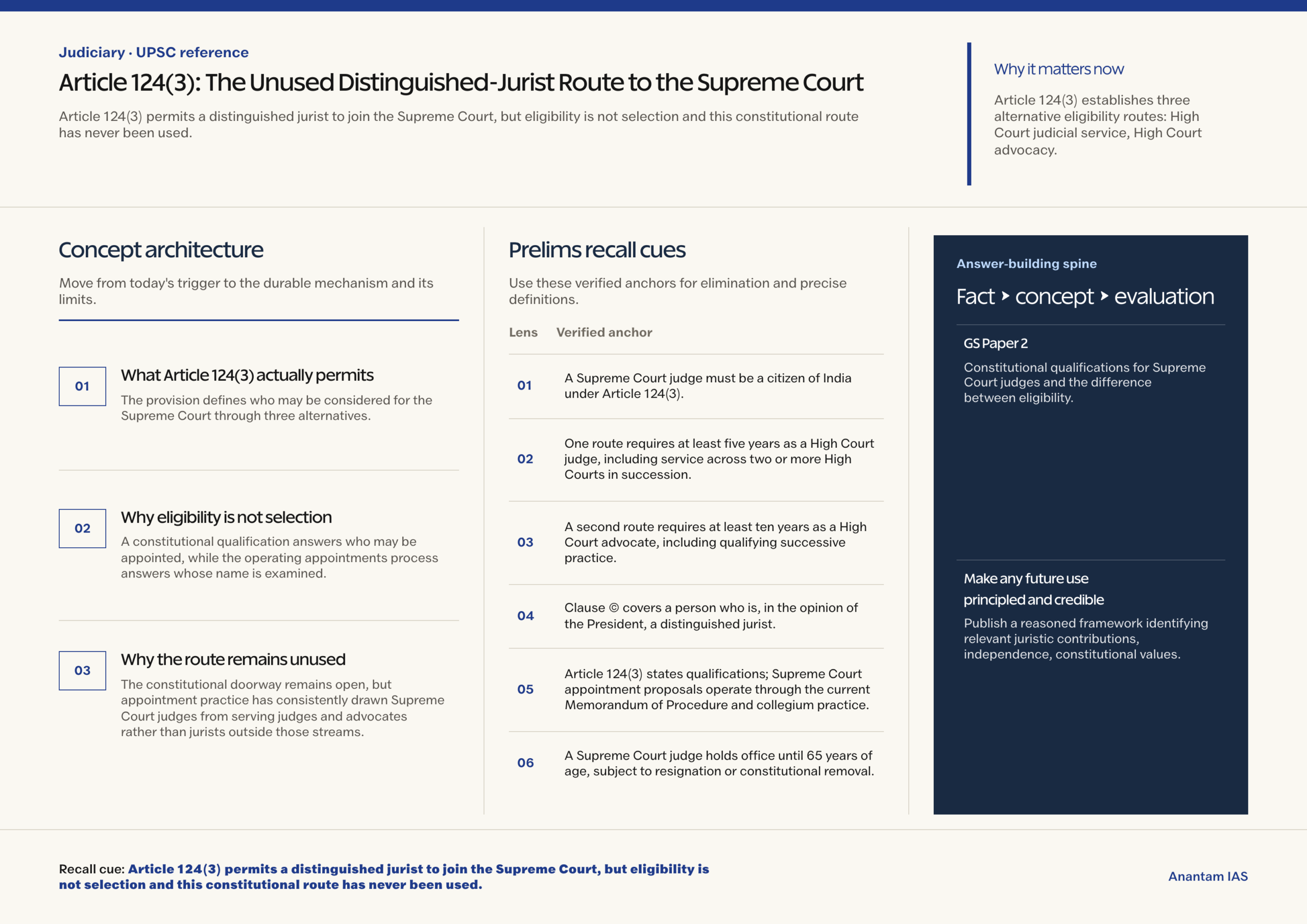
- A Supreme Court judge must be a citizen of India under Article 124(3).
- One route requires at least five years as a High Court judge, including service across two or more High Courts in succession.
- A second route requires at least ten years as a High Court advocate, including qualifying successive practice.
- Clause (c) covers a person who is, in the opinion of the President, a distinguished jurist.
- Article 124(3) states qualifications; Supreme Court appointment proposals operate through the current Memorandum of Procedure and collegium practice.
- A Supreme Court judge holds office until 65 years of age, subject to resignation or constitutional removal.
Mains Relevance
GS Paper 2
- Constitutional qualifications for Supreme Court judges and the difference between eligibility, recommendation and formal appointment
- Potential contribution of academic and juristic expertise to judicial diversity, balanced against transparent and defensible selection criteria
Essay
- Institutions gain from diverse expertise only when inclusion is joined by clear standards, independence and public legitimacy.
Background and Context
What Article 124(3) actually permits
The provision defines who may be considered for the Supreme Court through three alternatives, all subject to Indian citizenship and a separate appointment decision.
- The first route covers a person who has served for at least five years as a judge of one High Court or successive High Courts; the required period is cumulative across qualifying courts.
- The second covers a person who has practised for at least ten years as an advocate of one High Court or successive High Courts, allowing qualifying successive practice to count.
- The third covers someone who is, in the President’s opinion, a distinguished jurist; the clause provides no fixed academic title, publication threshold, judicial experience or service period.
- These are alternative qualifications, not cumulative requirements. A distinguished jurist need not first satisfy the five-year judicial or ten-year advocacy route, though citizenship remains common.
- The clause creates eligibility for consideration. It grants no enforceable entitlement to a seat, and a vacancy, institutional recommendation and formal appointment remain separately necessary.
Why eligibility is not selection
A constitutional qualification answers who may be appointed, while the operating appointments process answers whose name is examined, recommended and formally appointed in the real institutional sequence.
- Under the current Memorandum of Procedure, responsibility for initiating a Supreme Court appointment proposal rests with the Chief Justice of India; clause (c) does not itself start a search.
- The Chief Justice’s opinion is formed with the four senior-most Supreme Court judges; this collegium convention governs recommendations and gives the judiciary institutional primacy in candidate selection.
- The recommendation moves through the Union Law Minister and Prime Minister before the President formally appoints the judge, as constitutional appointing authority, by warrant under hand and seal.
- The phrase in the opinion of the President in clause (c) cannot be read as a stand-alone recruitment channel detached from executive advice, judicial consultation and the operating process.
- A jurist would still need institutional assessment and recommendation. The distinction prevents an exam answer from treating eligibility wording, or presidential opinion, as unilateral presidential selection.
Why the route remains unused
The constitutional doorway remains open, but appointment practice has consistently drawn Supreme Court judges from serving judges and advocates rather than jurists outside those streams.
- The Constitution does not define distinguished jurist through measurable criteria or an exhaustive test, leaving difficult comparisons among scholars, teachers, researchers, law-reform experts and other legal thinkers.
- Selection bodies may prefer candidates with demonstrated courtroom and adjudicatory experience, while a jurist route asks them to evaluate different evidence of legal judgment, institutional temperament and capacity across disputes.
- Clear criteria could improve predictability, but a rigid checklist might undervalue unconventional scholarship or reproduce existing networks under a new label unless reasons and evidence remain open to scrutiny.
- Using the route could broaden expertise in public law and legal research; it would not create a narrower class of judge, because every appointee performs the full judicial role.
- The present debate asks whether the route deserves serious exploration. A judicial speech neither places a person under consideration nor creates a binding definition or official appointment proposal.
Way Forward
Make any future use principled and credible
- Publish a reasoned framework identifying relevant juristic contributions, independence, constitutional values, professional integrity and ability to perform the full judicial role.
- Assess scholarship and public-law contribution alongside temperament, conflicts of interest, fairness and capacity to decide fact-intensive disputes beyond an academic specialisation.
- Record enough reasons to distinguish a jurist recommendation from patronage while protecting legitimate confidentiality around consultations and personal information.
- Treat the clause as one route to institutional diversity, not as a shortcut around judicial independence, scrutiny or the regular recommendation process.
Conclusion
- Article 124(3)(c) is an unused eligibility route, not an unused presidential power to appoint anyone independently; constitutional qualification and institutional selection must remain separate under Article 74 and current appointment practice.
- A strong Mains answer should pair the diversity case for juristic expertise with safeguards: clear criteria, reasoned evaluation, independence and equal judicial responsibility after appointment, without mistaking diversity for relaxed scrutiny.
UPSC Practice Questions
Prelims MCQ 1
With reference to Article 124(3) of the Constitution, consider the following statements:
- Every person appointed as a Supreme Court judge must be a citizen of India.
- Ten years as an advocate of a High Court is one qualification route.
- The Constitution prescribes a minimum number of years in legal academia for a distinguished jurist.
How many of the above statements are correct?
(a) Only one (b) Only two (c) All three (d) None
Answer: (b) Only two
Explanation:
Statements 1 and 2 are correct. Clause (c) uses the President’s opinion but sets no minimum academic-service period or other express definition of distinguished jurist.
Prelims MCQ 2
Which statement best describes the distinguished-jurist clause in Article 124(3)?
(a) It permits Parliament to elect a law professor directly to the Supreme Court (b) It applies only to advocates with at least ten years of High Court practice (c) It is an alternative constitutional qualification whose use still requires the regular appointment process (d) It creates a temporary advisory membership of the Supreme Court
Answer: (c) It is an alternative constitutional qualification whose use still requires the regular appointment process
Explanation:
Clause (c) is an alternative to the High Court judge and advocate qualifications. It makes a jurist eligible for consideration but does not itself select or appoint that person.
UPSC Mains Questions
- Article 124(3)(c) broadens eligibility for appointment to the Supreme Court, but its non-use exposes a gap between constitutional design and selection convention. Discuss.
- How can India explore the distinguished-jurist route to the Supreme Court while protecting judicial independence, transparency and confidence in the appointments process?
Sources: Indian Express Explained and Legislative Department, Constitution of India.
Frequently Asked Questions
Who is a distinguished jurist under Article 124(3)?
The Constitution supplies no fixed definition or minimum academic tenure. It covers a person who is, in the President’s opinion, a distinguished jurist, subject to the regular appointments process.
Has India appointed any Supreme Court judge through this route?
No. Supreme Court judges have been drawn from the Bench or directly from the Bar; Article 124(3)(c) remains constitutionally available but has not been used.
Can the President independently choose a distinguished jurist?
No stand-alone recruitment route follows from that phrase. Under current practice, the Chief Justice of India initiates Supreme Court proposals through collegium consultation before executive processing and formal presidential appointment.
Does eligibility guarantee appointment to the Supreme Court?
No. Article 124(3) sets threshold qualifications. Recommendation, executive processing and formal appointment are separate stages, so an eligible person has no automatic claim to a Supreme Court seat.
Why might a distinguished jurist be considered for the Court?
A jurist could add deep scholarship, comparative insight and public-law expertise. Any benefit depends on transparent assessment of independence, judgment, integrity and capacity to perform the Court’s complete judicial role.
Tell Google you want more of this.
Add Anantam IAS as a preferred sourceOne tap, and this site shows up more often in your own Top Stories, AI Overviews and AI Mode. Remove it any time.