Why in News?
Tamil Nadu moved the Supreme Court on August 30 seeking directions for Cauvery releases, placing the enforceability of the basin’s institutional water-sharing mechanism under scrutiny.
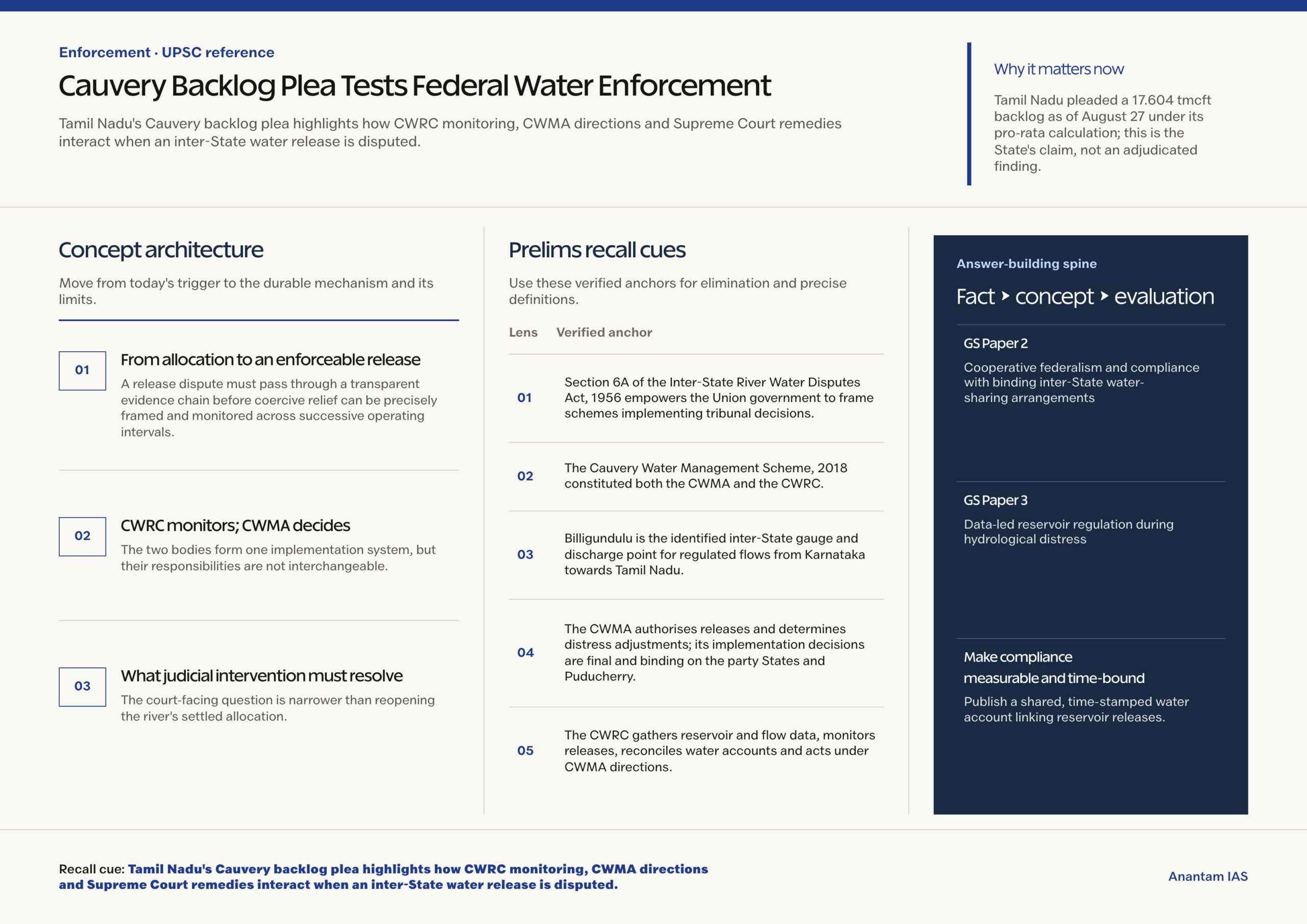
- Tamil Nadu pleaded a 17.604 tmcft backlog as of August 27 under its pro-rata calculation; this is the State’s claim, not an adjudicated finding.
- It also sought compliance with the 9,000-cusecs release direction for the specified late-August to early-September period and correction of any measured shortfall at Billigundulu.
- Tamil Nadu alleged that the CWRC and CWMA did not account for accumulated arrears while fixing current releases; the allegation still requires judicial assessment.
- The hearing tests whether a court should issue an immediate release direction or require the statutory implementation bodies to quantify and remedy the asserted default.
- The dispute is now about implementation and accounting: what was ordered, what crossed the gauge, whether distress adjustments applied, and how a shortfall should be made good.
- Effective river federalism needs a chain from verified hydrological data to a reasoned order and timely compliance; a numerical allocation alone cannot enforce itself.
- Judicial supervision can protect binding outcomes, but routine release management depends on specialised basin institutions that can revise directions as rainfall and storage change.
UPSC Relevance
Prelims Relevance
- Section 6A of the Inter-State River Water Disputes Act, 1956 empowers the Union government to frame schemes implementing tribunal decisions.
- The Cauvery Water Management Scheme, 2018 constituted both the CWMA and the CWRC.
- Billigundulu is the identified inter-State gauge and discharge point for regulated flows from Karnataka towards Tamil Nadu.
- The CWMA authorises releases and determines distress adjustments; its implementation decisions are final and binding on the party States and Puducherry.
- The CWRC gathers reservoir and flow data, monitors releases, reconciles water accounts and acts under CWMA directions.
Mains Relevance
GS Paper 2
- Cooperative federalism and compliance with binding inter-State water-sharing arrangements
- Institutional accountability when an implementing authority’s direction is alleged to be ineffective
GS Paper 3
- Data-led reservoir regulation during hydrological distress
- Water-accounting capacity as infrastructure for climate-resilient basin governance
Essay
- Federal institutions earn legitimacy when agreed rules remain enforceable during scarcity, not only when water is abundant.
Background and Context
From allocation to an enforceable release
A release dispute must pass through a transparent evidence chain before coercive relief can be precisely framed and monitored across successive operating intervals.
- The governing baseline is the tribunal award as modified by the Supreme Court, implemented through the 2018 scheme rather than renegotiated during each shortage.
- For each operating interval, storage, inflows, realised flows, authorised withdrawals and State indents must be compared to determine the release obligation.
- Water crossing Billigundulu supplies the crucial measured-flow record; a release from an upstream reservoir and a flow realised at the border are not automatically identical.
- In a deficiency month, the CWMA may consider proportionate reductions after the CWRC reports availability; distress is an institutional determination, not a unilateral State label.
- The alleged 17.604 tmcft arrear must be tested against the applicable direction, accepted data and distress calculation on a common evidentiary record before it becomes an enforceable quantified default.
CWRC monitors; CWMA decides
The two bodies form one implementation system, but their responsibilities are not interchangeable.
- The CWRC’s operational role includes collecting daily reservoir levels and inflows, twelve-hourly release data, rainfall information and daily flows at Billigundulu.
- It must ensure ten-daily releases as directed by the CWMA, monitor deviations, reconcile monthly reservoir accounts and report changing monsoon performance.
- The CWMA’s decisional role covers apportionment, reservoir supervision, release authorisation, distress identification and revision of directions as new hydrological data arrive.
- CWMA decisions for implementing the modified award are final and binding; CWRC action remains subject to the Authority’s directions and delegated powers.
- If a State does not cooperate, the CWMA may seek Central government assistance; where default causes delay or shortfall, the scheme provides for action to make good the deficiency.
What judicial intervention must resolve
The court-facing question is narrower than reopening the river’s settled allocation.
- Tamil Nadu asks for a specific performance-type remedy: release the pleaded backlog and ensure current flows, rather than alter the settled inter-State shares.
- A judicial direction requires clarity on the operative CWMA order, the measurement period, actual border flows and whether the asserted arrear already reflects distress adjustment.
- The Court can examine alleged non-compliance with its earlier judgment and implementation framework without becoming the basin’s day-to-day reservoir operator.
- Prematurely treating a pleaded number as proved would bypass the scheme’s technical process; refusing all review could weaken the binding character of the institutional arrangement.
- The durable balance is judicial enforcement of reasoned, lawful decisions alongside institutional primacy for measurement, short-interval regulation and hydrological revision.
Way Forward
Make compliance measurable and time-bound
- Publish a shared, time-stamped water account linking reservoir releases, travel-time assumptions and Billigundulu flows to each CWMA direction.
- Require the CWMA to record whether a claimed shortfall is a default, measurement variance or distress adjustment, with reasons accessible to every basin party.
- Use the scheme’s deficiency-correction and Central-assistance powers through a graduated compliance protocol before disputes repeatedly require emergency court hearings.
- Place concise compliance reports before the Court when litigation is pending, allowing targeted judicial relief without displacing technical reservoir management.
Conclusion
- The present controversy shows that federal water rights become real through institutions: common data, reasoned release orders, reconciled accounts and credible consequences for default.
- In an answer, distinguish the pleaded 17.604 tmcft figure from a judicial finding, then assess how CWRC monitoring, CWMA authority and judicial enforcement should complement one another.
UPSC Practice Questions
Prelims MCQ 1
With reference to the Cauvery Water Management Scheme, consider the following statements:
- The CWRC collects flow data at Billigundulu and reconciles reservoir water accounts.
- The CWMA may identify basin distress and authorise revised releases.
- CWRC decisions supersede CWMA directions when an affected State disagrees.
How many of the above statements are correct?
(a) Only one (b) Only two (c) All three (d) None
Answer: (b) Only two
Explanation:
Statements 1 and 2 are correct. The CWRC implements and monitors releases under CWMA directions; it does not supersede the Authority.
Prelims MCQ 2
Section 6A of the Inter-State River Water Disputes Act, 1956 primarily enables the Union government to:
(a) alter a tribunal award without adjudication (b) nationalise every inter-State river (c) frame a scheme to implement a tribunal decision (d) transfer river-water disputes to State legislatures
Answer: (c) frame a scheme to implement a tribunal decision
Explanation:
Section 6A permits the Union government to notify implementation schemes, including authorities and committees needed to give effect to a tribunal’s decision.
UPSC Mains Questions
- Inter-State river-water adjudication is incomplete without credible institutions of implementation. Discuss with reference to the respective roles of the CWMA, CWRC and Supreme Court.
- How can judicial remedies enforce federal water-sharing obligations without converting constitutional courts into day-to-day reservoir managers?
Sources: The Hindu and Supreme Court of India, Cauvery Water Management Scheme order.
Frequently Asked Questions
Is 17.604 tmcft a Supreme Court finding?
No. It is the backlog Tamil Nadu pleaded as of August 27 using its pro-rata calculation. The Court must assess the claim against orders, flow records and applicable distress adjustments.
What is the main role of the CWMA?
The CWMA implements the modified Cauvery award by authorising releases, supervising reservoir regulation, determining distress adjustments and issuing final, binding implementation decisions for the basin parties.
What does the CWRC do?
The CWRC is the operational monitoring body. It gathers reservoir, rainfall and flow data, tracks releases, reconciles accounts and implements ten-daily release directions issued by the CWMA.
Why is Billigundulu important?
Billigundulu is the scheme’s identified inter-State gauge and discharge site. Its measured flows help determine whether water directed from Karnataka was realised at the Tamil Nadu border.
What can happen if a State defaults on releases?
The scheme permits the CWMA to act to make good a default-caused deficiency and to seek Central government help when a basin State does not cooperate with implementation.
Tell Google you want more of this.
Add Anantam IAS as a preferred sourceOne tap, and this site shows up more often in your own Top Stories, AI Overviews and AI Mode. Remove it any time.