Why in News?
On 11 July 2025 the DRDO and the Indian Air Force (IAF) successfully flight-tested the indigenous Astra Beyond-Visual-Range (BVR) air-to-air missile from a Su-30 MKI fighter off the Odisha coast, the Ministry of Defence confirmed. Two launches were carried out against high-speed unmanned aerial targets, both destroyed with pin-point accuracy.
The headline milestone is the validation of an indigenous radio-frequency (RF) seeker — the missile’s terminal homing eye — replacing the imported seeker used so far. It is a concrete step in cutting dependence on foreign suppliers for a critical air-combat weapon technology under Aatmanirbhar Bharat.
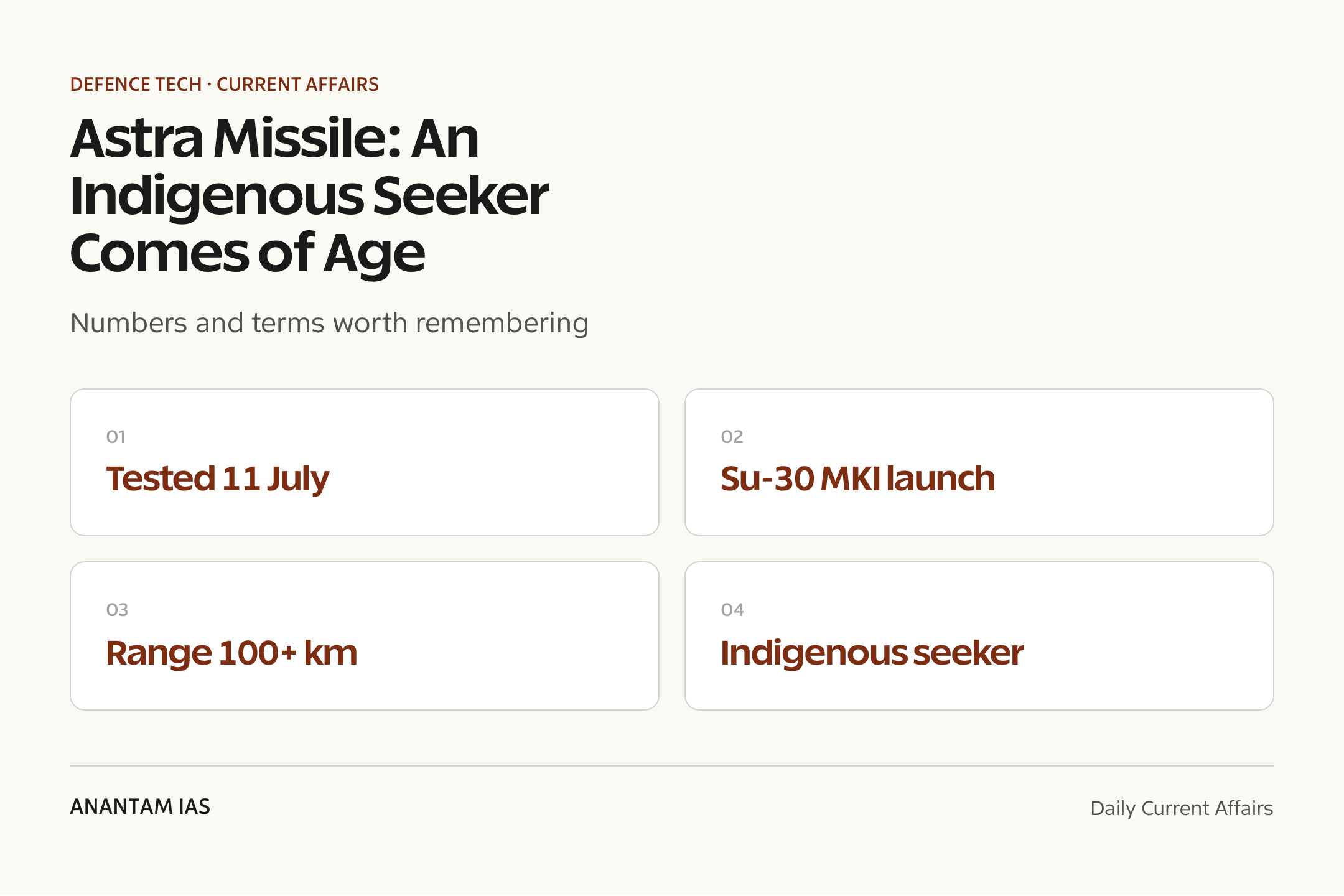
- Two launches from a Su-30 MKI against high-speed unmanned aerial targets; both targets destroyed with pin-point accuracy.
- Tests covered different ranges, target aspects and launch-platform conditions; all subsystems performed accurately.
- Validated an indigenous RF seeker, the key import-substitution gain in this trial.
- Astra Mk-1 has a strike range exceeding 100 km with a state-of-the-art guidance and navigation system.
- Defence Minister Rajnath Singh called it a major milestone in critical defence technology.
- DRDO Chairman Dr Samir V. Kamat congratulated the teams involved in the flight-test.
The development matters in the context of:
- Matters because the seeker is the most sensitive, technology-dense part of a BVR missile, and India long imported it — making an indigenous version a genuine self-reliance gain.
- Anchors India’s drive for an indigenous air-to-air missile family to replace costly foreign BVR weapons across IAF and Navy fighter fleets.
UPSC Relevance
Prelims Relevance
- Astra — India’s first indigenous beyond-visual-range air-to-air missile (BVRAAM).
- Lead developer is the Defence Research and Development Laboratory (DRDL), Hyderabad, under DRDO.
- Astra Mk-1 has a range above 100 km and a speed of about Mach 4.5.
- Propulsion is a solid-propellant rocket motor; the missile is all-weather capable.
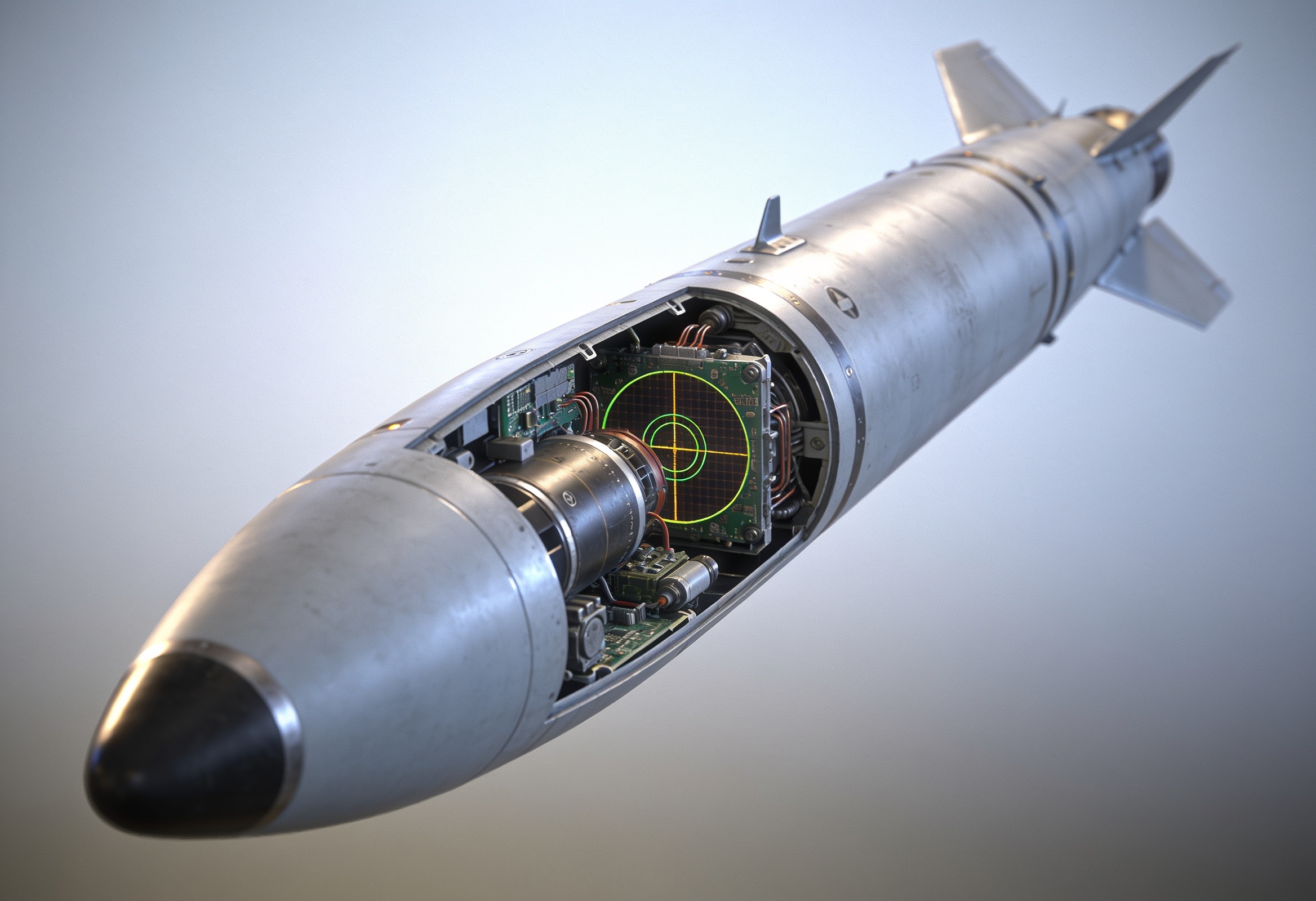
- A seeker is the missile’s terminal homing sensor; Astra uses an active radar (RF) seeker.
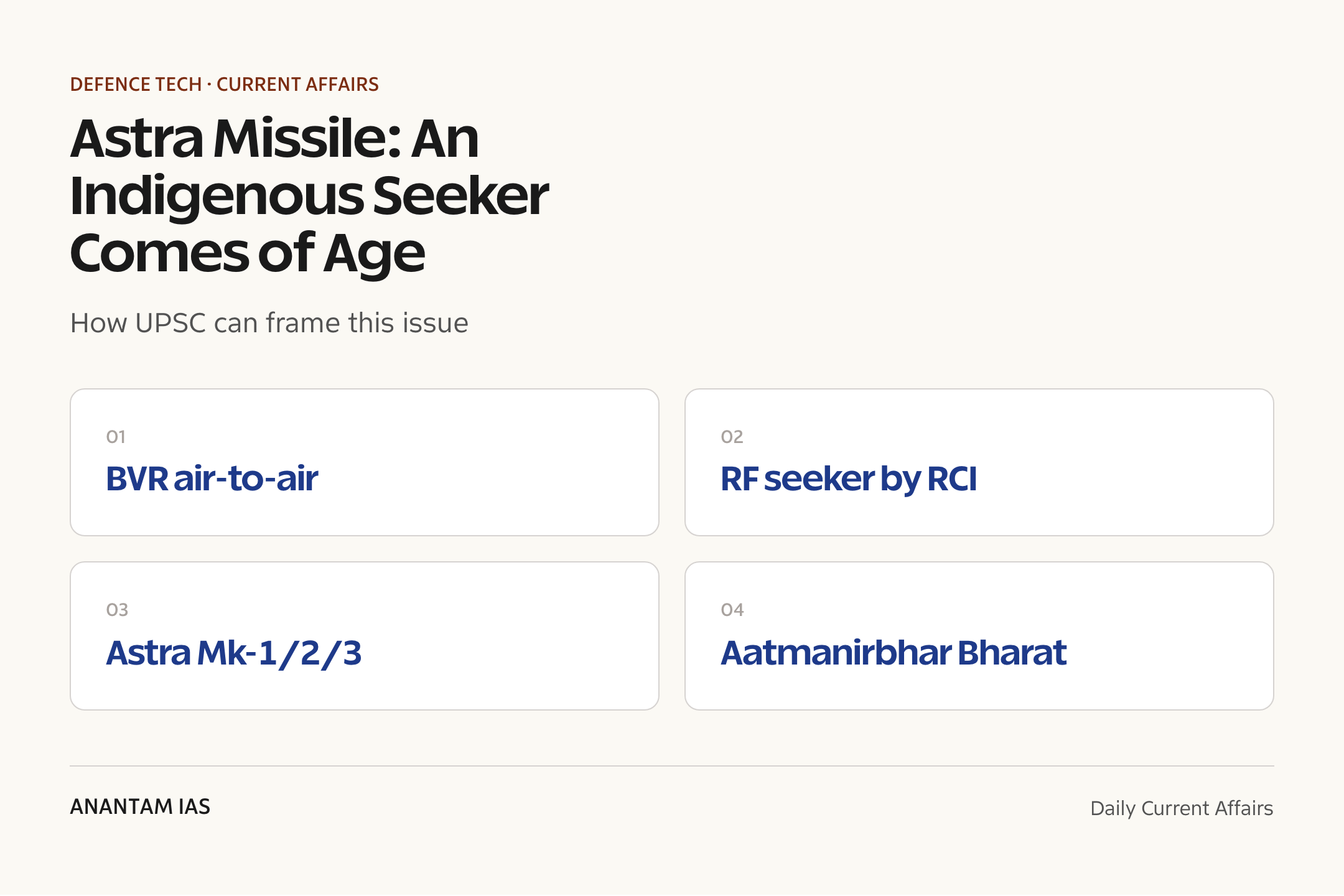
- The new seeker was developed by Research Centre Imarat (RCI), a DRDO lab.
- Integration platforms include the Su-30 MKI, HAL Tejas and the naval MiG-29K.
- Astra Mk-3 (Gandiva) is a longer-range variant powered by a solid-fuel ducted ramjet.
- Production partners include Bharat Dynamics Limited (BDL) for manufacture.
- The test was conducted off the Odisha coast on 11 July 2025.
Mains Relevance
GS Paper 3
- Indigenisation of technology and developing new technology — building a home-grown seeker and BVR missile.
- Achievements of Indians in science and technology; defence R&D and the DRDO ecosystem.
- Security challenges and the role of self-reliant weapon platforms in air dominance.
GS Paper 2
- Government policies for the defence-manufacturing sector and issues in their design and implementation.
Essay
- Self-reliance is the surest form of national security.
- From buyer to builder: India’s long road to defence indigenisation.
Background and Context
What Astra is
Astra is India’s first indigenously designed and developed beyond-visual-range air-to-air missile.
- A BVR air-to-air missile (BVRAAM) is fired from a fighter to destroy enemy aircraft beyond the pilot’s visual range — tens of kilometres away.
- Lead-developed by the Defence Research and Development Laboratory (DRDL), Hyderabad, with HAL and other DRDO labs.
- Astra Mk-1 has a range exceeding 100 km in favourable conditions and flies at roughly Mach 4.5.
- It is all-weather, day-and-night capable with a state-of-the-art guidance and navigation system.
- Astra has been in IAF service and was cleared for full-scale production, replacing pricier imported BVR weapons.
Why the seeker is the story
The seeker is the brain of a missile’s final attack, and India long bought it from abroad.
- A seeker is the on-board radar sensor that locks on and homes the missile onto the target in the terminal phase.
- Astra uses an active radar (RF) seeker — its own radar guides it once it nears the target, so the launching fighter can turn away.
- Production Astra Mk-1 has relied on a seeker of Russian (Agat) design, even if assembled in India.
- The 11 July 2025 test validated an indigenous RF seeker developed by Research Centre Imarat (RCI).
- Because the seeker is the most technology-dense and export-controlled part, indigenising it is the hardest and most valuable step.
What the 11 July test proved
The trial stress-tested the missile and its new seeker across realistic combat conditions.
- Two launches from a Su-30 MKI off the Odisha coast, both scoring direct hits.
- Targets were high-speed unmanned aerial targets simulating hostile aircraft.
- Engagements spanned different ranges, target aspects and launch-platform conditions.
- All subsystems — propulsion, guidance, navigation and the new seeker — performed accurately.
- Confirms the indigenous seeker can do the job in flight, not just on a test bench.
The Astra family
Astra is a growing family of variants meant to span short to very long ranges.
- Astra Mk-1 — the operational baseline, range over 100 km, solid-rocket powered.
- Astra Mk-2 — an extended-range version under development with improved range and propulsion.
- Astra Mk-3 (Gandiva) — a much longer-range variant using a solid-fuel ducted ramjet (SFDR) that keeps thrust over a wider envelope.
- VL-SRSAM — a vertically launched short-range surface-to-air derivative for the Navy.
- The family is being integrated on Su-30 MKI, Tejas and MiG-29K, with future fighters like the AMCA in view.
Why it matters for self-reliance
Replacing the imported seeker tightens India’s grip on a strategic supply chain.
- Imported seekers come with cost, delivery and end-use restrictions set by the supplier nation.
- An indigenous seeker insulates the IAF from sanctions risk and supply disruption during a conflict.
- It deepens domestic capability in RF/microwave electronics, signal processing and guidance with civilian spillovers.
- Strengthens the Aatmanirbhar Bharat push and the broader defence-manufacturing ecosystem (DRDO, BDL, private vendors).
- Lowers per-missile cost, allowing the IAF to stockpile a critical air-combat weapon in adequate numbers.
Where it fits in air combat
BVR weapons decide modern air engagements before fighters ever see each other.
- Modern air superiority hinges on first-look, first-shot, first-kill at long range.
- A reliable BVR missile lets IAF fighters engage hostile aircraft outside the reach of many enemy weapons.
- Indigenous Astra reduces reliance on imported BVR missiles like the R-77 and Western alternatives.
- Pairing Astra with India’s own radars and fighters builds a fully home-grown kill chain over time.
Way Forward
Industrialise the seeker
- Scale up RCI seeker production with BDL and private partners to ensure steady, quality-assured supply.
- Build a domestic RF component and microwave electronics base so the seeker is genuinely indigenous to the core.
Complete the family
- Speed up Astra Mk-2 and the ramjet-powered Mk-3 (Gandiva) to cover longer ranges.
- Integrate Astra across Tejas, MiG-29K and future fighters so a common, cheap weapon arms the whole fleet.
Close the kill chain
- Pair Astra with indigenous AESA radars and data-links for a self-reliant detection-to-engagement loop.
- Sustain funding and testing so capability gains are not lost between trial success and mass induction.
Conclusion
The 11 July 2025 test is less about another missile firing and more about the seeker that guided it. By validating an indigenous RF seeker on the Astra, DRDO and the IAF have brought home the single most sensitive and import-dependent component of a beyond-visual-range weapon, turning a missile that was largely Indian into one that is increasingly Indian to the core.
The harder task now is industrial — scaling the seeker, completing the Mk-2 and ramjet-powered Mk-3 variants, and arming the wider fighter fleet at a cost that allows real stockpiles. If that follows, Astra becomes a template for how India can move from buying critical defence technology to building it under Aatmanirbhar Bharat.
UPSC Practice Questions
Prelims MCQ 1
With reference to the Astra missile, consider the following statements:
- It is a beyond-visual-range air-to-air missile.
- It uses an active radar (RF) seeker for terminal guidance.
- It is a surface-to-surface ballistic missile developed for the Strategic Forces Command.
How many of the above statements are correct?
(a) Only one (b) Only two (c) All three (d) None
Answer: (b) Only two
Explanation:
Statements 1 and 2 are correct — Astra is a BVR air-to-air missile with an active radar (RF) seeker. Statement 3 is wrong; it is air-launched against aircraft, not a surface-to-surface ballistic missile.
Prelims MCQ 2
Which DRDO laboratory is the lead developer of the Astra air-to-air missile?
(a) Aeronautical Development Establishment (b) Defence Research and Development Laboratory (DRDL), Hyderabad (c) High Energy Materials Research Laboratory (d) Centre for Airborne Systems
Answer: (b) Defence Research and Development Laboratory (DRDL), Hyderabad
Explanation:
Astra is lead-developed by DRDL, Hyderabad, under DRDO, with the indigenous RF seeker developed by Research Centre Imarat (RCI).
UPSC Mains Questions
- The indigenisation of a missile’s seeker is often called the hardest step in self-reliant weapon development. In light of the 2025 Astra flight-test, examine why the seeker matters and how it advances India’s defence indigenisation.
- “Self-reliance in critical air-combat technology is a strategic, not merely an economic, choice.” Critically discuss with reference to India’s Astra missile programme and the Aatmanirbhar Bharat initiative in defence.
Sources: DRDO / Ministry of Defence (PIB) and Press Information Bureau (PIB).
Frequently Asked Questions
What is the Astra missile?
Astra is India’s first indigenously designed beyond-visual-range (BVR) air-to-air missile, lead-developed by DRDO’s Defence Research and Development Laboratory in Hyderabad. Fired from fighters such as the Su-30 MKI, the Mk-1 version has a range exceeding 100 km, flies at about Mach 4.5 and uses an active radar seeker to home onto enemy aircraft.
What happened in the July 2025 Astra test?
On 11 July 2025 the DRDO and the IAF flight-tested the Astra from a Su-30 MKI off the Odisha coast. Two launches against high-speed unmanned aerial targets both scored direct hits, and the trial validated an indigenous radio-frequency seeker, replacing the imported one.
Why is the indigenous seeker so important?
The seeker is the missile’s terminal homing radar — the most technology-dense and tightly export-controlled part of a BVR weapon. India had relied on a seeker of foreign design. An indigenous seeker cuts dependence on outside suppliers, removes sanctions and supply risk, and lowers cost.
What is a beyond-visual-range air-to-air missile?
A BVR air-to-air missile is launched from a fighter to destroy enemy aircraft far beyond the pilot’s visual range, often tens of kilometres away. An active radar seeker lets the missile guide itself in the final stage so the launching aircraft can break away after firing.
What are the Astra variants?
Astra Mk-1 is the operational version with a range above 100 km. Astra Mk-2 is an extended-range variant under development, and Astra Mk-3, also called Gandiva, uses a solid-fuel ducted ramjet for much longer reach. A naval surface-to-air derivative, VL-SRSAM, also stems from the programme.
How does Astra support Aatmanirbhar Bharat?
Astra replaces costly imported BVR missiles with a home-grown weapon, and indigenising the seeker brings the most sensitive component into Indian hands. This builds domestic capability in radar and guidance electronics, insulates the IAF from supply disruption, and lowers per-missile cost for adequate stockpiles.
Tell Google you want more of this.
Add Anantam IAS as a preferred sourceOne tap, and this site shows up more often in your own Top Stories, AI Overviews and AI Mode. Remove it any time.